
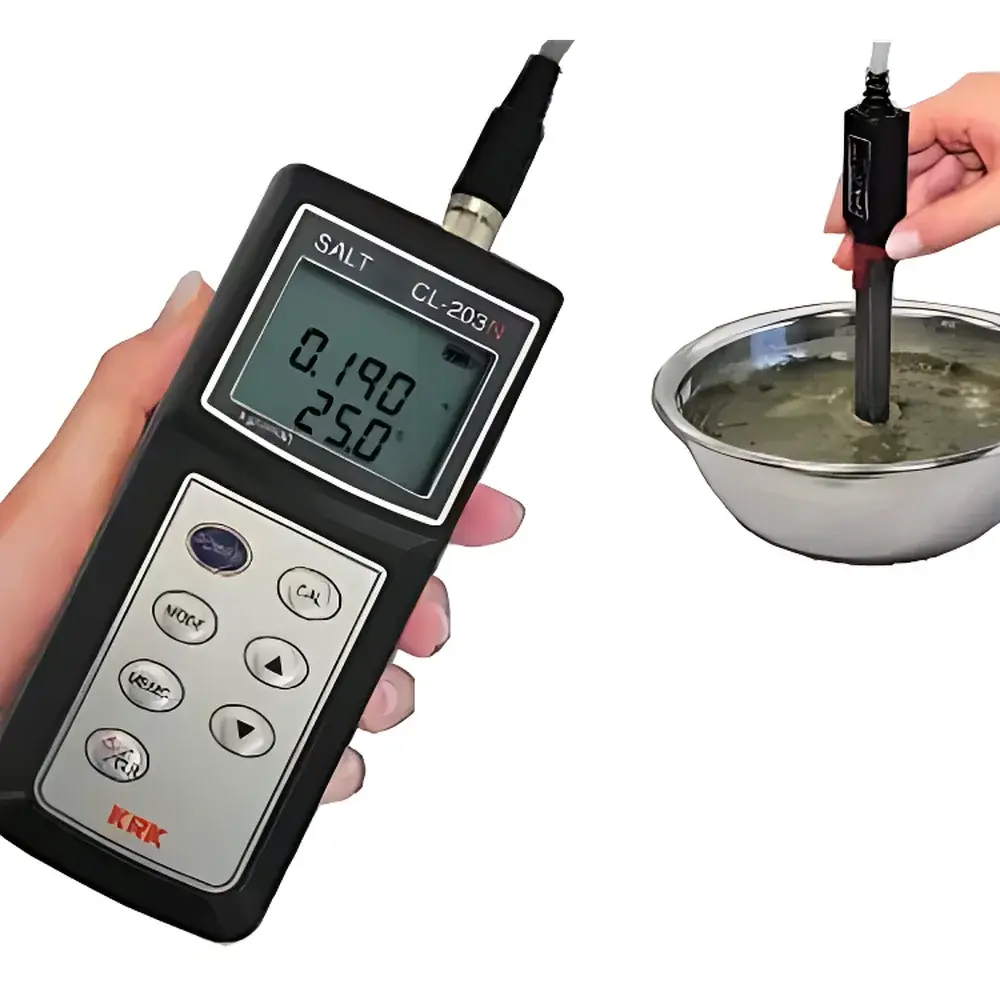
笠原理化 CL-203N Chloride Ion Analyzer for Fresh Concrete and Aqueous Samples
| Brand | Rikagaku |
|---|---|
| Origin | Japan |
| Model | CL-203N |
| Measurement Principle | Potentiometric ion-selective electrode (ISE) with Ag/AgCl-based chloride-specific sensing membrane |
| Application Domain | On-site and lab-based chloride quantification in fresh concrete mixtures, fine aggregates, wash water, and aqueous extracts per JIS A 1154, ASTM C114, and ISO 9557 |
| Temperature Compensation | Automatic (0–50 °C), NTC thermistor integrated in CLD-11 electrode |
| Display | Dual-line LCD — 4-digit resolution for chloride/salinity (% or kg/m³), 3-digit for temperature (°C) |
| Range | Salinity: 0.001–1.000 % (10–10,000 mg/L Cl⁻) |
| Chloride content | 0.001–1.999 kg/m³ (calculated from salinity × unit water volume W) |
| Electrode potential | −1000 to +1000 mV |
| Temperature | 0–50 °C |
| Resolution | 0.001 % salinity (10 mg/L), 1 mV, 0.1 °C |
| Repeatability | ±2 % of reading (salinity), ±0.5 °C (temperature) |
| Calibration | Two-point using certified NaCl standard solutions (0.01 % and 0.5 % w/v) |
| Memory | 30 measurement records with timestamp and temperature stamp |
| Housing Dimensions | 70 × 40 × 173 mm (W × H × D) |
| Weight | 290 g (main unit), 130 g (CLD-11 electrode with 1 m cable) |
| Compliance | Designed for GLP-aligned field testing |
Overview
The Rikagaku CL-203N Chloride Ion Analyzer is a portable, potentiometric measurement system engineered for rapid, field-deployable quantification of chloride ion concentration in fresh concrete mixtures, fine aggregate leachates, mixing water, and extracted pore solutions. It operates on the Nernst principle using a solid-state, silver/silver chloride (Ag/AgCl)-based chloride-selective electrode (CLD-11), which exhibits high selectivity against common interferents such as nitrate, sulfate, and hydroxide ions under typical concrete pH conditions (pH 10–13). Unlike colorimetric or titrimetric methods, the CL-203N delivers direct, real-time mV-to-concentration conversion without reagent consumption or sample digestion—enabling compliance verification against stringent chloride thresholds defined in structural concrete specifications (e.g., JIS A 5308, ACI 318-19 Chapter 20, EN 206:2013 Annex B). Its compact form factor and battery-powered operation make it suitable for use at batching plants, construction sites, and QA/QC laboratories where environmental control is limited.
Key Features
- Integrated CLD-11 long-life chloride ISE with optimized membrane formulation for stable response in high-ionic-strength concrete filtrates
- Automatic temperature compensation (ATC) via embedded NTC sensor in electrode body—eliminates manual correction errors across 0–50 °C operating range
- Dual-parameter LCD display showing simultaneous salinity (%), calculated chloride content (kg/m³), and sample temperature (°C)
- Two-point calibration protocol traceable to NIST-traceable NaCl reference standards (0.01 % and 0.5 % w/v)
- On-board memory storing up to 30 measurement events with ambient temperature stamp and user-defined batch ID
- Ruggedized housing (IP54-rated) and ergonomic handheld design for daily use in dusty, humid, or vibration-prone environments
- Low-power architecture enabling >200 hours of continuous operation on standard AA alkaline batteries
Sample Compatibility & Compliance
The CL-203N is validated for direct measurement of chloride in liquid-phase samples derived from standardized extraction procedures: filtered wash water from fine aggregates (per JIS A 1101), centrifuged or vacuum-filtered pore solution from fresh mortar/concrete (per JIS A 1154 or ASTM C114 Section 14), and mixing water used in batching. It does not require acidification or dilution for typical concrete-related matrices. The instrument’s measurement uncertainty profile aligns with ISO/IEC 17025 requirements for field-portable analyzers when operated within specified environmental limits (20–30 °C ambient, <80 % RH). While not FDA 21 CFR Part 11–certified as a standalone device, its output data (mV readings, temperature, timestamps) are compatible with LIMS integration for full electronic record retention in GMP-regulated precast manufacturing facilities.
Software & Data Management
The CL-203N operates as a self-contained measurement node without proprietary software dependency. All calibration coefficients, measurement logs, and system diagnostics are stored in non-volatile memory. For traceability, users may export recorded data manually via timestamped handwritten logs or integrate the unit into broader QA workflows using third-party data acquisition platforms (e.g., LabVIEW or custom Python scripts) via optional RS-232 or USB-to-serial adapters (sold separately). The instrument supports GLP-compliant recordkeeping: each measurement includes automatic temperature annotation and user-verifiable electrode potential (mV) output—critical for assessing electrode health and detecting drift prior to reporting.
Applications
- Verification of chloride content in ready-mix concrete batches prior to placement, per ACI 222R-19 exposure class limits
- Quality control of recycled fine aggregates by quantifying residual chloride from de-icing salt contamination
- Monitoring chloride ingress during accelerated curing trials or early-age leaching studies
- Field validation of water quality compliance for concrete mixing water (ASTM C94/C94M Table 1 limits)
- Supporting durability modeling inputs for service life prediction of reinforced concrete structures
FAQ
How is chloride content calculated for concrete reporting?
The CL-203N reports salinity (%) directly. Chloride content (kg/m³) is computed as: S = (measured salinity / 100) × W, where W is the unit water content (kg/m³) specified in the concrete mix design. This calculation follows JIS A 1154 Annex A and is required for conformity statements in Japanese and ASEAN infrastructure projects.
Can the CLD-11 electrode be used in highly alkaline concrete pore solution?
Yes—the CLD-11 features a chemically stabilized Ag/AgCl sensing layer with enhanced pH tolerance up to pH 13.5, validated per ISO 10304-1 for high-pH aqueous matrices. Routine electrode maintenance (rinsing with DI water, storage in 0.1 % KNO₃ stabilizer) is essential to preserve response time and slope stability.
Is calibration required before every measurement session?
A full two-point calibration is recommended at the start of each workday or after electrode replacement. Single-point verification using the 0.01 % standard is acceptable for routine checks between calibrations, provided electrode potential remains within ±10 mV of previous baseline.
Related Products




