
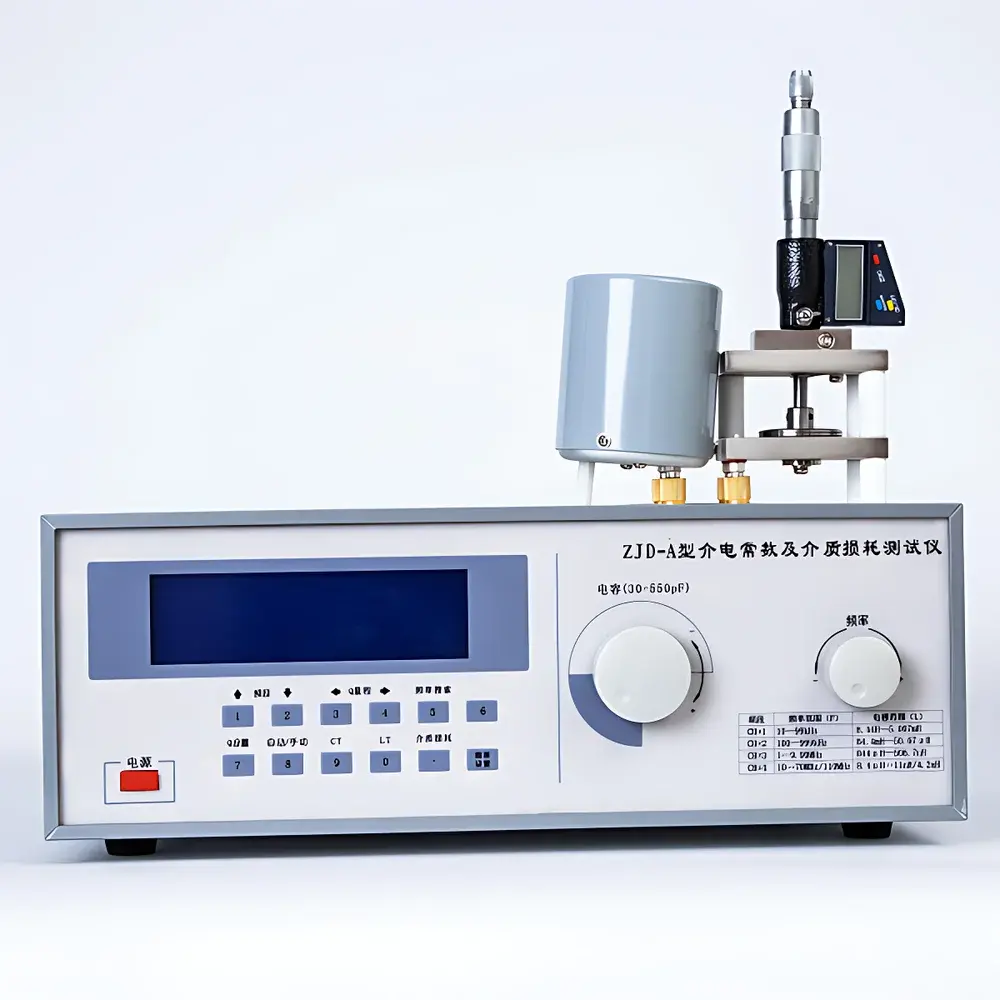
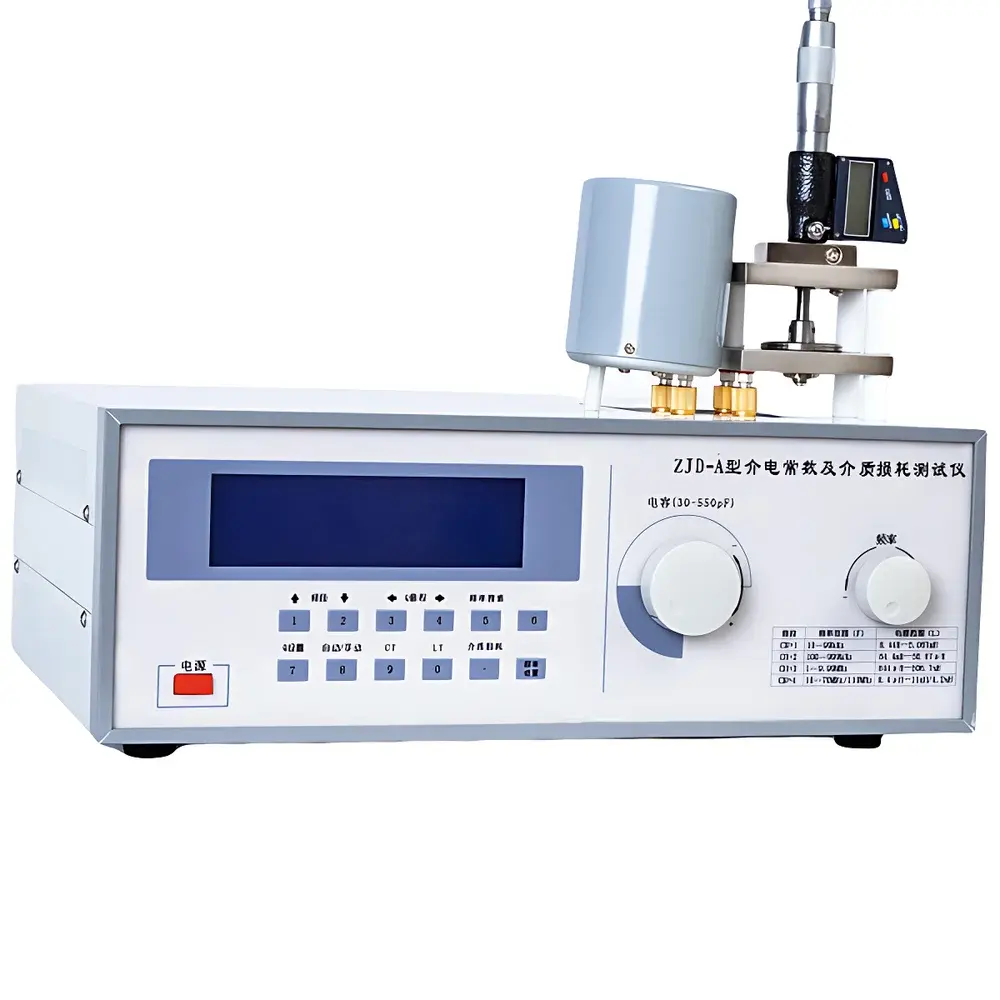
航天纵横 ZJD-C Dielectric Constant and Dissipation Factor Tester
| Brand | Aerospace Vertical |
|---|---|
| Origin | Beijing, China |
| Manufacturer Type | Authorized Distributor |
| Country of Origin | China |
| Model | ZJD-C Dielectric Constant and Dissipation Factor Tester |
| Price Range | USD 4,200 – 8,400 (FOB) |
| Frequency Range | 10 kHz – 70 MHz / 100 kHz – 160 MHz |
| Core Components | Q-meter main unit, precision parallel-plate or coaxial fixture, calibrated inductors |
| Standards Compliance | GB/T 1409–2006, GB/T 5594.4–2015, GB/T 1693–2007 |
| Primary Applications | Dielectric constant (ε′), loss factor (ε″), dissipation factor (tan δ), and complex permittivity characterization of solid and liquid insulating materials |
Overview
The Aerospace Vertical ZJD-C Dielectric Constant and Dissipation Factor Tester is a precision impedance-based measurement system engineered for the quantitative determination of complex permittivity—specifically the real part (dielectric constant, ε′) and imaginary part (loss factor, ε″)—of insulating materials under alternating electric fields. Operating on the principle of resonant frequency shift and Q-factor analysis in a high-stability LC oscillator circuit, the instrument determines dielectric properties by measuring changes in resonant frequency and bandwidth of a calibrated tank circuit when a sample is introduced into a defined electrode geometry. This method conforms to established physical models for low-conductivity dielectrics and provides traceable, repeatable results suitable for R&D laboratories, quality control environments, and regulatory-compliant testing facilities. The ZJD-C supports dual-frequency operation across two calibrated bands (10 kHz–70 MHz and 100 kHz–160 MHz), enabling broadband dispersion analysis essential for evaluating relaxation behavior in polymers, ceramics, and composite laminates.
Key Features
- Resonance-based Q-meter architecture with digital frequency synthesis and automatic Q-calculation for high signal-to-noise ratio measurements
- Dual-band RF excitation capability: 10 kHz–70 MHz and 100 kHz–160 MHz, each with independent calibration protocols
- Modular electrode configurations—including parallel-plate, coaxial, and liquid cell fixtures—to accommodate solids (films, sheets, rods), powders (with compression jig), and low-conductivity liquids
- Integrated temperature-compensated reference inductor bank with ±0.05% inductance stability over 15–30°C ambient range
- Real-time display of ε′, tan δ, Q-value, capacitance (C), and series/parallel equivalent resistance (Rs/Rp)
- Compliance-ready firmware supporting manual audit trail logging; compatible with external GLP/GMP data capture systems via RS-232 and USB virtual COM port
Sample Compatibility & Compliance
The ZJD-C is validated for use with non-conductive and weakly conductive materials including thermoplastics (e.g., PE, PP, PTFE), thermosets (epoxy, phenolic), elastomers (silicone rubber, EPDM), ceramic substrates (alumina, cordierite), glass compositions, and solvent-based polymer solutions. Sample thickness requirements range from 0.1 mm (for thin films) to 10 mm (for bulk ceramics), with surface flatness tolerance ≤ 2 µm for reliable parallel-plate contact. All test procedures align with national standards GB/T 1409 (determination of relative permittivity and dielectric loss tangent of solid electrical insulating materials), GB/T 5594.4 (ceramic dielectric characterization), and GB/T 1693 (rubber and plastic insulation testing). While not pre-certified to IEC 60250 or ASTM D150, the instrument’s measurement methodology and uncertainty budget are fully compatible with those standards’ technical requirements when operated within specified environmental conditions (23±2°C, 50±5% RH, EMI-shielded bench).
Software & Data Management
The ZJD-C operates without proprietary closed-source software; instead, it delivers ASCII-formatted serial output (CSV-compatible) containing timestamped measurement records, operator ID field, frequency point, raw Q and resonant frequency values, and calculated ε′ and tan δ. This open-data architecture enables direct integration with laboratory information management systems (LIMS), statistical process control (SPC) platforms, and custom Python/MATLAB analysis scripts. Optional Windows-based utility software (provided separately) supports batch report generation per GB/T 1409 Annex B, includes pass/fail threshold configuration, and exports PDF reports with embedded calibration certificate references (e.g., CAL-304-2024-XXX from China Academy of Metrology, CAL-514-2024-YYY from China Electronics Standardization Institute). Audit trail functionality meets basic FDA 21 CFR Part 11 expectations for electronic record retention when paired with time-stamped external storage.
Applications
- Quality assurance of capacitor dielectrics (e.g., polypropylene film, ceramic multilayer capacitors) for ε′ consistency and tan δ screening
- Development of aerospace-grade composites where low ε′ (<4.0) and ultra-low tan δ (<0.001 at 1 MHz) are required for radar-transparent structures
- Moisture ingress evaluation in epoxy encapsulants and PCB laminates via humidity-conditioned tan δ tracking
- High-frequency welding process optimization—identifying optimal polymer grades (e.g., PVC vs. PE) based on peak tan δ magnitude near 27.12 MHz or 40.68 MHz ISM bands
- Educational labs demonstrating Debye relaxation, interfacial polarization (Maxwell-Wagner effect), and frequency-dependent permittivity in heterogeneous systems
- Regulatory submission support for medical device packaging (ISO 10993-12) and military specification compliance (MIL-STD-202G Method 303)
FAQ
What is the recommended electrode configuration for thin polymer films (<0.2 mm)?
For films below 0.2 mm thickness, the standard parallel-plate fixture with spring-loaded gold-plated brass electrodes and adjustable pressure (0.5–2.0 N) is recommended. Surface contact must be verified optically prior to measurement.
Can the ZJD-C measure conductive fillers in polymer composites?
No—the instrument is designed for insulators with volume resistivity >10¹⁰ Ω·cm. Conductive composites (e.g., carbon-black-filled TPU) will cause resonance damping and invalid Q readings; alternative techniques such as broadband dielectric spectroscopy (BDS) or impedance analyzers with four-terminal sensing are advised.
Is calibration traceable to national metrology institutes?
Yes—certified calibration kits (inductors and standards) are traceable to NIM (National Institute of Metrology, China) via accredited third-party labs (e.g., CAL-304, CAL-514); full calibration certificates accompany each shipment.
How does ambient humidity affect tan δ measurements on hygroscopic polymers?
Humidity increases both ε′ and tan δ due to dipole reorientation of absorbed water molecules and enhanced ionic conduction; ISO 291 conditioning (23°C/50% RH, 48 h minimum) is mandatory before testing cellulose acetate, nylon, or polyvinyl alcohol.
Does the ZJD-C support automated frequency sweeps?
No—it performs discrete-point measurements at user-selected frequencies. For continuous sweep capability, integration with an external vector network analyzer (VNA) and custom fixture is required.



