
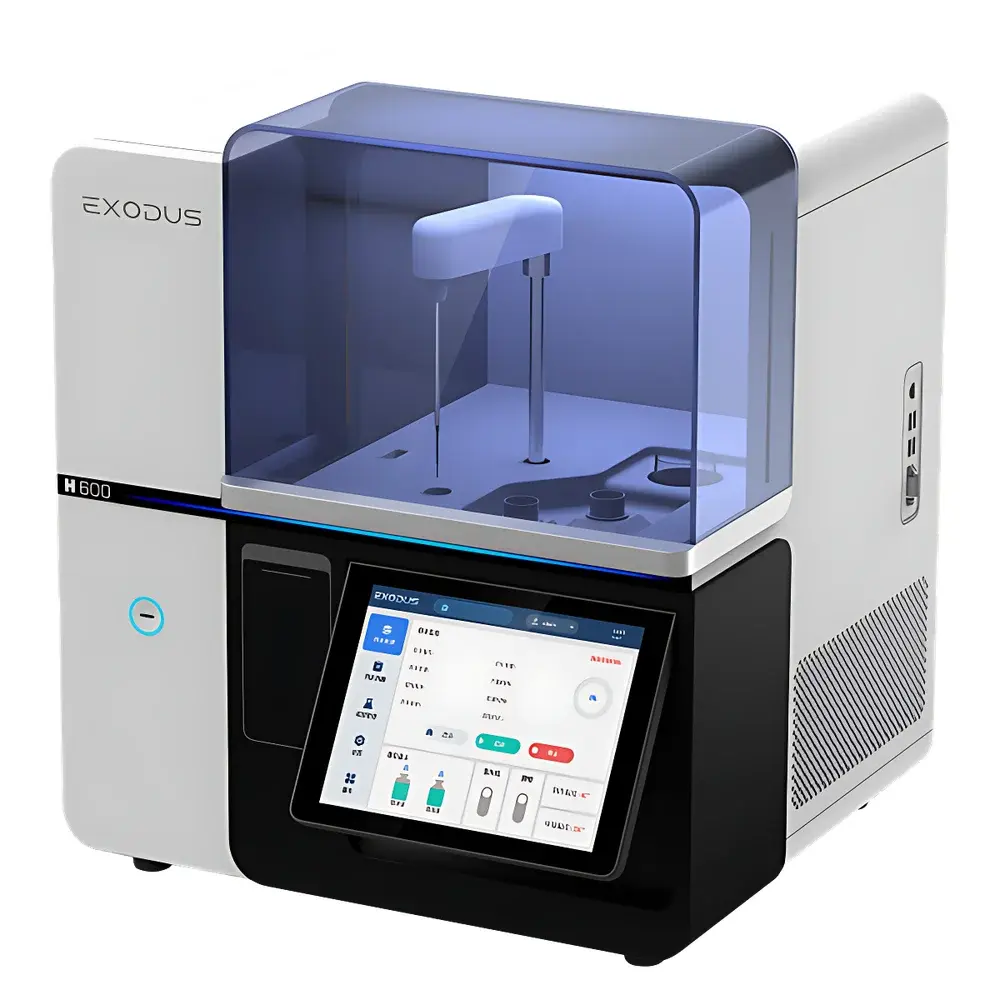
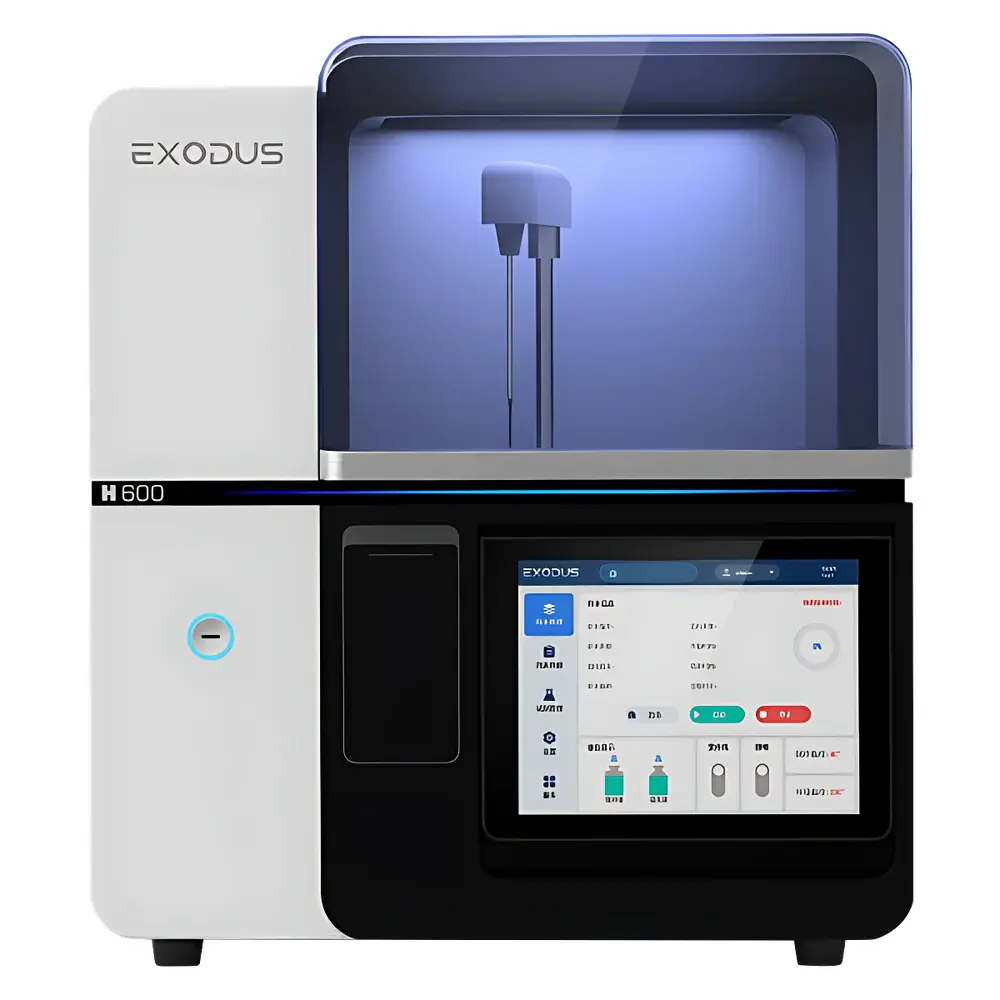
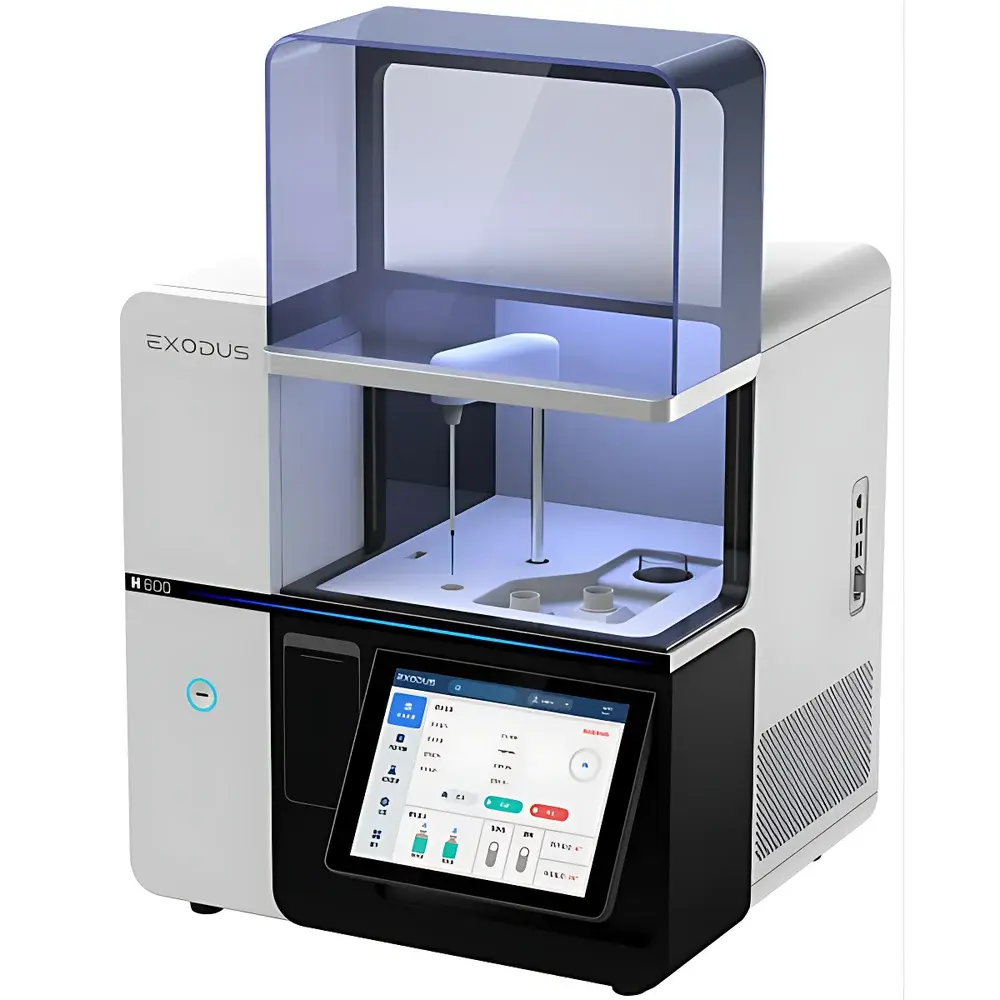
汇芯生物 EXODUS H-600 Automated Exosome Isolation System
| Brand | EXODUS |
|---|---|
| Origin | Shenzhen, China |
| Manufacturer Type | Authorized Distributor |
| Regional Classification | Domestic (China) |
| Model | H-600 |
| Quotation | Upon Request |
| Temperature Control Range | 2–8 °C |
| Sample Processing Volume | 10 μL to 250 mL |
| Sterilization Method | Ethylene Oxide (EO) Gas |
| Operating Principle | Ultrasonic Nanofiltration |
| Purification Cycle Time | 10 minutes to 2.5 hours |
Overview
The Huixin Bio EXODUS H-600 Automated Exosome Isolation System is an engineered platform for label-free, high-fidelity exosome enrichment from diverse biological matrices. It leverages ultrasonic nanofiltration—a physical separation modality grounded in size-exclusion and acoustic microstreaming—to isolate intact extracellular vesicles (30–150 nm) while preserving native surface topology, cargo integrity, and functional bioactivity. Unlike ultracentrifugation or polymer-based precipitation, the H-600 avoids shear-induced aggregation, protein contamination, or chemical carryover—critical for downstream applications requiring physiologically relevant exosome preparations. The system operates within a thermally stabilized environment (2–8 °C), minimizing enzymatic degradation and maintaining vesicle stability throughout processing. Designed for integration into translational research workflows, clinical assay development, and GMP-aligned process validation, the H-600 supports reproducible isolation across sample types including plasma, serum, urine, cell culture supernatant, cerebrospinal fluid (CSF), and saliva.
Key Features
- Automated, walk-away operation with pre-programmed protocols for 8 common biosample types—reducing inter-operator variability and manual handling errors
- Integrated temperature-controlled chamber (2–8 °C) with real-time monitoring and logging compliant with GLP audit requirements
- Patented dual-mode acoustic actuation: Negative Pressure Oscillation (NPO) combined with Harmonic Oscillation (HO) enhances transmembrane flux and prevents membrane fouling on nano-pore chips
- Single-use, EO-sterilized nanofiltration cartridges—eliminating cross-contamination and enabling traceable lot-level QC documentation
- Scalable processing range: accommodates volumes from 10 μL (e.g., micro-volume CSF samples) to 250 mL (e.g., pooled bioreactor supernatants) without protocol re-optimization
- Minimal hands-on time (<5 min setup); total cycle time configurable between 10 min (rapid screening mode) and 2.5 h (high-yield, high-purity mode)
Sample Compatibility & Compliance
The EXODUS H-600 demonstrates validated compatibility with anticoagulated whole blood derivatives (EDTA, citrate), clarified tissue homogenates, conditioned media from adherent and suspension cultures (including stem cell lines), and low-abundance biofluids such as tear fluid and bronchoalveolar lavage (BAL) fluid. All disposable nanofiltration modules are certified sterile via ethylene oxide sterilization per ISO 11135 and accompanied by CoA documentation. The instrument’s firmware supports 21 CFR Part 11-compliant user access control, electronic signatures, and immutable audit trails for data integrity. System validation packages—including IQ/OQ documentation, performance qualification (PQ) test scripts, and reference material traceability—are available upon request for regulatory submission support (e.g., IVD development under IVDR Annex II or FDA IDE pathways).
Software & Data Management
Controlled via a touchscreen interface running embedded Linux OS, the H-600 software enables method creation, parameter locking, batch logging, and export of raw sensor logs (temperature, pressure differential, acoustic amplitude, cycle duration). All metadata—including cartridge lot ID, operator ID, sample ID, and timestamped environmental conditions—is embedded in exported .csv and .xlsx files. Optional API integration allows bidirectional communication with LIMS platforms (e.g., LabVantage, Thermo Fisher SampleManager) and ELN systems (e.g., Benchling, LabArchives) using RESTful endpoints and TLS 1.2 encryption. Audit trail records retain full history of method edits, run executions, and calibration events—supporting ALCOA+ principles (Attributable, Legible, Contemporaneous, Original, Accurate, Complete, Consistent, Enduring, Available).
Applications
- Biomarker discovery pipelines requiring high-integrity exosomal RNA/DNA for NGS library prep and digital PCR quantification
- Therapeutic exosome manufacturing—supporting upstream purification steps prior to chromatographic polishing or tangential flow filtration (TFF)
- Functional assays including macrophage polarization studies, neuronal uptake kinetics, and endothelial barrier permeability modeling
- Drug loading optimization (e.g., siRNA, miRNA, small molecules) where vesicle surface charge, PDI, and zeta potential must remain unaltered post-isolation
- Reference standard generation for orthogonal characterization (NTA, TRPS, TEM, Western blot, and flow cytometry with CD63/CD81/TSG101 markers)
FAQ
What exosome yield and purity metrics does the H-600 typically achieve compared to ultracentrifugation?
Yield ranges from 75–92% relative to UC (measured by nanoparticle tracking analysis and acetylcholinesterase activity), with >95% reduction in albumin and ApoB contaminants (verified by SDS-PAGE and ELISA).
Can the system be validated for use in Good Manufacturing Practice (GMP) environments?
Yes—full validation documentation, including risk assessment (FMEA), cleaning verification, and equipment qualification reports, is provided for Class C and D cleanroom deployment.
Is the nanofiltration chip compatible with downstream mass spectrometry workflows?
All cartridge materials are MS-compatible (low leachables, no plasticizers); residual buffer salts are removed during integrated rinse cycles, yielding samples suitable for direct LC-MS/MS injection.
Does the system support remote monitoring or integration with hospital IT infrastructure?
Optional Ethernet/Wi-Fi module enables SNMP-based network health monitoring and HL7/FHIR-compliant data routing to enterprise clinical data warehouses.
Related Products




