
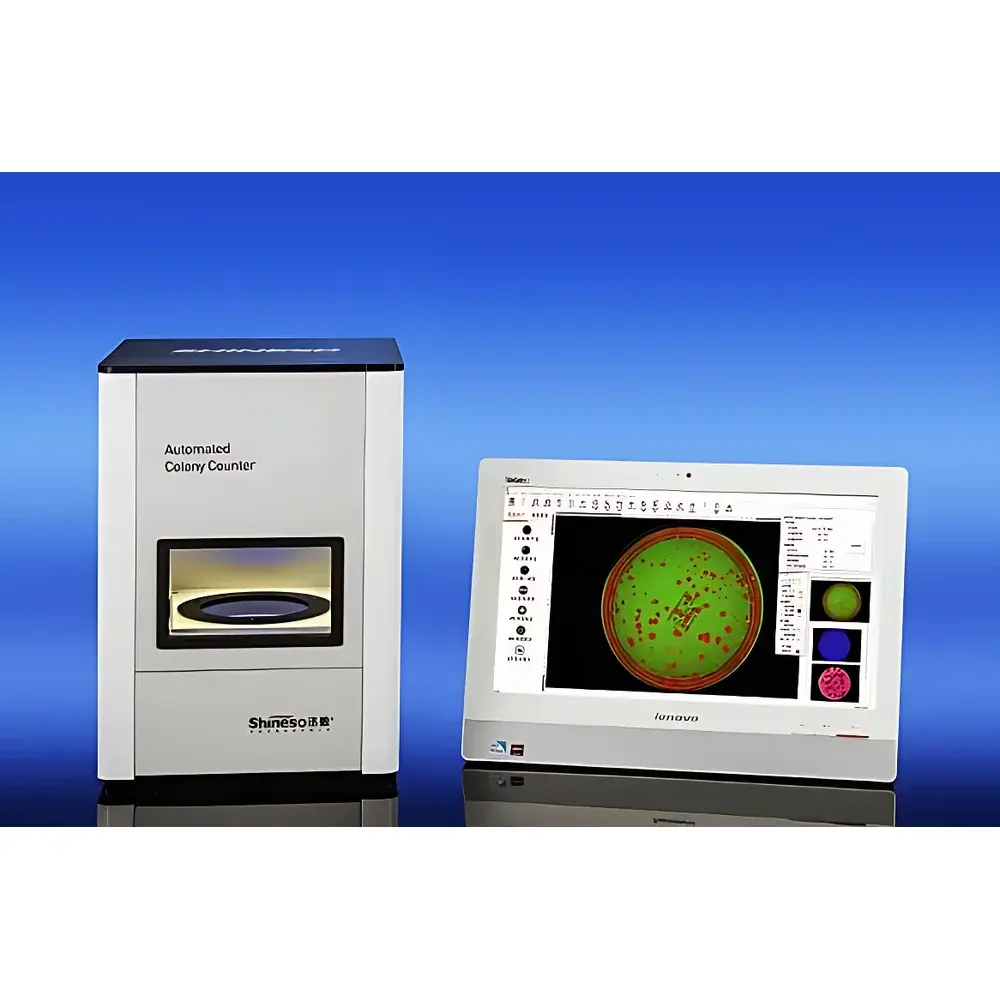
迅数 HD2000(AI) Smart Colony Counter
| Brand | Shunso |
|---|---|
| Origin | Zhejiang, China |
| Manufacturer Type | Manufacturer |
| Instrument Type | Fully Automated Colony Counter |
| Sample Types | Liquid media, solid media (pour plate, spread plate, membrane filtration, spiral plate, commercial test strips) |
| Sample Capacity | 35–150 mm Petri dishes |
| Counting Speed | 0.8 s/dish |
| Batch Throughput | 300 dishes |
| Counting Accuracy | ≥98% (reference strains), ≥95% (≤300 CFU, non-confluent) |
| Imaging Sensor | Sony 1″ color CMOS, 20 MP |
| Lens | 24 MP fixed-focus, 200 lp/mm resolution, f/2.4 |
| Illumination Modes | Suspended dark-field, gradient fog-light diffusion, translucent backlight, pseudo-infrared thin-film interference, dual-path dual-wavelength chromatic illumination |
| Software | AI Colony Counting Suite, Classic Colony Analysis Suite |
| Compliance Features | Audit trail, role-based access control (admin/operator/reviewer/auditor), electronic signature support, 21 CFR Part 11 readiness, GLP/GMP-aligned data integrity framework |
Overview
The Shunso HD2000(AI) Smart Colony Counter is a fully automated digital imaging system engineered for precise, reproducible, and high-throughput microbial colony enumeration in regulated and research laboratory environments. It operates on the principle of high-fidelity digital image acquisition followed by AI-driven morphological segmentation and classification—leveraging convolutional neural networks trained on over two decades of real-world colony imagery from global microbiology labs. Unlike conventional manual or rule-based counters, the HD2000(AI) integrates multi-spectral, multi-angle illumination physics with adaptive image processing to resolve challenging samples: low-contrast colonies on filter membranes, microcolonies (<0.1 mm) from psychrotrophic or mycoplasma cultures, turbid or uneven agar backgrounds, and complex mixed populations on chromogenic or selective media. Its optical architecture—featuring a 20-megapixel Sony 1″ CMOS sensor coupled with a 24-megapixel, f/2.4 fixed-focus lens—delivers sub-pixel spatial fidelity and consistent colorimetric response across the full 35–150 mm Petri dish range.
Key Features
- Multi-modal illumination system: Five independently controllable lighting modes—including suspended dark-field (for edge-enhanced contour detection), gradient fog-light diffusion (for natural color and texture rendering without glare), translucent multi-color backlight (5 selectable wavelengths, >90% uniformity), pseudo-infrared thin-film interference (optimized for membrane filtration assays per USP <61> and Ph. Eur. 2.6.12), and dual-path dual-wavelength chromatic illumination (to spectrally separate colonies from background via differential reflectance).
- UV-C disinfection module: High-output UVC-LED (265 nm) integrated into the sample chamber, activated automatically between runs—zero ozone generation, stable output, >10,000-hour lifetime.
- Robust mechanical design: Fully enclosed aluminum-alloy chassis (32 × 34 × 46 cm), light-tight sliding viewport, dust- and UV-leakage resistant sealing—engineered for ISO Class 5–7 cleanroom compatibility and long-term stability in QC laboratories.
- AI-powered analysis engine: Pre-trained CNN model validated against ISO 4833-1:2013 and AOAC 977.27 benchmarks; supports automatic correction of common artifacts including condensation droplets, lid text interference, agar thickness variation, and colony coalescence.
- Hardware-accelerated throughput: 0.8-second per-dish analysis latency; full batch processing of 300 dishes within 240 seconds—enabling same-day reporting for large-scale environmental monitoring or pharmaceutical release testing.
Sample Compatibility & Compliance
The HD2000(AI) supports all standard microbiological plating formats: pour plates, spread plates, membrane filters (including Millipore® and Pall®), spiral plates (according to ISO 7218 Annex C), contact plates (RODAC), and commercial rapid test devices (e.g., 3M™ Petrifilm™, BioControl™). It meets critical regulatory requirements for data integrity and traceability: built-in audit trail logs all user actions (login/logout, image import, parameter adjustment, report generation) with immutable timestamps; four-tier role-based access control enforces separation of duties per FDA 21 CFR Part 11 and EU Annex 11; electronic signatures are supported for final report approval; raw images, processed datasets, and metadata are stored as encrypted, versioned engineering files with SHA-256 checksum validation. The system is routinely deployed in GLP-compliant contract research organizations and GMP-certified pharmaceutical manufacturing sites for microbial limit testing (USP <61>, EP 2.6.12), sterility testing (USP <71>), and culture media growth promotion verification.
Software & Data Management
The HD2000(AI) ships with two complementary software suites: the AI Colony Counting Suite—designed for zero-parameter, one-click operation—and the Classic Colony Analysis Suite, which provides granular control over segmentation thresholds, color clustering, and morphometric measurement. Both interfaces operate within a unified data management framework supporting DICOM-like structured storage: each experiment is archived as a self-contained engineering file containing sample registration metadata (sample ID, dilution factor, analyst, date/time, testing lab), annotated images (original + segmented + overlay), statistical outputs (CFU/mL, log reduction, confidence intervals), and PDF/Excel export-ready reports. All files are encrypted at rest and backed up via configurable network paths or external USB 3.2 drives. Audit trails are exportable in CSV or XML format and retain full forensic detail—including IP address, session duration, and action-specific context—for internal audits or regulatory inspections.
Applications
- Pharmaceutical quality control: Microbial limit tests per USP <61>, <62>, and <1111>; bioburden assessment of raw materials and intermediates; environmental monitoring (EM) data trending across ISO 14644-1 classified areas.
- Food & beverage safety: Enumeration of total viable count (TVC), coliforms, yeasts/molds per ISO 4833-1, ISO 21528-2, and AOAC methods; rapid screening of pathogen indicators on chromogenic media.
- Clinical & public health labs: Quantification of bacterial load in urine, wound swabs, and respiratory specimens; validation of antimicrobial susceptibility assay plates (e.g., disk diffusion, E-test).
- Academic & industrial R&D: Morphotype-based colony phenotyping (size, color, margin, elevation, opacity); transparent zone analysis (halo, hydrolysis, hemolysis, calcium solubilization); multi-region quantification for heterogeneous biofilm or antifungal assays.
- Contract testing laboratories: High-volume batch processing for environmental monitoring programs, with automated report generation compliant with ISO/IEC 17025 documentation standards.
FAQ
Does the HD2000(AI) comply with FDA 21 CFR Part 11 requirements?
Yes—the system implements electronic signature workflows, audit trail immutability, role-based permissions, and data encryption aligned with Part 11’s “trustworthy, reliable, and equivalent to paper records” criteria. Full validation documentation (IQ/OQ/PQ protocols) is available upon request.
Can it distinguish colonies from debris or precipitates on turbid media?
Yes—via combined use of pseudo-infrared thin-film interference illumination and AI morphology classifiers trained on >12 million labeled particles. The system differentiates crystalline salts, agar particulates, and yeast clumps based on edge sharpness, radial symmetry, and spectral response.
Is calibration traceable to NIST or other national standards?
Instrument geometric calibration uses certified stage micrometers (NIST-traceable); color calibration employs X-Rite ColorChecker Passport targets. Software includes automated recalibration routines triggered by ambient light drift or sensor aging algorithms.
What level of technical support and software updates does Shunso provide?
Shunso offers global remote diagnostics, annual preventive maintenance contracts, and quarterly AI model updates trained on anonymized, aggregated customer data—ensuring continuous improvement in recognition accuracy across evolving microbial strain libraries.
Can the HD2000(AI) integrate with LIMS or ELN systems?
Yes—via RESTful API and HL7-compatible data export modules. Pre-built connectors exist for Thermo Fisher SampleManager, LabVantage, and Agilent OpenLab ECM; custom integration is supported through documented JSON schema specifications.




