
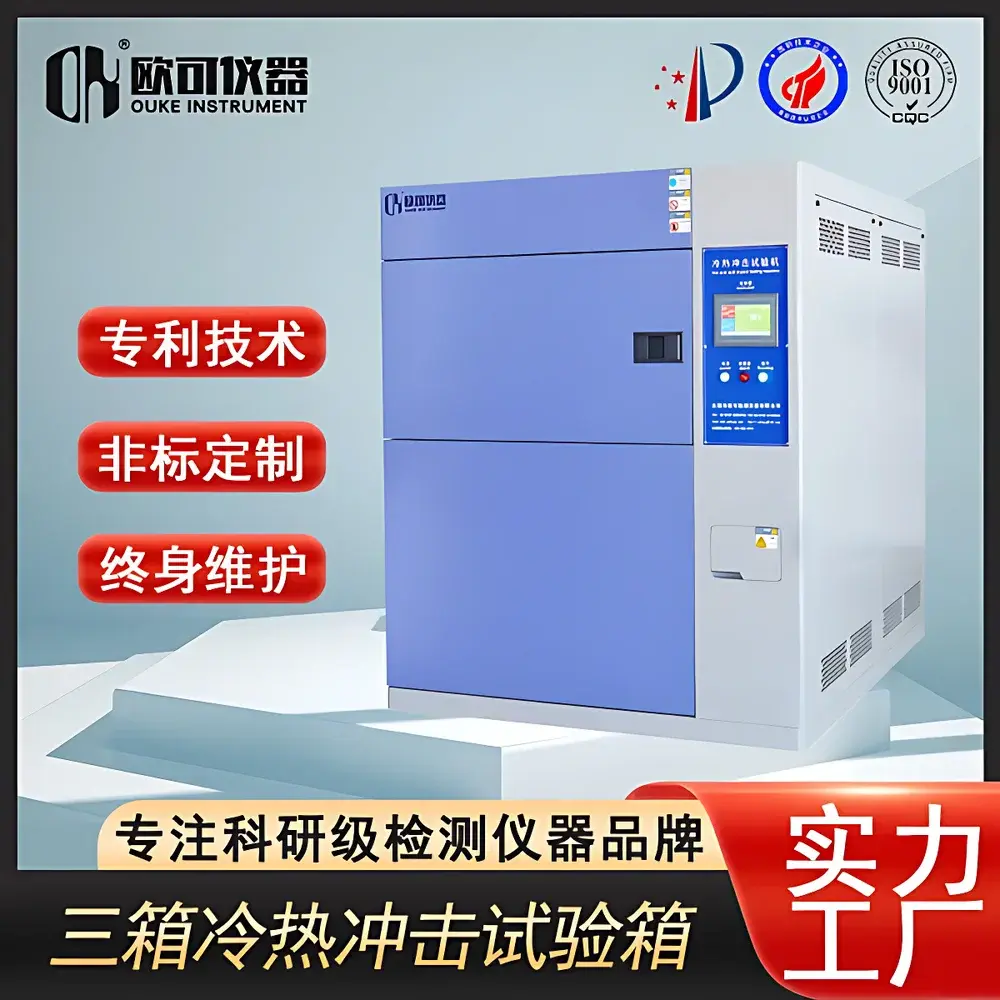
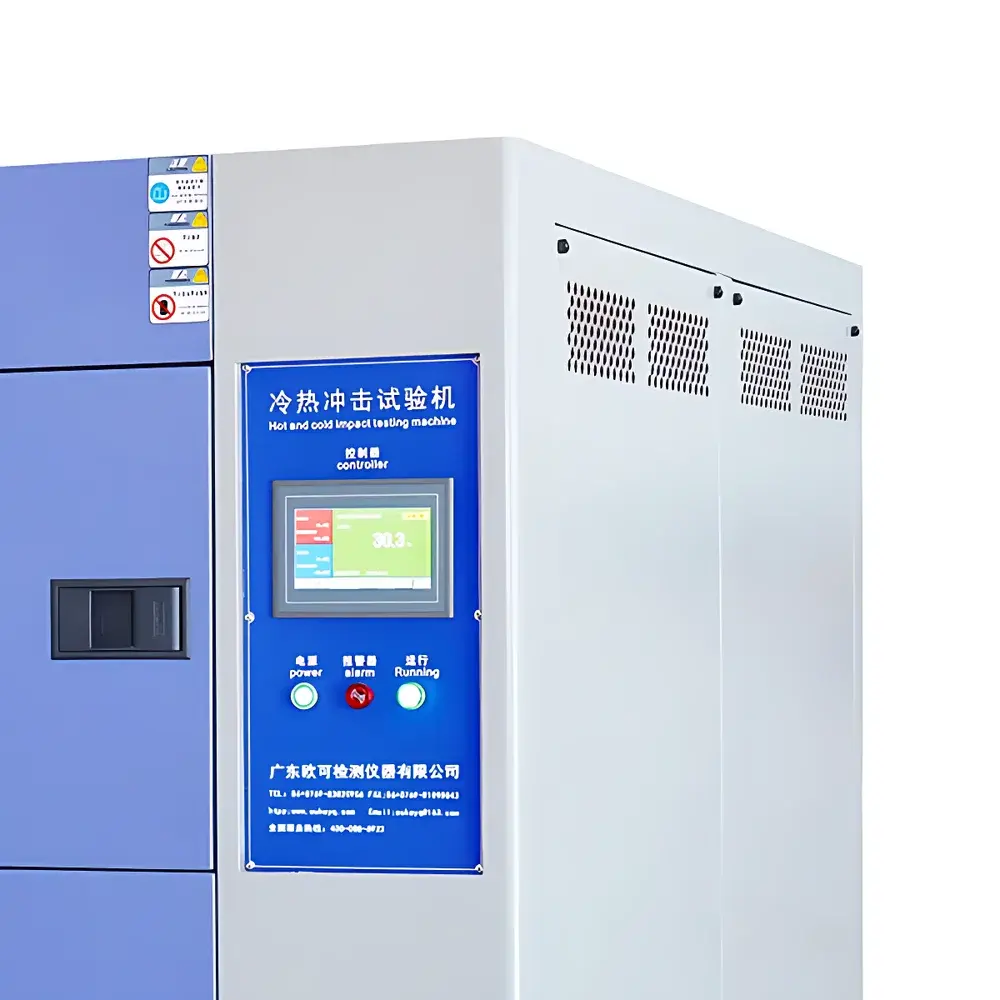
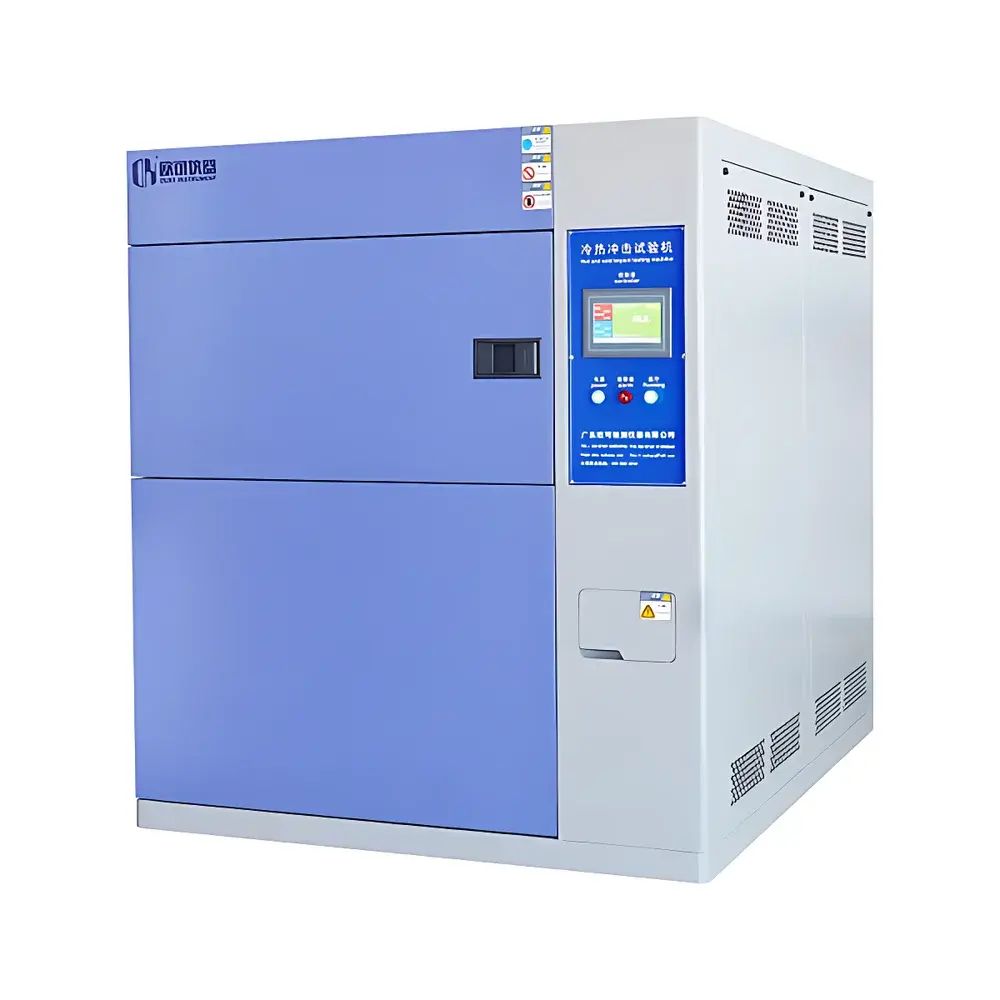
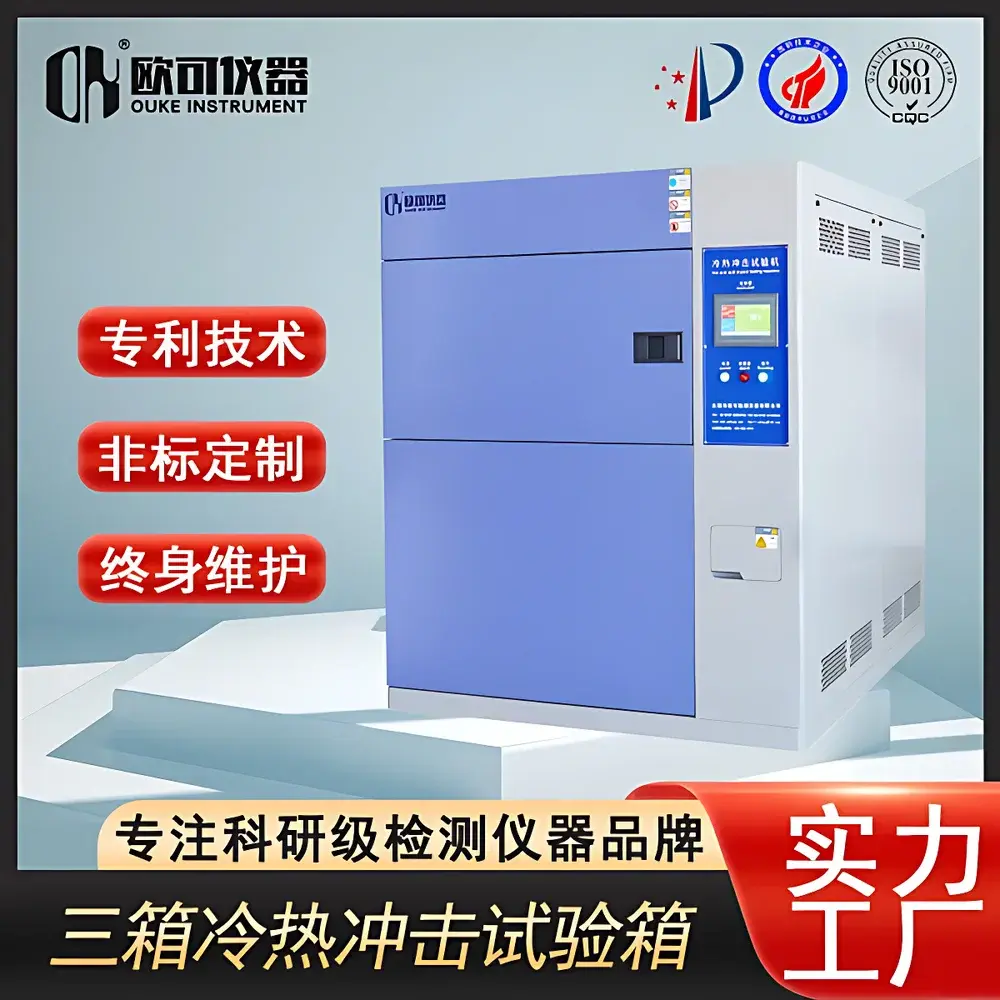
OK 0K-TS-49.66666 Thermal Shock Test Chamber
| Brand | OK |
|---|---|
| Origin | Guangdong, China |
| Manufacturer Type | Direct Manufacturer |
| Model | 0K-TS-49.66666 |
| High Temperature Range | +150 °C |
| Low Temperature Range | −55 °C |
| Thermal Shock Range | −55 °C to +150 °C |
| Temperature Stability | ±2 °C |
| Heating Rate | ≤20 s (to reach setpoint) |
| Cooling Rate | ≤20 s (to reach setpoint) |
Overview
The OK 0K-TS-49.66666 Thermal Shock Test Chamber is an engineered environmental test system designed to subject electronic components, automotive modules, aerospace assemblies, and packaging materials to rapid, repetitive transitions between extreme high- and low-temperature environments. Unlike temperature cycling or rapid thermal transition chambers—which impose linear, ramp-based thermal stress—the 0K-TS-49.66666 executes true thermal shock per the fundamental definition: a step-change thermal load where the test specimen experiences near-instantaneous exposure to two distinct, stabilized temperature zones. This methodology replicates real-world failure modes induced by differential thermal expansion, interfacial delamination, solder joint fracture, hermetic seal breach, and transient electrical discontinuity—phenomena governed by coefficient-of-thermal-expansion (CTE) mismatch across material interfaces.
Key Features
- Dual-Zone Two-Chamber Architecture: Comprises independently controlled high-temperature (+150 °C) and low-temperature (−55 °C) chambers with thermally isolated insulation and precision PID-controlled heating/cooling systems.
- High-Speed Basket Transfer Mechanism: Pneumatically actuated lift-and-shift sample basket achieves transfer time ≤10 seconds—meeting critical requirements of MIL-STD-883 Method 1010.8, IEC 60068-2-14 (equivalent to GB/T 2423.22), and JESD22-A104.
- Stable Thermal Hold Performance: Maintains ±2 °C temperature uniformity and stability within each chamber during dwell phases, ensuring repeatable dwell-to-shock boundary conditions.
- Rapid Transient Response: Achieves full thermal equilibration at target temperature within ≤20 seconds post-transfer—verified via calibrated PT100 sensors embedded in the basket mounting plate.
- Robust Structural Design: Stainless steel interior, reinforced chamber walls, and vibration-damped base frame minimize mechanical perturbation during basket motion while supporting loads up to 25 kg (standard configuration).
- Integrated Safety Protocols: Includes over-temperature cutoff, door interlock, refrigerant pressure monitoring, and emergency stop circuit compliant with IEC 61000-6-2 and UL 61010-1.
Sample Compatibility & Compliance
The 0K-TS-49.66666 accommodates specimens up to 400 mm × 400 mm × 400 mm (W×D×H) and is optimized for PCBAs, IC packages (QFP, BGA, CSP), MEMS sensors, LED modules, battery cells, and molded plastic housings. Its performance aligns with internationally recognized qualification standards including:
- MIL-STD-883H, Method 1010.8 – Temperature Cycling (Shock Variant)
- IEC 60068-2-14:2016 / GB/T 2423.22–2012 – Environmental testing – Part 2-14: Tests – Test N: Change of temperature
- JESD22-A104E – Temperature Cycling
- AEC-Q200 Rev D – Stress tests for passive components
All test profiles are programmable with independent dwell times, cycle counts, and directionality (high→low or low→high). The system supports GLP-compliant operation when paired with external data loggers meeting FDA 21 CFR Part 11 audit trail requirements.
Software & Data Management
The chamber integrates with OK’s proprietary ThermoLogic Control Suite, a Windows-based application enabling full profile definition, real-time parameter visualization (chamber temps, basket position status, elapsed cycle count), and automatic CSV export of timestamped thermal data. Optional Ethernet/IP and Modbus TCP interfaces allow integration into factory MES or LabVIEW-based test automation frameworks. All operational events—including mode changes, alarms, and manual interventions—are logged with date/time stamps and user ID fields to support ISO/IEC 17025 traceability and internal quality audits.
Applications
- Qualification testing of automotive ECUs prior to AEC-Q100 release
- Reliability screening of semiconductor die attach and wire bond integrity
- Evaluation of conformal coating adhesion under thermal discontinuity
- Validation of thermal interface material (TIM) performance in multi-layer stacks
- Failure analysis root cause isolation for field returns exhibiting intermittent opens/shorts
- Process capability assessment of reflow soldering and underfill cure cycles
FAQ
What distinguishes thermal shock testing from temperature cycling?
Thermal shock applies instantaneous step-change stress via physical relocation or air-stream switching between two stable thermal zones; temperature cycling uses a single chamber with controlled ramp rates (e.g., 10 °C/min), inducing cumulative fatigue rather than abrupt mechanical failure.
Is this unit suitable for powered-in testing?
The two-chamber basket-transfer design introduces mechanical motion; for live-bias or signal-monitoring applications, a three-chamber air-switching configuration is recommended to maintain sample stationarity.
Does the system support liquid nitrogen (LN2) augmentation?
The standard 0K-TS-49.66666 uses mechanical refrigeration only; LN2-assisted cooling is available as a factory-configurable option for sub-−65 °C low-temp extension and accelerated recovery times.
How is temperature uniformity verified across the test volume?
Uniformity is validated per IEC 60068-3-5 using nine calibrated PT100 sensors placed on a 3×3 grid within the basket footprint, with results documented in the出厂 calibration report.
Can test sequences be exported for regulatory submission?
Yes—test logs include cycle-by-cycle temperature traces, dwell durations, and pass/fail flags per user-defined acceptance criteria; reports are exportable in PDF and CSV formats with digital signature support.



