
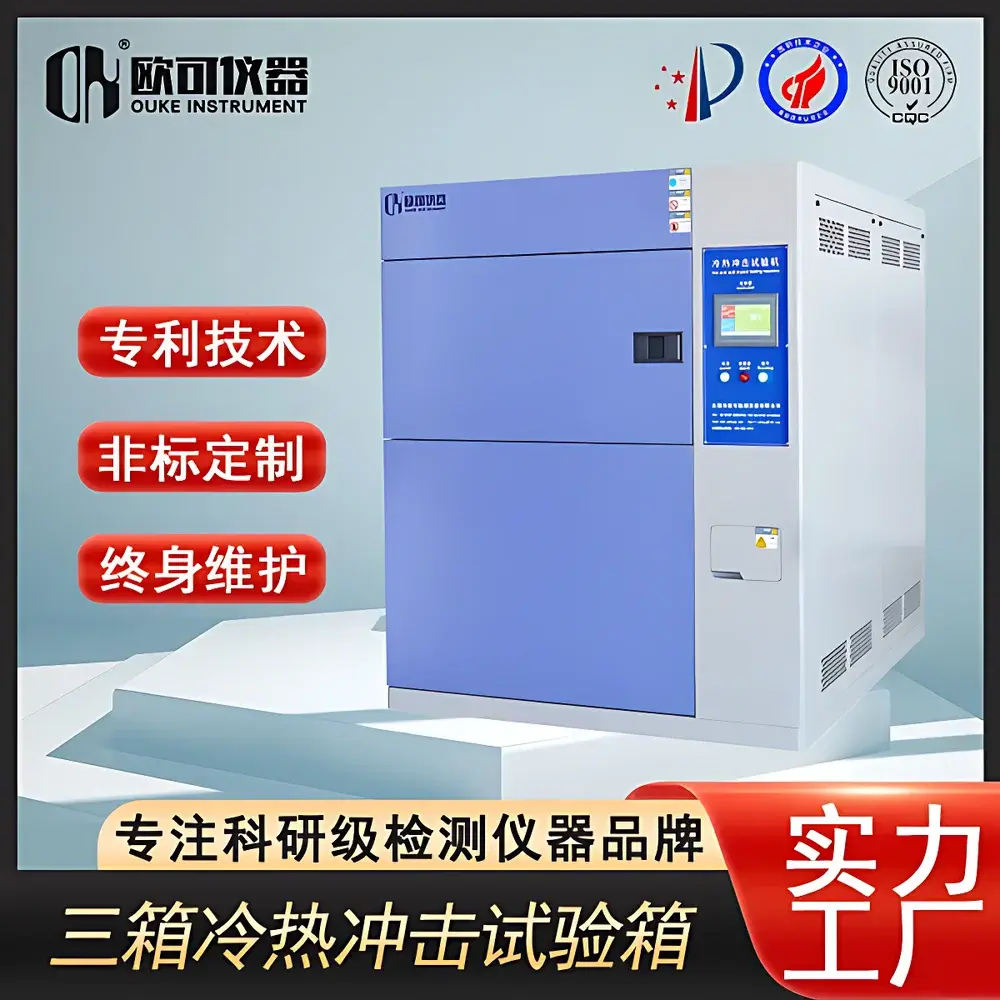
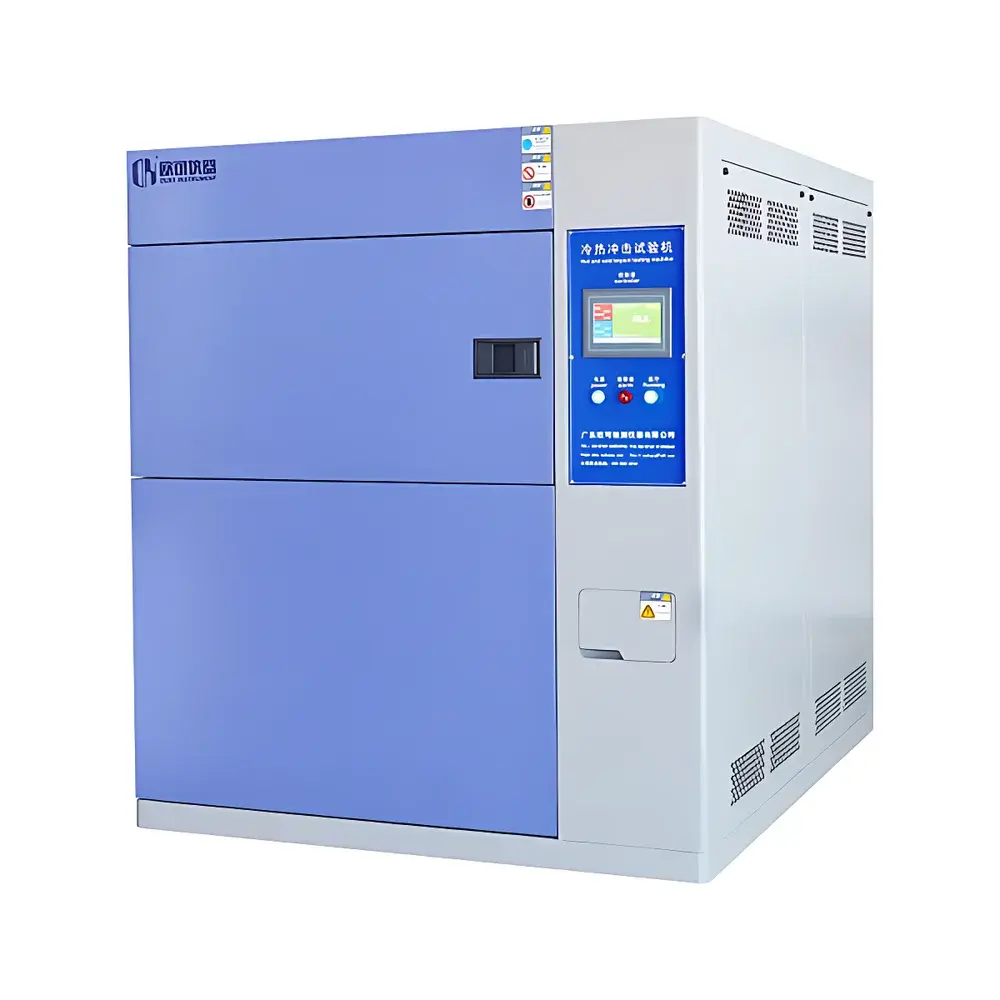
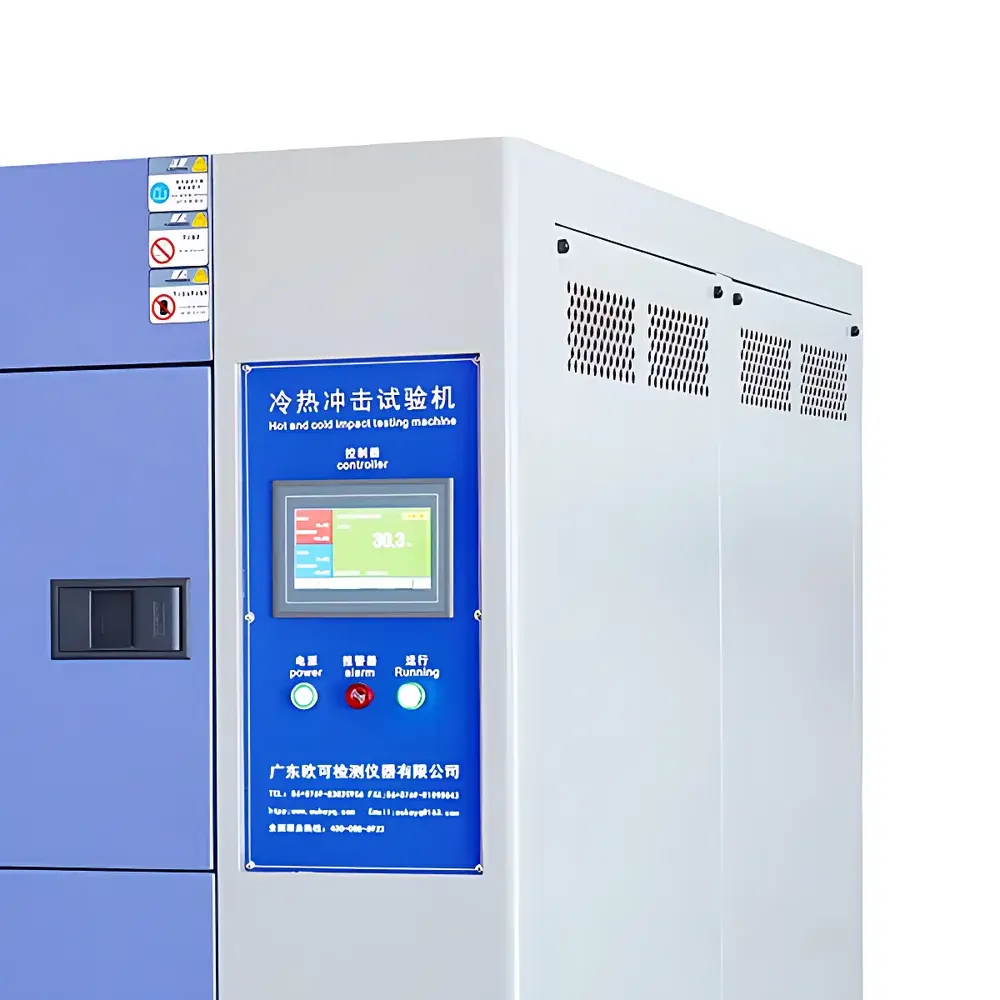
OK 0K-TS-49.88 Thermal Shock Test Chamber
| Brand | OK |
|---|---|
| Origin | Guangdong, China |
| Manufacturer Type | Direct Manufacturer |
| Model | 0K-TS-49.88 |
| High Temperature Range | +150 °C |
| Low Temperature Range | −40 °C |
| Thermal Shock Range | −40 °C to +150 °C |
| Temperature Stability | ±0.2 °C |
| Heating Rate | 20 °C/s (to target zone) |
| Cooling Rate | 20 °C/s (to target zone) |
Overview
The OK 0K-TS-49.88 Thermal Shock Test Chamber is an engineered environmental test system designed to subject electronic components, aerospace assemblies, automotive modules, and advanced packaging materials to rapid, repeatable thermal transitions between extreme temperature extremes. It operates on the principle of *thermal shock*—a mechanical stress mechanism induced by abrupt volumetric expansion or contraction due to mismatched coefficients of thermal expansion (CTE) across material interfaces. Unlike gradual thermal cycling or rapid temperature change (RTC) chambers, this system delivers discrete, step-function temperature excursions with sub-10-second transfer times—enabling detection of latent defects such as solder joint fractures, delamination in multilayer PCBs, sealant cracking, or interfacial debonding that remain undetected under slower ramp profiles. Its design complies with the fundamental timing and exposure requirements defined in IEC 60068-2-14 (identical to GB/T 2423.22), MIL-STD-883 Method 1010.8, and JEDEC JESD22-A104D, all of which specify maximum allowable transition durations and dwell times at temperature extremes.
Key Features
- Two-chamber (basket-transfer) architecture optimized for high-fidelity thermal shock replication: independent high-temperature (+150 °C) and low-temperature (−40 °C) zones with pneumatically actuated sample carrier
- Verified transfer time ≤10 seconds from one chamber to the other—ensuring compliance with stringent military and semiconductor qualification standards
- Temperature stability maintained at ±0.2 °C during dwell phases, critical for reproducible failure mode identification
- High-efficiency refrigeration system with cascade compressor staging and electric heating elements enabling 20 °C/s effective thermal response at the sample interface
- Stainless steel interior construction with insulated double-wall panels and nitrogen purge compatibility for moisture-sensitive testing
- Programmable controller with Ethernet-enabled remote monitoring, real-time data logging, and audit-trail-capable event history (supports GLP/GMP-aligned validation protocols)
Sample Compatibility & Compliance
The 0K-TS-49.88 accommodates samples up to 49.88 L total volume (interior dimensions: 400 × 400 × 312 mm W×D×H) with a maximum basket load capacity of 20 kg. Its two-chamber configuration is ideal for small-to-medium-sized devices—including IC packages (QFN, BGA, CSP), sensors, connectors, and optoelectronic modules—that can be safely mounted on the transfer basket without external cabling constraints. The system meets essential safety and electromagnetic compatibility requirements per IEC 61000-6-2/6-4 and carries CE marking. Calibration traceability follows ISO/IEC 17025 principles, with optional factory certification against NIST-traceable reference standards. It supports full qualification testing per AEC-Q200 for automotive electronics and is routinely deployed in laboratories conducting reliability screening per IPC-9701 and JEDEC standards.
Software & Data Management
Equipped with OK’s proprietary TSC-Studio control software, the chamber provides intuitive multi-step profile programming, real-time graphical temperature overlay (chamber A, chamber B, and basket sensor), and synchronized timestamped logging at user-selectable intervals (100 ms minimum). All operational parameters—including door status, compressor stage activation, heater duty cycle, and alarm history—are recorded with immutable timestamps. Data export is supported in CSV and PDF formats; raw logs include digital signatures for integrity verification. The system architecture permits integration into enterprise LIMS environments via Modbus TCP or OPC UA, and supports FDA 21 CFR Part 11-compliant user access controls, electronic signatures, and audit trail retention when configured with optional validation packages.
Applications
- Qualification of semiconductor packages undergoing JEDEC JESD22-A104D Level C or D shock profiles
- Failure analysis of solder interconnects in high-reliability avionics modules per MIL-STD-883 Method 1010.8
- Validation of hermetic seals in MEMS devices and medical implant housings
- Assessment of thermal interface material (TIM) adhesion integrity under cyclic shock loading
- Screening of conformal coating performance on printed circuit board assemblies exposed to field-relevant thermal transients
- Supporting accelerated life testing (ALT) programs where thermal shock serves as a root-cause trigger for latent defects
FAQ
What distinguishes thermal shock testing from thermal cycling or rapid temperature change (RTC) testing?
Thermal shock applies discrete, near-instantaneous temperature transitions (≤10 s transfer) to induce mechanical stress from differential expansion; thermal cycling uses controlled linear ramps (e.g., 10 °C/min) to assess fatigue over hundreds of cycles.
Does this model support liquid nitrogen (LN₂) assist for extended low-temperature capability?
The base 0K-TS-49.88 operates within −40 °C to +150 °C using mechanical refrigeration only; LN₂ augmentation is available as a factory-configurable option for −65 °C operation.
Is the chamber suitable for powered-in testing (e.g., functional monitoring during shock transitions)?
No—the two-chamber basket-transfer design requires sample disconnection during movement; for powered-in applications, OK recommends its three-chamber vertical airflow configuration (model 0K-TS-V series).
How is temperature uniformity verified across the test volume?
Uniformity is validated per IEC 60068-3-5 using nine calibrated PT100 sensors placed in a 3×3 grid at the nominal sample plane; typical deviation is ≤±1.0 °C at steady state.
Can test profiles be exported and shared between multiple OK chambers in a lab network?
Yes—TSC-Studio supports standardized XML-based profile exchange and version-controlled library management across distributed systems.



