
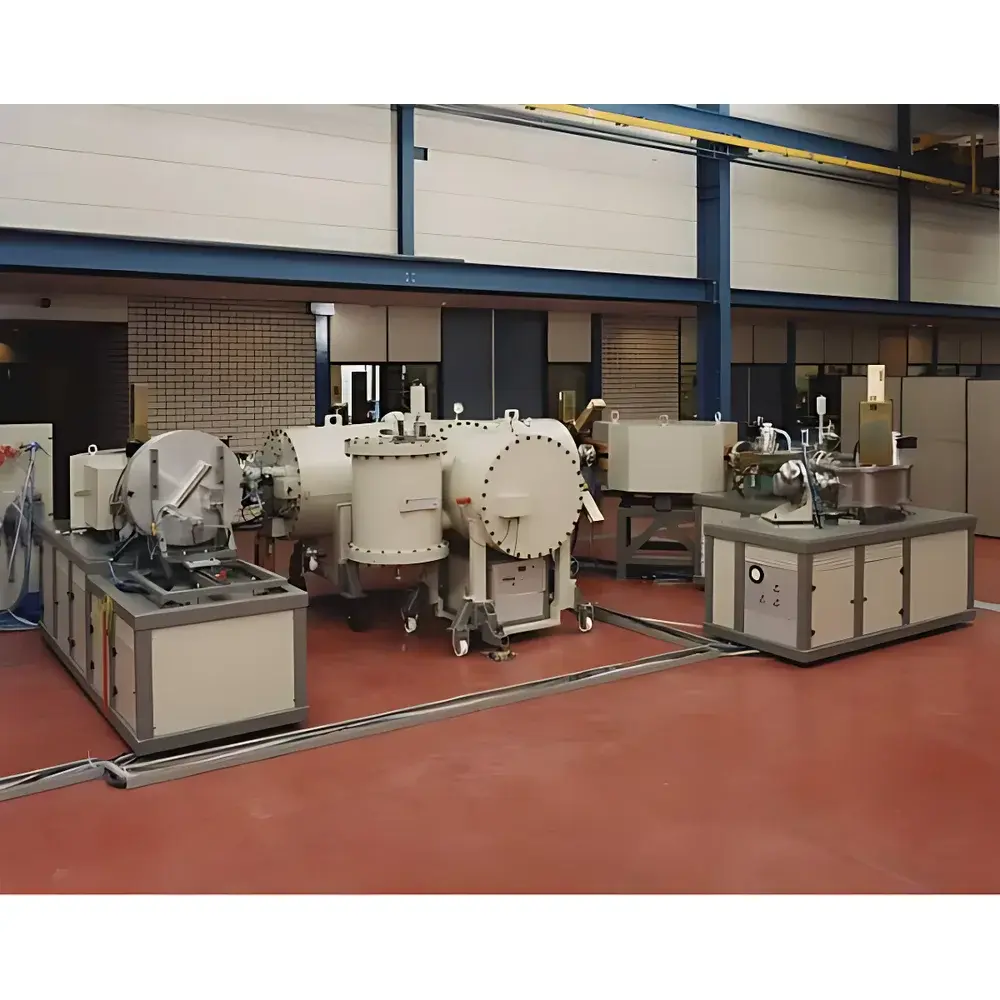
1.0 MV HVE Accelerator Mass Spectrometer
| Origin | Netherlands |
|---|---|
| Manufacturer Type | Distributor |
| Origin Category | Imported |
| Model | 4110Bo |
| Pricing | Upon Request |
Overview
The 1.0 MV HVE Accelerator Mass Spectrometer (AMS) is a high-precision, compact electrostatic accelerator system engineered for ultra-trace isotopic analysis of long-lived radionuclides and stable isotopes in geological, environmental, archaeological, and nuclear safeguards applications. Operating at a terminal voltage of 1.0 megavolt, this system employs tandem acceleration architecture to achieve effective isobaric suppression—particularly critical for discriminating rare isotopes such as 14C, 10Be, 26Al, 36Cl, 129I, and actinide nuclides (e.g., 236U, 239Pu) from their isobaric interferences. Ion beams are generated via a dual-mode hybrid sputter source capable of handling both solid targets and continuous CO2 gas introduction at ground potential—enabling direct, contamination-free carbon isotope analysis without graphitization. The system’s design follows established AMS physics principles: negative ions are injected, accelerated toward the high-voltage terminal, stripped of electrons in a gas or foil stripper to produce positive charge states, then re-accelerated to high energy before mass/energy separation in magnetic and electrostatic analyzers.
Key Features
- Hybrid 50/200-position sputter source accommodating solid samples (e.g., graphite, metal oxides, silicates) and continuous-flow CO2 gas—eliminating offline sample preparation for radiocarbon analysis.
- Bouncer-type low-energy mass spectrometer enabling rapid sequential injection (sub-second cycle time) and programmable slow sequential injection for high-precision multi-isotope runs.
- Rotatable low-energy static electron analyzer stage—designed for future integration of a secondary ion source (e.g., Cs+ or O−) to expand elemental coverage and matrix compatibility.
- Full solid-state terminal voltage supply delivering stable, ripple-free 1.0 MV output with >10-year operational reliability and minimal scheduled maintenance—no oil-filled transformers or mechanical regulators.
- High-energy magnetic sector combined with low-energy double-focusing magnet and electrostatic analyzer for optimized mass resolution (M/ΔM > 5000) and transmission efficiency across the mass range A = 10–240.
- Integrated anion isotope separator module compatible with standard AMS ion optics—supporting high-efficiency negative ion selection prior to acceleration.
Sample Compatibility & Compliance
The 4110Bo AMS accepts a broad spectrum of sample matrices including carbonate sediments, bone collagen hydrolysates, quartz extracts, uranium oxide powders, and gaseous CO2 from combustion or cryogenic trapping systems. Solid samples are pressed into aluminum or titanium targets; CO2 is introduced via a grounded, pressure-regulated inlet line with integrated flow control and cryo-trapping capability. The instrument meets ISO/IEC 17025 requirements for testing laboratories when operated under documented SOPs, and its data acquisition architecture supports audit trails compliant with FDA 21 CFR Part 11 and GLP/GMP environments. All vacuum subsystems conform to ASTM E1982–20 (Standard Guide for Vacuum System Integrity Testing in Mass Spectrometry).
Software & Data Management
The proprietary AMS Control Suite provides real-time beam tuning, automated sequence execution, live isotope ratio calculation, and raw data archiving in HDF5 format. Each measurement session includes timestamped metadata (source voltage, stripper gas pressure, magnet currents, detector gain settings), enabling full traceability. Batch processing tools support offline peak fitting using Gaussian deconvolution algorithms and interference correction based on measured blank and standard ratios. Export modules generate CSV, ASCII, and IAEA-compatible .dat files for integration with external platforms such as OxCal, BATS, or custom Python-based QA/QC pipelines. Software updates are delivered via secure HTTPS channel with SHA-256 signature verification.
Applications
- Environmental radioecology: quantification of anthropogenic 129I and 236U in seawater and biota for nuclear discharge monitoring.
- Geochronology: 10Be and 26Al exposure dating of glacial landforms and volcanic surfaces.
- Archaeological radiocarbon dating: high-throughput 14C analysis of microgram-sized charcoal, textile, and parchment samples.
- Nuclear forensics: isotopic fingerprinting of uranium and plutonium particles in swipe samples.
- Cosmogenic nuclide studies: 36Cl production rate calibration in chloride-rich bedrock and soil profiles.
- Biomedical tracer studies: ultra-low-level 41Ca detection in human metabolic turnover assays.
FAQ
What sample forms are supported for 14C analysis?
Solid graphite targets and continuous-flow CO2 gas—both introduced at ground potential to minimize memory effects and eliminate high-voltage feedthrough complications.
Can the system measure actinides such as 239Pu alongside 236U?
Yes—the high-energy magnetic analysis stage and optimized stripper configuration enable simultaneous detection of multiple actinide isotopes with isotopic ratio precision better than 1% (2σ) for samples ≥106 atoms.
Is remote operation supported?
Yes—full instrument control, diagnostics, and data review are accessible via TLS-encrypted web interface with role-based user permissions and session logging.
What vacuum level is maintained in the accelerator tube?
Ultra-high vacuum of ≤5×10⁻⁷ mbar is sustained by turbomolecular pumps backed by dry scroll pumps, monitored continuously via Bayard-Alpert and cold cathode gauges.
Does the system include calibration standards?
NIST-traceable reference materials (e.g., IAEA-C1, C2, C6; NIST SRM 4347B) are available as optional accessories with certified isotopic ratios and uncertainty budgets.
Related Products





