
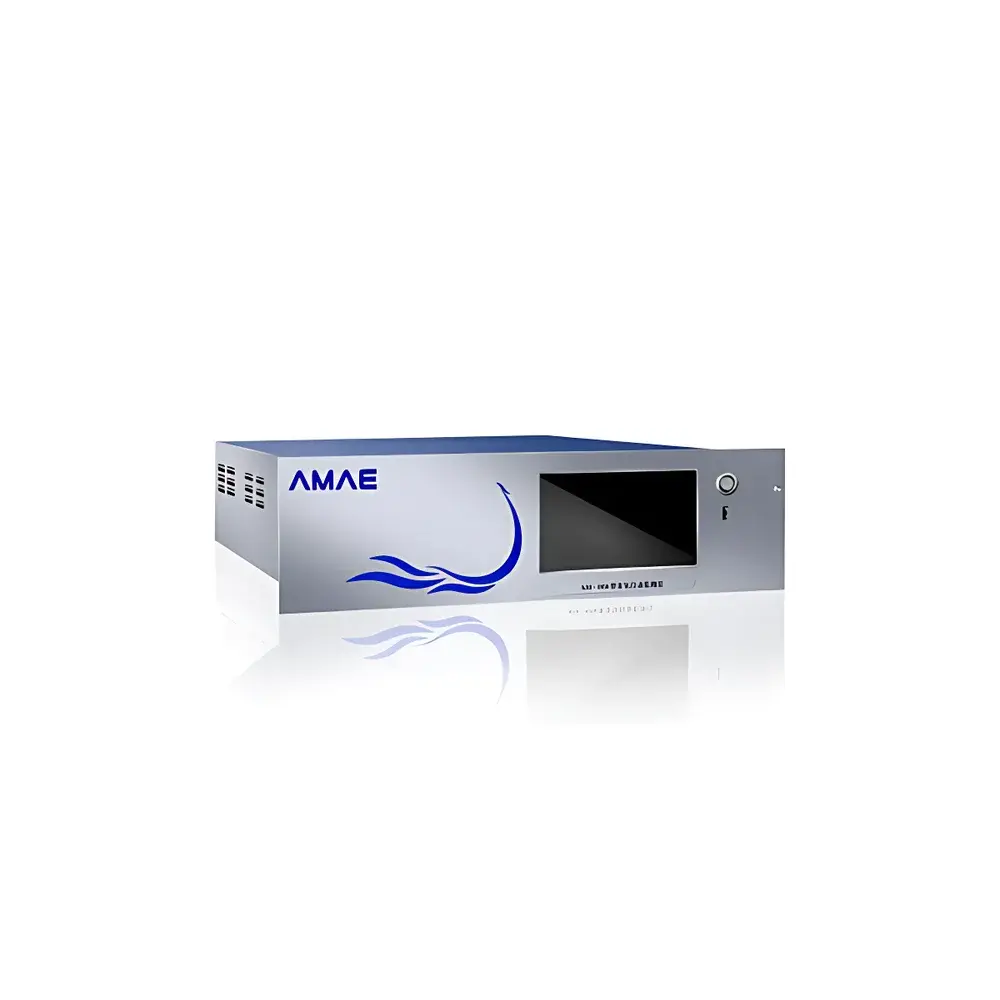
AM-1056 CO Automatic Monitoring Analyzer by AMAE
| Brand | AMAE |
|---|---|
| Origin | Jiangsu, China |
| Model | AM-1056 |
| Measurement Principle | Alternating Flow Modulated NDIR (Non-Dispersive Infrared) at 4.67 µm |
| Measurand | Carbon Monoxide (CO) in Ambient Air |
| Range | 0–10 / 25 / 50 ppm (field-expandable) |
| LOD | 0.2 ppm (2σ, ≤10 ppm range) or 0.5% F.S. (2σ, >10 ppm range) |
| Accuracy | ±1.0% F.S. |
| Linearity | ±1.0% F.S. |
| Zero Drift | ±0.5 ppm/day or ±1.0% F.S./day |
| Span Drift | ±1.0% F.S./day or ±3.0% F.S./week |
| Response Time (T90) | ≤80 s |
| Sample Flow Rate | ~1 L/min |
| Dimensions | 483 mm × 545 mm × 133 mm (L×W×H) |
| Power Consumption | 50 W |
| Connectivity | Embedded Web Server (Ethernet/Wi-Fi) |
| Calibration | Scheduled Auto-Calibration Support |
| Enclosure | Industrial Rack-Mountable Chassis (19″, 3U) |
Overview
The AM-1056 CO Automatic Monitoring Analyzer is an industrial-grade, rack-mountable (19″, 3U) ambient air quality analyzer engineered for continuous, unattended measurement of carbon monoxide (CO) concentration in real time. It employs alternating flow modulated non-dispersive infrared (NDIR) spectroscopy—optimized at the fundamental absorption band of CO at 4.67 µm—to deliver high specificity and long-term stability. The optical path utilizes a dual-beam configuration with active reference compensation, minimizing interference from water vapor, CO₂, and particulate scattering. Signal acquisition relies on a thermopile detector coupled with precision analog-to-digital conversion and digital signal processing algorithms compliant with ISO 12039 and EN 14625 requirements for fixed-source and ambient CO monitoring. Designed for deployment across diverse regulatory and operational environments—including urban roadside stations, industrial fence-line monitoring networks, laboratory reference systems, and CEMS (Continuous Emission Monitoring Systems) using dilution sampling—the AM-1056 meets functional equivalency benchmarks defined in EPA Method 10 and EU BREF reference protocols.
Key Features
- Modulated NDIR optical architecture with temperature-stabilized source and dual-channel detection, ensuring immunity to ambient thermal drift and optical contamination.
- Configurable response time (manual or automatic optimization), enabling adaptive temporal resolution for low-concentration (<1 ppm) trace monitoring without compromising dynamic range fidelity.
- Integrated embedded web server supporting HTTP/HTTPS access via Ethernet or Wi-Fi—enabling remote instrument status monitoring, real-time data visualization, firmware updates, diagnostic logging, and parameter reconfiguration without local physical access.
- Interactive graphical interface with live process flow diagrams, real-time calibration curve overlays, and spectral baseline tracking—accessible directly via browser or integrated into SCADA/EMS platforms via Modbus TCP or MQTT.
- Intelligent maintenance assistant: self-diagnostic routines identify sensor degradation, flow path obstruction, or optical window soiling; provides step-by-step guidance for consumables replacement (e.g., particulate filter, desiccant cartridge) and field recalibration procedures.
- Low-power modular design (rated 50 W nominal) with optimized thermal insulation and internal temperature regulation—reducing cold-start stabilization time and enhancing measurement repeatability under variable ambient conditions (−20 °C to +50 °C operating range).
Sample Compatibility & Compliance
The AM-1056 accepts conditioned ambient or diluted stack gas samples delivered at a nominal flow rate of 1.0 ± 0.1 L/min through a heated (60 °C) stainless-steel sample line. Integrated particulate filtration (≤2.5 µm cut-off) and moisture removal (permeation dryer or Nafion® membrane) ensure representative sampling integrity. The analyzer complies with key international standards for environmental monitoring instrumentation, including ISO 12039 (stationary source CO measurement), EN 14625 (ambient air quality—CO analyzers), and ASTM D6348 (standard test method for gaseous emissions by FTIR). Its data handling architecture supports audit-ready operation per GLP/GMP principles, with configurable data logging intervals (1 s to 1 h), timestamped event logs, and optional 21 CFR Part 11-compliant electronic signature modules for regulated laboratories.
Software & Data Management
Firmware v3.2+ includes native support for CSV/JSON export, secure TLS-encrypted data transmission, and compatibility with common environmental data management systems (EDMS) such as EnviroPro, AQS-Link, and custom SQL-based repositories. All calibration events, zero/span checks, and system diagnostics are automatically timestamped and stored with metadata (operator ID, location tag, ambient T/P). Optional cloud integration enables automated daily report generation, alarm threshold notifications (SMS/email), and cross-site trend analysis. Raw spectral data and processed concentration values are retained locally for ≥30 days and can be retrieved via FTP or direct USB mass storage.
Applications
- Ambient air quality monitoring networks (AQN) for urban, suburban, and rural background stations.
- Fence-line and perimeter monitoring at petrochemical plants, refineries, and metal processing facilities.
- Mobile monitoring platforms (e.g., van-mounted AQMS) requiring low-power, vibration-resistant analyzers.
- Research-grade studies on CO transport dynamics, emission factor validation, and model input verification.
- Dilution-based CEMS for combustion sources where certified reference methods require trace-level CO quantification.
- Indoor air quality (IAQ) assessment in transportation hubs, parking garages, and underground facilities.
FAQ
What is the minimum detectable CO concentration under standard operating conditions?
The limit of detection (LOD) is 0.2 ppm (2σ) for the 0–10 ppm range and 0.5% of full scale for higher ranges, validated per ISO 11843-1.
Does the AM-1056 support automatic zero and span calibration?
Yes—users may schedule daily, weekly, or event-triggered auto-calibration using certified zero air and span gases (e.g., 5 ppm CO in N₂); all calibrations are logged with traceability metadata.
Can the analyzer operate in high-humidity environments without condensation artifacts?
Yes—integrated heated sample line (60 °C), permeation dryer, and optical chamber temperature control mitigate humidity-induced signal attenuation and baseline instability.
Is external data acquisition hardware required to retrieve measurements?
No—embedded Ethernet/Wi-Fi and RESTful API eliminate dependency on third-party DAQ systems; raw and processed data are accessible via standard web protocols.
What maintenance intervals are recommended for optimal performance?
Particulate filters should be replaced every 30–90 days depending on site particulate loading; optical windows require cleaning every 6 months; annual factory verification is recommended for regulatory compliance.







