
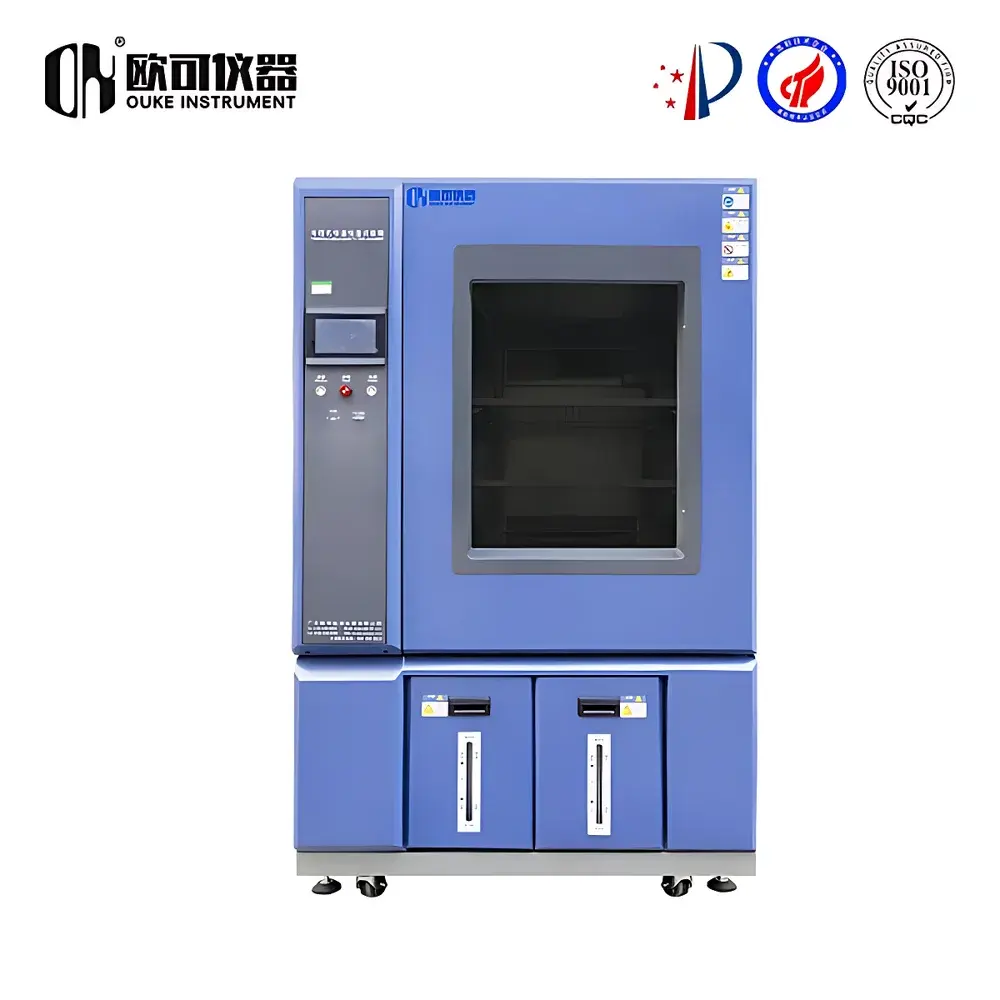
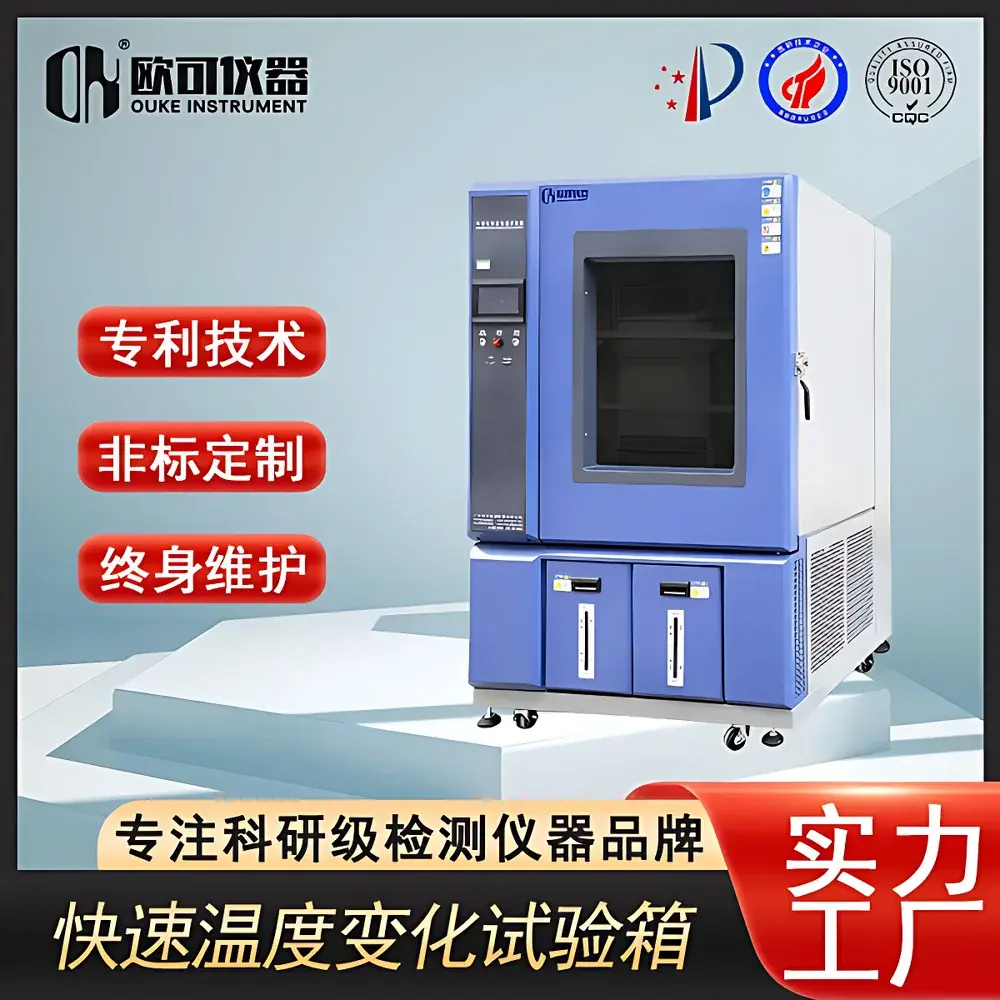
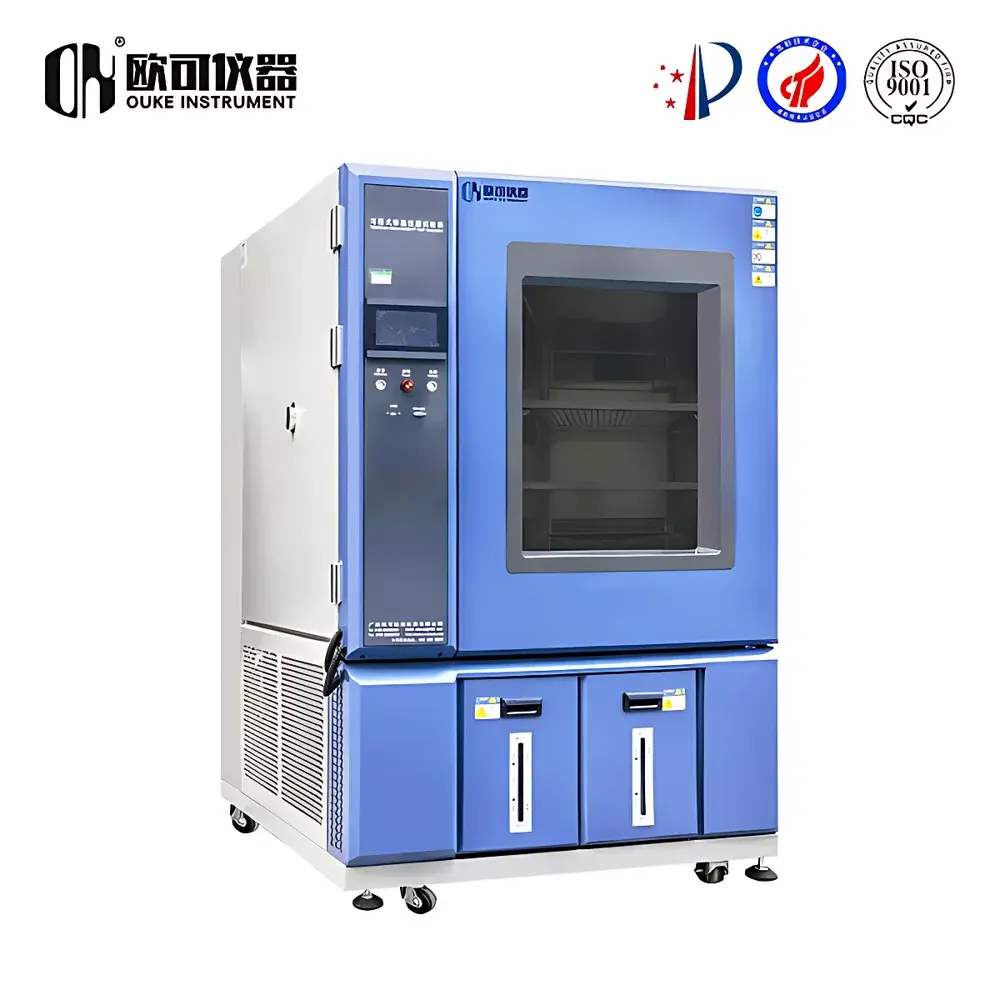
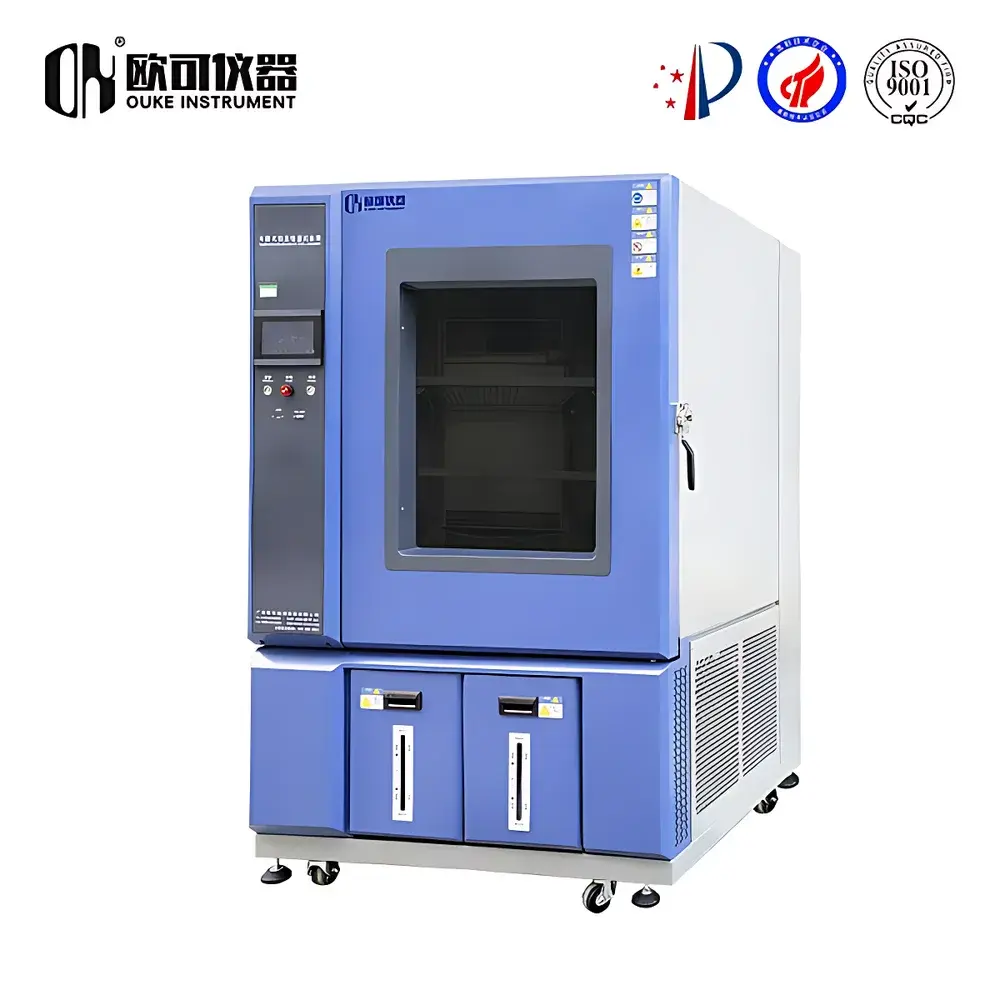
OK-TH-225 Two-Zone Rapid Temperature Transition Environmental Test Chamber
| Brand | OK Instruments |
|---|---|
| Origin | Guangdong, China |
| Manufacturer Type | Direct Manufacturer |
| Model | OK-TH-225.0.00 |
| Temperature Range (High Zone) | +80 °C to +200 °C |
| Temperature Range (Low Zone) | −10 °C to −70 °C |
| Operational Test Range | −40 °C to +150 °C |
| Temperature Control Accuracy | ±2 °C |
| Temperature Resolution | 0.01 °C |
| High-Temp Ramp Rate (RT to +150 °C) | ≤40 min |
| Low-Temp Ramp Rate (RT to −70 °C) | ≤100 min |
| Test Zone Temperature Recovery Time | 3–5 min |
| Internal Dimensions (W×H×D) | 600 × 500 × 500 mm |
| External Dimensions (W×H×D) | 1500 × 2100 × 2250 mm |
| Construction | Dual-zone stainless steel (SUS304) chamber with high-density glass wool and rigid polyurethane (PU) foam insulation |
| Actuation System | Pneumatic damper control for zone isolation and thermal airflow routing |
| Accessories | Cryo/thermal-resistant packing (−200 °C to +400 °C), dual adjustable test shelves |
Overview
The OK-TH-225 Two-Zone Rapid Temperature Transition Environmental Test Chamber is an engineered solution for accelerated thermal stress testing of electronic components, automotive modules, aerospace hardware, and polymer-based materials. Designed around a true two-chamber architecture—comprising physically isolated high-temperature and low-temperature zones—the system enables rapid thermal cycling without relying on single-chamber compressor modulation or resistive heating alone. Thermal transitions are executed via pneumatic actuation of insulated dampers, directing conditioned air from the designated zone into the test compartment. This architecture ensures high thermal inertia separation between zones, minimizing cross-contamination and enabling repeatable, high-fidelity thermal shock profiles per IEC 60068-2-14, MIL-STD-810H Method 503.5, and JESD22-A104. The test zone remains static during transitions, eliminating mechanical vibration or positional disturbance—a critical requirement for in-situ monitoring of solder joint integrity, MEMS device behavior, or battery electrochemical response under thermal transients.
Key Features
- Dual-zone thermal architecture with independent high-temperature (+80 °C to +200 °C) and low-temperature (−10 °C to −70 °C) chambers, enabling true thermal shock without intermediate dwell or ramp interpolation
- Pneumatically actuated damper system for sub-5-second zone isolation switching and <5-minute test zone temperature recovery after transition
- Test zone operational range of −40 °C to +150 °C with ±2 °C control accuracy and 0.01 °C digital resolution for precise profile definition and repeatability validation
- SUS304 stainless steel interior and exterior surfaces with electropolished finish; corrosion-resistant, non-outgassing, and compatible with cleanroom-grade maintenance protocols
- Multi-layer insulation system combining high-density glass wool and closed-cell rigid PU foam (λ ≤ 0.022 W/m·K), achieving thermal leakage <0.8 K/h at extreme setpoints
- Integrated cryo/thermal packing rated for −200 °C to +400 °C, ensuring long-term sealing integrity across full operational extremes
Sample Compatibility & Compliance
The OK-TH-225 accommodates samples up to 600 × 500 × 500 mm (W×H×D) with two height-adjustable stainless steel shelves supporting uniform airflow distribution and load balancing. Its static-test-zone configuration supports integration with external instrumentation—including thermocouple arrays, strain gauges, impedance analyzers, and real-time data loggers—without requiring sample repositioning during cycling. The chamber complies with structural and safety requirements of GB/T 10592–2021 (Chinese national standard for environmental test chambers), and its control architecture supports traceable calibration per ISO/IEC 17025 when paired with accredited reference sensors. While not certified to UL 61010-1 or CE Machinery Directive out-of-box, the system is designed to meet essential safety and EMC prerequisites for integration into GLP-compliant laboratories and ISO 9001-certified manufacturing environments.
Software & Data Management
The embedded controller features a 10.1-inch capacitive touchscreen HMI with real-time graphing, multi-segment profile programming, and event-triggered logging. All temperature readings, actuator states, alarm conditions, and cycle counters are timestamped with millisecond precision and exportable in CSV format via USB or Ethernet. Audit trail functionality records operator login/logout, parameter modifications, and manual overrides—supporting basic 21 CFR Part 11 readiness when deployed with network-authenticated user accounts and external time-server synchronization. Optional PC-based software (OK-EnviroSuite v3.2) provides advanced statistical process control (SPC) overlays, Weibull-based failure prediction modeling, and automated report generation aligned with AIAG CQI-9 thermal process audit criteria.
Applications
- Thermal shock qualification of PCB assemblies per IPC-9701A and JEDEC JESD22-A104
- Accelerated life testing of lithium-ion battery cells and modules under extreme thermal gradients
- Validation of elastomeric seals, adhesives, and composite laminates per ASTM D573 and ISO 188
- Pre-conditioning of optical sensors and infrared detectors prior to performance characterization
- Stress screening of avionics enclosures and engine control units in accordance with RTCA DO-160 Section 4.3
- Material coefficient of thermal expansion (CTE) correlation studies using DIC or laser interferometry
FAQ
What is the difference between the OK-TH-225’s two-zone architecture and conventional single-chamber thermal shock chambers?
Unlike single-chamber systems that rely on compressor throttling and heater cycling—which inherently limit ramp rates and introduce thermal lag—the OK-TH-225 maintains two fully conditioned zones at opposing extremes. Transitions occur by redirecting pre-stabilized air, yielding faster, more deterministic thermal shocks with superior repeatability.
Can the chamber be integrated into an automated test cell with PLC-level control?
Yes. Standard Modbus TCP and optional RS-485 (Modbus RTU) interfaces enable direct communication with industrial PLCs, SCADA systems, or test sequencers for synchronized operation with power supplies, data acquisition units, or robotic handlers.
Is calibration documentation provided with shipment?
Each unit ships with a factory calibration certificate covering sensor linearity, temperature uniformity mapping (per IEC 60068-3-5), and actuator timing verification. NIST-traceable calibration services are available upon request.
What maintenance intervals are recommended for long-term reliability?
Compressor oil and refrigerant levels should be verified annually; pneumatic solenoid valves and damper seals inspected every 18 months; and insulation integrity assessed during biennial thermal uniformity recalibration.



