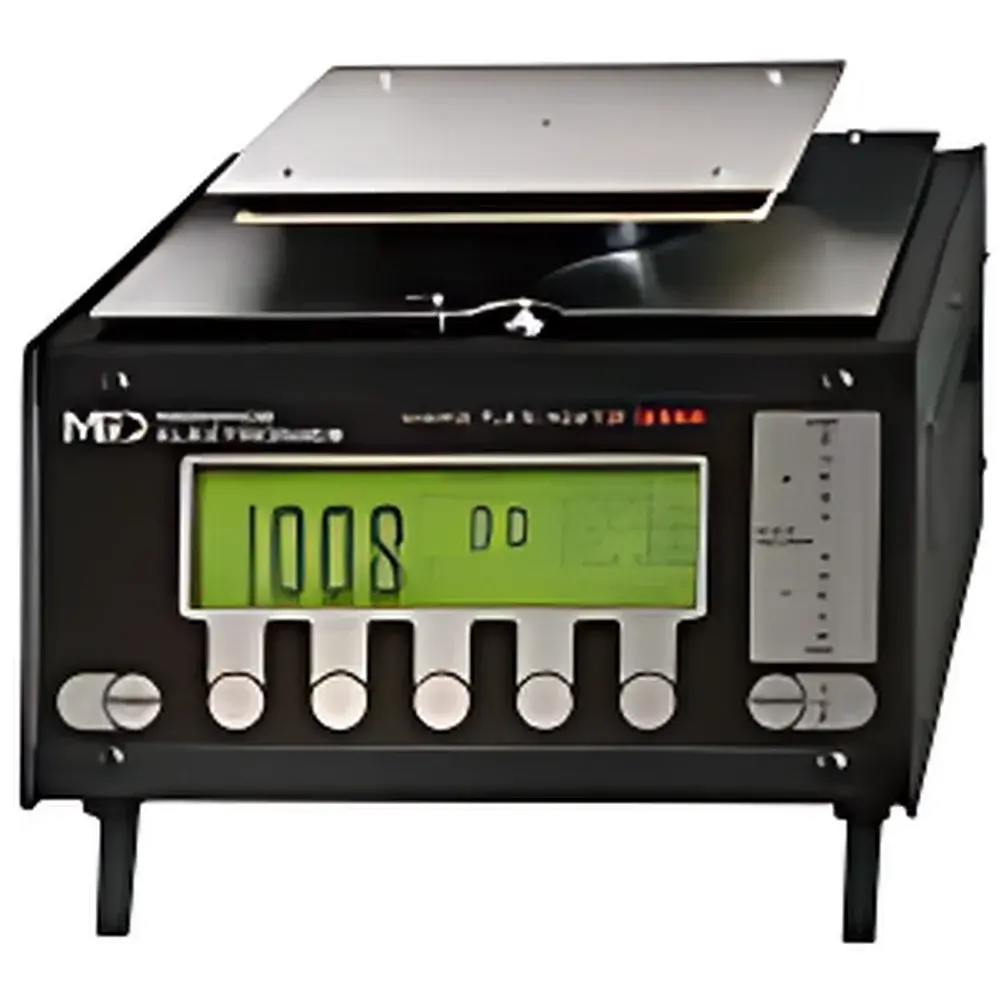
ME-288B Plate-Type Electrostatic Charge Monitor
| Origin | USA |
|---|---|
| Manufacturer Type | Authorized Distributor |
| Origin Category | Imported |
| Model | ME-288B |
| Pricing | Upon Request |
Overview
The ME-288B Plate-Type Electrostatic Charge Monitor is a precision-engineered instrument designed for quantitative measurement and real-time monitoring of electrostatic charge accumulation on insulating or semi-conductive surfaces. Based on the principle of capacitive coupling to a calibrated, grounded reference plate (20 pF ±10%), the ME-288B measures surface potential via electrostatic induction without physical contact—ensuring non-invasive, repeatable characterization of static voltage in industrial, cleanroom, and laboratory environments. Its core architecture supports high-fidelity transient capture, with sub-10 ms response time (90%–10% decay from 1 kV) and bandwidth-limited signal conditioning optimized for both fast discharge events and slow drift analysis. The system operates within a dynamic range of ±1200 V and maintains low intrinsic noise (<12 mV rms), enabling reliable detection of minute charge variations critical for ESD-sensitive manufacturing processes, polymer processing, powder handling, and photomask handling in semiconductor fabrication.
Key Features
- High-resolution digital LED display (240 × 64 pixels) with dual-parameter readout: voltage (±3½-digit) and elapsed time (4-digit)
- Voltage measurement accuracy: ±0.1% of reading ±3 LSD; resolution: 0.1 V (≤99 V), 1 V (>99 V)
- Time measurement accuracy: ±0.1% of reading ±1 LSD; resolution: 0.1 s (<1000 s), 1 s (≥999 s)
- Programmable start/stop thresholds: Start voltage range ±10–±1000 V (1 V step, ±0.3% + 2.5 V); Stop voltage range 0–±995 V (1 V step, ±3% + 2.5 V)
- Integrated temperature and relative humidity sensors: 0–50°C (±2°C typical), 10–80% RH (±5% at 25°C)
- Low-drift analog front-end: zero-point drift 200 mV/sec
- Peak-hold detector with <10 Hz bandwidth for balanced electrostatic testing protocols
- Isolated analog monitor output (÷200 scaling), 0.1% accuracy ±12 mV, 1 kΩ output impedance
- Robust mechanical design: 280 × 229 × 152 mm (11″ × 9″ × 6″), 5.7 kg; operates on universal AC input (90–250 V, 50/60 Hz, <12 W)
Sample Compatibility & Compliance
The ME-288B is compatible with flat, rigid, or moderately curved non-conductive samples—including plastics, ceramics, glass substrates, photoresist-coated wafers, and composite laminates—provided surface geometry permits stable proximity to the 20 pF sensing plate. It does not require sample grounding or conductive coating, making it suitable for in-line process verification where electrical isolation must be preserved. The instrument conforms to general requirements of ANSI/ESD S20.20 and IEC 61340-5-1 for electrostatic control program validation. While not certified as a standalone safety device, its measurement methodology aligns with test methods referenced in ASTM D257 (DC resistance/resistivity) and ISO 18587 (electrostatic charge decay evaluation). Data logging and threshold-triggered event capture support GLP-compliant documentation when integrated with external timestamped recording systems.
Software & Data Management
The ME-288B operates as a stand-alone hardware monitor with no embedded firmware-based data storage or USB/Ethernet connectivity. All measurements are displayed in real time on the front-panel LED screen and available via the analog monitor output for integration into SCADA, PLC, or PC-based acquisition systems (e.g., National Instruments DAQ, LabVIEW, or MATLAB). Users may configure start/stop voltage thresholds and resolution settings manually via front-panel controls. For auditability, the unit supports manual logging with timestamp correlation using external chronometers. When deployed in regulated environments (e.g., medical device packaging lines or aerospace composites manufacturing), the analog output can be routed through FDA 21 CFR Part 11–compliant data acquisition hardware to ensure electronic record integrity, including operator attribution and change tracking.
Applications
- Verification of ionizer performance and decay time validation per ANSI/ESD STM3.1
- In-process monitoring of static charge buildup during web handling, film extrusion, and roll-to-roll coating
- Qualification of anti-static packaging materials and tote containers in electronics assembly
- Surface potential mapping of photomasks and reticles prior to lithography exposure
- Charge decay profiling of engineered polymers and carbon-loaded composites
- Environmental correlation studies linking ambient RH/temperature to static generation rates in cleanrooms (ISO Class 5–8)
- Root-cause analysis of ESD-related yield loss in semiconductor probe stations and wafer sort facilities
FAQ
What is the effective measurement distance between the sensor plate and the sample?
The optimal working distance is 25 mm (1 inch), calibrated for nominal sensitivity. Deviations beyond ±5 mm require empirical recalibration against traceable voltage standards.
Can the ME-288B measure charge on moving surfaces?
Yes—its <10 ms response time enables valid readings on conveyors or rotating drums, provided relative motion does not induce vibration exceeding 0.5 g RMS at the sensor housing.
Is the 20 pF plate capacitance user-adjustable?
No—the sensing plate capacitance is fixed and factory-trimmed; users must account for this value when calculating surface charge density (Q = C × V) for quantitative analysis.
Does the unit include internal battery backup for portable use?
Yes—it features a rechargeable battery providing up to 6 hours of continuous operation; full recharge requires ≤8 hours via included AC adapter.
How is calibration traceability maintained?
The ME-288B is supplied with NIST-traceable calibration certificate (valid for 12 months); field verification is performed using a certified high-voltage calibrator (e.g., Trek 3020B or equivalent) at three points across the ±1200 V range.