
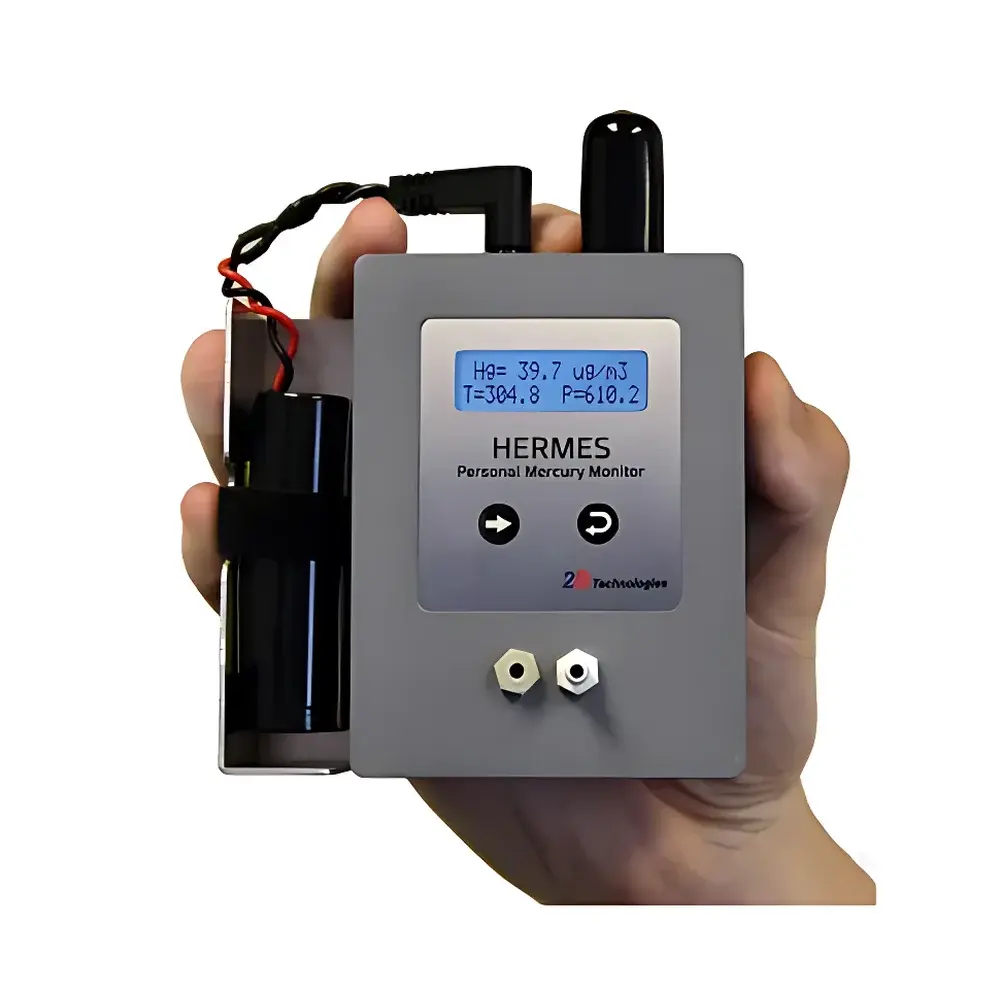
2B Tech HERMES Portable Trace Mercury Monitor
| Brand | 2B Tech |
|---|---|
| Origin | USA |
| Manufacturer Type | Authorized Distributor |
| Origin Category | Imported |
| Model | HERMES |
| Pricing | Upon Request |
Overview
The 2B Tech HERMES Portable Trace Mercury Monitor is a field-deployable, UV-absorption-based instrument engineered for high-sensitivity, real-time quantification of elemental mercury (Hg⁰) vapor in ambient air. It operates on the principle of differential optical absorption spectroscopy (DOAS) at the 254 nm mercury resonance line — a well-established, NIST-traceable method with proven selectivity and minimal cross-sensitivity to common atmospheric interferents. By folding the optical path into a compact U-shaped configuration, HERMES achieves an effective path length of 15 cm within a footprint of just 10.2 × 7.6 × 3.8 cm — enabling detection limits competitive with benchtop analyzers while maintaining true portability. Designed for unattended operation in resource-constrained environments, it integrates onboard GPS geotagging, low-power electronics, and robust thermal/pressure compensation algorithms to ensure metrological integrity across diverse operational conditions — from indoor occupational settings to high-altitude remote monitoring sites.
Key Features
- Ultra-compact form factor: 10.2 × 7.6 × 3.8 cm (4.0 × 3.0 × 1.5 in), mass 340 g — optimized for personal exposure assessment and handheld surveying.
- UV absorption measurement at 254 nm with NIST-traceable calibration; factory-certified calibration certificate included.
- Onboard GPS module enables synchronized spatial tagging of every mercury concentration reading (latitude, longitude, altitude, UTC timestamp).
- Dual measurement modes: rapid acquisition at 0.5 Hz (2 s interval) and high-stability mode at 0.1 Hz (10 s interval), configurable via firmware.
- Integrated environmental compensation: real-time correction for temperature (0–50 °C) and pressure (150–1013 mbar) to maintain accuracy across altitudes up to ~13.5 km.
- Low-power architecture: operates on internal 7.4 V Li-ion battery (1.6 Ah, 5–8 h runtime) or external 7–24 V DC supply; nominal power draw 3.0 W.
- Non-volatile data storage: 8,192 rows — supporting deployment durations from 4.6 hours (2 s mode) to over 1 year (1 h averaging).
Sample Compatibility & Compliance
HERMES measures gaseous elemental mercury (Hg⁰) exclusively; it does not detect oxidized mercury species (e.g., Hg²⁺) or particulate-bound mercury without prior thermal or chemical conversion. Sample air is drawn continuously at 0.8 L/min (minimum required flow: >0.5 L/min) through an optional heated sampling probe (sold separately) to prevent condensation or adsorption losses. The instrument complies with ASTM D6784-22 (Standard Test Method for Elemental, Oxidized, Particle-Bound, and Total Mercury in Flue Gas Streams) for Hg⁰ quantification methodology and supports GLP/GMP-aligned data integrity through time-stamped, GPS-georeferenced records. Its calibration traceability to NIST Standard Reference Materials (SRMs) satisfies ISO/IEC 17025 requirements for accredited environmental testing laboratories.
Software & Data Management
Data export is supported via RS-232 serial interface (19200 baud) or USB virtual COM port. The included 2B Display Software (Windows-compatible) provides real-time visualization, configurable averaging windows (1 min / 5 min / 1 h), unit conversion (ng/m³ ↔ ng/m³ ↔ ppb), and CSV export with full metadata (GPS coordinates, T/P, battery voltage, instrument status flags). All stored records include audit-trail fields: acquisition timestamp, measurement mode, flow rate, temperature, pressure, and zero-check status. Firmware updates and zero calibration are performed using the supplied zero cartridge and USB memory stick containing signed binaries and calibration history logs — supporting FDA 21 CFR Part 11 compliance when deployed in regulated occupational health programs.
Applications
- Personal exposure monitoring for workers in chlor-alkali plants, dental clinics, coal-fired power facilities, and artisanal gold mining support operations.
- Mobile mapping of mercury plumes near contaminated sites (e.g., legacy industrial zones, mining tailings) using vehicle-mounted or backpack configurations.
- Long-term ambient air quality studies in remote or off-grid locations — including polar research stations and high-elevation observatories — enabled by extended battery life and wide operating altitude range.
- Epidemiological field studies investigating spatial correlations between ambient Hg⁰ concentrations and biomarker levels (e.g., hair, blood) in vulnerable populations.
- Verification of mercury control technology performance (e.g., activated carbon injection, sorbent traps) during stack testing and fugitive emission surveys.
FAQ
Does HERMES require routine manual zeroing?
Yes — periodic zero checks using the supplied zero cartridge are recommended before critical deployments or after extended storage; automated zero drift correction is applied continuously based on baseline stability algorithms.
Can HERMES be used indoors without external power?
Yes — its internal Li-ion battery supports up to 8 hours of continuous operation in 10 s measurement mode, making it suitable for walk-through surveys and short-term indoor exposure assessments.
Is pressure compensation mandatory for accurate readings?
Yes — the instrument applies real-time pressure and temperature corrections per the ideal gas law; disabling compensation invalidates stated accuracy specifications and is not permitted in calibrated operation.
What is the minimum detectable concentration under field conditions?
The 2σ limit of detection is 0.2 µg/m³ in 10 s measurement mode, with typical 1σ noise ≤0.1 µg/m³ or 2% of reading — verified during factory acceptance testing and documented in the NIST-traceable calibration report.
Are firmware updates and calibration services available post-purchase?
Yes — 2B Technologies provides lifetime firmware updates and offers annual recalibration services with NIST-traceable documentation, supporting long-term regulatory compliance and data continuity across multi-year monitoring campaigns.
Related Products







