
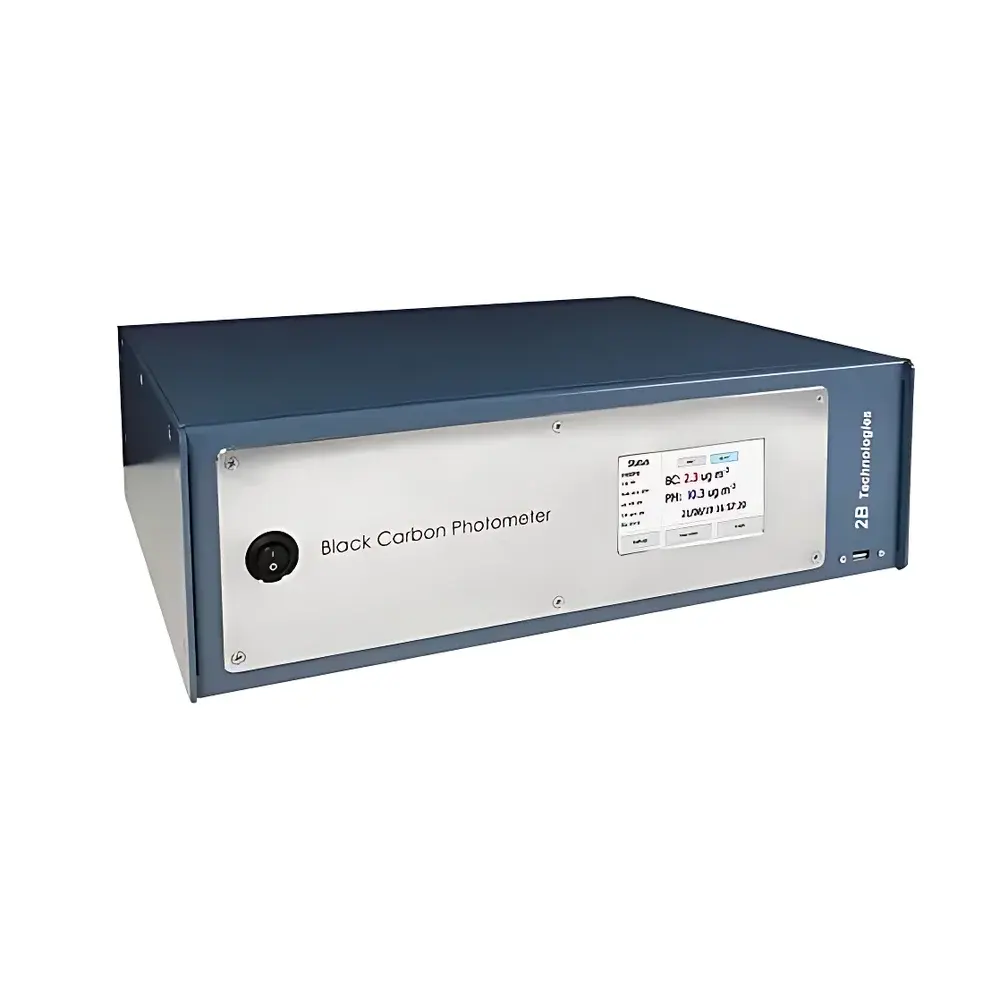
2B Technologies BCP™ Black Carbon Photometer
| Brand | 2B Technologies |
|---|---|
| Origin | USA |
| Model | BCP |
| Measurement Principle | Dual-wavelength (405 nm & 880 nm) direct extinction photometry |
| Dynamic Range | 0–10,000 Mm⁻¹ (880 nm: ~0–1300 µg·m⁻³) |
| Resolution | 0.1 Mm⁻¹ (0.1 µg·m⁻³) |
| Accuracy | ±2 Mm⁻¹ or ±2% of reading |
| Detection Limit (2σ, 1-hr avg) | 0.036 µg·m⁻³ at 880 nm |
| Flow Rate | 1.3 L·min⁻¹ (range: 1.0–1.6 L·min⁻¹) |
| Response Time (100% step, adaptive filter) | 20 s |
| Power Consumption | ~16 W (avg, post-warm-up) |
| Dimensions | 43 × 37 × 14 cm (17" × 14.5" × 5.5", rack-mountable) |
| Weight | 8.7 kg (19.2 lb) |
| Data Storage | 10 GB internal (≥3.2 years @ 10-s intervals) |
| Operating Temp | 5–45 °C |
| Pressure Range | 600–1000 mbar |
| Output Interfaces | RS-232, USB, 0–2.5 V analog (user-scaled), touchscreen GUI |
| Pump Lifetime | ~15,000 h |
Overview
The 2B Technologies BCP™ Black Carbon Photometer is an engineered solution for real-time, in-situ quantification of atmospheric black carbon (BC) and total aerosol extinction—without sample pre-concentration. It operates on the fundamental principle of dual-wavelength direct extinction photometry, measuring light attenuation at 405 nm (dominated by scattering from fine particulate matter, including PM2.5) and 880 nm (where absorption by graphitic black carbon dominates). Unlike filter-based absorption instruments (e.g., Aethalometers or MAAPs), the BCP employs a folded tubular optical cell with an effective path length of 2.1 meters within a compact, rack-mountable chassis. This design eliminates artifacts associated with filter loading, shadowing, and volatile organic compound (VOC) interference—common limitations in integrative filter-based methods. The instrument continuously draws ambient air at 1.3 L·min⁻¹ through a PTFE particle filter during reference measurements, enabling precise baseline subtraction via the Beer–Lambert law: Bext = (1/L) · ln(I0/I). Its physics-based calibration traceability to NIST standards ensures metrological rigor suitable for regulatory monitoring, climate research, and health exposure assessment.
Key Features
- Dual-wavelength (405 nm & 880 nm) real-time extinction measurement—provides simultaneous BC mass concentration (µg·m⁻³) and total aerosol extinction (Mm⁻¹).
- Folded-path optical cell architecture: achieves 2.1 m effective path length in a footprint compatible with standard 19-inch rack systems (43 × 37 × 14 cm).
- No filter pre-concentration required—eliminates time-dependent artifacts, loading corrections, and filter artifact compensation algorithms.
- Low power consumption (~16 W average post-warm-up) and robust 15,000-hour lifetime pump—enables unattended field deployment, including battery-powered operation.
- Integrated touchscreen interface with full parameter control: zero calibration, gain adjustment, mass conversion coefficients (e.g., MAC880), and user-defined averaging intervals (10 s, 1 min, 5 min, 1 hr).
- Onboard 10 GB data logger stores >3.2 years of 10-second resolution data; supports USB mass storage export and RS-232 serial communication.
- Adaptive optical filtering reduces noise at low concentrations—achieving a 2σ detection limit of 0.036 µg·m⁻³ at 880 nm with 1-hour averaging.
- Temperature- and pressure-corrected output (ambient T/P sensors included); compliant with ISO 21507:2019 for aerosol photometric instrumentation.
Sample Compatibility & Compliance
The BCP is optimized for ambient urban, rural, and roadside atmospheres where black carbon originates from incomplete combustion (diesel engines, biomass burning, residential heating). It accepts undiluted ambient air without conditioning—no drying, heating, or impactor pre-separation is required. Particulate-phase measurements include both externally and internally mixed BC-containing particles, provided they remain airborne and non-volatile under operating conditions (5–45 °C, 600–1000 mbar). The instrument meets key environmental monitoring requirements: it is referenced in EPA’s Compendium Method IO-3.3 for BC surrogate estimation, aligns with ASTM D6216 for optical aerosol measurement, and supports GLP-compliant data integrity through timestamped, audit-trail-enabled internal logging. While not intrinsically safe (non-explosion-proof), its low-power DC/AC operation and absence of high-voltage components make it suitable for fixed-site monitoring stations, mobile platforms, and research vessels.
Software & Data Management
Data acquisition and configuration are managed via an embedded Linux-based microprocessor with a capacitive touchscreen GUI—requiring no external PC for routine operation. All critical parameters—including zero offset, gain, mass absorption cross-section (MAC), and analog output scaling—are stored in non-volatile memory with version-stamped change logs. Raw extinction values (Mm⁻¹), calculated BC mass (µg·m⁻³), flow rate, temperature, pressure, and diagnostic flags are logged with UTC timestamps. USB export generates CSV files compatible with MATLAB, Python (pandas), R, and commercial analytics platforms (e.g., EPANET, AirQo). Optional firmware updates and calibration validation reports are distributed via secure HTTPS portal access. For regulated environments, the system supports 21 CFR Part 11–compliant audit trails when paired with validated third-party data management software (e.g., LabArchives or LabVantage), though native electronic signature functionality is not embedded.
Applications
- Urban air quality networks: Long-term BC trend analysis, source apportionment support (when co-located with CO, NOx, and size-resolved particle counters).
- Climate forcing studies: Quantifying BC radiative absorption efficiency and atmospheric heating rates in field campaigns (e.g., DOE ARM, NASA ATom).
- Exposure science: High-temporal-resolution community-level BC mapping for epidemiological cohort studies.
- Technology evaluation: Reference-grade benchmarking of low-cost sensor networks and filter-based BC monitors.
- Emission testing: Real-time BC monitoring during vehicle chassis dynamometer tests or stack sampling (with appropriate inlet conditioning).
- Indoor air quality: Monitoring BC infiltration from traffic or cooking emissions in schools, hospitals, and residential buildings.
FAQ
How does the BCP differ from filter-based black carbon instruments?
The BCP measures extinction directly in the sampled air stream using a long-path optical cell—avoiding filter deposition artifacts, compensation uncertainties, and time-lag inherent in integrating filter methods.
Is the 880 nm channel truly specific to black carbon?
At 880 nm, absorption dominates over scattering for typical urban aerosols; BC contributes >85% of total absorption in most polluted environments—validated against thermal-optical OC/EC analyzers in intercomparison studies (Birks et al., AMT, 2018).
Can the BCP be used for regulatory compliance reporting?
While not certified as a reference method under EU Directive 2008/50/EC or US EPA EQOA, its NIST-traceable calibration, documented uncertainty budget (<±2% + 2 Mm⁻¹), and peer-reviewed performance make it suitable for supplemental monitoring and trend analysis in regulatory frameworks.
What maintenance is required beyond routine zero checks?
Minimal: annual verification of flow rate accuracy, biannual optical window inspection, and periodic replacement of the PTFE reference filter (typically every 6–12 months in moderate-dust environments). No lamp or detector replacement is needed within the first 5 years.
Does the instrument correct for humidity effects?
No active humidity drying is employed; however, the 880 nm channel exhibits low hygroscopic sensitivity (<3% RH-induced bias up to 80% RH), as confirmed in controlled chamber tests per ISO/CD 21507 Annex C.
Related Products







