
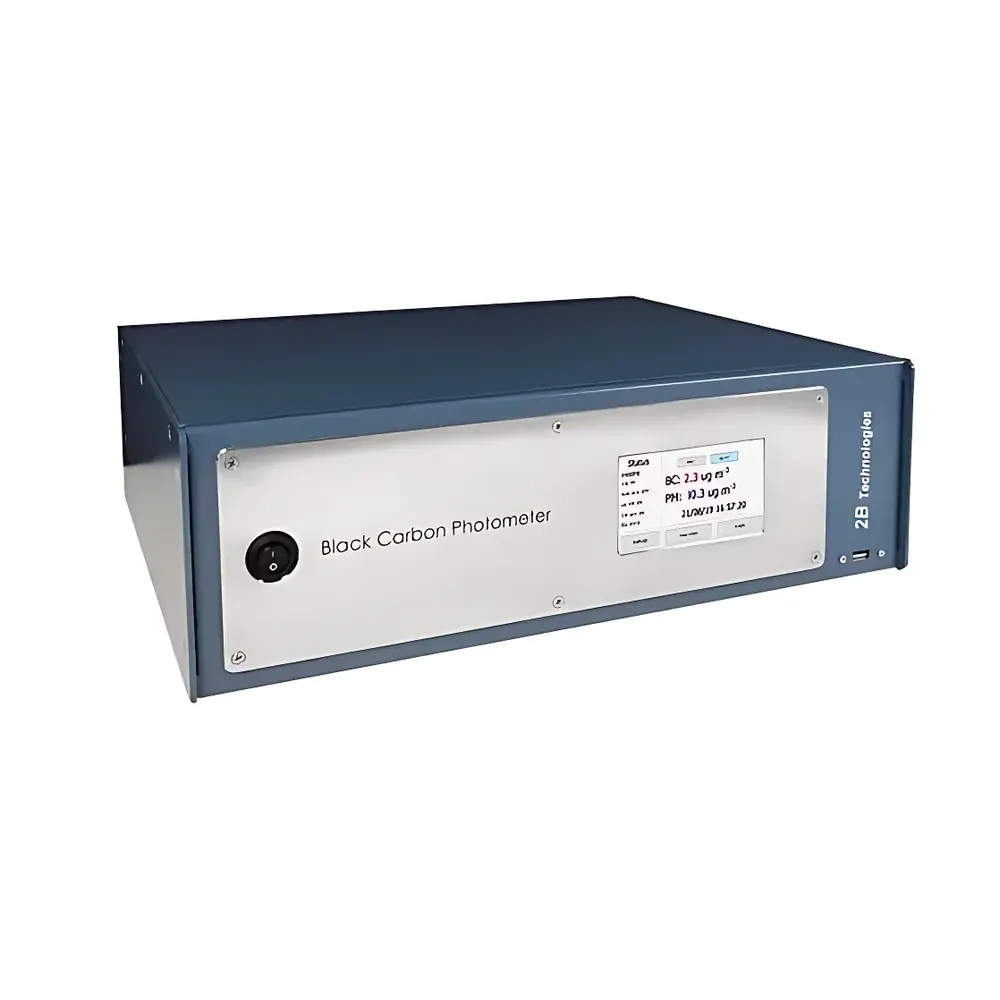
2B Technologies BCP™ Black Carbon Photometer
| Brand | 2B Technologies |
|---|---|
| Origin | USA |
| Model | BCP |
| Measurement Principle | Dual-wavelength (405 nm & 880 nm) direct extinction photometry |
| Dynamic Range | 0–10,000 Mm⁻¹ (880 nm: ~0–1300 µg·m⁻³) |
| Resolution | 0.1 Mm⁻¹ (0.1 µg·m⁻³) |
| Accuracy | ±2 Mm⁻¹ or ±2% of reading |
| Detection Limit (2σ, 1-hr avg) | 0.036 µg·m⁻³ at 880 nm |
| Flow Rate | 1.3 L·min⁻¹ (range: 1.0–1.6 L·min⁻¹) |
| Response Time (100% step, adaptive filter) | 20 s |
| Power Consumption | ~16 W (after warm-up) |
| Dimensions | 43 × 37 × 14 cm (17″ × 14.5″ × 5.5″ rack-mount) |
| Weight | 8.7 kg (19.2 lb) |
| Data Storage | 10 GB internal (≥3.2 years @ 10-s intervals) |
| Operating Temp | 5–45 °C |
| Operating Pressure | 600–1000 hPa |
| Compliance | NIST-traceable calibration certificate included, supports GLP/GMP data integrity via timestamped, audit-ready logs |
Overview
The 2B Technologies BCP™ Black Carbon Photometer is a field-deployable, dual-wavelength optical instrument engineered for direct, real-time quantification of atmospheric black carbon (BC) mass concentration and total aerosol extinction. Unlike filter-based absorption monitors (e.g., Aethalometers or MAAPs), the BCP employs a folded-tube long-path photometric design—validated in peer-reviewed literature (Birks et al., Atmos. Meas. Tech., 2018)—to achieve an effective optical path length of 2.1 meters within a compact 19-inch rack-mount chassis. It operates on the fundamental principle of Beer–Lambert extinction spectroscopy, measuring light attenuation at two strategically selected wavelengths: 405 nm (dominated by Mie scattering, empirically correlated with PM2.5) and 880 nm (where absorption by graphitic black carbon dominates over scattering in urban ambient air). The instrument continuously draws ambient air at 1.3 L·min⁻¹ through an integrated pump and alternately routes it either through a PTFE particle filter (reference channel, I0) or directly into the folded optical cell (sample channel, I). Extinction coefficient Bext (Mm⁻¹) is calculated as Bext = (1/L)·ln(I0/I), where L = 2.1 m. At 880 nm, BC mass concentration (µg·m⁻³) is derived using a wavelength-specific mass absorption cross-section (MAC) calibrated against NIST-traceable standards. This direct, filterless methodology eliminates artifacts associated with filter loading, shadowing, and volatile aerosol losses—common limitations in conventional thermal-optical or filter-based photometric systems.
Key Features
- Dual-wavelength real-time extinction measurement at 405 nm and 880 nm—enabling concurrent assessment of total aerosol load (405 nm) and BC-specific absorption (880 nm)
- Folded-tube optical cell architecture delivering 2.1 m effective path length in a lightweight (8.7 kg), rack-mountable form factor
- No pre-concentration required: avoids filter saturation, diffusion losses, and artifact-prone thermal desorption steps
- Low power consumption (~16 W average post-warm-up) and battery-compatible operation for unattended field deployment
- Integrated high-reliability diaphragm pump rated for >15,000 hours of continuous operation
- Onboard 10 GB flash memory supporting >3.2 years of 10-second resolution data logging with full timestamping and metadata tagging
- Touchscreen GUI with intuitive menu navigation; also supports remote configuration and data retrieval via RS-232 serial interface
- User-configurable averaging intervals: 10 s, 1 min, 5 min, or 1 hr—optimized for both rapid transient detection and long-term trend analysis
- Automatic zero-check function with reference filter switching, requiring minimal user intervention and enabling robust multi-day autonomous operation
- NIST-traceable calibration certificate supplied with each unit; calibration parameters (gain, zero, MAC) fully accessible and modifiable via firmware interface
Sample Compatibility & Compliance
The BCP is optimized for ambient outdoor air sampling in urban, suburban, and peri-urban environments. Its flow-controlled inlet accepts unheated, non-conditioned air—making it suitable for fixed-site monitoring networks, mobile platforms (e.g., vehicle-mounted or UAV-integrated deployments), and short-term campaign measurements. The instrument complies with standard ambient air quality measurement protocols requiring traceable photometric quantification of light-absorbing carbonaceous aerosols. While not intrinsically explosion-proof, its non-sparking electronics and low-voltage DC operation (11–14 V) permit safe use in typical environmental monitoring enclosures and laboratories. Data output adheres to FAIR principles: all logged records include UTC timestamps, temperature/pressure-corrected values, and operational status flags. Internal logging meets GLP-aligned requirements for audit trails, including immutable session start/stop markers and calibration event logging—facilitating regulatory reporting under EPA, EU Air Quality Directive, or WHO exposure assessment frameworks.
Software & Data Management
Data acquisition and system control are managed entirely onboard via embedded firmware. Raw extinction signals (405 nm and 880 nm), calculated BC mass concentrations, flow rate, temperature, pressure, and diagnostic flags are stored in comma-separated value (CSV) format with header metadata. USB host capability allows direct export to portable drives without external computers. For integration into centralized telemetry systems, the RS-232 port provides ASCII-formatted streaming output at 2400 baud, configurable for user-defined scaling factors and output ranges (0–2.5 V analog outputs also available for SCADA compatibility). Firmware updates and parameter reconfiguration are performed via serial command set or touchscreen interface. No proprietary software is required for basic operation; however, 2B Technologies provides optional Python and MATLAB toolkits for batch processing, spectral deconvolution, and time-series visualization—fully compatible with open-source atmospheric data workflows (e.g., PyAERPA, ACT).
Applications
The BCP serves critical roles across atmospheric science, public health, and regulatory monitoring domains. Researchers utilize it to quantify BC’s radiative forcing contribution in climate models, assess combustion source signatures (e.g., diesel vs. biomass burning) via spectral absorption Ångström exponents, and validate satellite-derived aerosol optical depth retrievals. Air quality management agencies deploy BCP units in community-level exposure studies—mapping spatial gradients of BC near traffic corridors, ports, or industrial zones—to inform targeted mitigation strategies and health impact assessments. Its portability and low maintenance make it ideal for mobile monitoring campaigns (e.g., street-level BC mapping using bicycle or van platforms), wildfire smoke characterization, and indoor–outdoor exposure comparisons. In occupational settings, it supports near-field emissions testing from cookstoves, generators, and off-road equipment—providing high-temporal-resolution BC data essential for exposure–response modeling.
FAQ
How does the BCP differ from filter-based black carbon monitors?
The BCP measures extinction directly in the sampled air stream without particle collection on filters—eliminating artifacts from filter loading, multiple scattering, and semi-volatile aerosol evaporation that affect filter-based instruments.
Is temperature and pressure correction applied automatically?
Yes—internal sensors measure ambient T and P in real time, and extinction values are automatically corrected to standard temperature (25 °C) and pressure (1013.25 hPa) using ideal gas law scaling.
Can the BCP be used for indoor air quality monitoring?
Yes—its low flow rate, quiet operation, and battery compatibility support extended indoor deployments; however, users should ensure representative sampling location and avoid localized drafts or HVAC exhaust vents.
What calibration standards are used?
Each unit ships with a NIST-traceable calibration certificate based on polystyrene latex (PSL) sphere extinction validation and BC-equivalent absorption calibration using certified lamp sources and reference filters.
Does the BCP require routine optical alignment or lamp replacement?
No—the solid-state LEDs and photodiodes are factory-aligned and rated for >50,000 hours; no user-serviceable optical components exist, ensuring long-term measurement stability with zero alignment drift.
Related Products







