
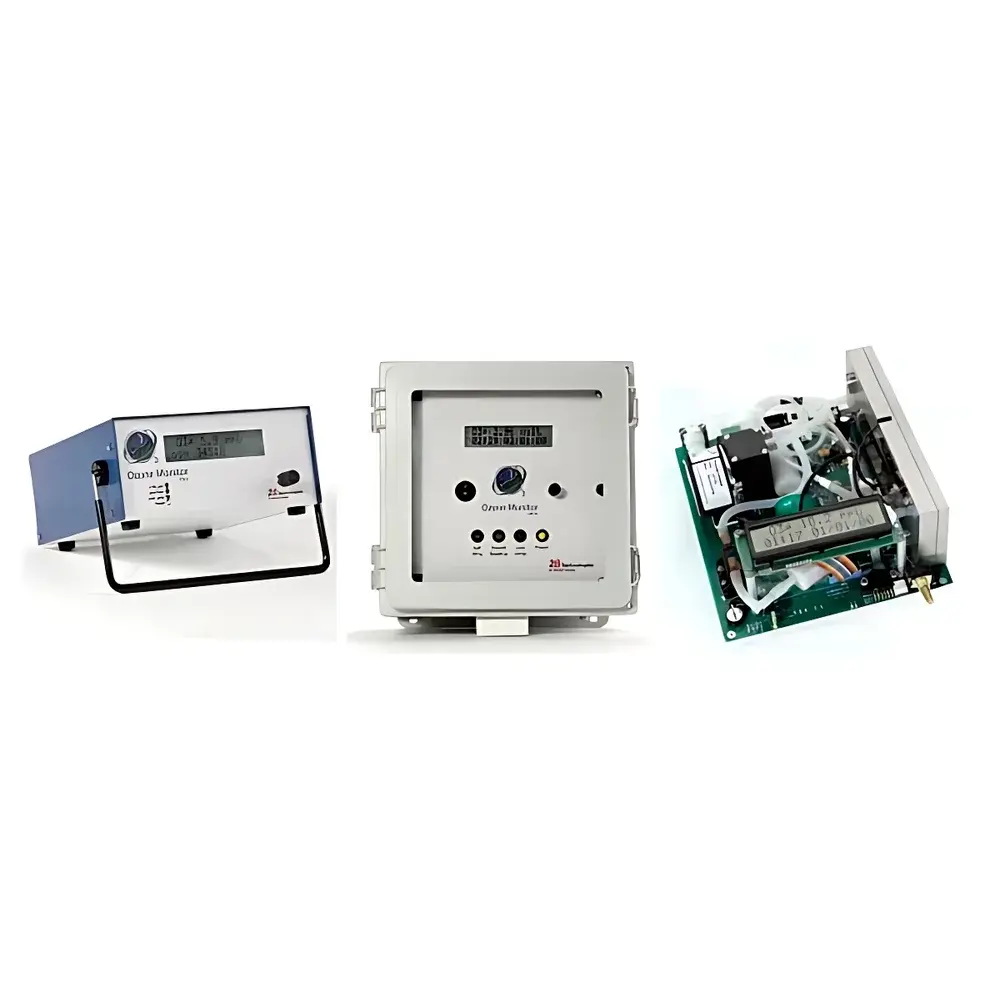
2B Technologies Model 106-M Portable Ozone Analyzer
| Brand | 2B Technologies |
|---|---|
| Origin | USA |
| Model | Model 106-M |
| Instrument Type | Portable |
| Measurement Range | 0–1000 ppm |
| Limit of Detection | 0.01 ppm |
| Response Time | 10 s |
| Zero Drift | ±1 ppbv (24 h) |
| Resolution | 1.5 ppbv |
| Power Consumption | 3.6 W |
| Dimensions | 9.5 × 21.0 × 21.6 cm |
| Weight | 2.1 kg |
| Measurement Principle | UV Absorption at 254 nm |
| Data Storage Capacity | 12,288 points |
| Output Interfaces | USB, RS-232, 0–2.5 V analog, 4–20 mA analog |
| Sampling Flow Rate | ~1 L/min |
| Compliance | NIST-traceable calibration, compatible with EPA ambient air monitoring protocols |
Overview
The 2B Technologies Model 106-M Portable Ozone Analyzer is a field-deployable, NIST-traceable instrument engineered for high-fidelity measurement of gaseous ozone (O₃) across a broad dynamic range—from ambient background levels to industrial process concentrations. It employs dual-beam ultraviolet absorption photometry at the well-characterized 254 nm mercury line, leveraging Beer-Lambert law principles to quantify ozone concentration with high specificity and minimal cross-sensitivity to other atmospheric constituents. Unlike electrochemical or metal oxide semiconductor sensors, this optical method delivers inherent stability, long-term reproducibility, and immunity to humidity-induced drift when paired with integrated DewLine™ Nafion® dryer tubing. The analyzer operates continuously with low power draw (3.6 W), enabling extended unattended operation in off-grid or battery-powered deployments—making it suitable for both regulatory-grade ambient monitoring and controlled-environment validation.
Key Features
- UV absorption-based detection at 254 nm ensures selectivity for ozone without chemical reagents or consumables
- Portable form factor (2.1 kg, 9.5 × 21.0 × 21.6 cm) with ruggedized enclosure rated for field use
- Real-time response time of ≤10 seconds (T90) with configurable averaging intervals (10 s, 1 min, 5 min, 1 hr)
- Onboard data logging capacity of 12,288 records—supporting up to 1.4 years of hourly averaged data
- Dual-output capability: digital (USB, RS-232) and analog (0–2.5 V, 4–20 mA) with user-selectable full-scale ranges (0–1 ppm, 0–10 ppm, 0–100 ppm, or custom)
- Integrated DewLine™ Nafion® membrane dryer minimizes water vapor interference without desiccant replacement
- Configurable relay outputs for high/low alarm thresholds (0.000–100.000 ppm), supporting automated control or safety interlocks
- Compliant with ASTM D5012 and ISO 13964 for ozone measurement methodology; supports GLP/GMP audit trails via timestamped data export
Sample Compatibility & Compliance
The Model 106-M is validated for direct sampling of ambient air, indoor environments, cleanroom exhaust streams, and industrial process gases—provided sample temperature remains within 0–40 °C and particulate loading is below 10 µg/m³. It meets performance criteria referenced in U.S. EPA Method IO-3 and EU Directive 2008/50/EC Annex IX for indicative ozone monitoring. While not certified as a reference method under 40 CFR Part 53, its accuracy (±0.01 ppm or ±2% of reading, whichever is greater) and precision (<1.5 ppbv RMS noise) align with supplemental monitoring requirements for networked urban air quality stations. For pharmaceutical cleanroom validation per ISO 14644-3 and USP , the instrument’s traceable calibration and low zero drift (±1 ppbv over 24 h) support documented ozone sterilization cycle verification.
Software & Data Management
Data acquisition and configuration are managed via 2B Technologies’ proprietary Ozonetool software (Windows-compatible), which enables real-time graphing, remote parameter adjustment, firmware updates, and CSV export with embedded metadata (timestamp, battery voltage, flow status, alarm flags). All logged records include UTC timestamps synchronized via internal RTC, satisfying FDA 21 CFR Part 11 requirements for electronic records when used with appropriate system controls (e.g., password-protected access, audit log review). Raw absorbance values and temperature-compensated ozone concentrations are stored separately, permitting retrospective recalibration or correction using updated extinction coefficients. Exported datasets comply with FAIR principles (Findable, Accessible, Interoperable, Reusable) and integrate natively with common environmental data platforms (e.g., EPA AirNow, OpenAQ).
Applications
- Long-term ambient ozone monitoring in remote or energy-constrained locations (e.g., mountaintop observatories, Arctic research stations)
- Urban air quality networks requiring low-maintenance, high-reliability nodes for EPA PM₂.₅/O₃ co-location studies
- Validation and routine monitoring of ozone-generating equipment—including ozone chambers, sterilization cabinets, and corona discharge generators
- Cleanroom ozone decontamination cycle qualification in pharmaceutical, biotech, and semiconductor manufacturing facilities
- Personal exposure assessment in occupational health studies, where portability and battery operation enable mobile microenvironment mapping
- Educational and research applications in atmospheric chemistry, photochemical modeling, and sensor intercomparison campaigns
FAQ
What is the recommended calibration frequency for the Model 106-M?
Calibration is advised every 3–6 months using a NIST-traceable ozone generator or certified gas standard; more frequent checks are recommended for regulatory reporting or critical cleanroom applications.
Can the Model 106-M operate on battery power?
Yes—it accepts 12 V DC input and is compatible with external portable power supplies (e.g., lithium-iron-phosphate packs) enabling >8 hours of continuous operation.
Does the instrument require routine consumables?
No. The UV lamp has a typical lifetime exceeding 2 years (>17,500 hours); the Nafion® dryer requires no replacement under normal operating conditions.
How is humidity managed during measurement?
The integrated DewLine™ system uses passive Nafion® membrane diffusion to remove water vapor prior to the optical cell, eliminating condensation artifacts without active cooling or desiccants.
Is the Model 106-M compliant with FDA 21 CFR Part 11 for electronic records?
When deployed with validated Ozonetool configuration, user access controls, and audit trail review procedures, it meets technical requirements for Part 11 compliance in GxP environments.
Related Products







