
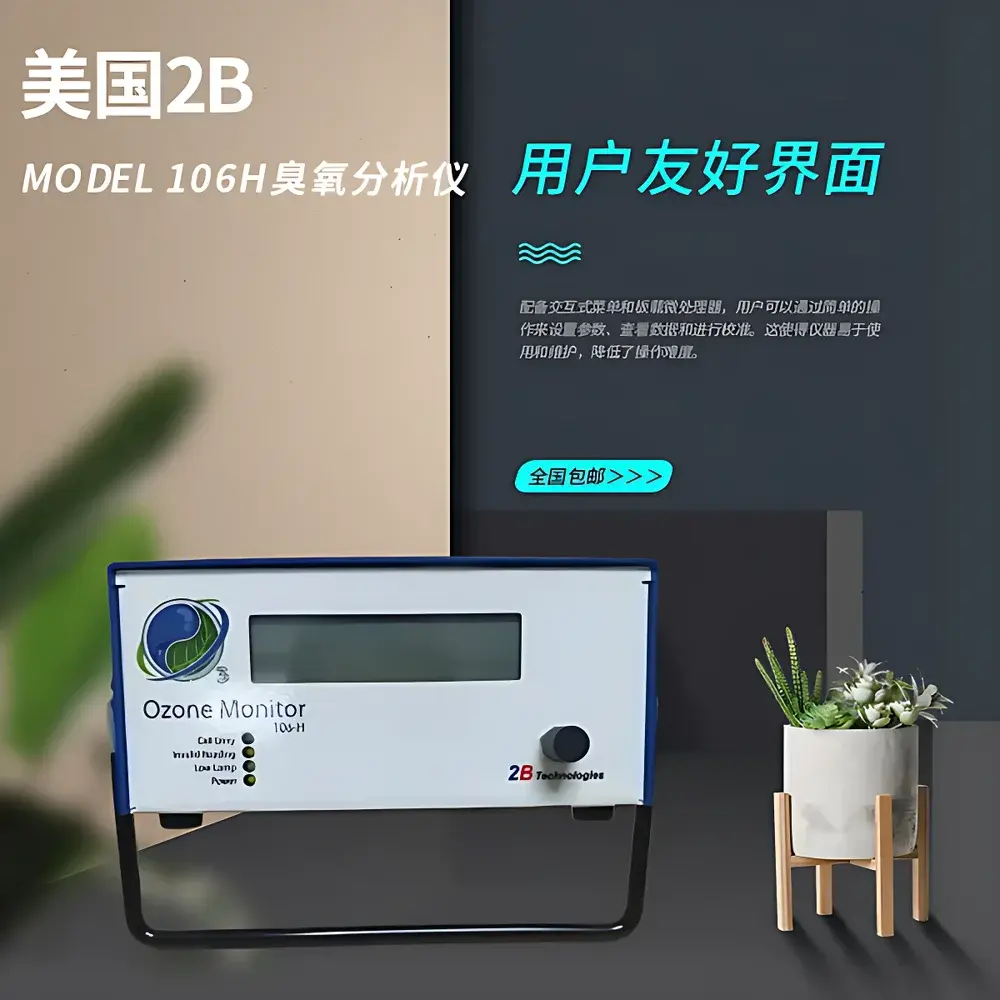
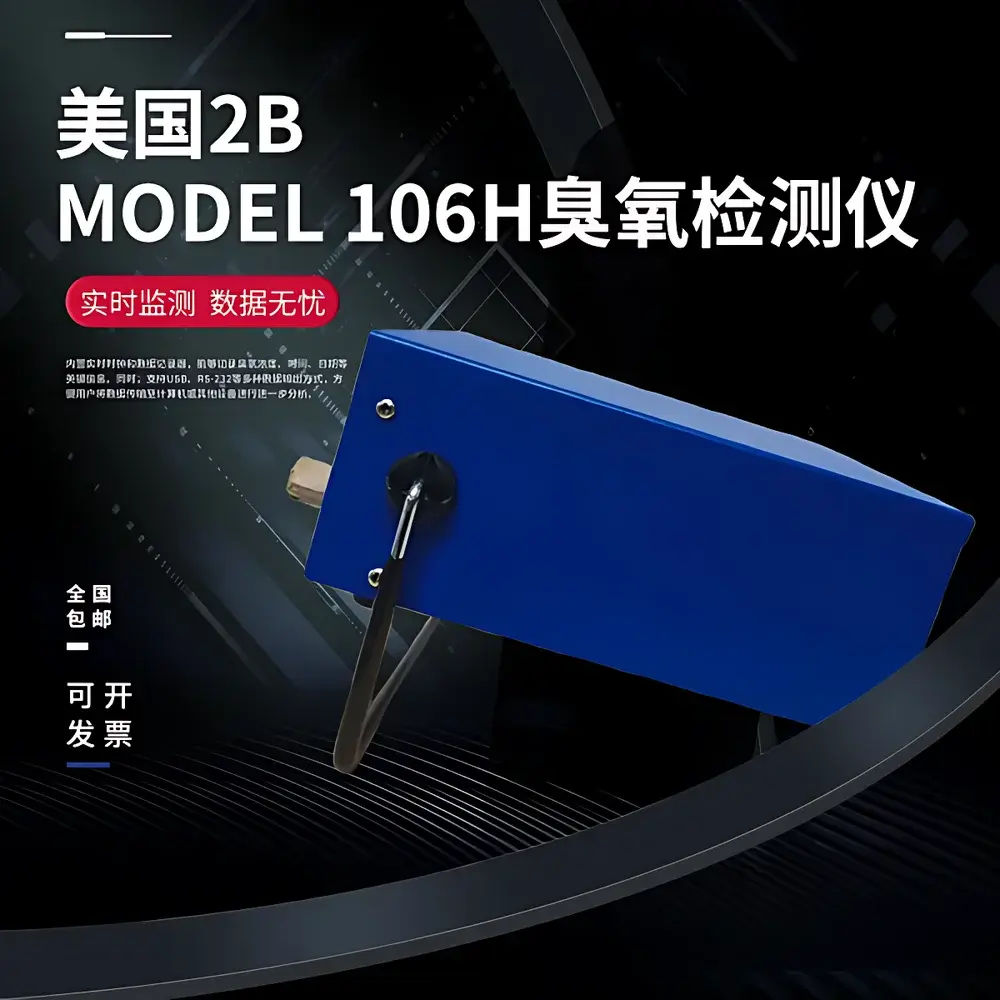
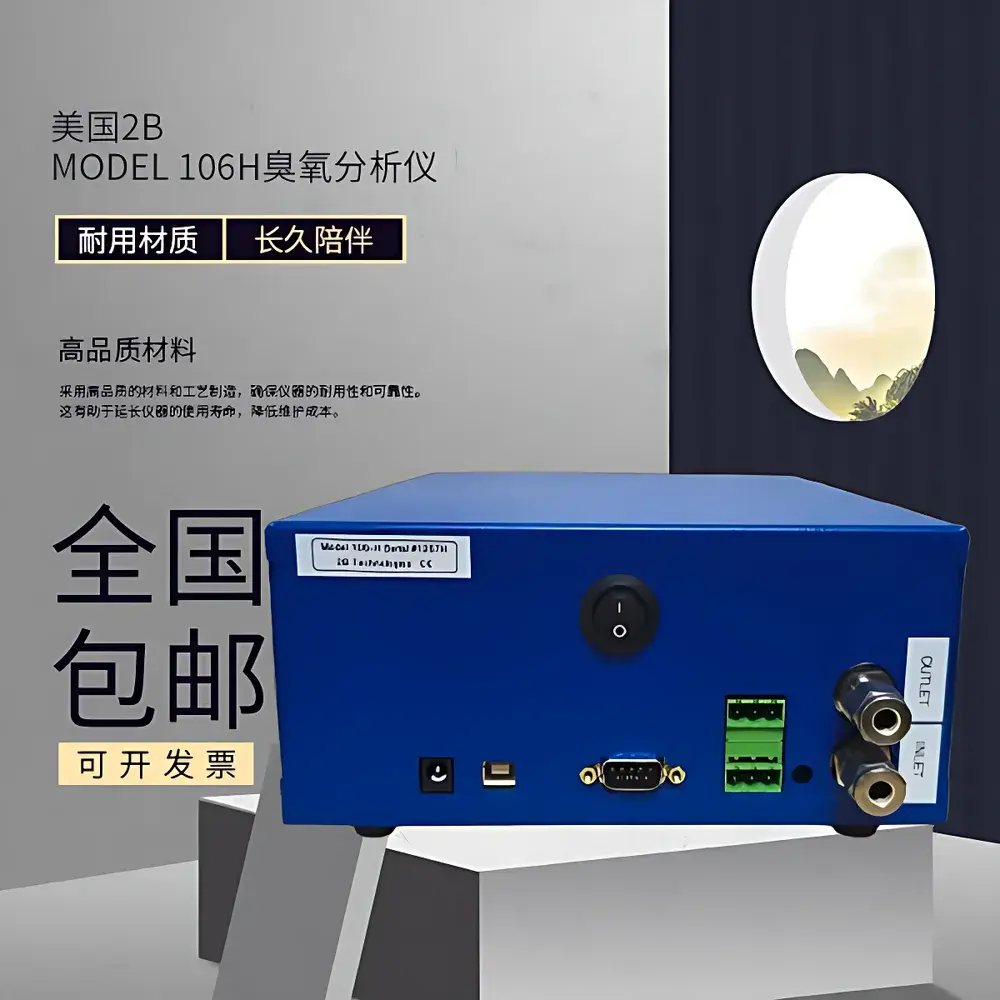
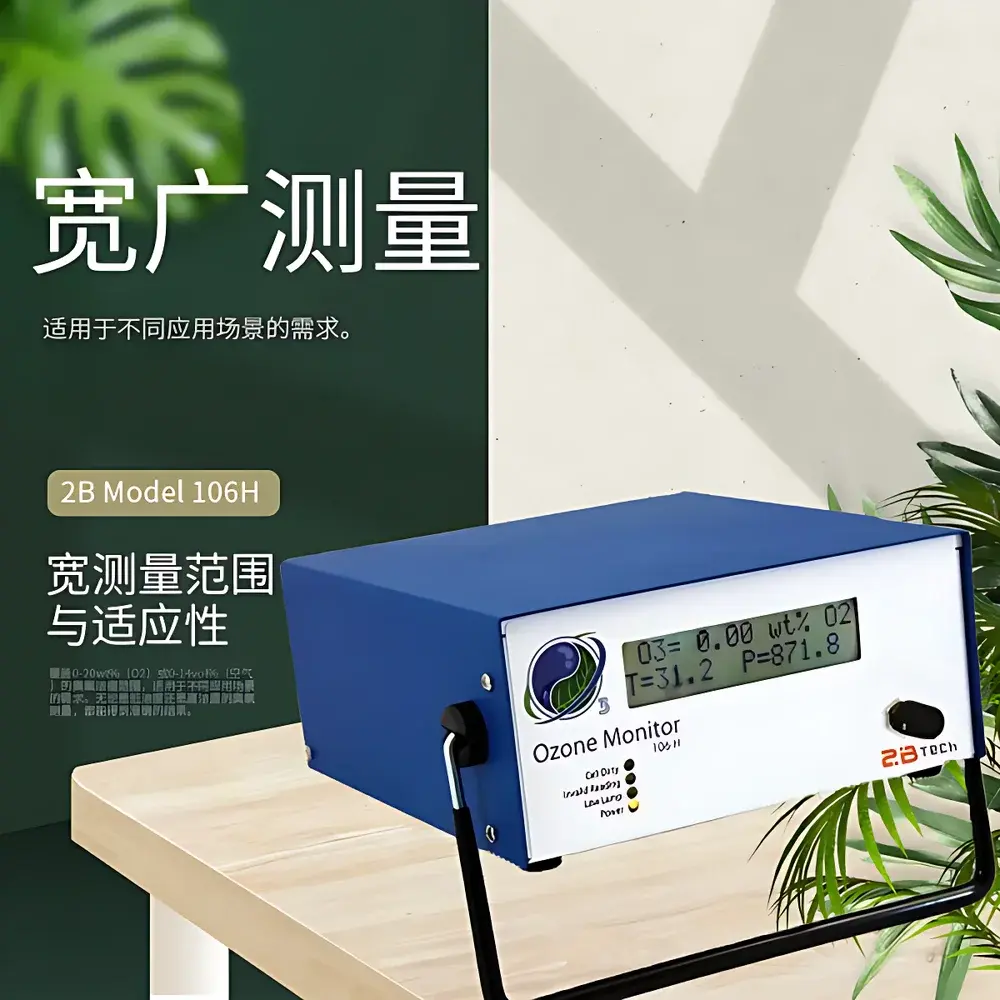
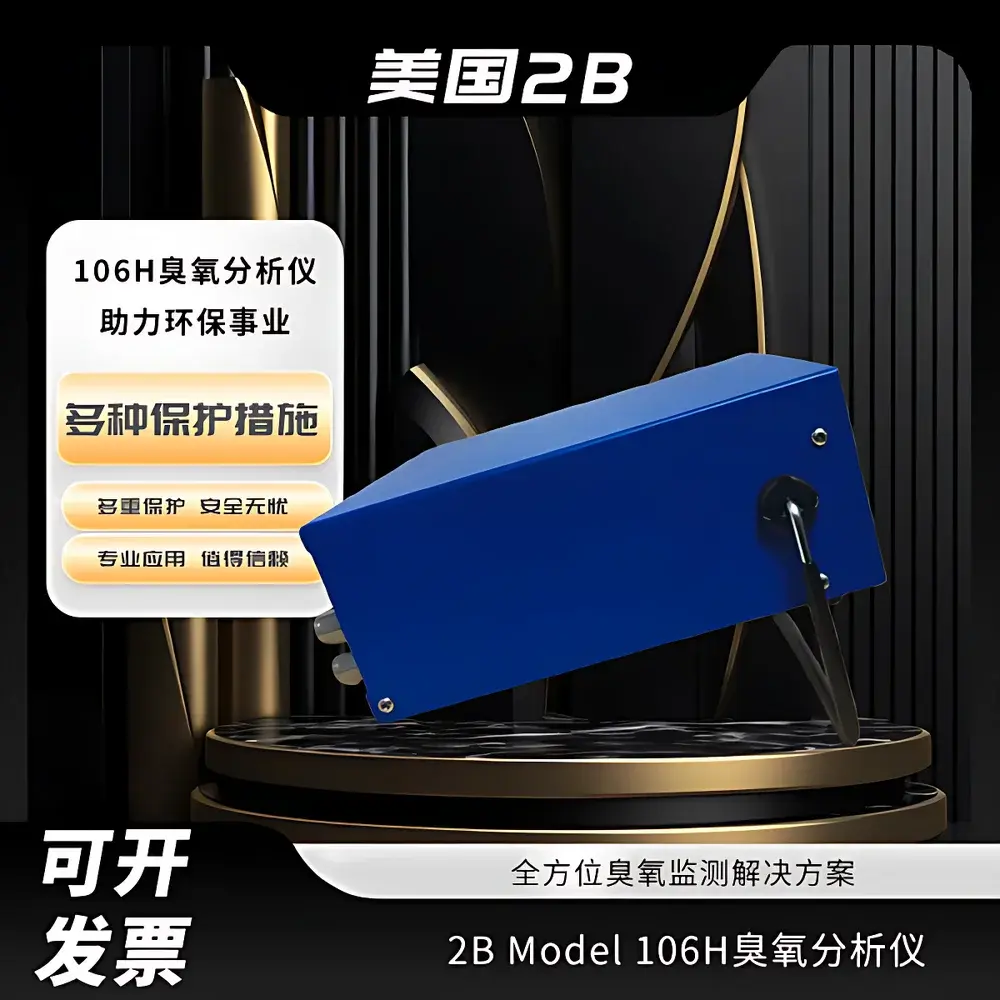
2B Technologies Model 106H Portable Ozone Analyzer
| Brand | 2B Technologies |
|---|---|
| Origin | USA |
| Model | Model 106H |
| Instrument Type | Portable |
| Measurement Range | 1.5 ppbv to 100 ppmv |
| LOD | 1 ppbv |
| Response Time | 10 s |
| Zero Drift | ±1 ppbv (24 h) |
| Resolution | 0.01 wt% (for 106H configuration) |
| Detection Principle | UV Absorption at 254 nm |
| Flow Rate | ~1 L/min |
| Data Storage | 12,288 points |
| Output Interfaces | USB, RS-232, 0–2.5 V analog, 4–20 mA |
| Power | 12 V DC or 120/240 V AC, 4.2 W |
| Dimensions | 9.5 × 21.0 × 21.6 cm |
| Weight | 2.1 kg |
Overview
The 2B Technologies Model 106H Portable Ozone Analyzer is a field-deployable, dual-range ultraviolet (UV) absorption-based instrument engineered for high-accuracy, real-time measurement of ozone (O₃) across an extended dynamic range—from trace atmospheric concentrations (1.5 ppbv) up to industrial-level concentrations (100 ppmv, or equivalently 20 wt% in high-concentration mode). It operates on the Beer–Lambert principle, utilizing a stable low-pressure mercury lamp emitting at 254 nm—the primary ozone absorption peak—coupled with a precision optical path and temperature-stabilized photodetector. Unlike conventional UV ozone analyzers, the Model 106H integrates Dew-Line™ moisture management technology, employing Nafion®-based permeation drying to actively suppress water vapor interference, reducing humidity-induced bias from >100 ppbv to <5 ppbv across ambient RH conditions (0–95% RH). This enables reliable operation in uncontrolled field environments—including mobile platforms, ozone generator exhaust streams, and ambient air monitoring networks—without requiring external dryers or frequent calibration drift correction.
Key Features
- True dual-range capability: Configurable for low-concentration environmental monitoring (ppbv–ppmv) or high-concentration industrial process control (up to 20 wt%) via interchangeable optical path modules.
- Dew-Line™ integrated humidity compensation: Patented Nafion® membrane-based drying system eliminates need for external desiccants or chilled mirrors while maintaining measurement integrity under variable ambient humidity and pressure.
- High-pressure sampling compatibility: Flow channel rated to 50 psi, enabling direct inline integration with ozone generators, water treatment systems, and sterilization equipment.
- OEM-ready architecture: “Board-level” design with all critical components mounted directly on a single PCB; available in bare-board (OEM-106H) and enclosed (Model 106H) configurations for custom integration.
- Field-optimized power and portability: Operates on 12 V DC (e.g., vehicle battery or solar-charged system) or universal AC input; compact footprint (9.5 × 21.0 × 21.6 cm) and lightweight (2.1 kg) support handheld, tripod-mounted, or vehicle-integrated deployment.
- Multi-interval data logging: Internal memory stores up to 12,288 averaged readings with user-selectable averaging periods (10 s, 1 min, 5 min, or 1 hr), supporting long-term unattended operation (up to 1.4 years at hourly intervals).
Sample Compatibility & Compliance
The Model 106H accepts ambient air, compressed gas streams, and humidified ozone effluents without condensation risk, provided inlet temperature remains above dew point. Its Nafion®-based moisture management ensures compliance with EPA Reference Method EQOA-01 for ambient ozone monitoring and aligns with ISO 13964:2021 (stationary source emissions — determination of ozone concentration) when used with appropriate flow conditioning. The instrument supports GLP/GMP-aligned data integrity through timestamped internal logging, configurable alarm relays (high/low setpoints), and non-volatile memory retention during power loss. While not FDA 21 CFR Part 11 certified out-of-box, its audit-trail-capable firmware and exportable CSV/ASCII logs facilitate validation in regulated pharmaceutical or water disinfection applications.
Software & Data Management
Data acquisition and configuration are managed via 2B Technologies’ free Windows-compatible software (2B Tech Ozone Logger), which enables real-time graphing, remote parameter adjustment, firmware updates, and batch export to CSV or Excel. All logged data include UTC timestamps, temperature, pressure, relative humidity (derived from internal sensors), and raw photometer voltage—enabling post-hoc environmental correction. Analog outputs (0–2.5 V, 4–20 mA) support integration into SCADA, DCS, or PLC systems with user-defined scaling (e.g., 0–100 ppmv = 4–20 mA). USB and RS-232 interfaces allow bidirectional communication for automated calibration routines and remote diagnostics.
Applications
- Ambient air quality monitoring networks (EPA Core Site, CASTNET, EMEP)
- Mobile atmospheric chemistry research (ground vehicles, UAVs, balloon payloads)
- Ozone generator performance verification and feedback control in water/wastewater treatment plants
- Industrial hygiene assessment in semiconductor cleanrooms and medical sterilization facilities
- Calibration transfer standard for secondary ozone monitors and photometric reference instruments
- Long-term trend analysis in climate research stations where low-power, autonomous operation is required
FAQ
What is the difference between Model 106-L, 106-M, and 106-H?
The suffix denotes optimized optical path length and detector gain for distinct concentration ranges: 106-L targets ultra-low ambient ozone (0–100 ppmv, 0.1 ppb resolution); 106-M covers mid-range industrial applications (0–1000 ppmv); and 106-H is configured for high-concentration ozone generation and process control (0–20 wt%, 0.01 wt% resolution), with reinforced flow path rated to 50 psi.
Does the Model 106H require periodic calibration with ozone standards?
Yes. While zero stability is maintained via internal shutter and dark-current compensation, span calibration using NIST-traceable ozone generators or certified gas standards is recommended every 3–6 months depending on usage intensity and regulatory requirements.
Can the instrument operate continuously in high-humidity environments?
Yes. The integrated Dew-Line™ system actively manages water vapor interference, allowing stable operation at up to 95% RH without external drying—critical for tropical deployments or indoor disinfection monitoring.
Is the Model 106H suitable for regulatory reporting?
It meets EPA EQOA-01 equivalency criteria for ambient ozone when deployed per manufacturer-specified inlet configuration, flow rate, and maintenance schedule; however, site-specific QA/QC protocols and third-party verification may be required for official compliance reporting.
What data formats are supported for export?
All logged data export as plain-text CSV files with tab-delimited columns including timestamp, O₃ concentration, temperature, pressure, humidity, and status flags—ensuring full compatibility with Python, MATLAB, R, and laboratory information management systems (LIMS).
Related Products







