
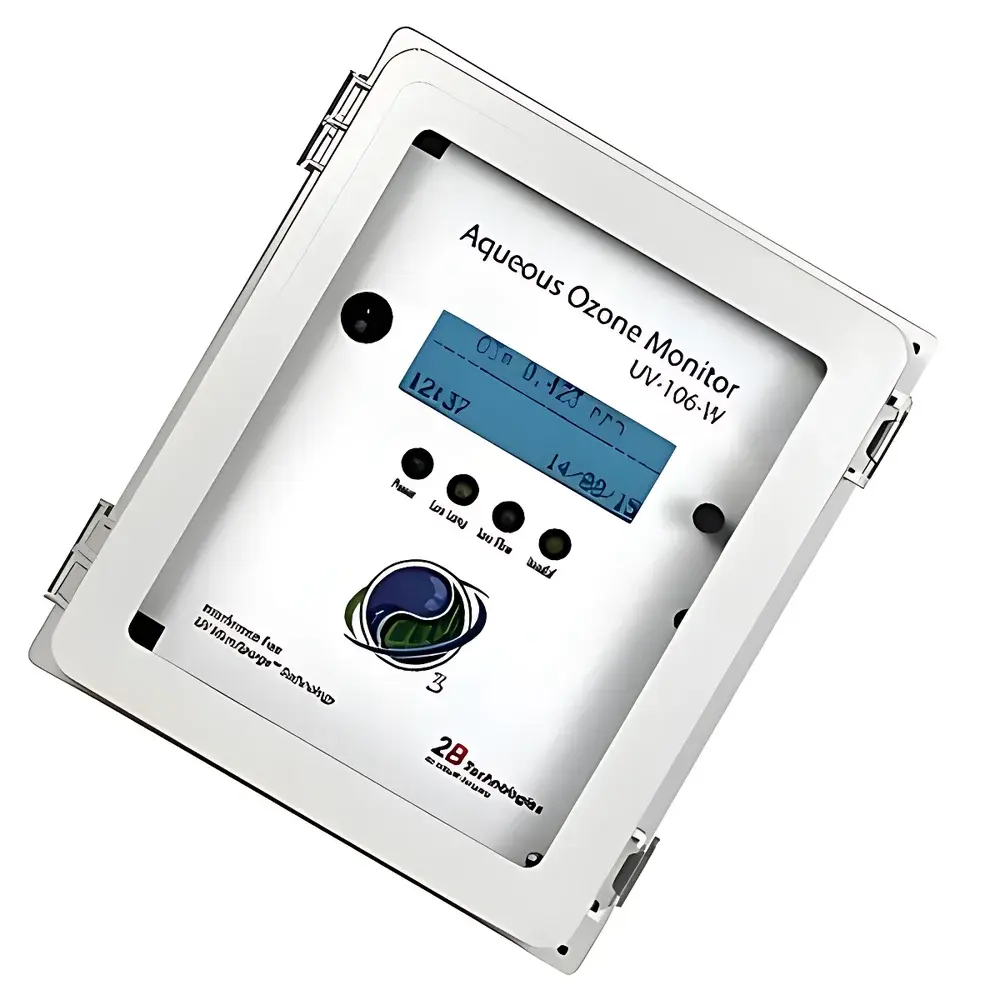
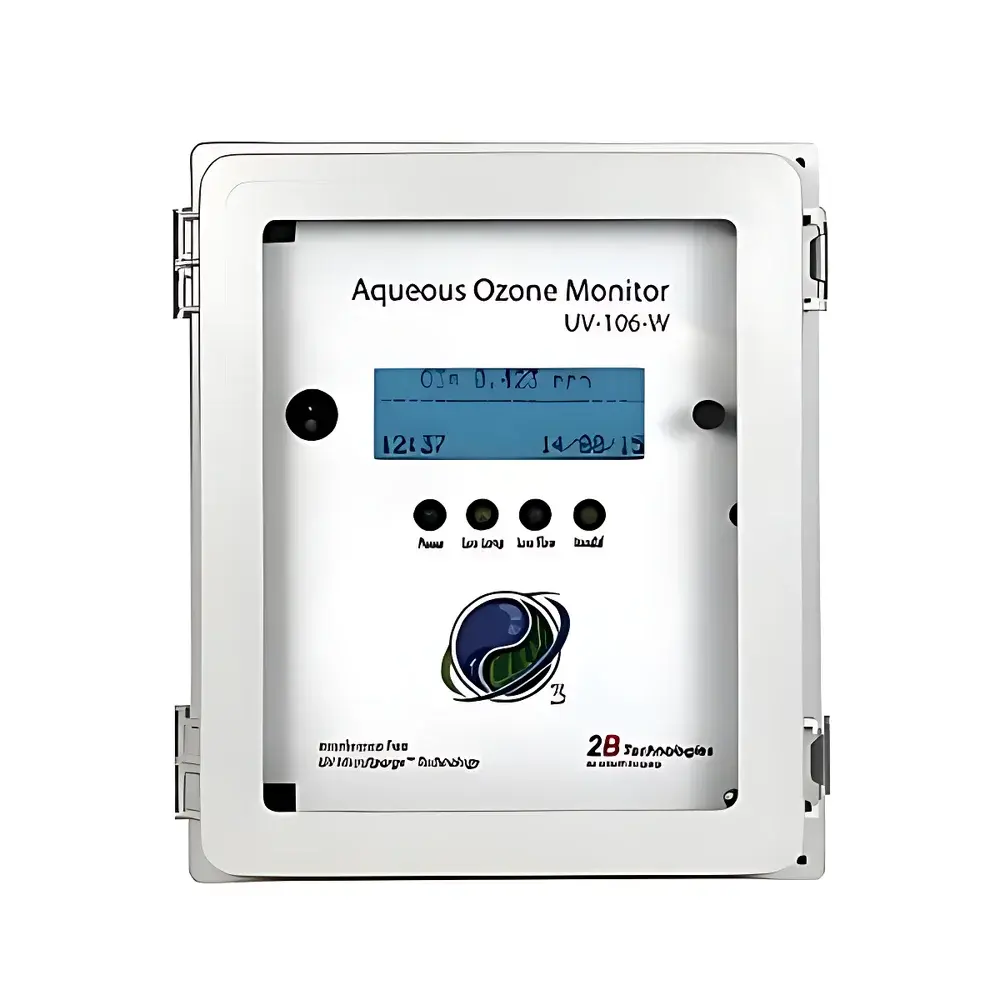
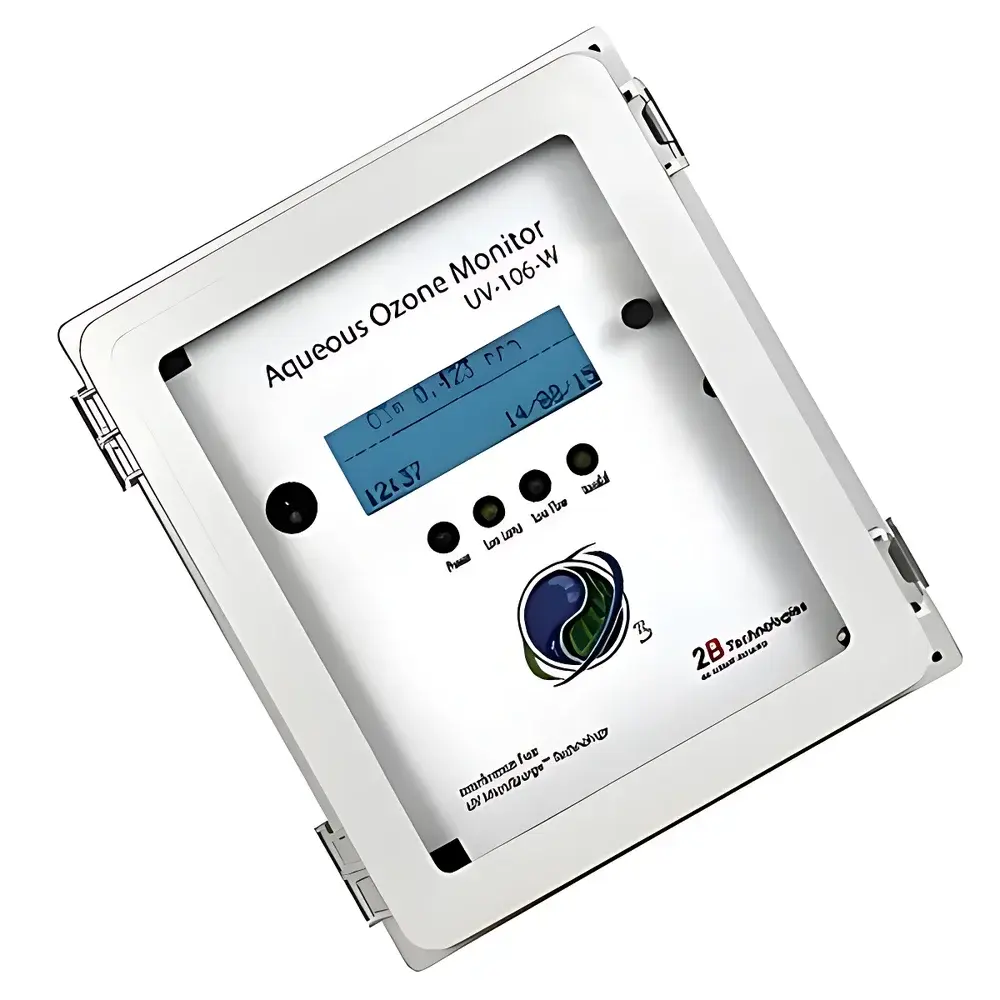
2B Technologies Model 106W Dissolved Ozone Analyzer
| Brand | 2B Technologies |
|---|---|
| Origin | USA |
| Model | Model 106W |
| Instrument Type | Portable |
| Measurement Range | 0–100 ppm |
| Detection Limit | 0.05 ppm (or ±1% of reading) |
| Response Time | <10 seconds (t₉₀) |
| Zero Drift | <0.02 ppm/24 h |
| Resolution | 0.01 ppm |
| Flow Rate | ~12 mL/min |
| Data Storage | 16,368 records |
| Sampling Interval Options | 10 s, 1 min, 5 min, 1 h |
| Output Interfaces | RS-232 serial, 0–2.5 V analog, LCD display, LED alarm |
| Power Supply | 12 V DC or 100–240 V AC, 5.0 W (3.9 W in low-power mode) |
| Dimensions | 33.8 × 30.5 × 18.5 cm |
| Weight | 6.6 kg |
Overview
The 2B Technologies Model 106W Dissolved Ozone Analyzer is a field-deployable, UV-absorption-based instrument engineered for precise, interference-free quantification of dissolved ozone (O₃) in aqueous matrices. Unlike conventional membrane-based electrochemical or amperometric sensors—whose performance degrades with fouling, biofilm formation, or particulate loading—the Model 106W employs 2B’s proprietary MicroSparge™ sample introduction technology. This method physically transfers a discrete 2 mL water sample into a gas-phase reaction chamber, where controlled sparging induces rapid thermal decomposition of dissolved ozone into gaseous ozone. The liberated O₃ vapor is then swept through a temperature-stabilized, dual-beam UV photometer operating at 254 nm, enabling highly reproducible absorbance measurement per the Beer–Lambert law. The absence of consumable membranes, electrodes, or catalytic surfaces eliminates calibration drift associated with surface passivation and ensures long-term stability across heterogeneous water types—including potable water, wastewater effluent, cooling tower recirculation streams, and ozonated process water containing suspended solids, humic substances, or transition metal ions.
Key Features
- MicroSparge™ direct-sampling technology eliminates membrane fouling and sensor poisoning—no consumables, no routine membrane replacement.
- High-fidelity UV photometry with thermally stabilized optical path and dual-beam referencing for robust baseline correction.
- Factory-calibrated with NIST-traceable ozone standards; optional on-site verification using certified gas-phase O₃ generators.
- Integrated data logger storing up to 16,368 timestamped measurements with user-selectable averaging intervals (10 s, 1 min, 5 min, or 1 h).
- NEMA-4X rated enclosure (IP66 equivalent) for reliable operation in humid, outdoor, or industrial environments.
- Low-power design (3.9 W in sleep mode) supports extended battery-backed or solar-powered deployments.
- Real-time visual feedback via backlit LCD and programmable LED alarm thresholds for exceedance notification.
Sample Compatibility & Compliance
The Model 106W demonstrates exceptional tolerance to matrix complexity. It maintains accuracy in waters with turbidity up to 100 NTU, total suspended solids (TSS) ≤ 200 mg/L, and dissolved organic carbon (DOC) concentrations exceeding 10 mg/L. No pretreatment—such as filtration, centrifugation, or chemical quenching—is required. This operational resilience aligns with ASTM D6759–22 (Standard Test Method for Determination of Dissolved Ozone in Water by UV Absorption) and supports compliance with EPA guidance for disinfection validation in drinking water treatment (e.g., EPA Guidance Manual for Disinfectants and Disinfection Byproducts). The instrument’s traceable calibration protocol and audit-ready data logging meet foundational requirements for GLP-compliant environmental monitoring and GMP-aligned water system qualification.
Software & Data Management
Data export is supported via RS-232 serial interface (ASCII protocol) or analog 0–2.5 V output compatible with SCADA, PLC, or data acquisition systems. 2B’s free Windows-based O3Log software enables configuration, real-time monitoring, firmware updates, and batch download of logged datasets in CSV format. Each record includes UTC timestamp, measured O₃ concentration (ppm), internal temperature, pressure-compensated flow rate, and diagnostic flags. All stored data are write-protected and include immutable timestamps—supporting basic audit trail functionality consistent with FDA 21 CFR Part 11 principles when deployed within validated workflows.
Applications
- Validation and continuous monitoring of ozone contact chambers in municipal drinking water plants.
- Process control in bottled water and beverage production lines requiring residual O₃ verification pre-bottling.
- Swimming pool and spa water quality assurance—measuring post-injection dissolved ozone prior to UV or carbon quenching.
- Cooling water system management to verify biocide efficacy and prevent microbial regrowth in HVAC infrastructure.
- Research applications involving advanced oxidation processes (AOPs), including O₃/H₂O₂ and O₃/UV studies.
- Field assessment of ozonation efficiency in decentralized wastewater reuse systems.
FAQ
Does the Model 106W require daily calibration or zeroing?
No—zero drift is specified at <0.02 ppm/24 h, and factory calibration remains stable for ≥3 months under typical use. A full span check with certified ozone gas is recommended quarterly.
Can it measure ozone in seawater or high-salinity brines?
Yes; salinity up to 35 g/kg NaCl has no measurable effect on accuracy due to the gas-phase detection principle.
Is the instrument suitable for unattended, long-term deployment?
Yes—its low power draw, non-volatile memory, and NEMA-4X housing enable continuous operation for >30 days on a standard 12 V, 20 Ah battery pack.
How does it handle chlorine interference?
Free chlorine (HOCl/OCl⁻) does not absorb significantly at 254 nm and poses no spectral interference; however, chloramines may generate minor positive bias at concentrations >5 ppm—pre-treatment with selective scavengers is advised in mixed-disinfectant systems.
What maintenance is required beyond routine cleaning?
Only periodic inspection of the MicroSparge™ injector tip and purge gas line; no optical cleaning or lamp replacement is needed during the first 5 years of operation.
Related Products







