
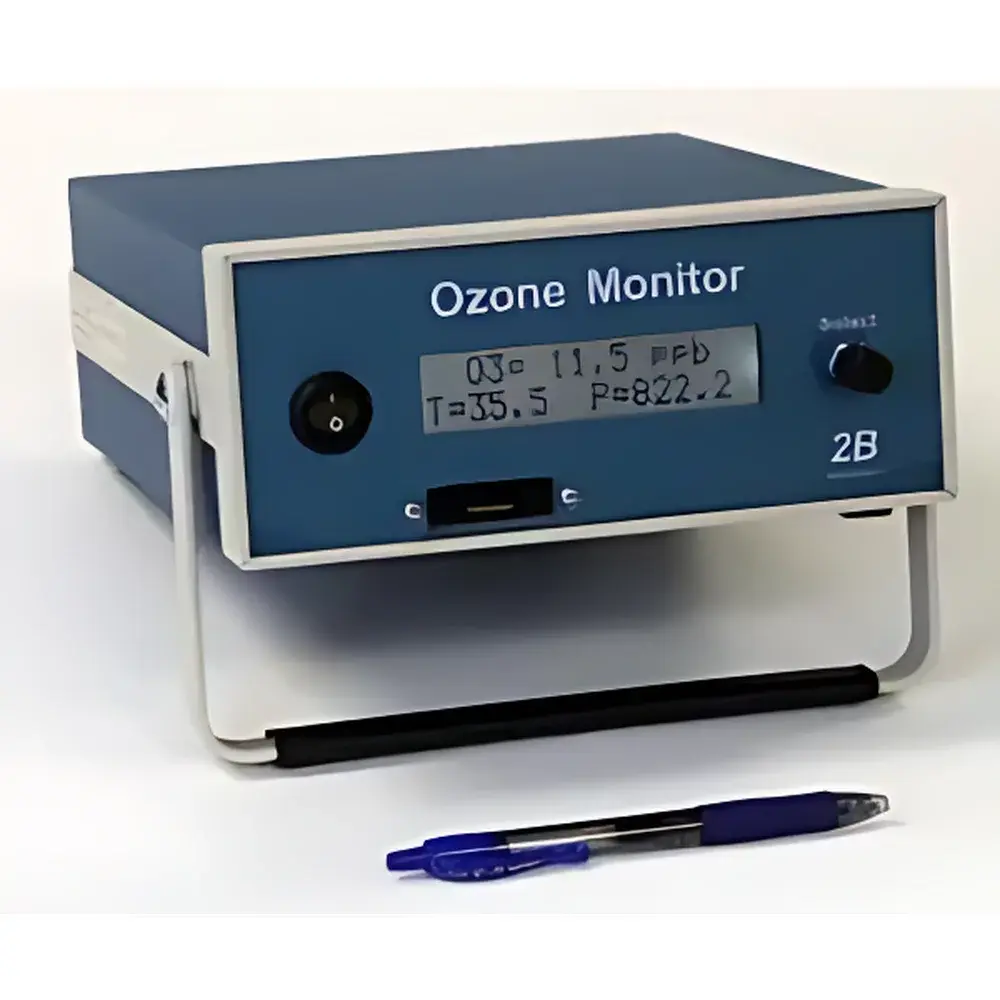
2B Technologies Model 202 Ozone Monitor
| Brand | 2B Technologies |
|---|---|
| Origin | USA |
| Model | 202 |
| Instrument Type | Portable |
| Measurement Range | 0–250 ppm (0–250,000 ppb) |
| Detection Limit | 3.0 ppb (10-sec mode) |
| Resolution | 0.1 ppb |
| Accuracy | ±1.5 ppb or ±2% of reading |
| Precision | ±1.5 ppb or ±2% of reading |
| Response Time (100% step) | 20 sec |
| Zero Drift | <2 ppb/day, <5 ppb/year |
| Sensitivity Drift | <1%/day, <3%/year |
| Flow Rate | ~1.0 L/min (min. 0.6 L/min) |
| Data Logging Capacity | 16,383 rows internal |
| Operating Temperature | 0–50 °C standard |
| Operating Altitude | 0–13.5 km (standard) |
| Power | 11–14 V DC / 120–240 V AC, 600 mA, 7.2 W |
| Dimensions | 9 × 21 × 29 cm |
| Weight | 2.5 kg (instrument only) |
Overview
The 2B Technologies Model 202 Ozone Monitor is a portable, NIST-traceable ultraviolet (UV) absorption analyzer engineered for high-fidelity ozone (O3) quantification in ambient air, stratospheric profiling, occupational health monitoring, and laboratory research environments. It operates on the well-established principle of Beer-Lambert absorption spectroscopy at 254 nm — a wavelength where ozone exhibits strong, selective absorbance — enabling direct, interference-free measurement without chemical reagents or consumables. Certified as a Federal Equivalent Method (FEM) by the U.S. Environmental Protection Agency (EQOA-0410-190), the Model 202 meets regulatory requirements for ambient ozone monitoring under 40 CFR Part 53. Its linear dynamic range spans 0–250 ppm (0–250,000 ppb), with sub-part-per-trillion baseline stability and long-term drift performance validated per ASTM D5012 and ISO 13964 protocols.
Key Features
- UV photometric detection at 254 nm with dual-beam optical architecture (upgradeable to Model 205 configuration)
- Integrated, ultra-quiet, long-life diaphragm pump delivering stable flow (~1.0 L/min) with built-in flow metering and pressure compensation
- Onboard data logger storing up to 16,383 records; expandable via removable SD card (≥2 GB, supporting >5 years of 10-second logging)
- Real-time temperature, pressure, and humidity correction (T, P, RH) applied to all concentration outputs (ppb, ppm, µg/m³, mg/m³, pphm)
- Low-power design: 7.2 W nominal consumption; compatible with 12 V DC battery systems (e.g., Li-ion packs for 12+ hours continuous operation)
- Compact form factor (9 × 21 × 29 cm) and lightweight construction (2.5 kg instrument-only) optimized for balloon-borne, UAV, kite, and aircraft-based vertical profiling
- Comprehensive analog and digital I/O: RS232 serial interface, 0–2.5 V analog output, three auxiliary 0–2.5 V analog inputs (for external T/P/RH sensors), optional 4–20 mA current loop
Sample Compatibility & Compliance
The Model 202 is designed for direct analysis of ambient air, filtered or unfiltered (with optional external particulate filter). It complies with U.S. EPA FEM EQOA-0410-190 for regulatory-grade ozone monitoring and satisfies key international standards including ISO 13964 (ambient air quality — determination of ozone — UV photometric method) and EN 14625 (ambient air — specification and testing of automated measuring systems). All factory calibrations are NIST-traceable and documented with individual certificates of calibration. The instrument supports GLP-compliant operation through timestamped, non-erasable data logging, audit-ready metadata (including firmware version, serial number, and calibration history), and optional Bluetooth-enabled wireless transmission for remote validation. For regulated environments, it can be configured to meet FDA 21 CFR Part 11 requirements when paired with validated software platforms that enforce electronic signature and audit trail functionality.
Software & Data Management
Data acquisition and post-processing are supported via 2B Technologies’ proprietary Ozone Tools software suite (Windows/macOS), which enables real-time visualization, spectral diagnostics, zero/span verification, and automated report generation. Raw data files (CSV/ASCII) include full metadata headers — instrument ID, timestamp (UTC), raw absorbance, corrected concentration, T/P/RH values, and diagnostic flags. SD card logs are directly readable without proprietary drivers. Firmware updates are delivered via USB or SD card and include cryptographic integrity checks. Optional GPS integration (enabled at ≥10-second sampling) embeds georeferenced coordinates (latitude, longitude, altitude) into every data record, facilitating spatial mapping in mobile monitoring campaigns. All data export formats conform to ICARTT and NASA Ames file standards for atmospheric science interoperability.
Applications
- Ambient air quality monitoring networks (urban, rural, background sites)
- Vertical ozone profiling using tethered balloons, RPVs, light aircraft, and sounding platforms
- Personal exposure assessment in occupational hygiene and epidemiological field studies
- Indoor air quality audits and HVAC system validation
- Material degradation studies (e.g., rubber cracking, polymer aging) under controlled ozone atmospheres
- Biological response assays (plant physiology, microbial viability) requiring precise, time-resolved O3 dosing
- Calibration transfer and reference standard verification for secondary ozone monitors
FAQ
Is the Model 202 compliant with U.S. EPA Federal Equivalent Method (FEM) requirements?
Yes — certified as EQOA-0410-190, meeting performance criteria defined in 40 CFR Part 53 for ambient ozone monitoring.
What is the minimum detectable ozone concentration, and under what conditions?
The limit of detection is 3.0 ppb (signal-to-noise ratio = 2) in 10-second averaging mode, verified per EPA Method TO-11A.
Can the instrument operate reliably at high altitude or sub-zero temperatures?
Standard operation covers 0–13.5 km altitude and 0–50 °C; optional cold-weather kit extends low-temperature capability to –20 °C, and high-altitude pressure sensor upgrade supports operation up to 25 km.
Does the Model 202 support automated zero calibration?
Yes — includes dedicated zero-air cartridge port and programmable zero-check intervals; manual zero function also available via front-panel interface.
How is data integrity ensured during long-term unattended deployments?
Internal memory employs write-protected circular buffering; SD card writes are atomic and timestamped; power-fail recovery preserves last valid record; all logged data include CRC-32 checksums.







