
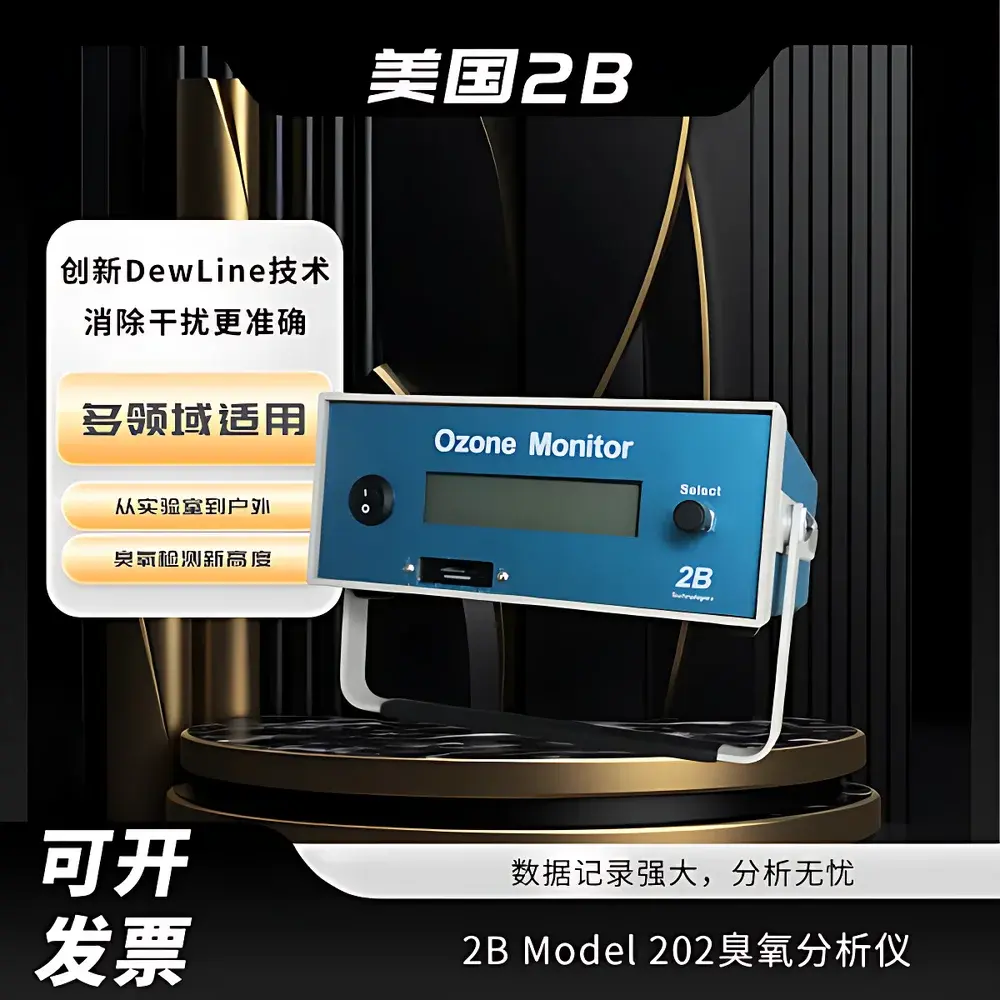
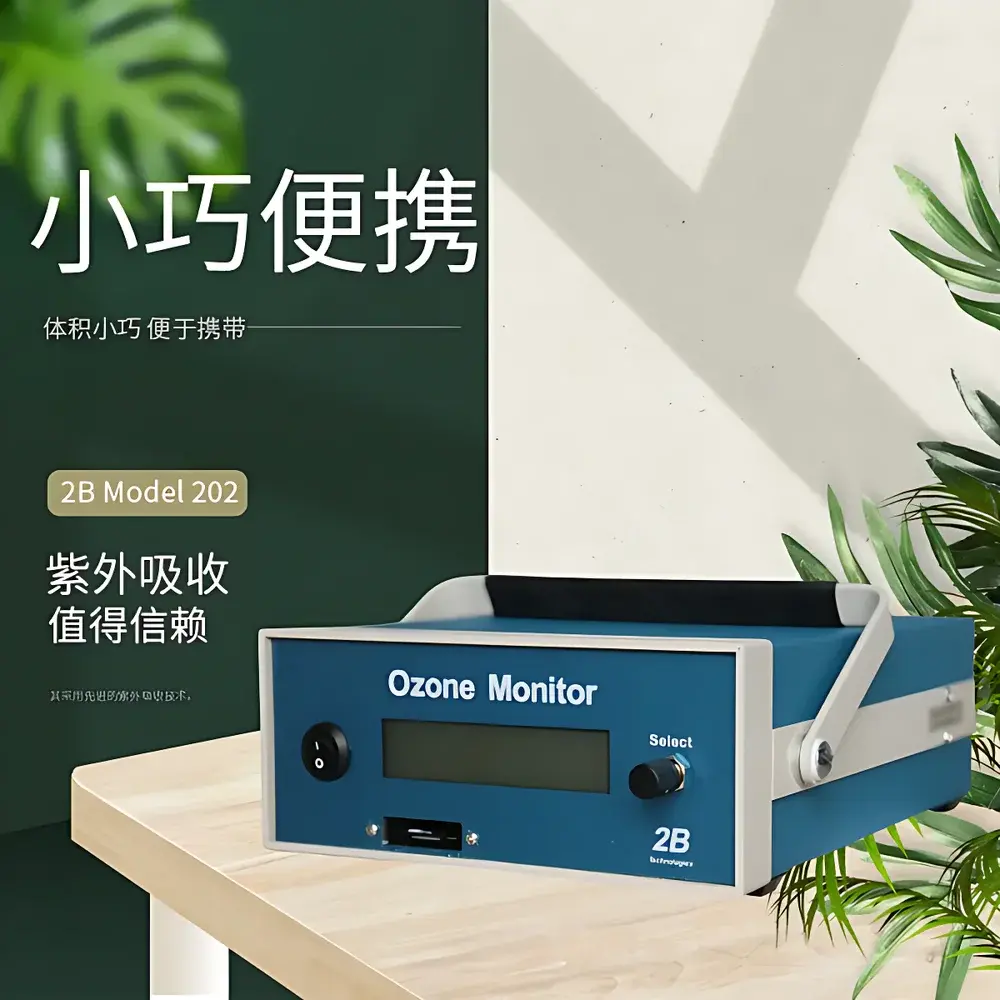
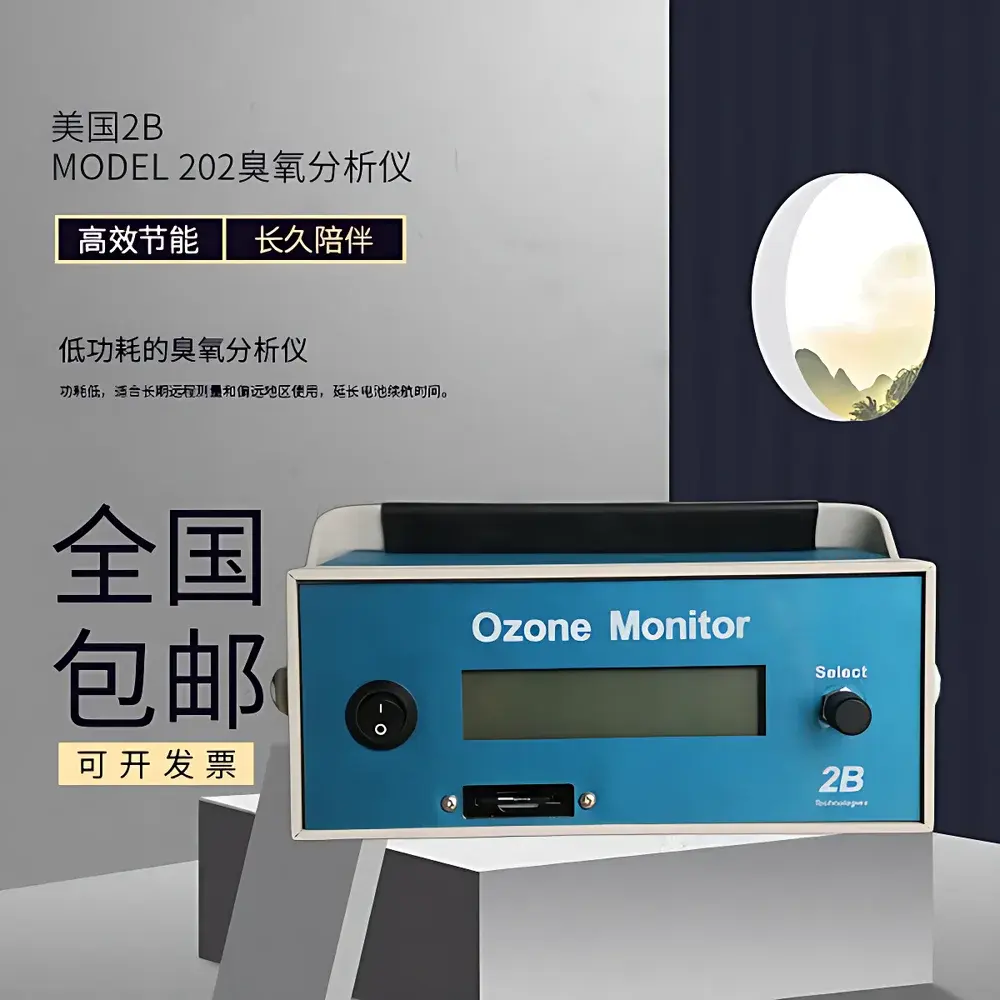
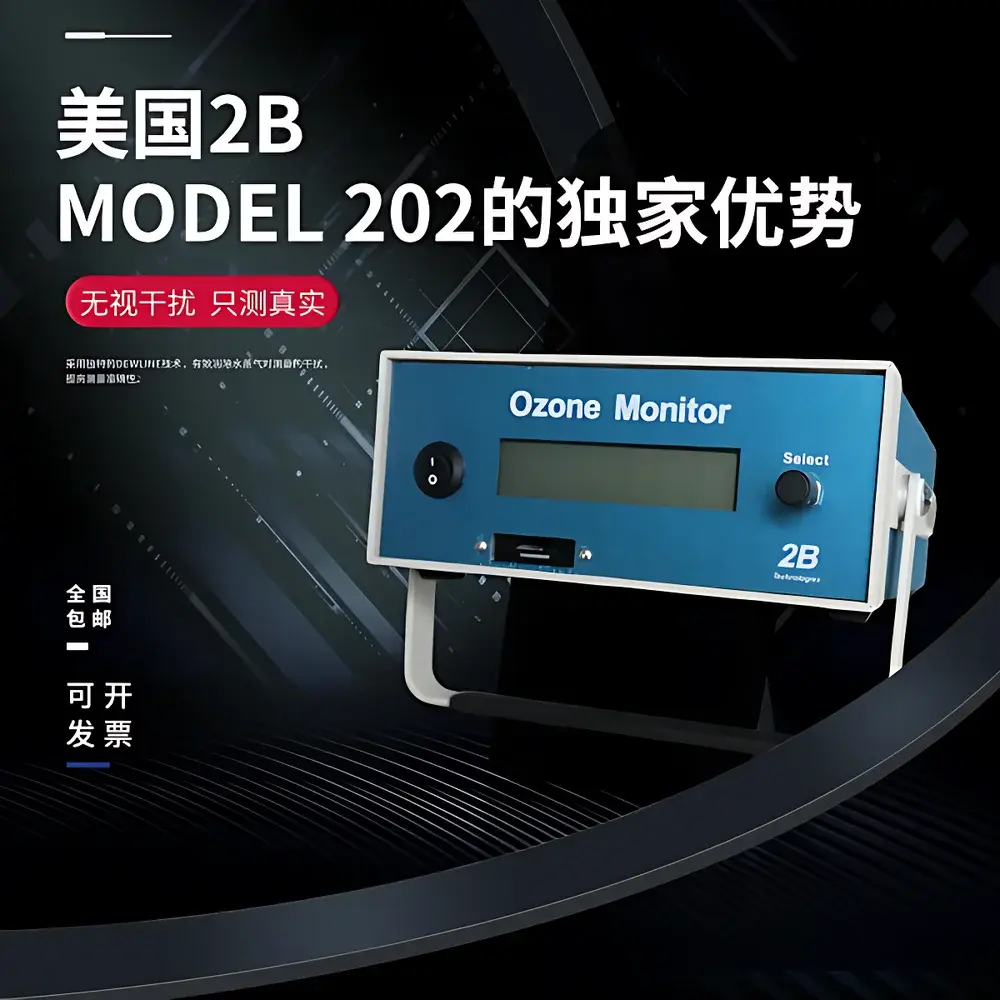
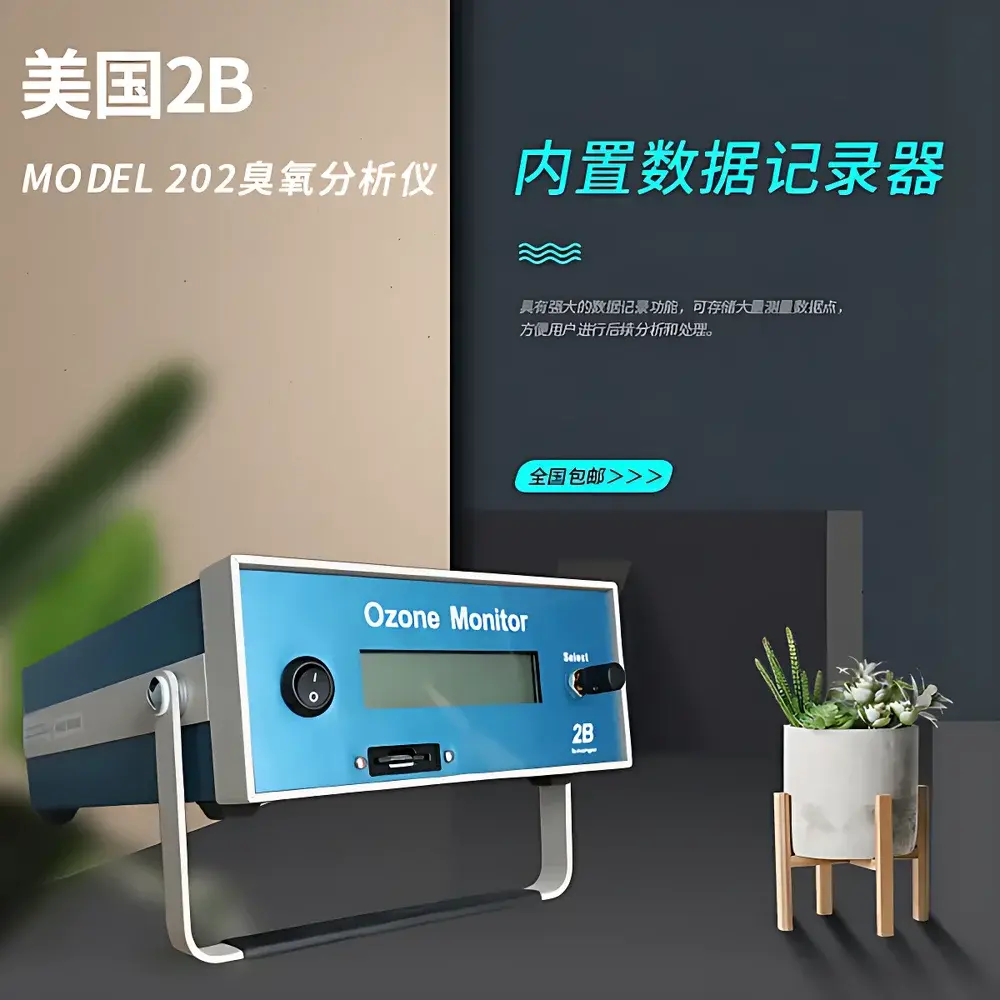
2B Technologies Model 202 Portable Ozone Analyzer
| Brand | 2B Technologies |
|---|---|
| Origin | USA |
| Model | Model 202 |
| Instrument Type | Portable |
| Measurement Range | 0–250 ppm |
| Detection Limit | 1 ppb |
| Response Time | 2 s |
| Zero Drift | ±1 ppb/24 h |
| Resolution | 1 ppb |
| Operating Voltage | 12 V DC |
| Power Consumption | 4.0 W (2.9 W in low-power mode) |
| Flow Rate | ~1 L/min |
| Data Storage Capacity | 20,480 records |
| Measurement Interval | 10 s (configurable averaging: 10 s, 1 min, 5 min, 1 hr) |
| Output Interfaces | RS-232 / USB / 0–2.5 V analog |
| Input Channels | 3 × 0–2.5 V analog |
| Display | Integrated LCD |
| Units Supported | ppm, ppb, pphm, g/Nm³, µg/m³ |
| EPA FEM Designation | EQOA-0410-190 |
| Compliance | 40 CFR Part 58 Appendix A |
Overview
The 2B Technologies Model 202 Portable Ozone Analyzer is a field-deployable, UV photometric instrument engineered for high-fidelity ozone (O₃) quantification in ambient air, occupational environments, and controlled laboratory settings. It operates on the principle of ultraviolet absorption spectroscopy at 254 nm—a well-established, NIST-traceable method where ozone molecules exhibit strong, selective absorbance. This optical path is thermally stabilized and pressure-compensated to ensure measurement integrity across variable environmental conditions. The Model 202 delivers a dynamic linear range from 1.5 ppbv to 250 ppmv with automatic range switching and real-time unit conversion, enabling seamless transition between regulatory monitoring (e.g., ambient air quality standards) and high-concentration industrial applications (e.g., ozone generator output verification). Its compact form factor (2.1 kg), low power draw, and internal data logger make it suitable for unattended operation in remote or resource-constrained locations—including UAV-mounted atmospheric profiling, mobile platforms, personal exposure studies, and long-term ground-based monitoring networks.
Key Features
- U.S. EPA Federal Equivalent Method (FEM) designation EQOA-0410-190—validated per 40 CFR Part 58 Appendix A for regulatory-grade ambient ozone monitoring.
- Dew-Line™ humidity compensation technology reduces water vapor interference from >100 ppb to <5 ppb, eliminating the need for external dryers or Nafion® membranes in most field deployments.
- Integrated temperature, relative humidity, and barometric pressure sensors enable real-time altitude- and density-corrected concentration reporting—critical for vertical profile measurements where elevation-induced bias exceeds 14% per 1000 m.
- Onboard data logging stores up to 20,480 timestamped records (with user-selectable averaging intervals: 10 s, 1 min, 5 min, or 1 hr), supporting >2.4 months of continuous operation at 5-minute intervals.
- Three analog input channels (0–2.5 V DC) allow synchronous acquisition of co-located sensor data—e.g., meteorological parameters, CO, NO₂, or particulate mass—without external data loggers.
- Low-power operating mode (2.9 W) extends battery life for extended field campaigns; compatible with standard 12 V DC sources including vehicle power systems and solar-charged lithium packs.
Sample Compatibility & Compliance
The Model 202 is designed for direct sampling of ambient air, indoor air, and process streams with minimal conditioning. It meets U.S. Environmental Protection Agency requirements for ambient ozone monitoring under 40 CFR Part 58 and is approved for use in State Implementation Plans (SIPs) and National Ambient Air Quality Standards (NAAQS) compliance reporting. Its hardware architecture and firmware support GLP-compliant audit trails when used with optional time-synchronized logging protocols. While not intrinsically safe for Class I Division 1 hazardous locations, it complies with FCC Part 15 Class B and CE EN 61326-1 for electromagnetic compatibility in laboratory and field environments. Calibration traceability follows ISO/IEC 17025 principles through documented two-point (zero/span) procedures using NIST-traceable ozone generators or certified gas standards.
Software & Data Management
Data retrieval and configuration are managed via the proprietary 2B Technologies Data Logger Software (Windows-compatible), which supports real-time telemetry, batch export to CSV/Excel, and automated calibration report generation. All logged data include embedded metadata: UTC timestamp, instrument serial number, firmware version, sensor status flags, and environmental correction coefficients. The RS-232 and USB interfaces provide plug-and-play connectivity with SCADA systems, mobile tablets, and custom Python- or LabVIEW-based acquisition frameworks. Analog outputs (0–2.5 V DC) are scalable and linear, enabling integration into legacy PLCs or chart recorders without signal conditioning. Firmware updates are delivered via secure HTTP download and verified using SHA-256 checksums to maintain data integrity throughout the instrument lifecycle.
Applications
- Ambient air quality monitoring networks (urban, rural, and background sites) aligned with EPA reference and equivalent methods.
- Vertical ozone profiling via tethered balloons, unmanned aerial vehicles (UAVs), and light aircraft—leveraging its weight-to-performance ratio and low power envelope.
- Personal exposure assessment in epidemiological studies linking ozone concentration gradients to respiratory health outcomes.
- Indoor air quality validation in healthcare facilities utilizing ozone-based sterilization systems.
- Material degradation testing—quantifying ozone flux during accelerated aging of elastomers, coatings, and polymer composites.
- Calibration transfer and intercomparison studies among research-grade analyzers under ISO 5725-2 precision guidelines.
FAQ
Is the Model 202 compliant with U.S. EPA requirements for regulatory ozone monitoring?
Yes—the Model 202 holds EPA FEM designation EQOA-0410-190 and satisfies the performance criteria outlined in 40 CFR Part 58 Appendix A for ambient ozone measurement.
Does the instrument require external drying or scrubbing for humid environments?
No—its proprietary Dew-Line™ algorithm actively corrects for humidity-induced spectral interference, reducing typical errors from >100 ppb to <5 ppb without consumables or mechanical dryers.
Can the Model 202 operate continuously on battery power?
Yes—when configured in low-power mode (2.9 W), it can run for >48 hours on a standard 12 V, 10 Ah lithium battery pack, making it suitable for unattended field deployments.
What calibration standards are recommended for routine verification?
NIST-traceable ozone gas standards generated by UV photolysis of oxygen or certified permeation devices (e.g., AccuGas®) are recommended; zero air must meet ASTM D1072 specifications for hydrocarbon and ozone-free content.
Is firmware update capability available remotely?
Firmware updates require local connection via USB or RS-232 and must be initiated manually using the official 2B Technologies software; no over-the-air (OTA) update functionality is implemented for security and traceability reasons.
Related Products







