
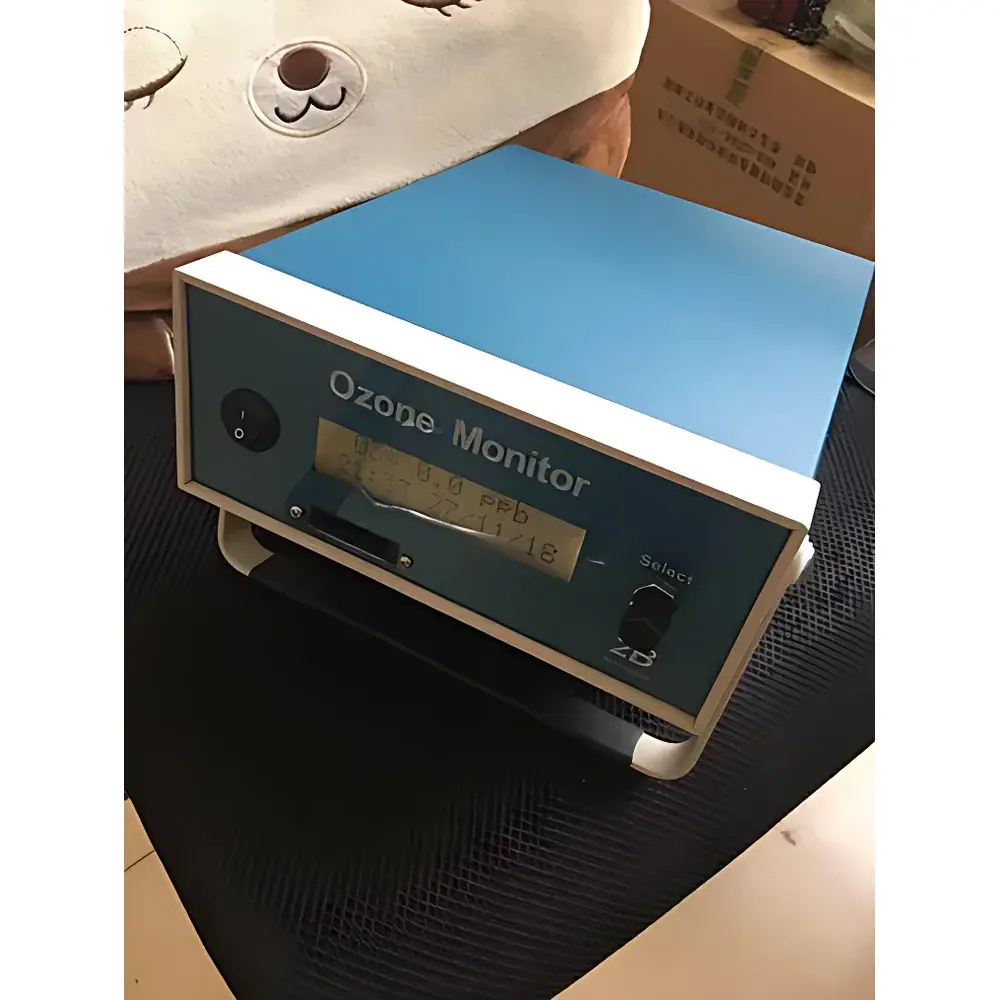
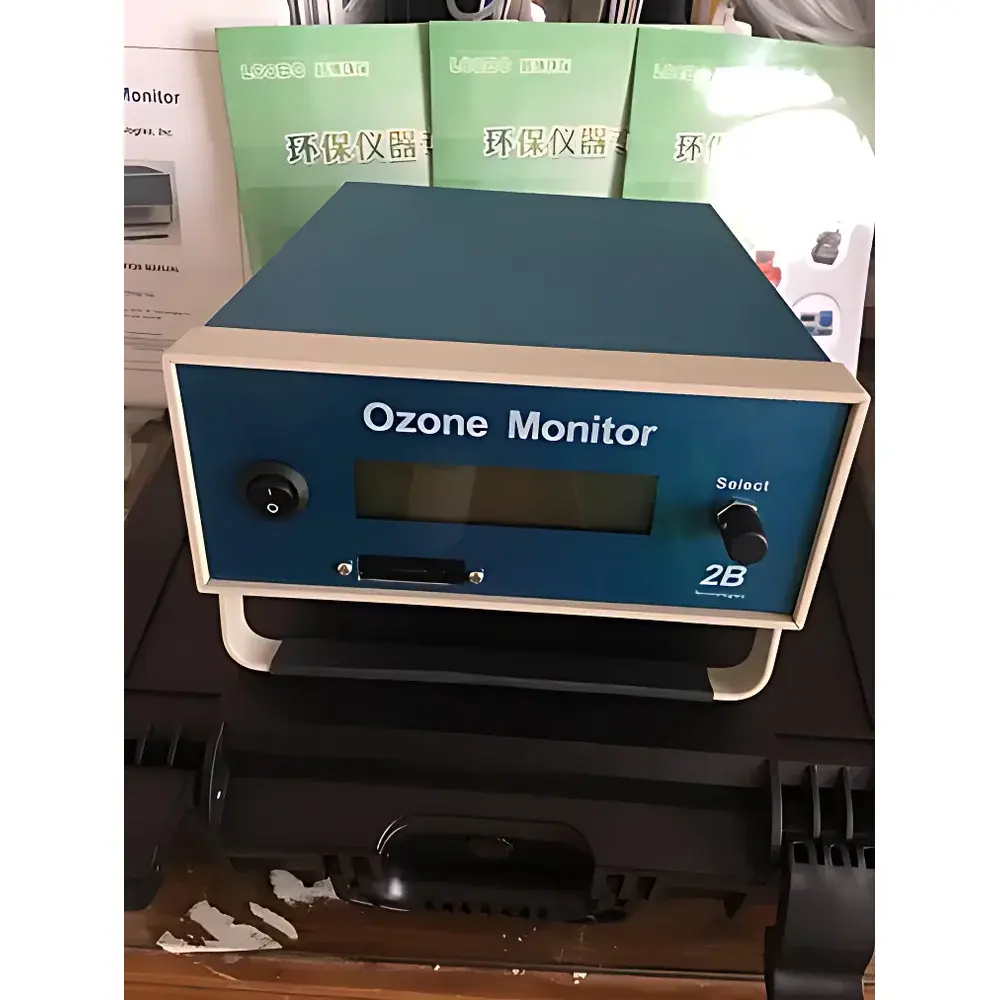
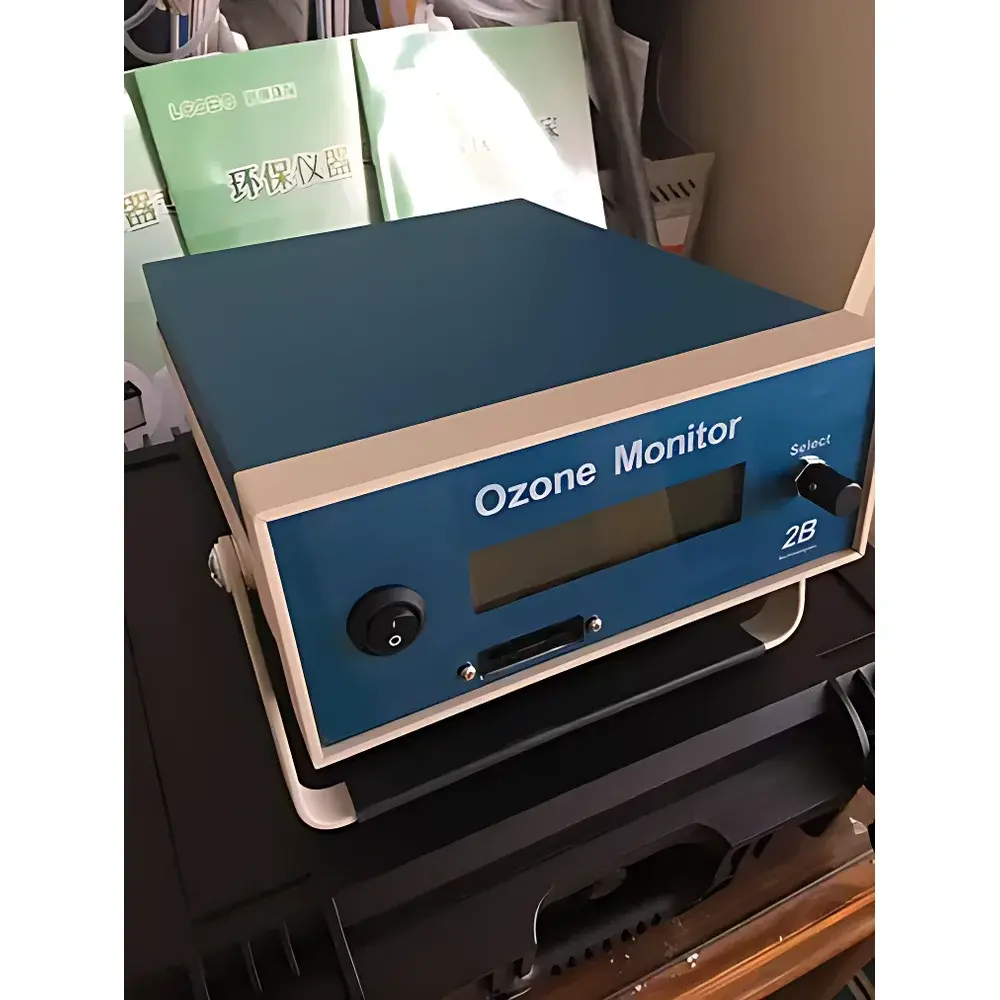
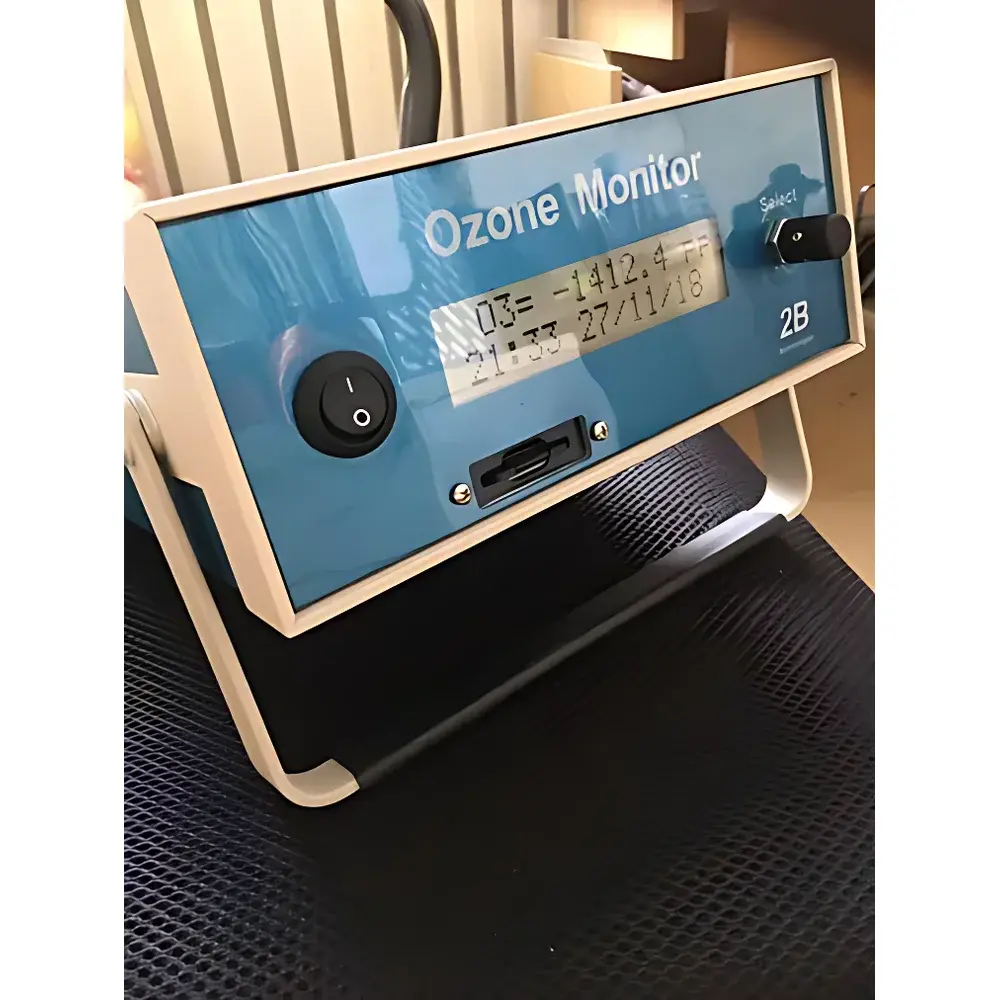
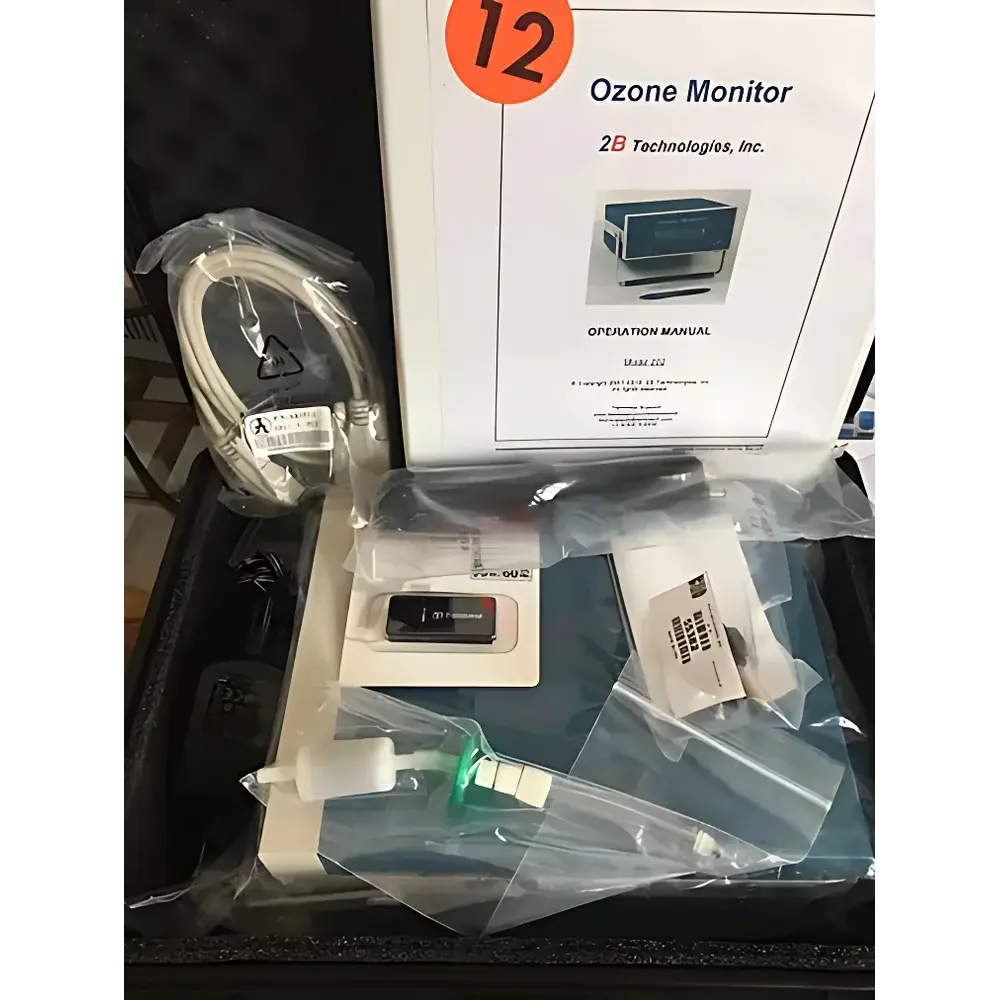
2B Technologies Model 202 Portable Ozone Analyzer
| Brand | 2B Technologies |
|---|---|
| Origin | USA |
| Model | Model 202 |
| Instrument Type | Portable |
| Measurement Range | 1.5 ppb to 250 ppm |
| LOD | 1.5 ppb |
| Response Time | 20 s |
| Zero Drift | <2 ppb/day |
| Resolution | <3% |
| Detection Principle | UV Absorption at 254 nm |
| Accuracy | ±0.1 ppb (1σ RMS noise) or ±2% of reading |
| Span Drift | <1%/day, <3%/year |
| Baseline Drift | <2 ppb/day, <5 ppb/year |
| Flow Rate | 1.0 L/min (min. required: 0.6 L/min) |
| Averaging Intervals | 10 s, 1 min, 5 min, 1 h |
| Data Storage | 20,480 lines (e.g., 2.4 days at 10-s avg |
| Output Units | ppb, ppm, pphm, µg/m³, mg/m³ |
| Weight | 2.1 kg (4.7 lb) |
| Dimensions | 9 cm × 21 cm × 29 cm |
| Power | 12 VDC, 4.0 W (2.9 W in low-power mode) |
| Analog Inputs | Three 0–2.5 V DC channels for temperature, pressure, and humidity |
| GPS | Integrated real-time geotagging (latitude, longitude, altitude) |
| Battery | Metal hydride, 12 h continuous operation |
| External Particle Filter | Standard |
| Interface | USB serial |
| Air Pump | Low-temperature, quiet rotary vane pump with extended service life |
Overview
The 2B Technologies Model 202 Portable Ozone Analyzer is a field-deployable, NIST-traceable instrument engineered for high-fidelity ambient and occupational ozone (O₃) monitoring. It employs dual-beam ultraviolet absorption spectroscopy at 254 nm — the industry-standard photometric method for ozone quantification — ensuring compliance with EPA Reference Method EQOA-01 and equivalent ISO 13964:2021 requirements. The analyzer’s optical path is thermally stabilized and sealed against humidity and particulate interference, minimizing spectral baseline drift and enabling long-term stability in uncontrolled environments. Designed for regulatory-grade data collection, it delivers calibrated ozone concentration values traceable to NIST Standard Reference Materials (SRMs), supporting audit-ready reporting under GLP and GMP frameworks.
Key Features
- Dual-beam UV photometer with 254 nm mercury lamp source and matched reference/detection channels for real-time compensation of lamp aging and window fouling
- Integrated GPS module providing continuous, time-synchronized geolocation metadata (latitude, longitude, altitude) for spatial mapping of ozone gradients
- Three analog input channels (0–2.5 V DC) for simultaneous acquisition of co-located environmental parameters — including temperature, barometric pressure, and relative humidity — enabling on-device correction of ozone density to standard conditions (e.g., STP or SATP)
- High-capacity internal memory storing up to 20,480 data records with user-selectable averaging intervals (10 s, 1 min, 5 min, or 1 h), supporting both short-term exposure assessment and multi-week network deployment
- Low-power metal hydride battery enabling 12 hours of continuous operation; optimized power management reduces average consumption to 2.9 W in low-duty-cycle configurations
- Quiet, low-temperature rotary vane air pump rated for >10,000 hours of service life; includes replaceable external particulate filter (0.5 µm pore size) compliant with ISO 10155:2020 sampling recommendations
- USB serial interface compatible with Windows/Linux/macOS platforms; supports direct data download, remote configuration, and firmware updates via 2B’s proprietary DataLogger software
Sample Compatibility & Compliance
The Model 202 is validated for use with ambient air, indoor workplace atmospheres, and stratospheric/tropospheric air samples collected via balloon-borne or aircraft-mounted platforms. Its inlet design meets EPA Compendium Method TO-11A requirements for particle-free sampling, and the integrated filter prevents deposition of submicron aerosols that could scatter UV light or catalyze surface ozone decomposition. The instrument satisfies performance criteria outlined in ASTM D5012–22 (Standard Practice for Determining Ozone Concentration by UV Absorption), ISO 13964:2021 (Ambient air — Determination of ozone — UV photometric method), and US EPA 40 CFR Part 53 Subpart C for Federal Equivalent Methods (FEM). All factory calibrations are documented with NIST-traceable certificates, including uncertainty budgets per ISO/IEC 17025:2017.
Software & Data Management
DataLogger software (v3.2+) provides full instrument control, real-time visualization, and export to CSV, Excel, and NetCDF formats. Audit trails record all calibration events, zero/span adjustments, and parameter changes with timestamps and operator IDs — fulfilling FDA 21 CFR Part 11 electronic record requirements when used in regulated environments. Raw absorbance signals and processed concentrations are stored with metadata tags (GPS coordinates, analog sensor inputs, battery voltage, pump status), enabling post-hoc QA/QC analysis. Firmware updates preserve backward compatibility with legacy datasets and support optional cloud synchronization via third-party MQTT brokers for distributed monitoring networks.
Applications
- Ambient air quality monitoring networks (urban, rural, background sites) compliant with EU Directive 2008/50/EC and US NAAQS standards
- Occupational health and safety assessments in industrial settings where ozone is generated (e.g., water treatment, semiconductor fabrication, laser printing)
- Vertical profiling campaigns using tethered balloons, UAVs, or research aircraft for tropospheric ozone layer characterization
- Personal exposure studies requiring lightweight, GPS-tagged instrumentation with sub-ppb detection capability
- Calibration transfer and field validation of lower-cost electrochemical or metal oxide sensors
- Educational and citizen science deployments supported by open data protocols and public-domain calibration procedures
FAQ
What ozone measurement principle does the Model 202 employ?
It uses dual-beam ultraviolet absorption at 254 nm, measuring the Beer-Lambert law attenuation of UV light through an ozone-containing sample stream.
Is the instrument suitable for unattended long-term deployment?
Yes — with its low-power architecture, robust pump, and internal memory, it supports autonomous operation for up to 2.4 months when configured for 5-minute averaging.
Does the Model 202 meet regulatory requirements for official air quality reporting?
It is certified as a Federal Equivalent Method (FEM) by the U.S. EPA and conforms to ISO 13964:2021, making it appropriate for inclusion in national monitoring networks subject to local accreditation.
How is calibration traceability maintained in the field?
Each unit ships with a NIST-traceable calibration certificate; users may perform field zero checks using the included zero cartridge and verify span with portable ozone generators traceable to NIST SRM 2687.
Can external sensors be interfaced beyond the three analog inputs?
No — only the three 0–2.5 V DC channels are provided; however, external multiplexers or data loggers can be connected via USB to expand sensor integration capabilities.







