
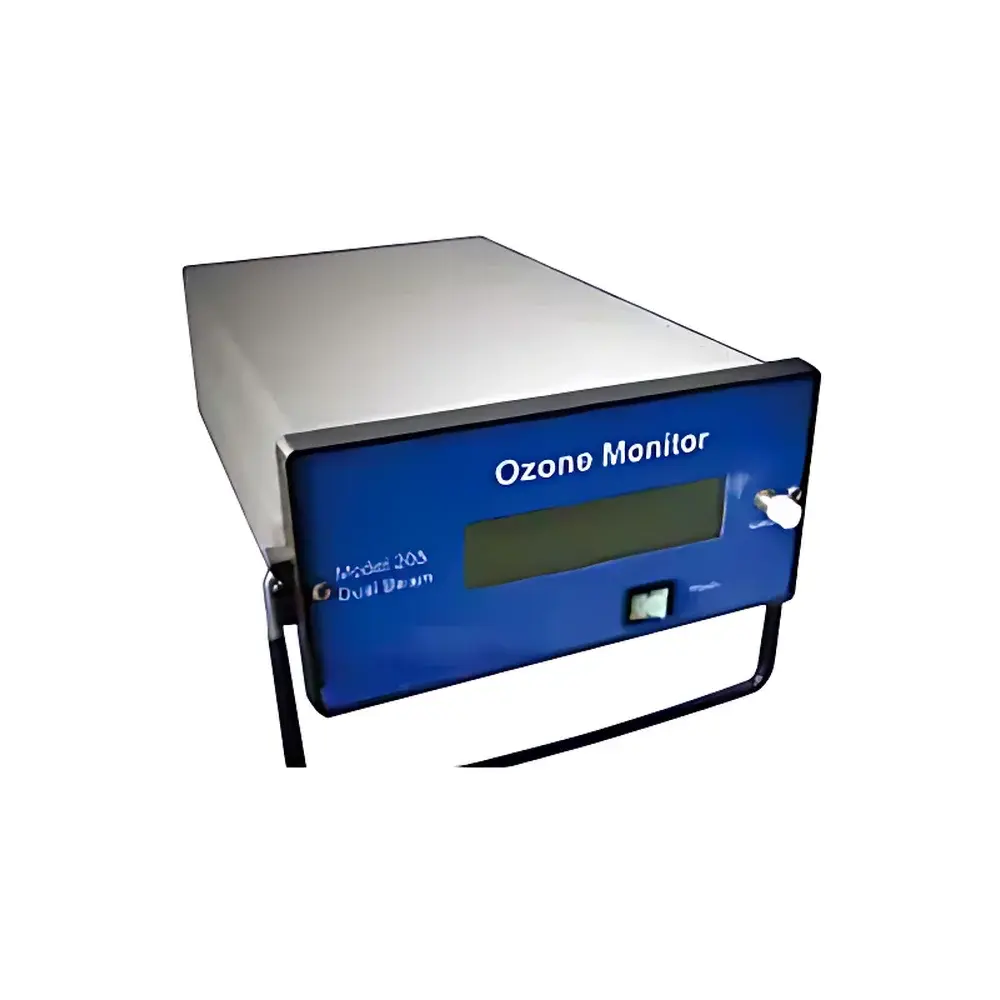
2B Technologies Model 205 Dual-Beam Ozone Analyzer
| Brand | 2B Technologies |
|---|---|
| Origin | USA |
| Model | 205 |
| Instrument Type | Portable |
| Measurement Range | 1 ppb–100 ppm (auto-ranging across 1 ppb–10 ppm, 1–10 ppm, and 10–100 ppm sub-ranges) |
| Detection Limit | 1 ppb |
| Accuracy | ±2% or ±1 ppb (whichever is greater) |
| Response Time (t₉₀) | 2 s |
| Sampling Flow Rate | 1.0 L/min |
| Data Storage Capacity | 20,480 data points |
| Logging Intervals | Configurable (2 s, 10 s, 1 min, 5 min, 1 h) |
| Power Supply | 12 VDC or 120/240 VAC |
| Dimensions | 9 cm × 21 cm × 29 cm |
| Weight | 0.9 kg (instrument only) |
| Output Interfaces | RS-232 serial, 0–2.5 VDC analog, built-in LCD display |
| Compliance | Designed for field-deployable environmental monitoring per EPA TO-11A guidance principles and ISO 13964:2022 (ambient air—determination of ozone by UV photometry) |
Overview
The 2B Technologies Model 205 Dual-Beam Ozone Analyzer is a field-deployable, portable ultraviolet (UV) photometric instrument engineered for high-fidelity, real-time measurement of ambient or process ozone (O₃) concentrations. It operates on the fundamental principle of differential UV absorption at 254 nm — a wavelength strongly absorbed by ozone but minimally affected by common atmospheric interferents. Unlike single-beam analyzers, the Model 205 employs a true dual-beam optical architecture: one beam passes through an ozone-scrubbed reference stream (I₀), while the other traverses the sample air stream (I). This continuous, real-time ratioing (I/I₀) eliminates drift caused by lamp intensity fluctuations, optical fouling, or detector sensitivity changes — significantly enhancing long-term stability and measurement reproducibility without requiring frequent zero/span calibration. The analyzer is optimized for regulatory-grade applications where trace-level accuracy (1 ppb detection limit), rapid response (t₉₀ ≤ 2 s), and operational robustness under variable humidity conditions are critical.
Key Features
- Dual-beam UV photometric design with real-time I/I₀ ratio computation for intrinsic drift compensation
- DewLine® integrated humidity management system — actively heats the optical path to suppress water vapor interference without desiccant replacement or manual maintenance
- Auto-ranging measurement capability spanning 1 ppb to 100 ppm, with seamless switching between three calibrated sub-ranges (1 ppb–10 ppm, 1–10 ppm, 10–100 ppm)
- High-resolution internal data logging: stores up to 20,480 timestamped records with user-selectable intervals (2 s to 1 h)
- Low-power architecture: 3.9 W in energy-saving mode enables extended battery operation in remote deployments
- Compact form factor (9 × 21 × 29 cm) and lightweight construction (0.9 kg instrument mass) support handheld, mobile, and UAV-mounted configurations
- Multiple output options: RS-232 serial interface for direct PC or datalogger integration, 0–2.5 VDC analog output compatible with SCADA systems, and intuitive backlit LCD display with real-time concentration and status indicators
Sample Compatibility & Compliance
The Model 205 is validated for continuous measurement of ozone in ambient air, indoor environments, and controlled process streams. Its sampling system accommodates standard 1.0 L/min volumetric flow with minimal pressure drop and includes inlet particulate filtration (2.5 µm cutoff) to prevent optical contamination. The analyzer meets performance criteria outlined in U.S. EPA Traceability Protocol for Gaseous Calibrations (TO-11A) and aligns with the measurement principles specified in ISO 13964:2022 for ambient ozone determination. While not certified as a Federal Reference Method (FRM) or Federal Equivalent Method (FEM) device, it is widely deployed in supplemental monitoring networks, exposure assessment studies, and QA/QC verification protocols where high temporal resolution and portability are prioritized over formal regulatory certification. All firmware and hardware designs adhere to CE electromagnetic compatibility (EMC) directives and RoHS material restrictions.
Software & Data Management
Data acquisition and configuration are managed via 2B Technologies’ proprietary O3Soft™ software (Windows-compatible), which supports real-time telemetry, remote parameter adjustment, and automated calibration sequence execution. Logged data are stored in ASCII CSV format with UTC timestamps, enabling straightforward import into MATLAB, Python (pandas), R, or commercial environmental data platforms (e.g., EnviroDIY, AQS Cloud). The instrument supports GLP-compliant audit trails when used with external time-synced dataloggers; though it does not implement FDA 21 CFR Part 11 electronic signature functionality, its deterministic logging behavior and non-volatile memory ensure data integrity for scientific reporting and peer-reviewed publication. Firmware updates are delivered via serial interface and include version-controlled release notes with traceable validation summaries.
Applications
- Ambient air quality monitoring networks — especially in urban, suburban, and background sites requiring high-frequency ozone profiling
- Personal exposure assessment studies using wearable or backpack-mounted configurations
- Indoor air quality audits in schools, offices, hospitals, and HVAC-equipped facilities
- Verification and optimization of ozone-based disinfection systems (e.g., water treatment, surface sterilization units)
- Field validation of satellite-derived tropospheric ozone products and photochemical model outputs
- Calibration transfer and intercomparison campaigns among research-grade ozone monitors
FAQ
What is the minimum detectable ozone concentration?
The instrument achieves a lower limit of detection (LLD) of 1 ppb (signal-to-noise ratio ≥ 3) under typical ambient conditions.
Does the Model 205 require routine zero/span calibration?
While the dual-beam architecture minimizes drift, periodic zero checks (using ozone-scrubbed air) and span verification (with NIST-traceable ozone standards) are recommended every 7–14 days for regulatory-grade data continuity.
Can the analyzer operate unattended for extended periods?
Yes — with external 12 VDC power and configured for 5-minute logging, internal memory supports over 2.4 months of continuous operation without data offload.
Is the DewLine® system user-serviceable?
No — DewLine® is a fully integrated, factory-calibrated thermal control subsystem; no user-accessible components or consumables are required throughout the instrument’s service life.
What certifications does the Model 205 hold?
It complies with CE EMC Directive 2014/30/EU and RoHS Directive 2011/65/EU; it is not EPA FEM/FRM certified but is referenced in multiple peer-reviewed method validation studies (e.g., J. Air Waste Manage. Assoc. 2021;71:1127–1139).
Related Products







