

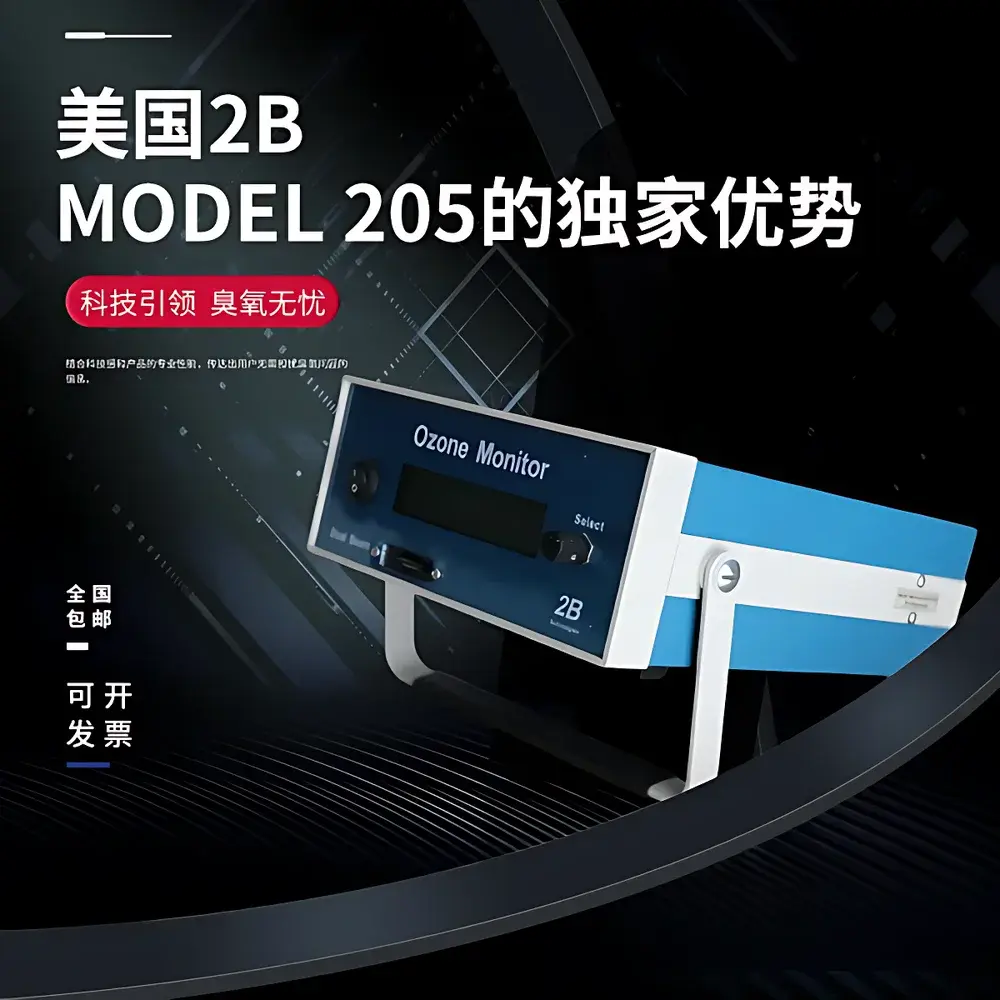


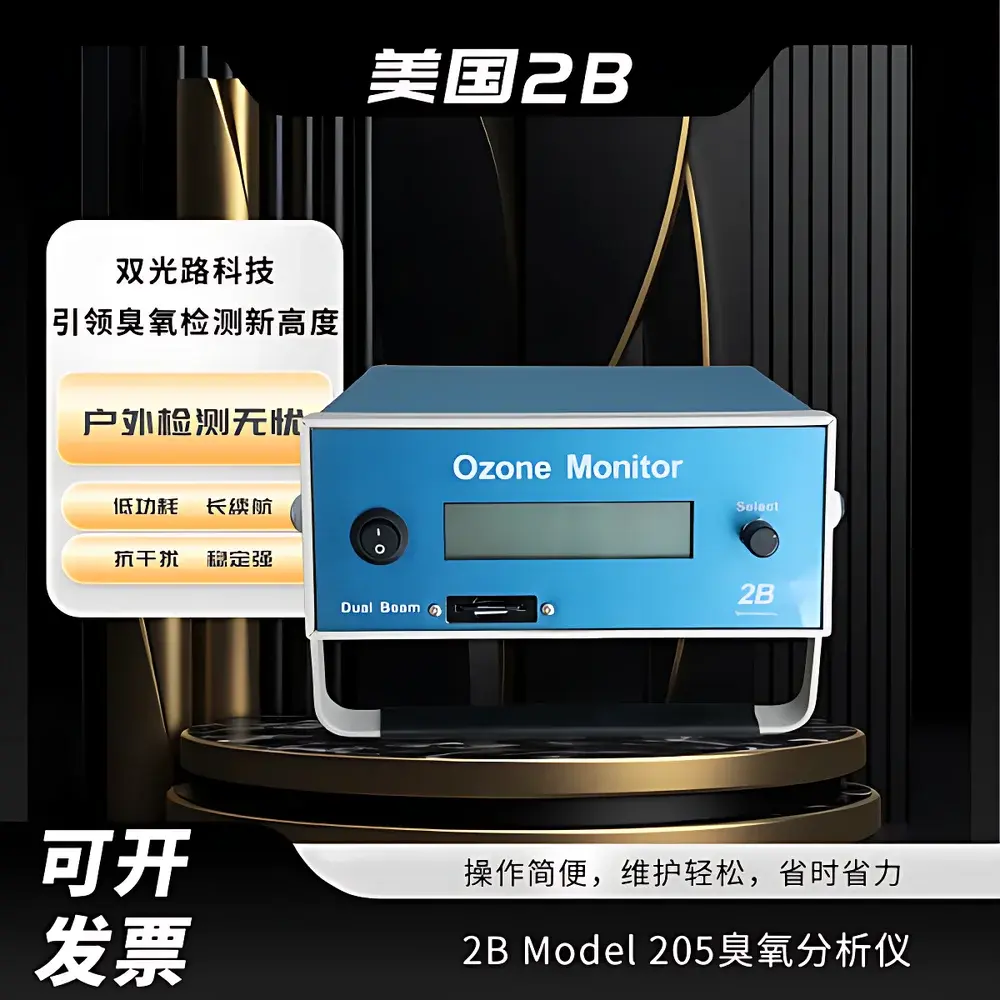
2B Technologies Model 205 Dual-Beam UV Ozone Analyzer
| Brand | 2B Technologies |
|---|---|
| Origin | USA |
| Model | Model 205 |
| Instrument Type | Portable |
| Measurement Range | 0–250 ppm |
| Limit of Detection | 1 ppb |
| Response Time | 2 s |
| Zero Drift | ±1.5 ppb (24 h) |
| Resolution | 1.5 ppb |
| Power Requirement | 12 V DC, 5.0 W |
| Flow Rate | 1.8 L/min (min. 1.2 L/min) |
| Data Storage | 14,336 records |
| Weight | 2.1 kg (4.7 lb) |
Overview
The 2B Technologies Model 205 Dual-Beam UV Ozone Analyzer is a portable, NIST-traceable instrument engineered for high-temporal-resolution ozone (O₃) quantification in ambient air, stratospheric profiling, and occupational environments. It employs dual-beam 254 nm ultraviolet absorption spectroscopy—a physically grounded, first-principles measurement method compliant with EPA Reference Method EQOA-01 and ISO 13964—where ozone concentration is derived from the Beer-Lambert law via simultaneous detection of transmitted intensities through both sample and reference (ozone-scrubbed) air streams. This architecture eliminates lamp intensity drift as a primary source of error, enabling stable baseline performance and sub-second effective measurement intervals. With a native data acquisition rate of 0.5 Hz (2 s response time), the Model 205 delivers the fastest real-time ozone readings among commercially available UV photometric analyzers. Its compact form factor (2.1 kg), low power draw (5.0 W @ 12 V DC), and robust thermal management make it uniquely suited for unmanned aerial systems (UAS), balloon-borne payloads, mobile monitoring platforms, and fixed-site networks requiring high-frequency temporal resolution without infrastructure dependency.
Key Features
- Dual-beam 254 nm UV absorption optics with active reference channel for continuous drift compensation
- NIST-traceable calibration certificate included; factory calibration valid per ASTM D5012 and EPA IQ/OQ protocols
- DewLine™ proprietary humidity compensation technology minimizes water vapor interference across 0–95% RH (non-condensing)
- Internal real-time clock with timestamped data logging (14,336 records; configurable averaging: 2 s, 10 s, 1 min, 5 min, or 1 h)
- Simultaneous analog outputs (0–2.5 V) for ozone concentration, internal temperature, and barometric pressure
- RS-232 serial interface supporting ASCII output of time, date, O₃ (ppb/ppm), temperature (°C), pressure (hPa), and up to three auxiliary inputs
- Optional GPS synchronization and CF card expansion for extended field deployments
- Low-power design enables battery operation via external 12 V DC source; compatible with standard aviation and UAV power buses
Sample Compatibility & Compliance
The Model 205 is validated for direct analysis of ambient air, indoor workplace air, and clean-dry gas streams without pre-conditioning. It meets the performance criteria specified in U.S. EPA Federal Reference Method (FRM) for ozone (40 CFR Part 53, Appendix A) when operated within its certified range (1 ppb–100 ppm). The analyzer complies with IEC 61000-6-3 (EMC emission standards) and IEC 61000-6-2 (immunity), and supports GLP/GMP data integrity requirements through audit-trail-capable firmware (time-stamped logs, calibration history, and configuration change records). All units ship with full documentation packages including Certificate of Conformance, NIST-traceable calibration report, and OEM manufacturing certificate.
Software & Data Management
Data acquisition and post-processing are supported via 2B Technologies’ proprietary O3Soft software (Windows-compatible), which enables real-time visualization, batch export to CSV/Excel, and automated QA/QC flagging based on user-defined thresholds (e.g., zero-check deviation >3 ppb). Firmware v3.2+ supports 21 CFR Part 11-compliant electronic signatures when deployed with validated IT infrastructure. Raw sensor voltages (I₀ and I), calculated absorbance, and environmental metadata are stored at native 2-second resolution; averaging intervals are applied during export—not acquisition—to preserve signal fidelity. Export formats include UTC-referenced timestamps, SI units (µg/m³, nmol/mol), and customizable column headers for integration into EPA AQS, EEA AirBase, or custom SCADA systems.
Applications
- Stratospheric and tropospheric ozone profiling via radiosonde, UAV, and high-altitude balloon platforms
- Urban and regional air quality monitoring networks requiring sub-minute temporal resolution for photochemical modeling input
- Occupational health and safety compliance monitoring in industrial settings (e.g., water treatment, semiconductor fabrication, medical sterilization)
- Indoor air quality assessment in schools, hospitals, and office buildings per ASHRAE Standard 62.1
- Validation and intercomparison studies with satellite-based ozone retrievals (e.g., TROPOMI, OMPS) and ground-based lidar networks
- Research-grade process control in ozone-generating equipment R&D and catalyst testing laboratories
FAQ
What is the measurement principle used by the Model 205?
It uses dual-beam 254 nm ultraviolet absorption spectroscopy, measuring the differential attenuation of UV light between ozone-containing and ozone-scrubbed air streams.
Is the instrument suitable for unattended long-term deployment?
Yes—its low power consumption, internal data logger, and DewLine™ humidity mitigation enable continuous operation for up to 1.4 months at 5-minute averaging intervals.
Does it require periodic zero/span calibration in the field?
While factory calibration is NIST-traceable, EPA and ISO recommend quarterly zero checks using an integrated catalytic scrubber; span verification is advised annually or after exposure to >100 ppm ozone.
Can the Model 205 be integrated into existing SCADA or IoT monitoring systems?
Yes—via RS-232 ASCII output or optional analog voltage signals, with protocol documentation provided for Modbus RTU and MQTT gateway adaptation.
What regulatory standards does it satisfy for ambient air monitoring?
It meets U.S. EPA equivalency criteria under 40 CFR Part 53 for ozone FRM/FEM designation and aligns with EU Directive 2008/50/EC Annex III technical requirements.







