
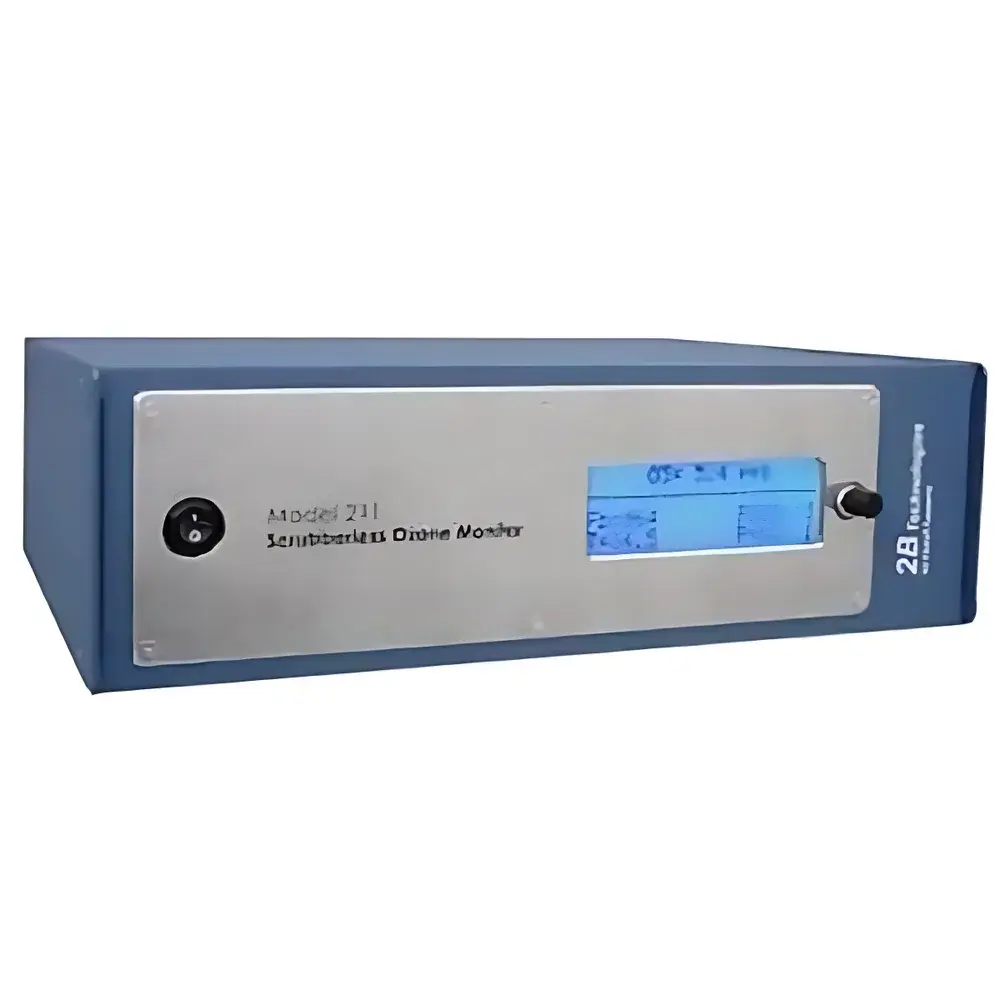
2B Technologies Model 211 Zero-Scrub Ozone Analyzer
| Brand | 2B Technologies |
|---|---|
| Origin | USA |
| Model | Model 211 |
| Instrument Type | Portable |
| Measurement Range | ppm |
| LOD | 1 ppb |
| Response Time | 2 s |
| Zero Drift | <0.5 %/day, <3 %/year |
| Resolution | 0.1 ppb |
| Operating Temperature | 10–50 °C |
| Power Supply | 11–14 V DC or 120/240 V AC, 8 W |
| Dimensions | 43 × 37 × 14 cm |
| Weight | 6.5 kg (14.3 lbs) |
| Data Outputs | USB, RS-232, 0–2.5 V analog, optional 4–20 mA |
| Internal Memory | 16,333 records (scalable via USB flash drive) |
| Averaging Intervals | 10 s to 1 h |
| Units | ppb, ppm, pphm, µg/m³, mg/m³, mbar, torr, °C, K |
| T&P Correction | Yes |
| DewLine™ Humidity Compensation | Yes |
| Integrated Pump Lifetime | 20,000 hours |
| Flow Meter | Optional |
| Accessories | GPS module, heater kit, Bluetooth wireless telemetry |
Overview
The 2B Technologies Model 211 Zero-Scrub Ozone Analyzer is a field-deployable, dual-beam ultraviolet (UV) absorption spectrometer engineered for high-fidelity, interference-free ozone (O₃) quantification in complex ambient and industrial atmospheres. Unlike conventional single-beam UV ozone analyzers—whose accuracy degrades in the presence of aerosols, mercury vapor, or volatile organic compounds (VOCs)—the Model 211 employs a patented gas-phase scrubbing technique based on the stoichiometric reaction between nitric oxide (NO) and ozone: O₃ + NO → NO₂ + O₂. This reaction proceeds quantitatively at ambient conditions with near-instantaneous kinetics (k ≈ 1.8 × 10⁻¹⁴ cm³ molecule⁻¹ s⁻¹), enabling selective, catalytic removal of ozone from the sample stream without perturbing co-present UV-absorbing gases such as SO₂ or NO₂. By alternating between sample and NO-scrubbed reference modes, the instrument implements a true differential measurement architecture grounded in the Beer–Lambert law, eliminating baseline drift caused by optical fouling, lamp aging, or window contamination. The result is long-term stability and metrological traceability suitable for regulatory-grade monitoring, atmospheric chemistry research, and calibration transfer applications.
Key Features
- Dual-beam UV photometry at 254 nm with real-time background correction via gas-phase NO scrubbing
- No consumable scrubber cartridges or chemical reagents—NO is supplied externally or generated internally via UV photolysis of compressed air
- Integrated DewLine™ humidity compensation algorithm mitigates water vapor interference across 0–95% RH
- Onboard 20,000-hour diaphragm pump with integrated mass flow sensor (optional)
- Auto-ranging concentration output in ppb, ppm, pphm, µg/m³, or mg/m³ with user-configurable T&P correction
- Internal data logger storing up to 16,333 records; expandable indefinitely via USB flash storage
- Comprehensive I/O suite: RS-232 (2400–19200 baud), USB-C, 0–2.5 V analog, and optional 4–20 mA current loop
- Field-serviceable optics and lamp assembly; no alignment tools required
Sample Compatibility & Compliance
The Model 211 is validated for continuous operation in environments exceeding EPA-defined severe pollution criteria—including urban smog, biomass combustion plumes, and industrial stack effluents. Its immunity to particulate scattering (<10 µm PM), elemental mercury vapor (Hg⁰), and aromatic VOCs (e.g., benzene, toluene) meets the performance requirements of ISO 13964:2022 (Ambient air—Determination of ozone—UV photometric method) and ASTM D5012-21 (Standard Test Method for Determining Ozone Concentration Using UV Absorption). The instrument’s zero drift specification (<0.5 %/day) satisfies U.S. EPA Reference and Equivalent Method (R/EM) criteria for Class I ozone monitors under 40 CFR Part 53. All firmware and data logging routines comply with GLP audit trail requirements, including timestamped metadata, operator ID tagging, and immutable record integrity.
Software & Data Management
The included OzoneView™ desktop application provides real-time visualization, spectral diagnostics, and post-processing capabilities—including linear interpolation, rolling averages, and unit conversion across pressure and temperature domains. Raw data exports support CSV, NetCDF, and EPA-compatible .DAT formats. Firmware updates are performed via signed USB packages with SHA-256 verification. Remote configuration and diagnostic access are supported over TCP/IP when paired with optional Bluetooth or cellular telemetry modules. Data integrity is enforced through cyclic redundancy checks (CRC-32) on all internal memory writes and USB transfers. Optional GPS synchronization enables geotagged time-series mapping for mobile monitoring campaigns.
Applications
- Regulatory ambient air quality networks (AQMS) requiring EPA-equivalent performance
- Mobile laboratories and UAV-mounted platforms for vertical ozone profiling up to 30 km altitude
- Indoor air quality assessment in semiconductor cleanrooms and pharmaceutical manufacturing suites
- Validation of satellite-based ozone retrievals (e.g., TROPOMI, OMPS) through ground-truth intercomparison
- Photochemical chamber studies requiring sub-second ozone dynamics resolution
- Calibration transfer standards for secondary ozone generators and transfer standards labs
FAQ
How does the “zero-scrub” technique eliminate cross-interference from other UV-absorbing gases?
The NO scrubbing reaction selectively removes only ozone from the sample stream. Since NO does not react with SO₂, NO₂, or formaldehyde—and the reaction product NO₂ exhibits negligible absorption at 254 nm—the optical path remains chemically specific to ozone alone.
Can the Model 211 operate unattended for extended deployments?
Yes. With external NO cylinder supply (rated for ≥1 year at 0.5 L/min flow) and optional solar-charged battery pack, the analyzer supports continuous operation for >6 months without maintenance.
Is T&P correction applied automatically during data acquisition?
Yes. Integrated temperature and absolute pressure sensors feed real-time corrections into the Beer–Lambert calculation; users may disable or customize the correction algorithm via menu settings.
What calibration protocols are recommended for regulatory compliance?
Annual two-point calibration using NIST-traceable ozone generator and zero air source is required per EPA 40 CFR Part 58 Appendix A; full system checks (lamp intensity, flow rate, scrub efficiency) are advised quarterly.
Does the instrument support remote firmware updates and diagnostics?
Yes—via USB or RS-232 connection using authenticated OzoneView™ software; over-the-air updates are enabled when Bluetooth or LTE telemetry accessories are installed.







