
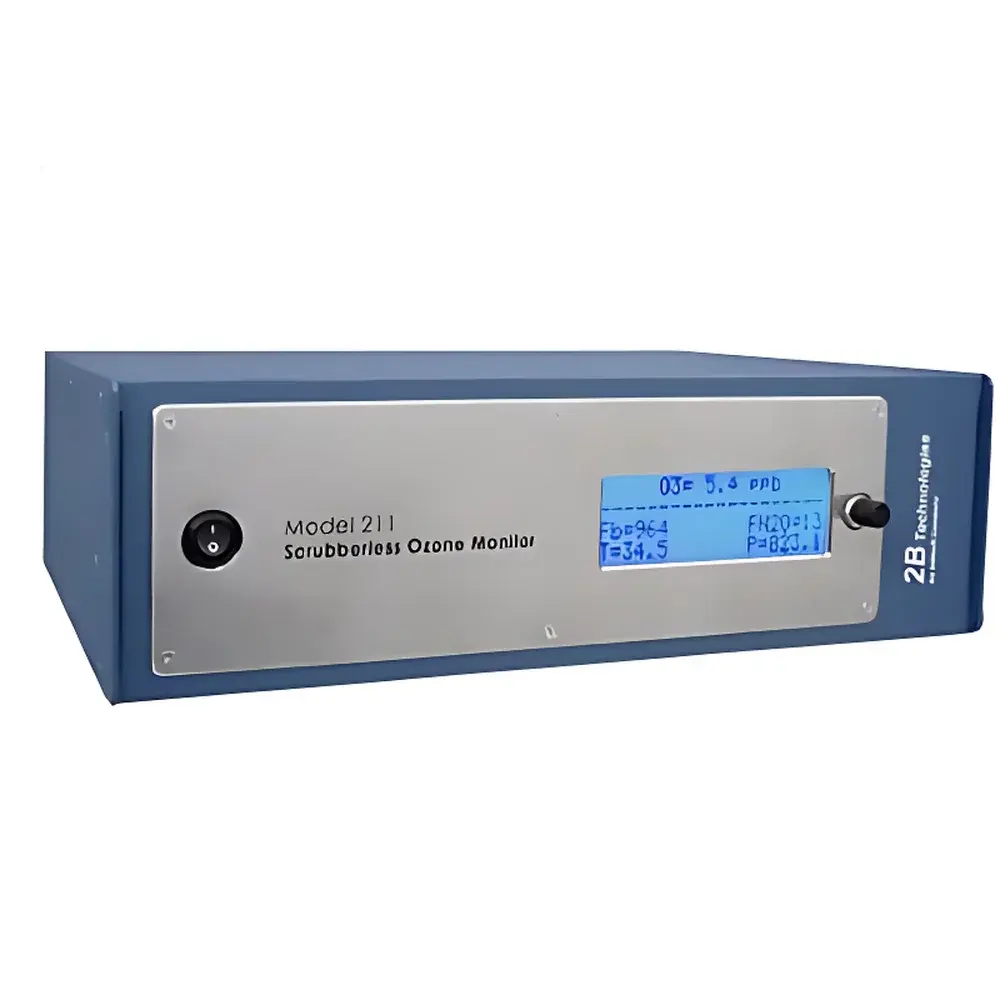
2B Technologies Model 211 Zero-Scrub Ozone Analyzer
| Brand | 2B Technologies |
|---|---|
| Origin | USA |
| Model | Model 211 |
| Instrument Type | Portable |
| Measurement Range | ppm |
| Limit of Detection | 1 ppb |
| Response Time | 2 s |
| Zero Drift | <0.5 %/day, <3 %/year |
| Resolution | 0.1 ppb |
| Operating Temperature | 10–50 °C |
| Power Supply | 11–14 V DC or 120/240 V AC, 8 W |
| Dimensions | 43 × 37 × 14 cm |
| Weight | 6.5 kg (14.3 lb) |
| Data Outputs | USB, RS-232, 0–2.5 V analog, optional 4–20 mA |
| Internal Memory | 16,333 records (scalable via USB flash drive) |
| Pressure & Temperature Compensation | Yes |
| DewLine™ Humidity Compensation | Yes |
| Flow Meter | Optional |
| Built-in Pump Lifetime | 20,000 hours |
Overview
The 2B Technologies Model 211 Zero-Scrub Ozone Analyzer is a field-deployable, dual-beam ultraviolet (UV) absorption spectrometer engineered for high-fidelity ozone (O3) quantification in ambient air and complex industrial environments. Unlike conventional UV photometers that rely solely on optical pathlength and Beer–Lambert law calibration, the Model 211 integrates a chemically selective gas-phase scrubbing technique—using precisely metered nitric oxide (NO) to stoichiometrically remove ozone from the sample stream—enabling true zero-reference measurement without mechanical scrubbers or catalytic converters. This approach eliminates baseline drift induced by particulate fouling, mercury vapor, VOC interference, or window contamination—common failure modes in long-term urban, roadside, or stack monitoring applications. The instrument operates at 254 nm, where ozone exhibits strong, well-characterized molar absorptivity (ε ≈ 1.17 × 10⁴ L mol−1 cm−1), and employs real-time pressure and temperature correction to maintain traceable accuracy across altitudes up to 30 km. Its architecture complies with EPA Reference Method EQOA-0111 for ozone monitoring and aligns with ISO 13964:2022 (ambient air—determination of ozone—UV photometric method).
Key Features
- Dual-beam UV absorption design with active reference channel for continuous optical drift compensation
- Gas-phase chemical scrubbing using externally supplied or internally generated NO—eliminates need for consumable scrubber cartridges or heated catalysts
- DewLine™ integrated humidity compensation algorithm minimizes water vapor spectral interference at 254 nm
- Onboard 20,000-hour diaphragm pump with integrated flow meter (optional) for stable, pulse-free sampling at 0.5–2.0 L/min
- Full parameter configurability via intuitive front-panel menu: averaging intervals (2 s to 1 h), output units (ppb, ppm, μg/m³, mg/m³), pressure/temperature correction toggle
- Comprehensive data logging: 16,333 internal records + unlimited expansion via USB flash storage (FAT32 formatted)
- Multi-protocol connectivity: RS-232 (2400/4800/19200 bps), USB virtual COM port, 0–2.5 V analog output, and optional 4–20 mA current loop
- Robust environmental rating: operational range 10–50 °C; designed for unattended deployment in mobile labs, rooftop stations, and UAV-mounted platforms
Sample Compatibility & Compliance
The Model 211 is validated for direct analysis of undiluted ambient air, flue gas (with optional heated inlet), and indoor air samples containing elevated levels of PM2.5, SO2, NOx, formaldehyde, and elemental mercury—none of which interfere with the NO–O3 reaction kinetics or UV absorbance at 254 nm. It meets U.S. EPA Performance Specification PS-2 for ozone analyzers and satisfies key requirements of ISO/IEC 17025:2017 for laboratory-developed methods. When configured with time-stamped audit logs and user-accessible calibration history, the system supports GLP and 21 CFR Part 11 compliance when used with 2B’s Traceable Calibration Software (TCS v3.2+). All firmware updates and calibration certificates are NIST-traceable and include uncertainty budgets per GUM (JCGM 100:2008).
Software & Data Management
2B’s proprietary DataWizard™ software provides real-time visualization, configurable alarm thresholds, and export-ready CSV/Excel reports with embedded metadata (GPS coordinates, barometric pressure, relative humidity). Raw absorbance ratios, scrubbed/unscrubbed intensities, and diagnostic flags (e.g., lamp intensity decay, flow deviation >±5%) are stored alongside concentration values. For networked deployments, optional Bluetooth 5.0 or cellular telemetry modules enable remote firmware updates, parameter reconfiguration, and secure TLS-encrypted data transmission to cloud platforms (e.g., AWS IoT Core, ThingSpeak). Internal memory management supports circular buffering and event-triggered logging—ideal for episodic pollution events such as wildfire plumes or industrial releases.
Applications
- Ambient air quality monitoring networks (EPA SLAMS, EEA AirBase)
- Mobile emissions testing: vehicle exhaust plume characterization, tunnel studies, and roadside gradient mapping
- Indoor air quality assessment in hospitals, cleanrooms, and semiconductor fabrication facilities
- Validation of ozone destruction units (e.g., catalytic converters, UV reactors) in wastewater treatment plants
- Atmospheric chemistry research: ozonesonde launches, aircraft-based profiling, and photolysis rate studies
- Regulatory compliance reporting under EU Directive 2008/50/EC and U.S. NAAQS (40 CFR Part 50)
FAQ
How does the “zero-scrub” technique differ from traditional ozone scrubbers?
The Model 211 uses gaseous NO to quantitatively convert O3 to NO2 in the sample stream—creating a true chemical zero—rather than relying on manganese dioxide or activated carbon cartridges that degrade, saturate, or introduce memory effects.
Is external NO supply mandatory?
No. An optional photolytic NO generator (Model 405-PG) produces ultra-pure NO on demand from compressed air and UV light—eliminating cylinder logistics and enabling year-long unattended operation.
Can the instrument operate at high altitude or low pressure?
Yes. Real-time barometric pressure input enables automatic pathlength correction per the ideal gas law; validated performance up to 30 km (100 hPa) with optional pressure sensor.
What maintenance is required for long-term field deployment?
Annual lamp intensity verification, biannual optical window inspection, and periodic pump filter replacement—no recalibration needed between NIST-traceable annual audits.
Does the Model 211 support remote diagnostics?
Yes. RS-232/USB command set includes live status queries (lamp voltage, detector gain, flow rate, scrub efficiency), enabling predictive maintenance via SCADA or custom Python scripts.
Related Products







