
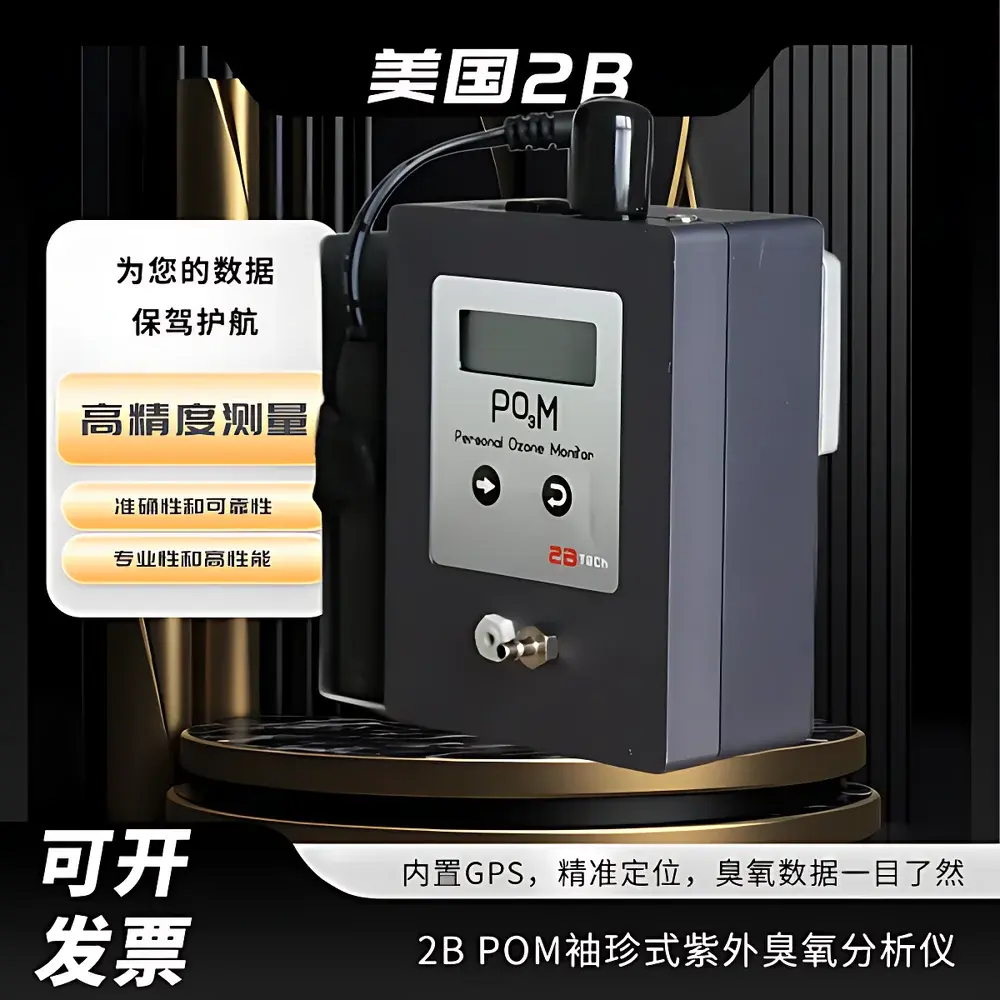
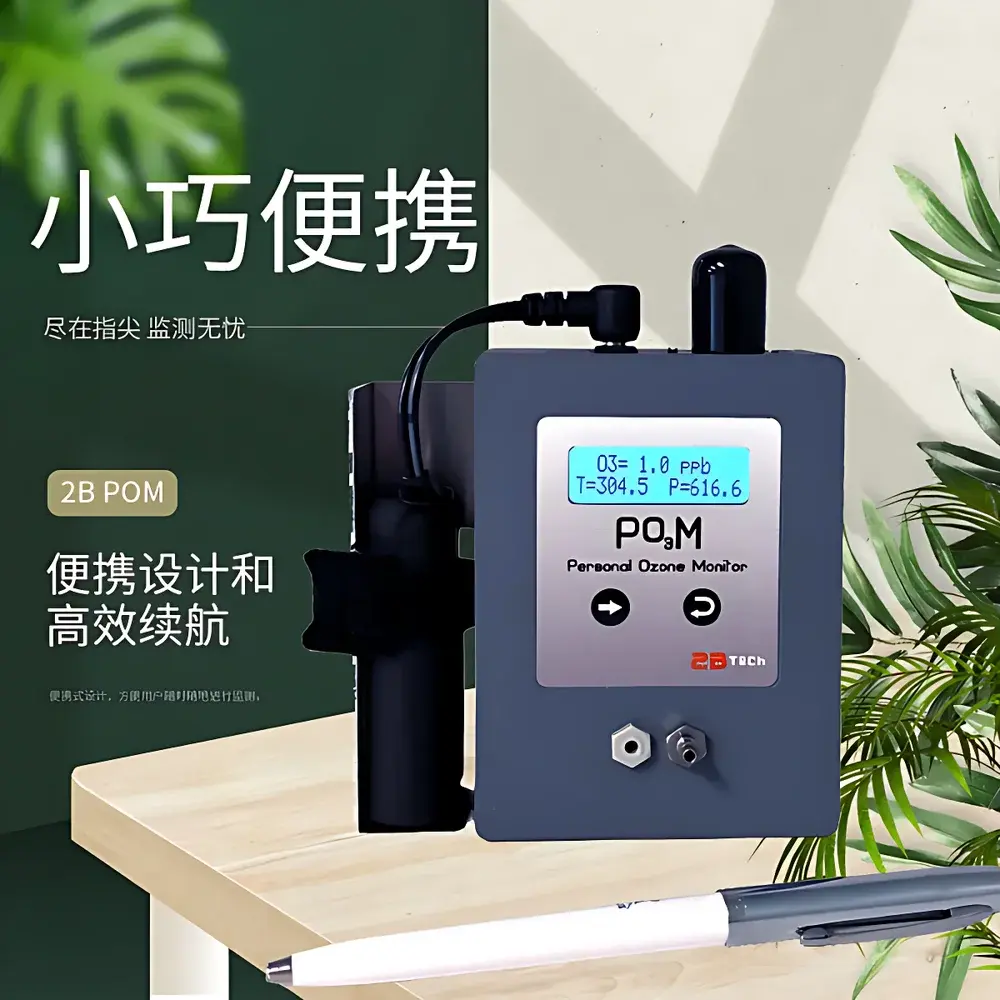
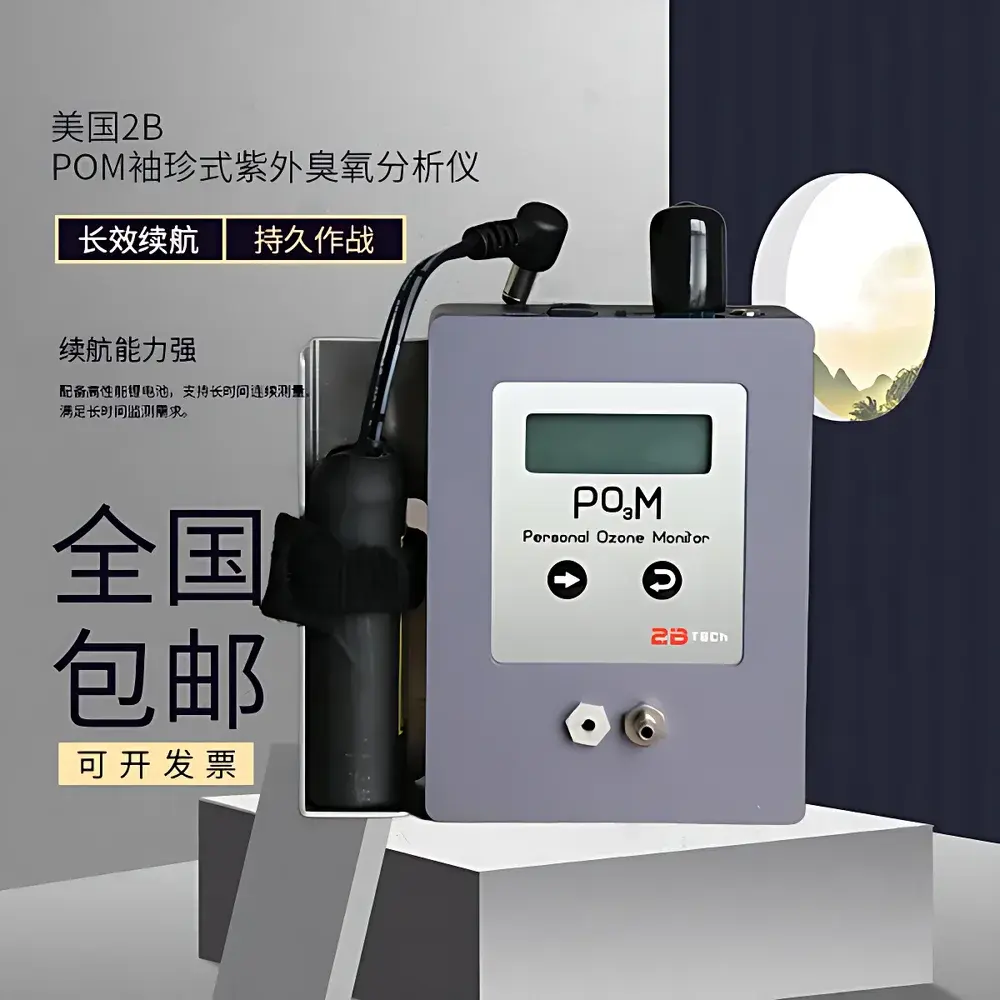
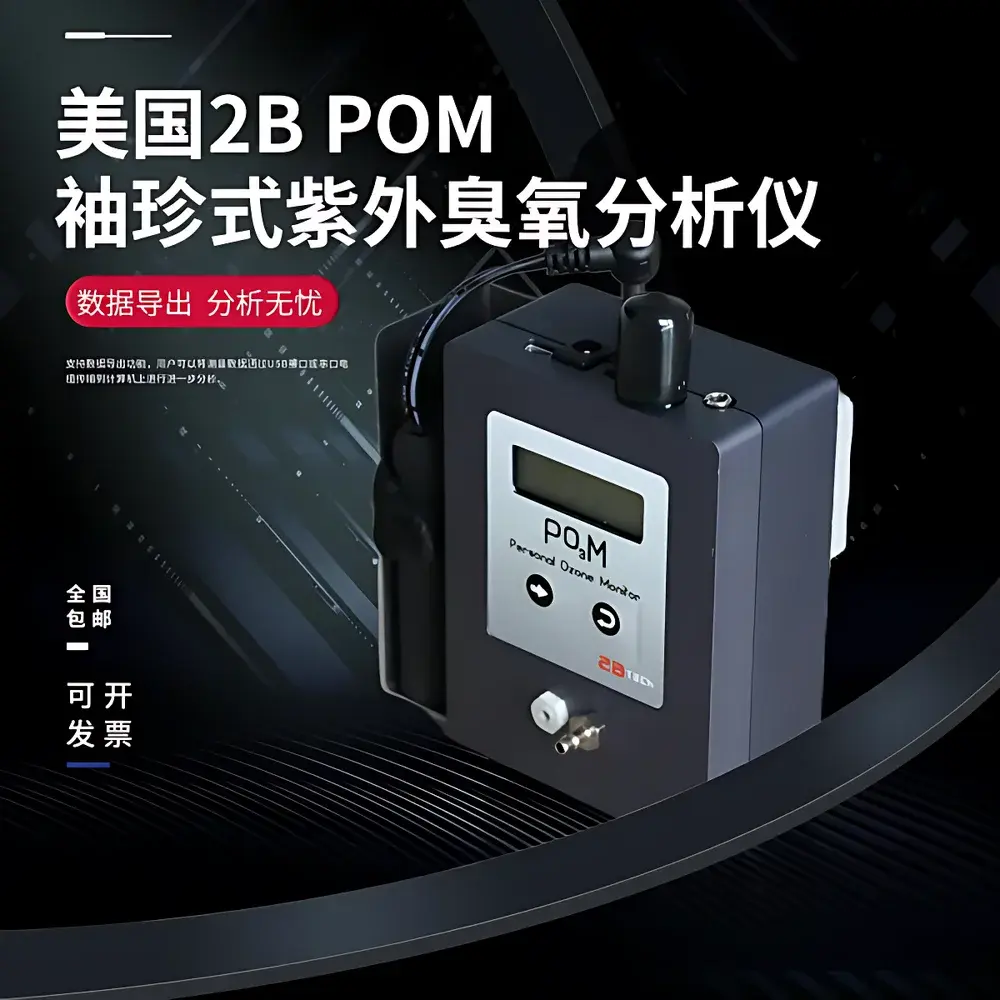
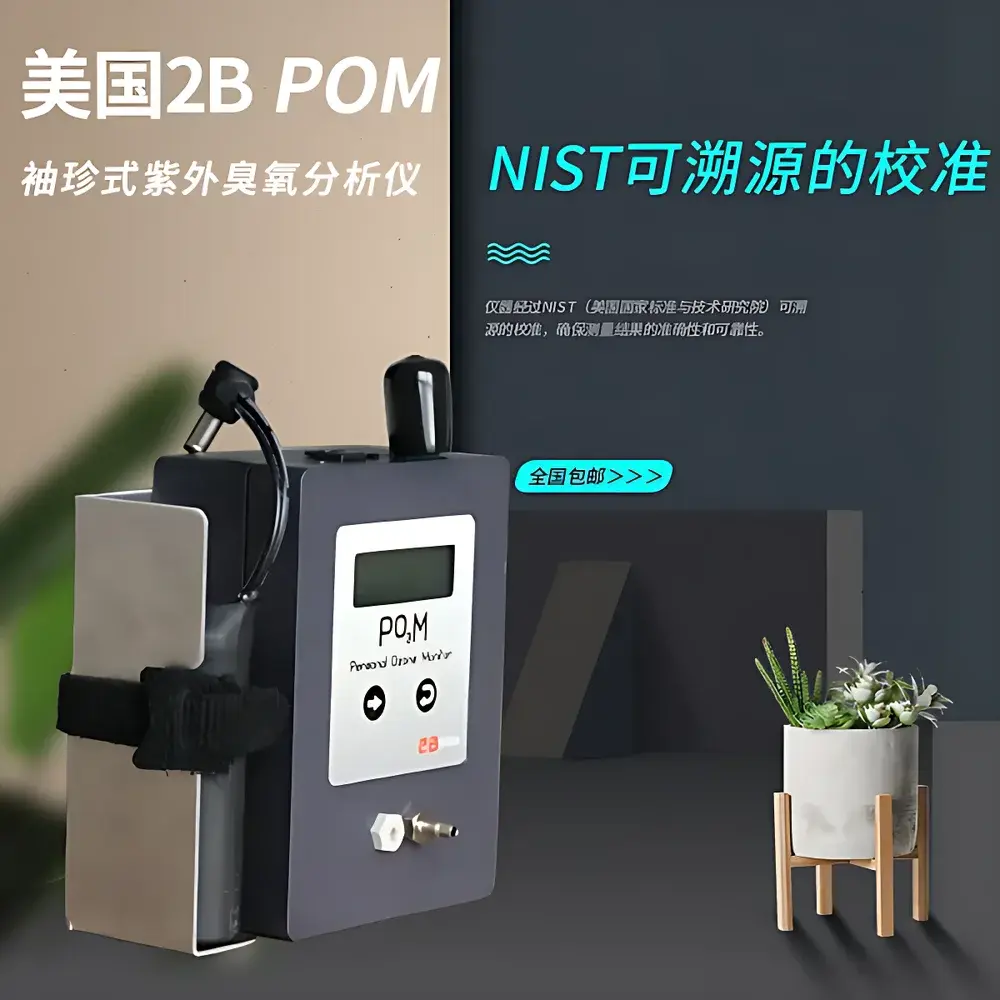
2B Technologies POM Portable UV Absorption Ozone Analyzer
| Brand | 2B Technologies |
|---|---|
| Origin | USA |
| Model | POM |
| Instrument Type | Portable |
| Measurement Range | 0–10 ppm |
| LOD | 4 ppb |
| Response Time | 10 s |
| Zero Drift | 1.5 ppb |
| Resolution | 1 ppb |
| Detection Principle | UV Absorption at 254 nm |
| FEM Designation | EQOA-0815-227 |
| NIST-Traceable Calibration | Yes |
| Operating Temperature | 0–50 °C |
| Pressure Range | 150–1013 mbar |
| Data Storage Capacity | 8,192 records |
| Power | 7.4 V Li-ion battery (5–8 h) or AC adapter (100–240 VAC to 12 VDC) |
| Dimensions (with GPS) | 12.7 × 7.6 × 3.8 cm |
| Weight (with battery) | 450 g |
Overview
The 2B Technologies POM (Portable Ozone Monitor) is a compact, field-deployable ozone analyzer engineered for high-fidelity ambient and occupational ozone monitoring using the well-established principle of ultraviolet absorption at 254 nm. Based on Beer–Lambert law quantification, the POM employs a folded U-shaped optical path to achieve an effective path length comparable to that of 2B’s benchtop models (e.g., Models 202, 205, and 106-L), enabling laboratory-grade accuracy (~2 ppb) in a palm-sized package. Its design complies with U.S. EPA Federal Equivalent Method (FEM) EQOA-0815-227, confirming its suitability for regulatory-grade data collection in air quality networks and exposure assessment studies. The instrument integrates real-time GPS geotagging, pressure and temperature compensation, and DewLine™ moisture management—ensuring stable performance across diverse environmental conditions, from sea-level urban sites to high-altitude balloon-borne platforms.
Key Features
- UV photometric detection at 254 nm with NIST-traceable calibration and documented uncertainty budget
- Folded optical path architecture delivering ~2 ppb accuracy and <1.5 ppb zero drift over 24 hours
- Integrated GPS module for synchronized spatial–temporal ozone logging (latitude, longitude, altitude, UTC timestamp)
- DewLine™ active humidity control to suppress water vapor interference without consumables or purge gas
- Multi-interval data acquisition: configurable averaging periods (10 s, 1 min, 5 min, 1 h) and fast mode (2 s resolution)
- Onboard non-volatile memory storing up to 8,192 data points with automatic timestamping and metadata tagging
- Robust power architecture supporting dual-mode operation: rechargeable 7.4 V Li-ion battery (5–8 h runtime) or universal AC/DC adapter (100–240 VAC input)
- Compliant with ISO 17025-aligned calibration documentation, including full NIST-traceable certificate and factory baseline report
Sample Compatibility & Compliance
The POM is optimized for continuous sampling of ambient air, indoor workplace air, and stratospheric/tropospheric air collected via UAVs, tethered balloons, or light aircraft. It requires no external scrubbers, zero-air generators, or catalytic converters—only a minimum sample flow of 0.5 L/min (nominal flow: 0.8 L/min). Its pressure and temperature compensation algorithms adhere to ISO 11355-1 and ASTM D5012 standards for trace gas measurement under variable meteorological conditions. As an EPA-recognized FEM instrument, it satisfies data quality objectives (DQOs) for regulatory reporting under 40 CFR Part 58 and supports GLP-compliant audit trails when used with 2B’s Display Software (v4.0+), which logs all configuration changes, calibration events, and firmware updates with user authentication.
Software & Data Management
Data retrieval and configuration are managed via 2B’s cross-platform Display Software (Windows/macOS/Linux), which provides real-time visualization, export to CSV/Excel, and automated metadata embedding (GPS coordinates, barometric pressure, sensor temperature). The software supports FDA 21 CFR Part 11–compliant audit trail generation—including operator ID, timestamped parameter modifications, and electronic signature capture—when deployed in regulated environments such as occupational health surveillance or clinical exposure studies. All firmware updates are digitally signed and validated prior to installation. Raw serial output (19200 baud) enables integration with third-party SCADA systems, IoT gateways, or custom Python/Matlab analysis pipelines via standard ASCII protocol.
Applications
- Personal exposure assessment in epidemiological studies linking ozone concentration gradients to respiratory outcomes
- Mobile monitoring campaigns using backpack-mounted, vehicle-mounted, or drone-deployed configurations
- Vertical profiling of tropospheric ozone layers via radiosonde or UAV payloads (operational up to 13.5 km / ~150 mbar)
- Long-term unattended operation in remote or off-grid locations using solar-charged battery banks
- Calibration transfer and intercomparison exercises between reference-grade analyzers and low-cost sensor networks
- Industrial hygiene compliance monitoring per OSHA PEL (0.1 ppm TWA) and ACGIH TLV (0.05 ppm TWA)
FAQ
Is the POM certified as a Federal Equivalent Method (FEM) by the U.S. EPA?
Yes—the POM is designated EQOA-0815-227 under 40 CFR Part 53, validating its equivalence to reference method performance criteria for ambient ozone monitoring.
Does the instrument require zero-air or span gas for routine operation?
No. The POM operates autonomously using internal optical zero referencing and does not require external zero-air sources or calibration gases during field deployment.
Can the POM be used above 50 °C or below 0 °C?
The specified operating range is 0–50 °C. Extended-range variants with enhanced thermal management are available upon request for specialized applications.
How is NIST traceability established for each unit?
Each POM ships with a unique calibration certificate documenting multi-point ozone generation against NIST SRM 2691a, including uncertainty budgets per GUM (JCGM 100:2008) and full linearity verification across 0–10 ppm.
What GPS specification does the integrated module meet?
The embedded GPS receiver conforms to ICAO Annex 10 standards, providing position accuracy ≤3 m CEP (95% confidence) and time synchronization traceable to UTC(NIST) via GNSS signals.







