
2mag Stirring Hotplate 15 — 15-Position Induction Magnetic Stirrer with Integrated PTFE-Coated Aluminum Heating Plate
| Brand | 2mag |
|---|---|
| Origin | Germany |
| Model | Stirring Hotplate 15 |
| Max. Stirring Volume per Position | 1,000 mL |
| Speed Range | 100–2,000 rpm |
| Temperature Range | +40 °C to +200 °C |
| Stirring Positions | 15 |
| Stirring Point Spacing | 65 mm |
| Stirring Power | 40 W per position |
| Power Setting | 10-step (10–100%) |
| Heating Output | 1,200 W at 230 V |
| Plate Material | Anodized Aluminum with PTFE Coating |
| Dimensions (W×D×H) | 250 × 430 × 75 mm |
| Weight | ~13.0 kg |
| IP Rating | IP20 |
| Voltage | 230 V AC |
Overview
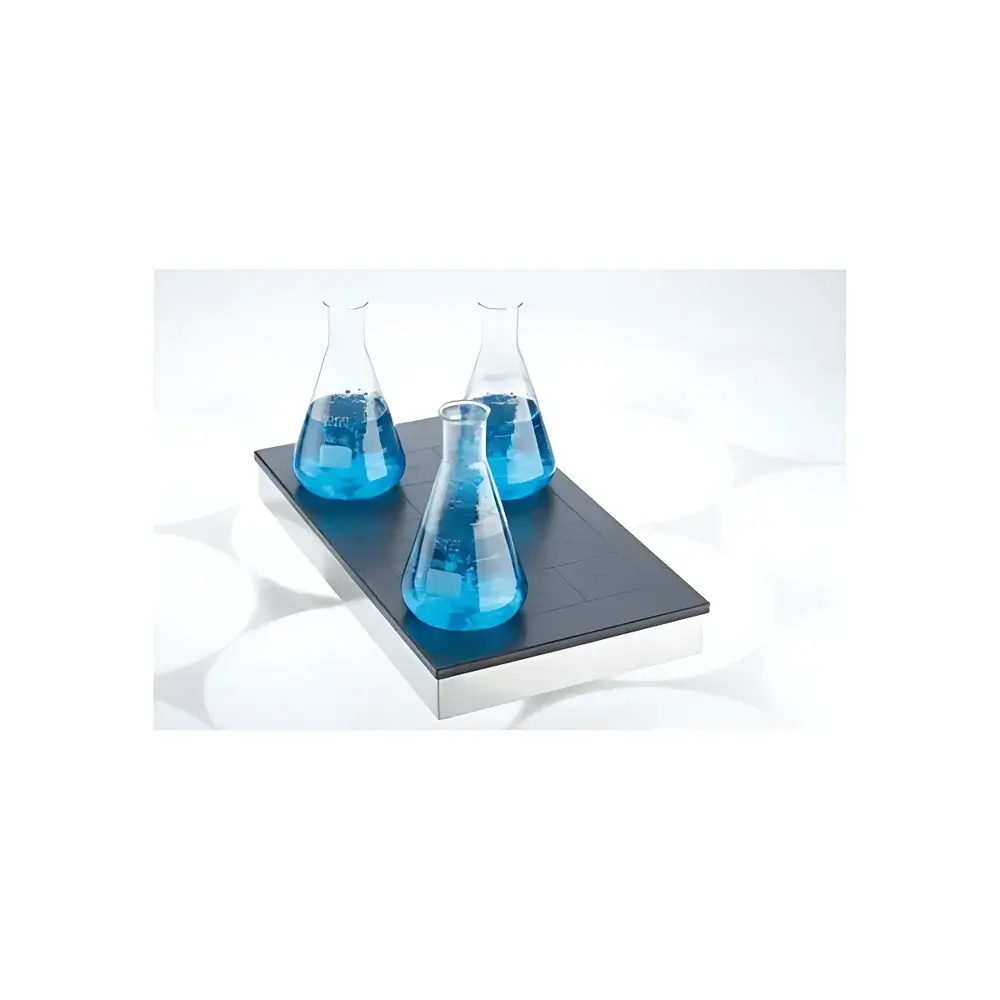
The 2mag Stirring Hotplate 15 is a high-precision, multi-position laboratory heating and stirring system engineered for reproducible, long-term operation in demanding R&D, quality control, and production environments. Unlike conventional hotplate stirrers relying on mechanical drive shafts or brushed motors, this unit employs 2mag’s proprietary induction-based magnetic drive technology—eliminating physical contact between the motor and stir bar, thereby ensuring zero wear, no maintenance intervals, and full synchronization across all 15 positions even at low rotational speeds (100 rpm). The system integrates a thermally optimized, PTFE-coated anodized aluminum heating plate with uniform thermal distribution and active PowerDetect compensation, which dynamically adjusts heating output to counteract power loss induced by viscous loads or elevated ambient temperatures—maintaining setpoint stability within ±1.5 °C across the full 40–200 °C range. Designed for continuous unattended operation under GLP-compliant workflows, the unit features internal overtemperature cutoff, corrosion-resistant stainless steel housing, and electronic protection against condensation and chemical vapor ingress.
Key Features
- 15 independent stirring positions with precise 65 mm center-to-center spacing—optimized for simultaneous use of standard 250 mL to 1,000 mL vessels including round-bottom flasks, beakers, and custom reactor tubes.
- Induction-driven magnetic stirring mechanism (wirbel_mini technology) delivering 100–2,000 rpm with SoftStart functionality for reliable stir bar capture, centring, and controlled acceleration—critical for shear-sensitive samples and low-viscosity solvents.
- PTFE-coated anodized aluminum heating surface offering superior chemical resistance, non-stick performance, and ease of decontamination—validated for compatibility with organic solvents, aqueous buffers, and mild acids/bases.
- Digital dual-display interface showing real-time speed (rpm), power level (%), and plate temperature (°C); all parameters adjustable via intuitive rotary encoder with tactile feedback.
- 10-stage power regulation (10–100%) enabling fine-tuned torque delivery—high-power mode supports viscous media (e.g., polymer solutions, cell culture matrices), while low-power settings prevent splashing or vortex collapse in low-volume micro-reactions.
- Integrated PowerDetect algorithm continuously monitors load-dependent power absorption and compensates heating output up to 40% to maintain thermal setpoint fidelity during dynamic mixing conditions.
Sample Compatibility & Compliance
The Stirring Hotplate 15 accommodates a broad range of vessel geometries and materials—including borosilicate glass, polypropylene, PTFE-lined containers, and stainless steel reactors—without requiring adapter plates or position-specific calibration. Its open-platform design supports both vertical and angled vessel orientation, making it suitable for parallel synthesis, dissolution testing (per USP <711>), and accelerated stability studies (ICH Q1A). The device conforms to IEC 61010-1:2010 for electrical safety in laboratory equipment and meets EN 61326-1:2013 for electromagnetic compatibility. While not intrinsically rated for hazardous locations, its IP20 enclosure is appropriate for cleanroom Class 8 (ISO 14644-1) and general-purpose lab environments operating under ISO/IEC 17025-accredited quality systems. Optional documentation packages support traceable calibration (NIST-traceable RTD verification), audit-ready maintenance logs, and 21 CFR Part 11–compliant electronic record generation when paired with validated third-party LIMS interfaces.
Software & Data Management
The heatMIXcontrol unit operates as a standalone embedded controller with no external PC dependency; however, it supports RS-232 serial communication (ASCII protocol) for integration into centralized lab automation frameworks. Through standardized command sets, users can remotely initiate/stops sequences, query real-time parameters (speed, temp, power), and log timestamped operational data to external SCADA or ELN platforms. Firmware updates are performed via USB port using signed binary files—ensuring integrity and version control. All parameter changes are recorded in a non-volatile event log with UTC timestamps, supporting GLP audit trails for method validation and process deviation investigations. No cloud connectivity or proprietary software installation is required, preserving network security boundaries in regulated pharmaceutical or academic core facilities.
Applications
- Chemical Synthesis: Parallel reaction screening across 15 vessels with synchronized heating/stirring—ideal for catalyst optimization, solvent effect studies, and kinetic profiling under controlled thermal ramping.
- Pharmaceutical Development: Dissolution testing per USP Apparatus II (paddle), excipient blending validation, and buffer preparation with temperature-stabilized pH equilibration.
- Biotechnology: Gentle agitation of mammalian cell cultures in multi-well formats, microbial growth assays, and enzyme activity assays requiring strict thermal consistency across replicates.
- Materials Science: Nanoparticle dispersion in polymer matrices, sol-gel precursor homogenization, and rheological preconditioning of viscoelastic formulations prior to downstream characterization.
- Environmental & Food Testing: Extraction efficiency studies (e.g., Soxhlet alternatives), heavy metal leaching protocols (EPA Method 1311), and standardized digestions per AOAC guidelines.
FAQ
What is the maximum recommended vessel height for stable operation?
Vessels up to 250 mm tall may be used; however, optimal vortex formation and thermal coupling are achieved with standard 100–200 mm tall cylindrical containers placed centrally over each stirring point.
Can the unit operate without heating while maintaining stirring function?
Yes—the heating element and magnetic drive circuits are fully decoupled; stirring-only mode is selectable and maintains full speed and power control range.
Is calibration certificate included with shipment?
A factory-issued conformity statement is provided; NIST-traceable calibration certificates (including temperature uniformity mapping and speed accuracy verification) are available as optional add-ons upon order.
What maintenance is required during routine use?
None—induction drive eliminates brushes, gears, or bearings; only periodic cleaning of the PTFE-coated surface with isopropanol or mild detergent is recommended.
Does the unit support programmable temperature ramps or multi-step protocols?
No—this is a manually operated analog/digital hybrid instrument without built-in programmable logic; however, external PLC or LabVIEW integration enables full sequence automation via RS-232 commands.



