
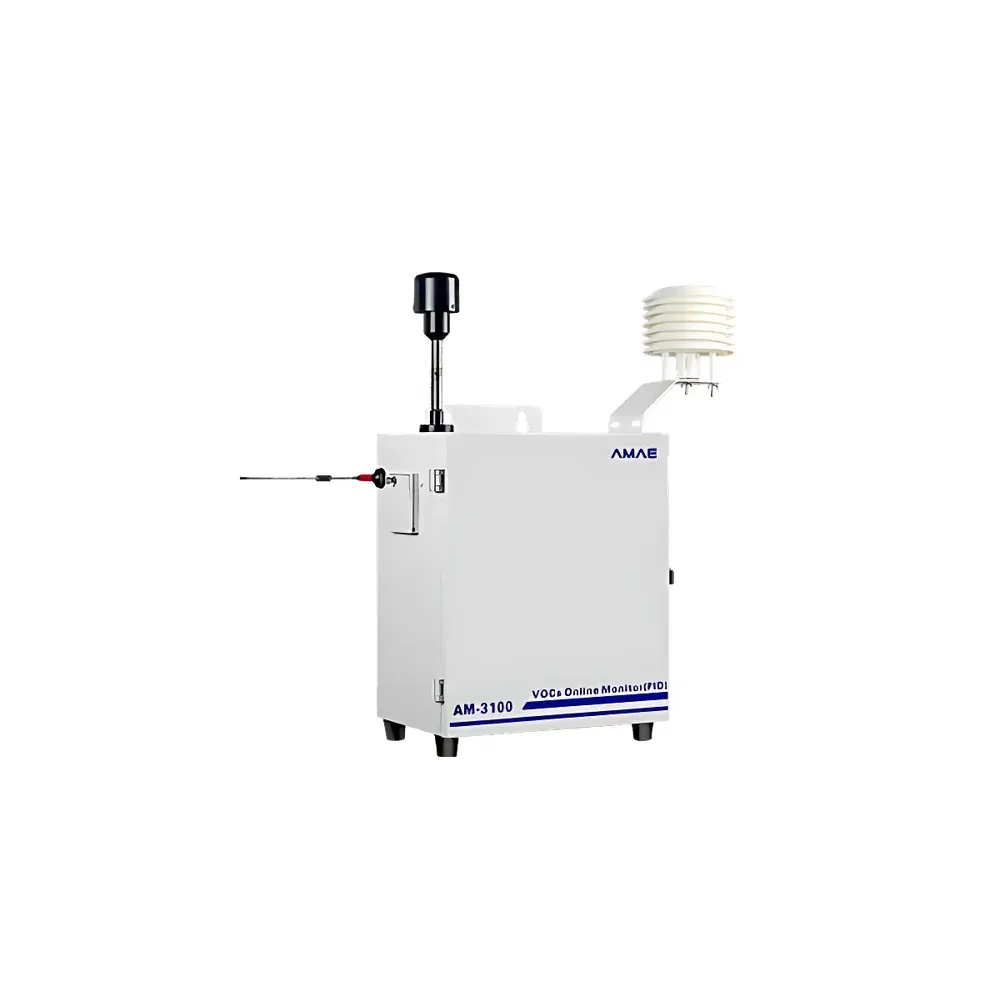
AM-3100 TVOC Online Monitoring System by AMAE
| Brand | AMAE |
|---|---|
| Origin | Jiangsu, China |
| Model | AM-3100 |
| Detection Principle | Photoionization Detection (PID) with 10.6 eV UV Lamp |
| Measurement Range | 0–10,000 ppb (as isobutylene equivalent) |
| Detection Limit | ≤1 ppb (typical) |
| Response Time (T90) | <30 s |
| Operating Temperature | 0–45 °C |
| Humidity Range | 0–90% RH (non-condensing) |
| Data Storage Capacity | ≥3 years of continuous 1-minute interval data and system logs |
| Power Supply | 220 VAC ±10%, 50 Hz with integrated UPS backup |
| Communication Interfaces | RS485, RS232, Ethernet (Modbus TCP/RTU, HTTP API), optional 4G/LTE module |
| Enclosure Rating | IP54 |
| Dimensions | 482 × 360 × 177 mm (19″ rack-mountable) |
| Compliance | CE, RoHS, GB/T 3836.1–2010 (Explosion-Proof Optional) |
Overview
The AM-3100 TVOC Online Monitoring System is a compact, industrial-grade continuous emission monitoring system engineered for real-time quantification of total volatile organic compounds (TVOC) in ambient air or process streams. It employs photoionization detection (PID) technology using a stable, high-output 10.6 eV ultraviolet lamp—optimized to ionize a broad spectrum of VOCs including aromatics, ketones, aldehydes, esters, and aliphatic hydrocarbons while minimizing interference from common background gases (e.g., CO₂, N₂, O₂, H₂O vapor). Unlike flame ionization detectors (FID), the AM-3100 operates at ambient temperature and requires no hydrogen fuel or combustion, making it intrinsically safe for indoor and semi-outdoor deployment. The system integrates sample acquisition, conditioned gas handling, PID-based signal transduction, embedded control logic, and secure data telemetry into a single 19-inch rack-mountable chassis. Its design targets long-term unattended operation in environmental monitoring stations, industrial hygiene zones, cleanroom environments, semiconductor fab utilities, and indoor air quality (IAQ) management systems.
Key Features
- Modular architecture: Independent plug-in modules for sampling, gas conditioning, PID sensing, power management, and communications enable field-replaceable maintenance and functional scalability without system downtime.
- Integrated gas conditioning: Built-in particulate filter, hydrophobic membrane-based water trap, and activated carbon pre-scrubber remove aerosols, moisture, and interfering low-molecular-weight organics prior to PID cell entry—enhancing sensor longevity and measurement stability.
- Expandable configuration: Optional automated zero/span calibration module supports scheduled drift correction using certified standard gas cylinders; additional sensor slots accommodate co-monitoring of CO, NO₂, O₃, or H₂S via electrochemical or metal oxide semiconductor (MOS) sensors.
- High-fidelity PID source: Sealed, quartz-windowed 10.6 eV krypton-based UV lamp ensures consistent photon flux and spectral purity over >12,000 hours of operational life—critical for reproducible ionization efficiency across compound classes.
- Uninterruptible operation: Integrated UPS provides ≥30 minutes of battery-backed runtime during mains failure, enabling full transmission of alarm states, final readings, and system health metadata before graceful shutdown.
- Embedded data integrity: Local storage utilizes industrial-grade SLC NAND flash supporting write endurance >100,000 cycles; time-stamped raw signals, diagnostic logs, calibration records, and event flags are retained for ≥3 years at 1-minute resolution.
Sample Compatibility & Compliance
The AM-3100 is validated for use with ambient air, ducted ventilation exhaust, and low-particulate indoor air streams. It complies with national standards GB/T 18883–2022 (Indoor Air Quality) and HJ 683–2014 (Ambient Air – Determination of Carbonyl Compounds by HPLC), serving as a reference-grade screening tool aligned with ISO 16000-29 for TVOC assessment. While not certified for hazardous area installation out-of-the-box, explosion-proof variants (Ex d IIB T4) are available upon request. All firmware and data handling protocols adhere to GLP principles, supporting audit-ready traceability—including user access logs, parameter change history, and calibration certificate linkage. Raw output conforms to IEEE 1451.2 TEDS templates for sensor metadata interoperability.
Software & Data Management
The system ships with AMAE’s WebAccess™ embedded web server (HTTPS-enabled), allowing browser-based configuration, real-time waveform visualization, and historical trend replay without client software. Data export supports CSV, JSON, and XML formats compliant with EPA Method TO-15 and EU Directive 2008/50/EC reporting structures. For enterprise integration, RESTful APIs and Modbus TCP registers expose live values, status flags, and maintenance alerts to SCADA, BMS, or cloud platforms (e.g., AWS IoT Core, Microsoft Azure IoT Hub). All remote commands require role-based authentication (RBAC), and firmware updates are cryptographically signed to prevent unauthorized modification—meeting baseline requirements for FDA 21 CFR Part 11 electronic record controls.
Applications
- Continuous workplace exposure monitoring per OSHA PEL and ACGIH TLV® guidelines in chemical manufacturing, painting booths, and printing facilities.
- Real-time IAQ assurance in hospitals, schools, office buildings, and data centers—triggering HVAC response when TVOC exceeds 500 µg/m³ (WHO-recommended threshold).
- Leak detection and fugitive emission surveillance at refinery perimeters, storage tank farms, and loading/unloading interfaces.
- Process validation support in pharmaceutical cleanrooms (ISO 14644-1 Class 5–8) where solvent residuals must remain below 1 ppmv.
- Regulatory compliance reporting for municipal ambient air monitoring networks under China’s “Blue Sky Defense Campaign” and provincial VOCs reduction mandates.
FAQ
What VOC compounds does the AM-3100 detect?
It responds to most VOCs with ionization potentials (IP) below 10.6 eV—including benzene, toluene, xylene, acetone, ethanol, formaldehyde (with reduced sensitivity), and styrene. Compounds with IP >10.6 eV (e.g., methane, ethane, Freons) are not detected.
Can the system operate in high-humidity environments?
Yes—the integrated hydrophobic membrane separator maintains stable performance up to 90% RH non-condensing; condensation in the sampling line must be prevented upstream via heated tubing or chiller-based dew point control.
Is factory calibration traceable to NIST standards?
Each unit is calibrated using isobutylene-certified gas standards (NIST-traceable, ±2% uncertainty); calibration certificates include multi-point linearity verification and zero drift assessment over 72-hour stabilization.
How frequently should field calibration be performed?
Under normal operation, quarterly span checks are recommended; in high-concentration or contaminated environments, monthly verification is advised per ISO 17025 quality assurance protocols.
Does the system support remote diagnostics and predictive maintenance?
Yes—embedded health monitoring tracks lamp intensity decay, sensor baseline drift, filter pressure drop, and communication latency; anomaly thresholds trigger proactive service alerts via email or SNMP trap.
Related Products







