
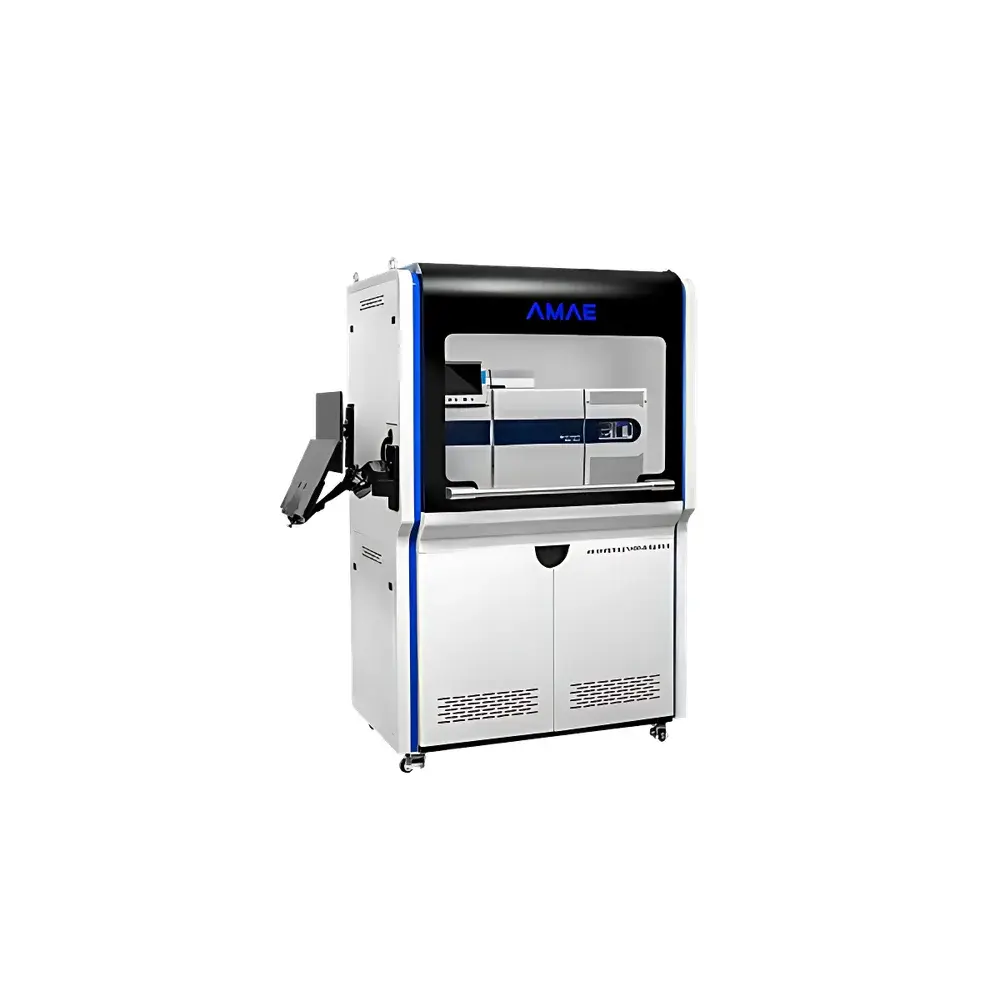
AM-3200 Series Ambient Air VOCs Online Monitoring System
| Brand | AMAE (Guoji Instruments) |
|---|---|
| Origin | Jiangsu, China |
| Model | AM-3200 Series |
| Detection Methods | Dual-FID + Optional GC-MS |
| Target Compounds | 57 PAMS VOCs (Dual-FID), up to 117 VOCs including TO-15 compounds and carbonyls (GC-MS mode) |
| Expandable to Odorants | H₂S, CH₃SH, CH₃SCH₃, CH₃SSCH₃, CS₂ |
| Sample Introduction | Continuous, cryo-trap-assisted preconcentration |
| System Inertness | High-inertness valves, tubing, and switching manifolds |
| Software | AMAE proprietary intelligent chromatographic analysis platform with automated peak identification, calibration management, and audit-ready data logging |
Overview
The AM-3200 Series Ambient Air VOCs Online Monitoring System is a fully integrated, laboratory-grade gas chromatography–based continuous emission monitoring system engineered for unattended, real-time quantification of volatile organic compounds (VOCs) in ambient air. Designed and manufactured by AMAE (Guoji Instruments), the system implements dual-channel gas chromatography coupled with flame ionization detection (GC-FID) as its primary analytical architecture—capable of resolving and quantifying all 57 PAMS (Photochemical Assessment Monitoring Stations) target VOCs with sub-part-per-trillion (pptv) detection limits and high chromatographic resolution across boiling point ranges from −42 °C (isoprene) to 191 °C (naphthalene). An optional GC–mass spectrometry (GC-MS) module extends analytical capability to 117 compounds, including EPA TO-15 priority analytes (e.g., chlorinated ethenes, benzene homologues), reactive carbonyls (formaldehyde, acetaldehyde, acetone), and polar oxygenates—enabling comprehensive speciation required for ozone precursor attribution, source apportionment, and regulatory compliance reporting.
Key Features
- Dual-FID architecture ensures redundancy, enhanced uptime, and cross-validated quantitative results—critical for long-term unattended operation in remote or urban ambient monitoring stations.
- Cryo-focused preconcentration with zero-blind-spot sampling: A continuously operated, temperature-programmable trap captures VOCs across full diurnal cycles without duty-cycle gaps, eliminating temporal aliasing and preserving true concentration dynamics.
- High-inertness fluidic path: All critical components—including heated valves, PTFE-lined transfer lines, and deactivated silica capillary columns—are selected and validated to minimize adsorption, catalytic decomposition, or memory effects—particularly essential for labile species such as formaldehyde, hydrogen sulfide, and methyl mercaptan.
- Modular expandability: The base platform supports seamless integration of additional analytical channels—e.g., sulfur chemiluminescence detection (SCD) or pulsed fluorescence (PF) modules—for simultaneous quantification of odorant compounds (H₂S, CH₃SH, CH₃SCH₃, CH₃SSCH₃, CS₂) without hardware redesign or downtime.
- Thermal desorption–gas chromatography (TD-GC) core: Employs standardized EPA TO-17 methodology principles for sample introduction, ensuring method traceability and compatibility with reference protocols used in national air quality networks.
Sample Compatibility & Compliance
The AM-3200 Series is validated for direct analysis of ambient air samples collected at flow rates of 0.5–2.0 L/min, with typical sampling intervals of 30–60 minutes per analysis cycle. It complies with fundamental performance criteria outlined in ISO 16000-6 (indoor air), EPA Method TO-14A/TO-15 (ambient air), and EU Directive 2008/50/EC Annex IX (VOC monitoring requirements). All hardware and firmware are designed to support GLP- and GMP-aligned operational practices: full electronic audit trails, user-access-level controls, calibration verification logs, and secure data export compliant with FDA 21 CFR Part 11 requirements when deployed in regulated environmental laboratories or municipal air quality control centers.
Software & Data Management
The system operates under AMAE’s proprietary ChromaView™ Intelligent Monitoring Platform—a Windows-based application built on .NET Framework with embedded SQL Server Express database. ChromaView provides automated baseline correction, retention time alignment, spectral deconvolution (for GC-MS mode), multi-point calibration curve generation (linear/non-linear), and real-time flagging of out-of-specification events (e.g., detector saturation, column bleed, trap breakthrough). Raw chromatograms, processed results, instrument status logs, and QA/QC reports are stored with immutable timestamps and SHA-256 hash integrity verification. Data export formats include CSV, XML (compatible with EEA AirBase schema), and direct OPC UA integration for SCADA-level telemetry into central environmental information systems (EIS).
Applications
- Ambient air quality monitoring networks (urban, suburban, industrial fence-line, background sites)
- Photochemical modeling input generation (O3 and PM2.5 precursor speciation)
- Source identification and receptor modeling (e.g., PMF, CMB) using compound-specific fingerprinting
- Compliance verification against local VOC emission standards (e.g., China’s HJ 1010–2018, US EPA NAAQS precursors)
- Odor impact assessment near wastewater treatment plants, landfills, and chemical manufacturing facilities
- Long-term trend analysis of anthropogenic vs. biogenic VOC contributions under climate change studies
FAQ
What VOC compound lists does the AM-3200 Series support out-of-the-box?
The dual-FID configuration covers all 57 PAMS compounds; the optional GC-MS module enables analysis of EPA TO-15 compounds, C2–C12 aldehydes/ketones, and select halogenated organics—totaling 117 analytes with library-match confidence scoring.
Is formaldehyde measurement reliable despite its reactivity?
Yes—the system incorporates a derivatization-free, cryo-focusing pathway with inertized stainless-steel and fused-silica surfaces, validated per ASTM D6196-19 for formaldehyde recovery >92% at 50 pptv level.
Can the system operate unattended for extended periods?
It supports fully autonomous 30-day operation with scheduled auto-calibration, leak diagnostics, and remote health monitoring via embedded SNMP/HTTP APIs.
Does the software meet regulatory data integrity requirements?
ChromaView™ includes full 21 CFR Part 11 functionality: role-based access control, electronic signatures, audit trail review tools, and exportable PDF/A-2 reports with digital signature embedding.
How is system performance verified during routine operation?
Built-in daily system suitability checks include retention time stability (±0.05 min), peak area RSD (<3%), and surrogate recovery tracking (e.g., deuterated toluene, d8-benzene) per EPA Method TO-15 QA/QC guidelines.
Related Products







