
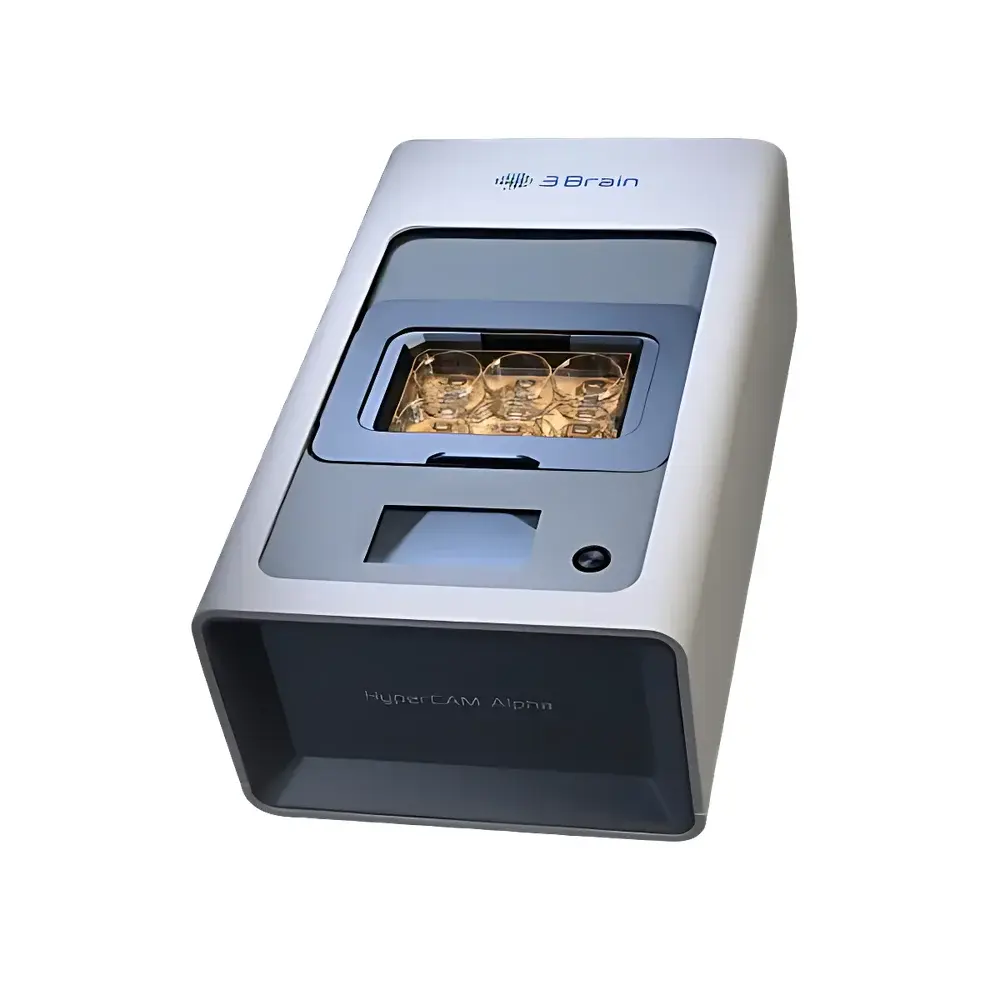
3Brain BioCAM DupleX High-Resolution Microelectrode Array (MEA) System
| Brand | 3Brain |
|---|---|
| Origin | USA |
| Manufacturer Type | Authorized Distributor |
| Origin Category | Imported |
| Model | BioCAM DupleX |
| Instrument Type | Multiwell |
| Application Scope | In Vitro |
| Electrode Count | 4096 |
| Compliance | CE, ISO 13485 (for research use only) |
| Software Platform | BrainWave v5.x |
| Data Format | HDF5, MATLAB-compatible |
| Environmental Control Support | Integrated temperature & CO₂ regulation (37 °C ± 0.2 °C, 5% CO₂ ± 0.1%) |
| Recording Bandwidth | DC–10 kHz |
| Input Noise | < 3.5 µV RMS (1–10 kHz) |
Overview
The 3Brain BioCAM DupleX High-Resolution Microelectrode Array (MEA) System is an advanced in vitro electrophysiology platform engineered for large-scale, long-term, and high-fidelity recording of extracellular electrical activity across neural and cardiac microtissues. Based on complementary metal-oxide-semiconductor (CMOS)-integrated microelectrode technology, the system enables simultaneous acquisition from 4096 low-noise electrodes arranged in a dense 64 × 64 array with 17.5 µm inter-electrode pitch—providing true subcellular spatial resolution at the single-neuron and synaptic level. Unlike conventional MEA systems limited to sparse electrode layouts (e.g., 60–256 electrodes), the BioCAM DupleX captures mesoscale network dynamics across millimeter-scale cultures with micron-level localization fidelity. Its dual-layer architecture supports concurrent recording and stimulation without cross-talk, enabling closed-loop interrogation of functional connectivity, spike timing-dependent plasticity, and network-level pharmacological responses. Designed for rigorous preclinical research, the system operates under fully controlled environmental conditions—including real-time regulation of temperature (37 °C ± 0.2 °C) and CO₂ (5% ± 0.1%)—ensuring signal stability over weeks to months of continuous culture monitoring.
Key Features
- 4096-channel CMOS-based microelectrode array with 17.5 µm pitch and < 3.5 µV RMS input noise (1–10 kHz), enabling single-unit spike sorting and subcellular field potential mapping.
- Dual-mode operation: simultaneous high-resolution recording and programmable biphasic electrical stimulation across arbitrary electrode subsets.
- CorePlate multiwell compatibility: supports standardized 6-, 24-, and 96-well formats with integrated fluidics interfaces for automated medium exchange and compound dosing.
- Modular hardware design: interchangeable chips (BioCAM DupleX, HyperCAM Alpha, HyperCAM Delta) optimized for distinct applications—e.g., acute slice electrophysiology (HyperCAM Alpha), long-term organoid maturation (BioCAM DupleX), or high-throughput screening (HyperCAM Delta).
- Real-time environmental control unit with PID-regulated heating and gas mixing, validated per ISO 13485 for consistent culture viability and electrophysiological reproducibility.
Sample Compatibility & Compliance
The BioCAM DupleX is validated for diverse in vitro biological preparations requiring stable, non-invasive, long-duration electrophysiological monitoring. Compatible specimens include primary rodent and human iPSC-derived neuronal cultures; cortical, hippocampal, and dopaminergic brain organoids; retinal organoids and explants; acute brain slices (200–400 µm); cardiomyocyte monolayers and microtissue constructs; and microfluidic organ-on-chip platforms integrating endothelial, neuronal, and epithelial compartments. All experimental workflows comply with GLP-aligned documentation standards, and raw data are stored in HDF5 format with embedded metadata (timestamp, electrode mapping, stimulus parameters, environmental logs) to support FDA 21 CFR Part 11–compliant audit trails when deployed in regulated environments. The system carries CE marking for research use only (RUO) and adheres to IEC 61000-4 electromagnetic compatibility standards.
Software & Data Management
BrainWave v5.x—the native acquisition and analysis suite—provides end-to-end pipeline automation from real-time visualization to publication-ready quantification. It delivers >73 preconfigured electrophysiological metrics, including spike rate, burst frequency, synchrony index (Pearson correlation across channels), network burst duration, inter-spike interval entropy, and functional connectivity graphs derived from cross-correlation and transfer entropy algorithms. Batch processing supports parallel analysis of multi-well datasets, while MATLAB and Python APIs (via PyMEAP) enable custom algorithm integration. All processed results are exportable in CSV, MAT, or NWB 2.0 formats, ensuring interoperability with established neuroinformatics frameworks such as Neurodata Without Borders and the Human Brain Project infrastructure.
Applications
- Longitudinal assessment of network maturation in human iPSC-derived cortical organoids over 60+ days.
- High-content neurotoxicity screening using multi-parameter readouts (e.g., spontaneous firing suppression, burst fragmentation, synchrony loss) in response to environmental toxins or pharmaceutical candidates.
- Pharmacological profiling of ion channel modulators (e.g., Nav, Kv, HCN) in stem-cell-derived cardiomyocytes under physiological pacing conditions.
- Closed-loop neuromodulation studies combining real-time spike detection with targeted electrical stimulation to probe causal network dynamics in epilepsy or Parkinson’s disease models.
- Validation of microphysiological systems (MPS) by correlating electrophysiological endpoints with transcriptomic and metabolic biomarkers across multi-omics experiments.
FAQ
What is the maximum recording duration supported by the BioCAM DupleX system?
Continuous recording is supported for up to 90 days under stable environmental control, with verified signal integrity and electrode impedance stability across all 4096 channels.
Can the system be integrated with existing incubators or perfusion setups?
Yes—the CorePlate interface supports third-party incubator integration via analog/digital I/O ports and RS-485 communication, enabling synchronized control of temperature, CO₂, and media flow rates.
Is spike sorting performed onboard or post-acquisition?
Spike detection and template matching occur in real time during acquisition; full waveform extraction and unsupervised clustering (e.g., Kilosort2, MountainSort) are executed offline using BrainWave’s integrated Python environment.
Does the system meet regulatory requirements for preclinical safety pharmacology studies?
While designated RUO, the system’s data provenance architecture, audit-log functionality, and HDF5 metadata schema align with ICH S7B and ICH E14 guidelines for thorough QT/QTc studies when used within validated laboratory workflows.
How is electrode calibration and impedance verification handled?
Automated daily impedance spectroscopy (1 Hz–10 MHz) is performed before each experiment; results are logged and visualized in BrainWave, with alerts triggered if any electrode exceeds 2 MΩ at 1 kHz.



