
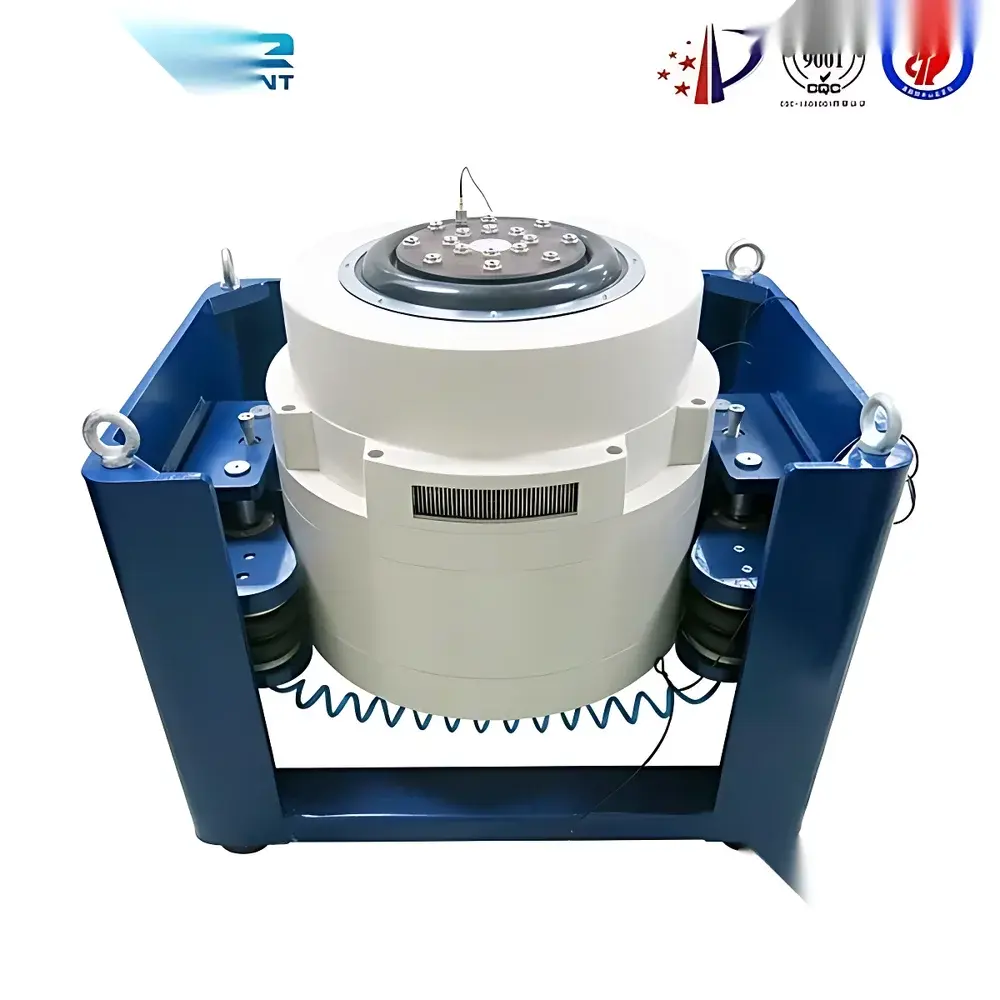
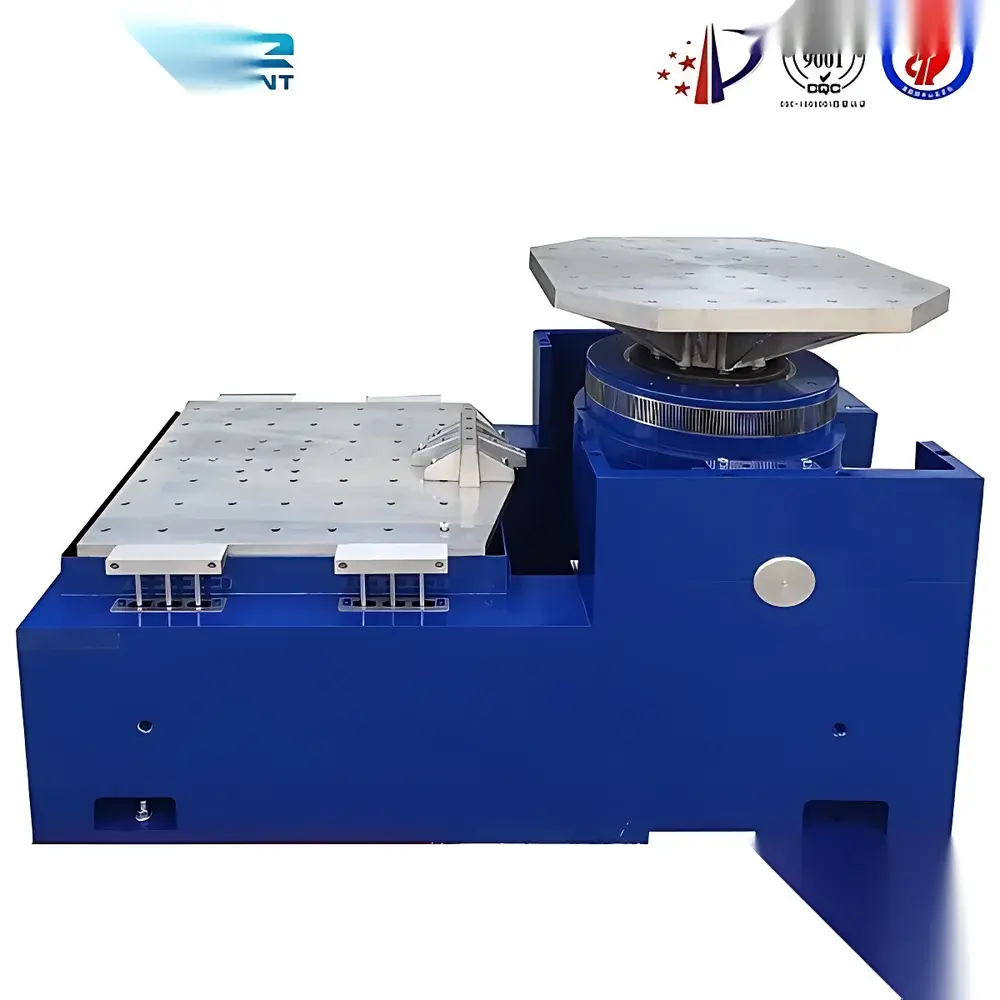
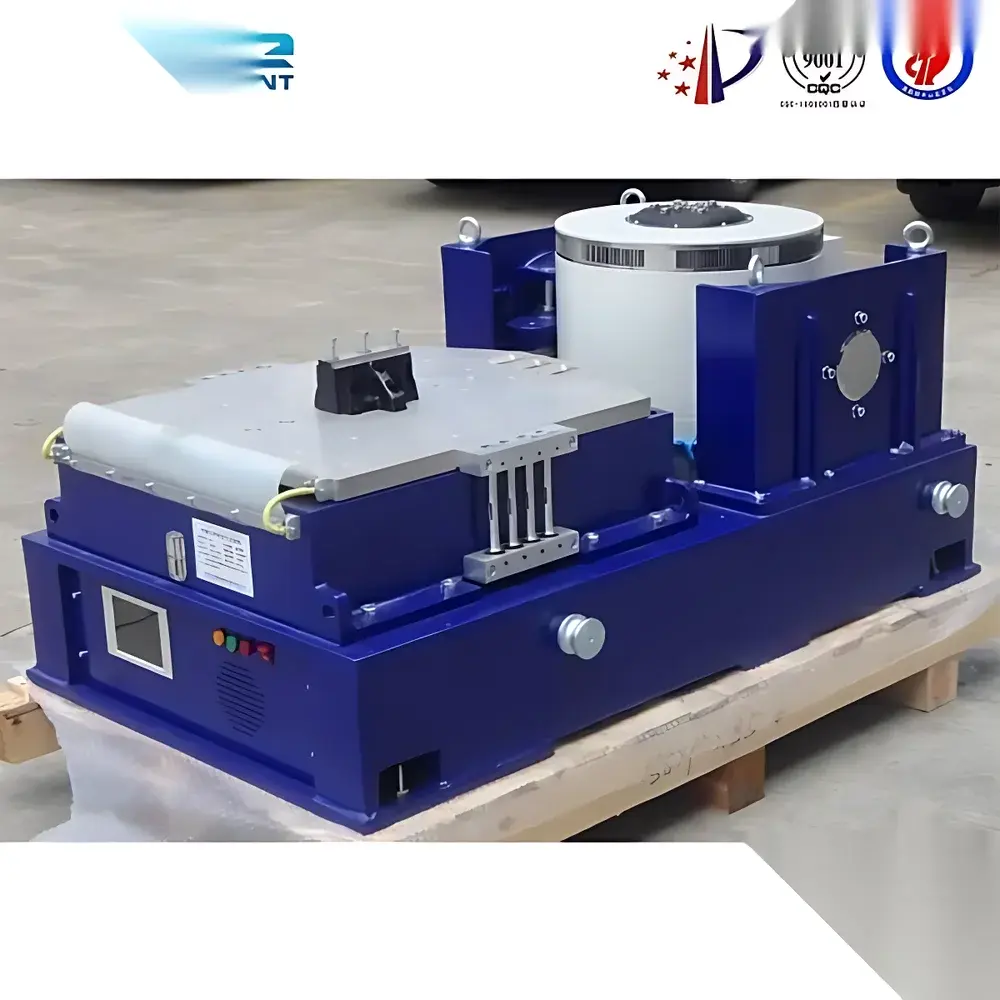
3D Electromagnetic Vibration Testing System
| Brand | OEM / Custom-Built |
|---|---|
| Origin | Imported |
| Manufacturer Type | Authorized Distributor |
| Price | USD 21,500 (FOB) |
| Max Load Capacity | 100 kg |
| Frequency Range | 1–600 Hz (standard), optional 1–5000 Hz |
| Displacement Amplitude | 0–5 mm peak-to-peak |
| Max Acceleration | 20 g |
| Vibration Axes | Vertical + Horizontal (X/Y/Z orthogonal triaxial capability) |
| Waveform | Sinusoidal, AM-modulated, Swept Sine, Logarithmic Sweep, Programmable Multi-segment Profile (up to 15 segments, max 65,500 s per segment) |
| Control Interface | RS-485 (PC-compatible, optional real-time remote control, data logging & report generation) |
| Timer/Counter | Dual-mode independent timing (1 s – 1 year) and cycle counting |
| Power Supply | 220 V / 380 V AC, 50/60 Hz |
| Motor Power | 2.2 kW / 3.8 kW |
| Worktable Dimensions | 50 cm × 50 cm (customizable up to 120 cm × 120 cm) |
| Table Material | High-strength Al-Mg alloy die-cast structure with anodized surface finish |
| Mounting Thread Protection | Stainless steel or high-tensile alloy insert sleeves for M6–M10 threaded holes |
| Isolation System | High-damping elastomeric isolator feet (resonance suppression compliant with ISO 2041 & ASTM D999) |
Overview
The 3D Electromagnetic Vibration Testing System is a precision-engineered triaxial electrodynamic shaker platform designed for rigorous mechanical stress evaluation under simulated transportation and operational vibration environments. Operating on electromagnetic force generation principles—where voice-coil actuators convert electrical input into controlled inertial motion—the system delivers repeatable, traceable, and spectrally stable excitation across three orthogonal axes (X, Y, Z). Its core function is to replicate real-world dynamic loading conditions—including road transport, air cargo handling, and warehouse stacking—to accelerate fatigue failure mechanisms in packaging systems and end products. This enables early detection of structural weaknesses, solder joint fractures, connector loosening, or material delamination prior to field deployment. The system complies with foundational vibration test standards including ISO 8568 (shaker performance verification), ISO 2041 (vibration and shock vocabulary), and ASTM D999 (performance testing of shipping containers), serving as a foundational tool for reliability engineering and quality assurance labs operating under GLP or GMP-aligned workflows.
Key Features
- Triaxial electromagnetic actuation architecture enabling simultaneous or sequential excitation in vertical (Z) and dual horizontal (X/Y) directions—fully decoupled motion control ensures minimal cross-axis coupling (<3% per ISO 5347-13).
- High-rigidity aluminum-magnesium die-cast shaker table with hard-anodized surface (60 µm thickness, Class II, MIL-A-8625F), engineered for extended service life and consistent modal response above 1 kHz.
- Reinforced mounting interface featuring stainless steel or nickel-alloy thread inserts (M6–M10) to prevent thread stripping under repeated high-cycle loading—validated for ≥50,000 torque cycles at rated preload.
- Dual-display operator interface showing real-time frequency (Hz) and displacement amplitude (mm) without mode switching—eliminates manual unit conversion errors during test setup.
- RS-485 serial interface supporting Modbus RTU protocol for integration with SCADA systems, PLCs, or custom LabVIEW/Python-based test orchestration software.
- Programmable waveform engine supporting 15-segment profiles (each up to 65,500 seconds), logarithmic sweep, fixed-frequency sine, amplitude modulation (AM), and time-controlled dwell modes—all timestamped with microsecond resolution.
- Active isolation base with high-loss elastomeric feet compliant with ISO 10848-3, suppressing floor-borne resonance transmission and eliminating secondary structural excitation in shared laboratory facilities.
Sample Compatibility & Compliance
The system accommodates test specimens from small electronics enclosures (e.g., PCB assemblies, medical handheld devices) up to mid-size industrial components (e.g., automotive ECUs, HVAC control modules) within its 100 kg payload limit. Worktable dimensions are modular and customizable—from standard 50 cm × 50 cm to extended configurations up to 120 cm × 120 cm—enabling full-footprint mounting of palletized loads or multi-unit fixtures. All mechanical interfaces meet ISO 2247 (vibration testing of packaged products) and ISTA 3A/3E requirements. Electrical safety conforms to IEC 61000-4-2/4-3 (EMC immunity) and UL 61010-1 (laboratory equipment safety). Optional calibration certificates traceable to NIST or PTB standards are available upon request for audit-ready validation.
Software & Data Management
While the embedded controller provides standalone operation, the RS-485 interface enables seamless connection to Windows-based host software (supplied as optional add-on). This application supports full test sequencing, live spectrum monitoring (FFT-based), automated pass/fail threshold evaluation per user-defined metrics (e.g., acceleration RMS >12 g for >10⁶ cycles), and export of CSV/Excel-formatted reports compliant with FDA 21 CFR Part 11 requirements—including electronic signatures, audit trails, and version-controlled test protocols. Raw time-history data is captured at 20 kHz sampling rate and stored with embedded metadata (operator ID, environmental conditions, calibration status).
Applications
- Transportation simulation per ASTM D4728 (random vibration), ASTM D999 (resonance search), and MIL-STD-810H Method 514.7 (vibration exposure).
- Early-life failure screening (burn-in vibration) for consumer electronics, aerospace avionics, and industrial IoT sensors.
- Packaging integrity validation—including corrugated box compression fatigue, foam cushion degradation, and tape adhesion endurance.
- Structural modal analysis support via swept-sine excitation for natural frequency mapping and damping ratio estimation.
- Supplier qualification testing where vibration robustness is contractually mandated (e.g., Tier-1 automotive PPAP submissions).
FAQ
What standards does this system help users comply with?
It supports test execution aligned with ISO 2247, ASTM D999/D4728, ISTA Series 3, MIL-STD-810H Method 514.7, and JIS Z 8701—making it suitable for internal QA, third-party certification labs, and regulatory submission packages.
Is PC-based control mandatory for operation?
No—the front-panel controller enables fully autonomous test execution. PC connectivity is optional and used only for advanced scripting, long-term data archiving, or enterprise-level test management integration.
Can the system perform random vibration testing?
This base configuration supports deterministic waveforms only (sine, swept sine, AM, programmable profiles). Random vibration capability requires optional digital signal processing (DSP) module and dedicated controller firmware—available as upgrade path.
What maintenance intervals are recommended?
Annual verification of force calibration and table modal response is advised. Air gap inspection and coil resistance measurement should be performed quarterly. Full preventive maintenance—including bearing lubrication and amplifier thermal profiling—is recommended every 2,000 operational hours.
Is installation support provided internationally?
Yes—technical commissioning assistance, including site survey, leveling, grounding verification, and operator training, is included in the installation package for all export deliveries. Local service partners are appointed in EU, APAC, and North America regions.



