
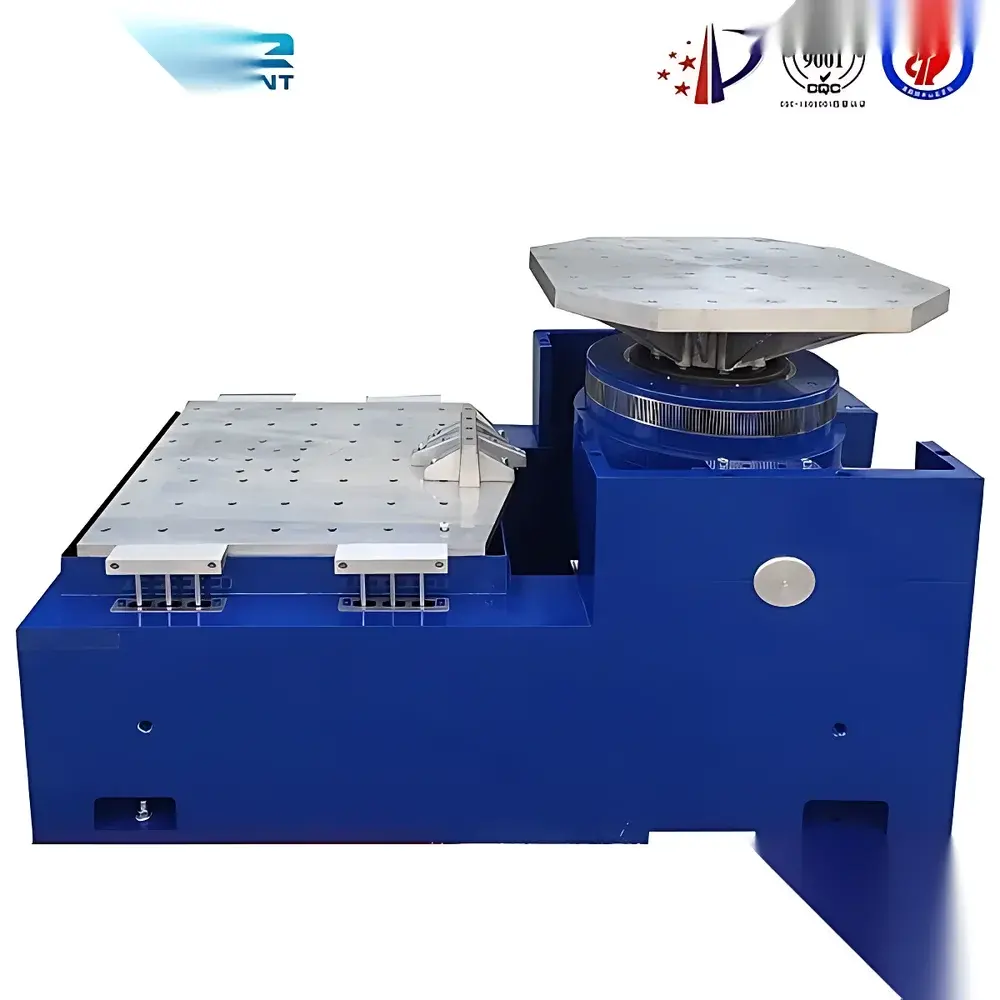
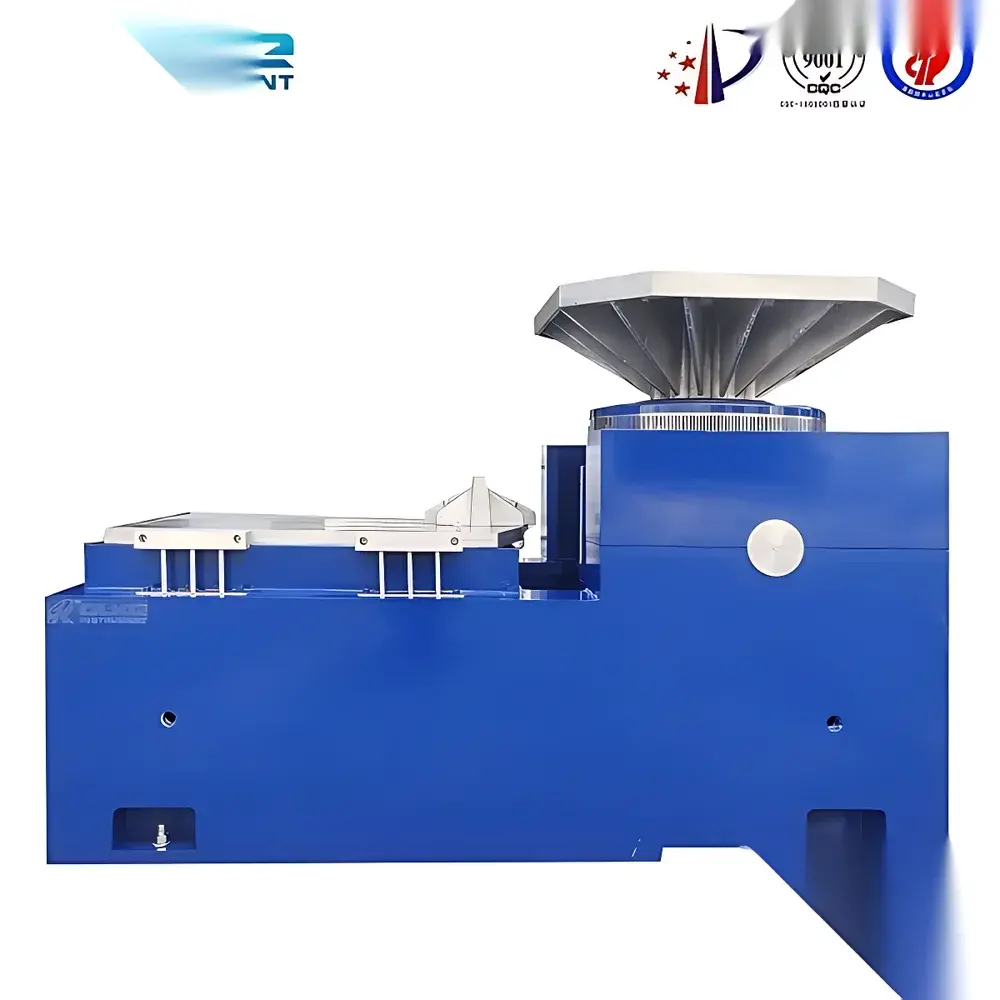
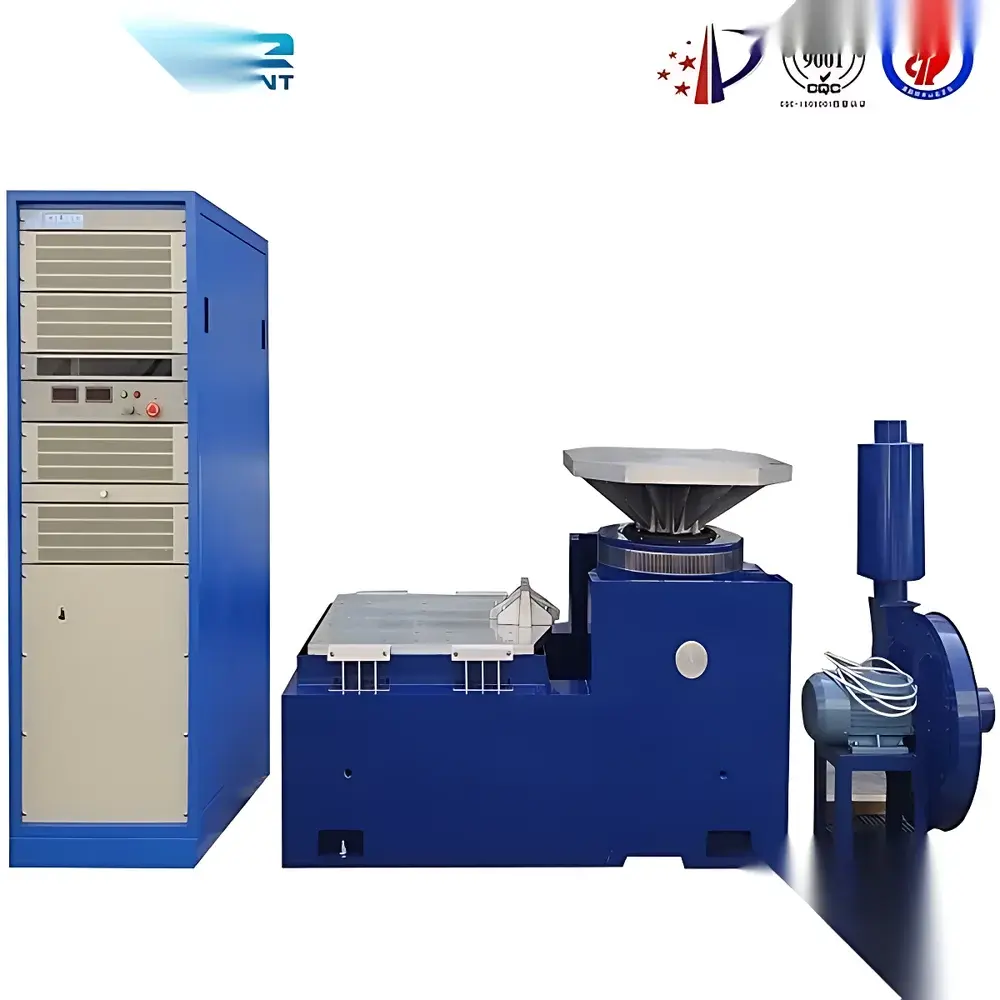
3D Random Vibration Simulation Testing System
| Brand | OEM |
|---|---|
| Max Load Capacity | 100 kg |
| Table Surface Dimensions (L×W) | 50 × 50 cm |
| Vibration Axes | Vertical (Z) + Horizontal (X/Y) |
| Frequency Range | 1–600 Hz (optional up to 5 kHz) |
| Max Acceleration | 20 g |
| Max Displacement (p-p) | 5 mm |
| Waveform | Sinusoidal |
| Drive Power | 2.2 kW |
| Control Interface | RS-485 (external controller required) |
| Frequency Resolution | 0.01 Hz |
| Frequency Accuracy | ±0.1 Hz |
| Input Voltage | 220 V ±20% |
| Max Current | 5 A |
| Compliance | Designed for ISO 10816, ASTM D999, MIL-STD-810H vibration profile execution |
Overview
The 3D Random Vibration Simulation Testing System is an electromechanical shaker platform engineered for multi-axis sinusoidal vibration testing under controlled laboratory or qualification environments. It operates on electromagnetic excitation principles, converting electrical input into precise mechanical motion via a voice-coil actuator and rigid moving mass assembly. Unlike single-axis systems, this triaxial configuration enables simultaneous or sequential excitation along the vertical (Z) and two orthogonal horizontal axes (X and Y), replicating real-world transport, operational, and environmental vibration spectra encountered during product lifecycle—particularly in aerospace, defense electronics, automotive ECUs, and telecommunications infrastructure. The system supports deterministic waveform generation (sine, sweep, programmable, logarithmic, and octave-based profiles), enabling compliance-driven validation per MIL-STD-810H Method 514.8, ISO 16750-3, and IEC 60068-2-6. Its architecture prioritizes mechanical rigidity, thermal stability, and low harmonic distortion to ensure high reproducibility across repeated test cycles.
Key Features
- Triaxial excitation capability: Independent or coupled control of Z (vertical), X (fore-aft), and Y (left-right) axes for true 3D vibration simulation
- Wide dynamic range: Programmable frequency sweep from 1 Hz to 600 Hz standard (upgradable to 5 kHz upon request), with acceleration up to 20 gpk and displacement up to 5 mmp-p
- Precision digital control: Frequency resolution of 0.01 Hz and accuracy within ±0.1 Hz; real-time parameter feedback requires optional external transducer interface
- Multi-mode operation: Supports sine sweep (linear/logarithmic), programmable step tests (15-segment user-defined frequency/time sequences), octave tracking, and resonant dwell functions
- Robust mechanical design: Rigid aluminum alloy table surface (50 × 50 cm), optimized for uniform modal response and minimal parasitic resonance up to 1 kHz
- Thermally managed drive system: 2.2 kW Class H insulated amplifier with forced-air cooling ensures stable output during extended duty cycles
- Standard RS-485 interface: Enables integration with third-party controllers, data acquisition systems, or SCADA platforms for automated test sequencing and remote monitoring
Sample Compatibility & Compliance
The system accommodates test specimens up to 100 kg mounted directly on its 50 × 50 cm table surface, with configurable fixture interfaces (T-slots, threaded inserts) supporting custom adapters. It meets mechanical interface requirements for MIL-STD-810H Annex G (vibration test tailoring), ISO 10816-1 (machinery vibration severity evaluation), and ASTM D999 (shipping container vibration testing). While not inherently compliant with FDA 21 CFR Part 11 or GLP audit trails, the system can be integrated into validated workflows when paired with qualified PC-based control software featuring electronic signatures, audit logging, and data integrity safeguards. All vibration profiles are traceable to NIST-traceable calibration standards via optional accelerometers and charge amplifiers (sold separately).
Software & Data Management
Control and data acquisition require an external host system running vendor-agnostic vibration test software compatible with RS-485 Modbus RTU protocol. Recommended platforms include VibrationVIEW (VibSoft), m+p VibRunner, or NI LabVIEW-based custom applications. These support real-time spectrum analysis, time-history recording, pass/fail thresholding, and report generation in PDF/CSV formats. Raw acceleration and displacement waveforms are timestamped and stored with metadata (test ID, operator, date, profile parameters). For regulated industries, users may implement supplementary cybersecurity controls (e.g., network segmentation, role-based access) and periodic verification per ISO/IEC 17025 calibration intervals.
Applications
- Early-life failure detection in printed circuit assemblies (PCBAs), connectors, and solder joints under simulated transit vibration
- Structural integrity assessment of avionics enclosures, satellite subsystems, and UAV airframes per DO-160 Section 8
- Qualification testing of automotive infotainment units, ADAS sensors, and battery management systems against ISO 16750-3 Level 3 profiles
- Reliability screening of consumer electronics (smartphones, wearables) prior to accelerated life testing
- Modal survey preparation and resonance mapping for finite element model correlation
- Environmental stress screening (ESS) in manufacturing quality assurance protocols
FAQ
What is the maximum payload capacity for this shaker system?
The system supports static loads up to 100 kg on its 50 × 50 cm table surface, provided center-of-gravity alignment remains within specified moment limits.
Can the system perform random vibration testing?
This model is configured for deterministic (sine-based) vibration only. True random vibration capability requires a dedicated electrodynamic shaker with broadband power amplifier and digital signal processor—available as a separate product line.
Is calibration documentation included?
Factory calibration certificates are provided for mechanical and electrical subsystems. Full metrological traceability to national standards requires optional third-party calibration services performed annually or per ISO/IEC 17025.
Does the system comply with MIL-STD-810H?
It is engineered to execute vibration test methods defined in MIL-STD-810H Method 514.8, but formal compliance certification requires test plan validation and independent lab verification.
What accessories are required for full functionality?
RS-485 interface card, control PC with licensed vibration software, accelerometer(s), signal conditioner, and mounting fixtures are not included and must be procured separately.



