
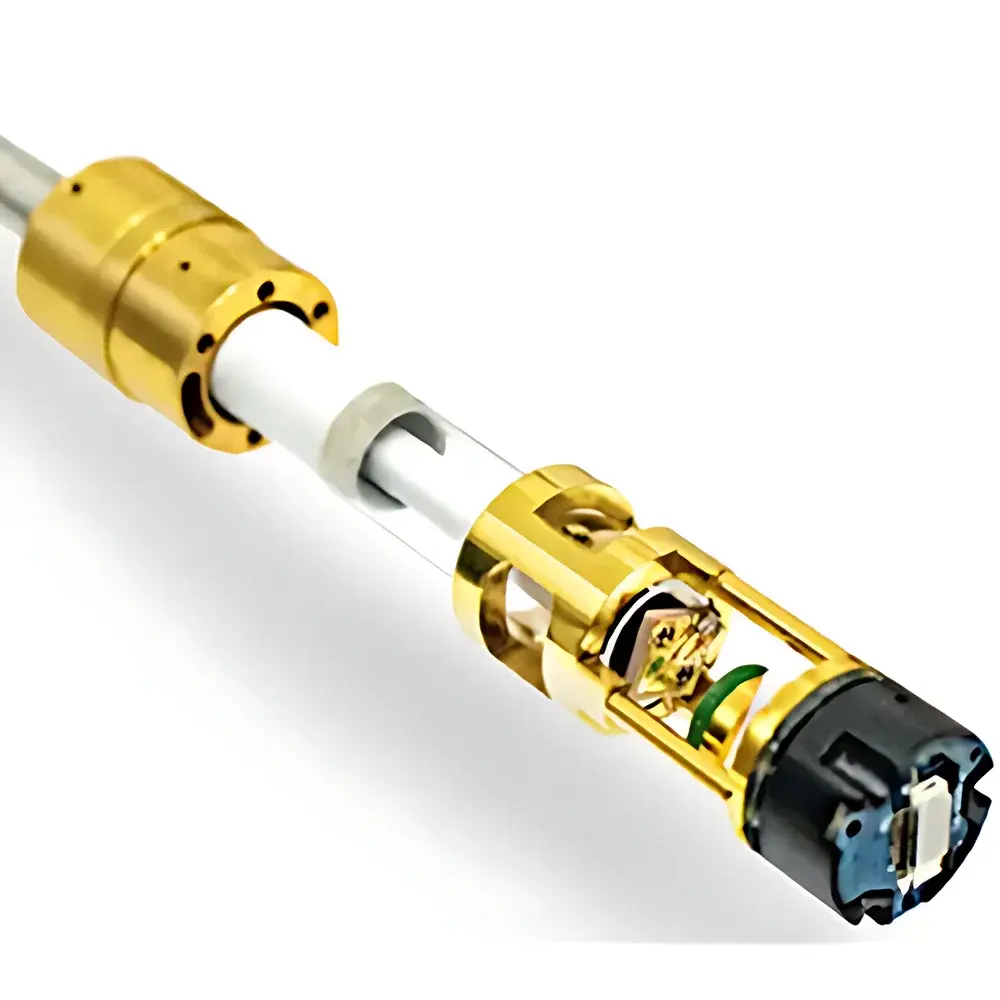
3i LT-AFM/MFM Low-Temperature Atomic Force Microscope
| Brand | 3i |
|---|---|
| Origin | Germany |
| Manufacturer Type | Authorized Distributor |
| Origin Category | Imported |
| Model | LT-AFM/MFM |
| Price | Upon Request |
| Operating Temperature Range | 20 mK – 300 K |
| Magnetic Field Capability | Up to 16 T |
| Displacement Noise Floor | 15 fm/√Hz (fiber interferometer, standard configuration) |
| Magnetic Resolution | 10 nm at 4 K |
| Interferometer Wavelength | 1310 nm |
| Fabry–Pérot Interferometer Noise Floor | 1 fm/√Hz (4–300 K) |
| Theoretical Shot-Noise Limit | 0.51 fm/√Hz |
| Scan Head Z-Range | 10 mm (stick-slip piezo stage) |
| XY Travel | Ø3 mm |
| Positioning Sensitivity | 50 nm |
| Scan Area Options (X×Y×Z @ Temp) | Ultra-Large: 200×200×7.2 µm @ 300 K, 50×50×4.8 µm @ 77 K, 30×30×2.4 µm @ 4.2 K |
| Large | 150×150×7 µm @ 300 K, 36×36×1.8 µm @ 77 K, 18×18×0.8 µm @ 4.2 K |
| Standard | 52×52×4.8 µm @ 300 K, 14×14×1.2 µm @ 77 K, 6×6×0.5 µm @ 4.2 K |
| Cantilever Alignment | Tri-point alignment chip (compatible with commercial cantilevers, no optical alignment required) |
| Scanner Architecture | Dual concentric piezotubes — inner tube for scanning, outer tube for coarse sample positioning |
| Scanner Electrodes | Quadrant electrodes + integrated excitation piezo for cantilever actuation |
| Signal Output | Analog BNC outputs (deflection, error, Z-feedback), LEMO interface to microscope control unit |
Overview
The 3i LT-AFM/MFM Low-Temperature Atomic Force Microscope is a high-stability, ultra-low-noise scanning probe platform engineered for quantitative nanoscale imaging and spectroscopy under extreme cryogenic and high-magnetic-field conditions. It operates on the principle of dynamic or static force detection via microfabricated cantilevers, with displacement resolution enhanced by fiber-based optical interferometry—either standard 1310 nm single-mode fiber interferometry or an integrated Fabry–Pérot cavity design. This architecture enables sub-picometer displacement sensitivity across a continuous temperature range from 20 millikelvin to 300 kelvin, while maintaining compatibility with superconducting magnets delivering up to 16 tesla. The system’s core innovation lies in its alignment-free mechanical design: a tri-point alignment chip ensures precise, repeatable cantilever mounting without manual optical alignment—a critical advantage for reproducible low-temperature experiments where access and thermal stability are constrained.
Key Features
- Ultra-low-noise displacement detection: 15 fm/√Hz (standard fiber interferometer) and 1 fm/√Hz (integrated Fabry–Pérot interferometer), approaching the theoretical shot-noise limit of 0.51 fm/√Hz.
- Continuous cryogenic operation from 20 mK to 300 K, validated across dilution refrigerator, closed-cycle cryostat, and liquid helium environments.
- Dual concentric piezotube scanner: inner tube provides high-fidelity XY scanning with quadrant electrode segmentation; outer tube enables coarse sample positioning and active drift compensation.
- Integrated excitation piezo element within the scanning tube enables direct cantilever drive—eliminating external shakers and reducing acoustic coupling.
- Modular scan head options: three calibrated scan ranges (Standard, Large, Ultra-Large), each thermally optimized for performance at 4.2 K, 77 K, and 300 K—with corresponding Z-range scaling to maintain aspect ratio fidelity.
- Safety-integrated fiber positioning: 2 mm travel piezo nano-positioner aligns the Fabry–Pérot fiber tip to the cantilever and retracts it during cantilever exchange, preventing mechanical damage.
- Stick-slip Z-stage with 10 mm travel and 50 nm closed-loop sensitivity supports large topographic variations and multi-layer sample interrogation.
Sample Compatibility & Compliance
The LT-AFM/MFM accommodates standard commercial AFM cantilevers—including conductive, magnetic, and diamond-coated variants—via its mechanically registered tri-point chip. No optical alignment is required, significantly reducing setup time and operator dependency. The system complies with fundamental requirements for low-temperature metrology infrastructure: vacuum-compatible construction (UHV-rated materials and seals), non-magnetic titanium and ceramic components, and EMI-shielded signal routing. While not certified to a specific regulatory standard by default, its analog signal architecture (BNC/LEMO) and deterministic feedback loop timing support integration into GLP- and GMP-aligned workflows when paired with validated third-party data acquisition systems. All firmware and control logic are timestamped and fully traceable—enabling audit-ready experimental logs per FDA 21 CFR Part 11 guidelines when implemented with compliant software layers.
Software & Data Management
Control is executed via a real-time Linux-based platform supporting deterministic PID feedback with sub-millisecond loop latency. Raw analog signals—including deflection, error, Z-piezo voltage, and optional Hall sensor or KPFM bias outputs—are routed through shielded BNC connectors to external digitizers (e.g., National Instruments PXI or Zurich Instruments HF2LI). The system generates HDF5-formatted datasets containing metadata such as temperature (from calibrated RuO₂ and Cernox sensors), magnetic field (Hall probe or NMR-derived), piezo calibration matrices, and interferometer gain coefficients. Batch scripting, automated parameter sweeps (e.g., temperature-dependent resonance tracking), and multi-channel lock-in demodulation are natively supported. Export modules ensure compatibility with Igor Pro, Python (via h5py and afmformats), and Gwyddion for post-acquisition analysis.
Applications
- Quantitative nanomechanical mapping of quantum materials (e.g., twisted bilayer graphene, topological insulators) under correlated electron regimes.
- Magnetic domain imaging via MFM at sub-10 nm resolution in high-field superconducting magnet environments.
- Scanning Hall probe microscopy (SHPM) for local current density reconstruction in mesoscopic superconductors and oxide heterostructures.
- Surface potential profiling using Kelvin probe force microscopy (KPFM) with compensated electrostatic crosstalk down to 4.2 K.
- Conductive AFM (C-AFM) and tunneling AFM (TUNA) studies of epitaxial oxide interfaces and 2D material heterojunctions.
- In situ strain engineering studies enabled by thermal contraction matching between sample mount and scanner housing.
FAQ
What temperature stages is the LT-AFM/MFM compatible with?
The system is designed for integration with commercial dilution refrigerators (DR), wet and dry cryostats, and variable-temperature inserts (VTIs); mechanical interfaces and thermal anchoring protocols are provided for each class.
Can the Fabry–Pérot interferometer be retrofitted to existing LT-AFM units?
Yes—3i offers factory upgrade kits including the multi-layer dielectric-coated fiber, nano-positioner assembly, and revised scanner firmware; installation requires recalibration but no structural modification.
Is magnetic field homogeneity compensation supported?
The system does not include active field homogenization, but its rigid titanium frame and non-magnetic piezoceramics minimize Lorentz-force-induced distortion; users may apply post-processing correction using field maps acquired via Hall probe raster scans.
How is thermal drift managed during long-duration scans?
Drift is mitigated via dual-stage stabilization: outer piezotube performs slow, coarse repositioning based on fiducial tracking, while inner tube executes high-bandwidth scanning; combined with active temperature regulation (±1 mK stability), drift remains below 0.1 nm/min at 4.2 K.
Are custom scan patterns (e.g., spiral, Lissajous) supported?
Yes—the real-time controller accepts user-defined waveform tables via ASCII upload; arbitrary trajectories are executed with synchronized data acquisition at up to 2 MS/s aggregate sampling rate.



