
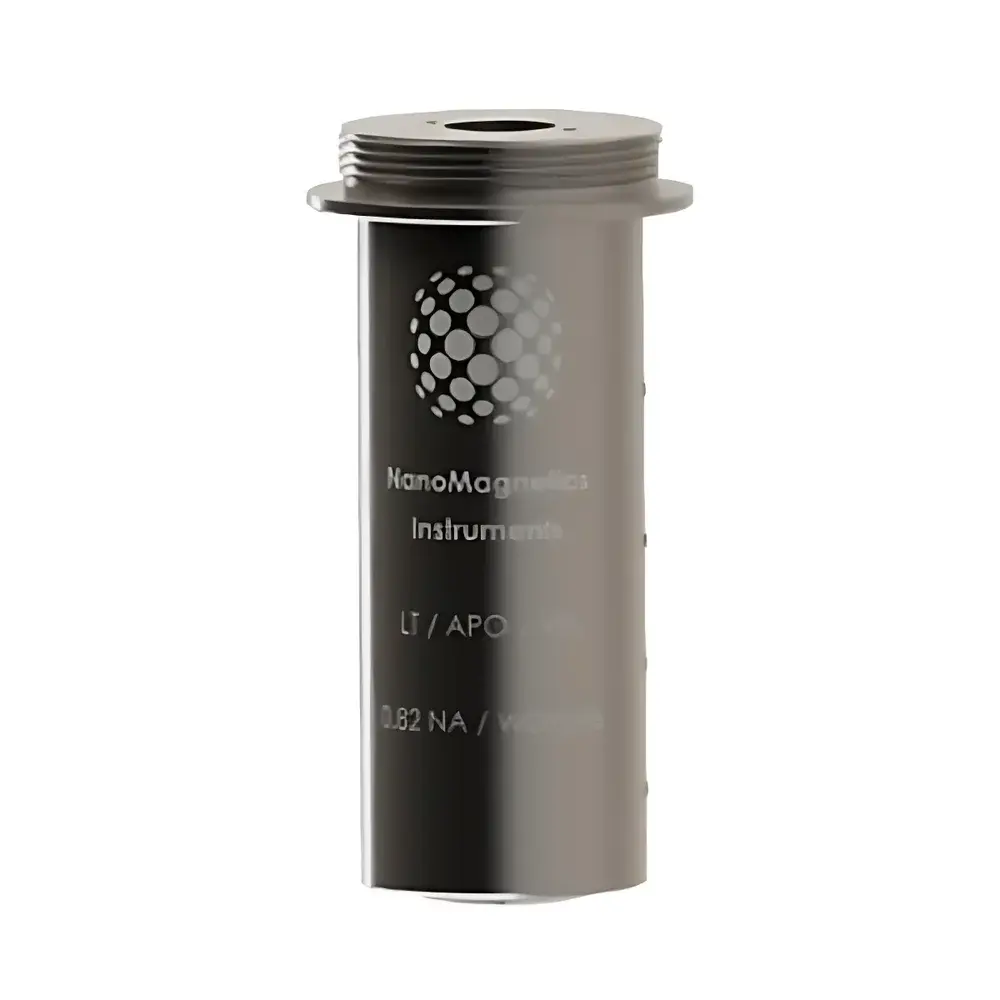
3i LT-APO Cryogenic Apochromatic Objective
| Brand | 3i |
|---|---|
| Origin | Germany |
| Manufacturer Type | Authorized Distributor |
| Origin Category | Imported |
| Model | LT-APO OBJECTIVES |
| Price | Upon Request |
| Clear Aperture (CA) | 4.7 mm |
| Focal Length (FL) | 2.8–2.9 mm |
| Numerical Aperture (NA) | 0.82 |
| Working Distance (WD) | 0.95 mm (up to 1.45 mm depending on configuration) |
| Transmission Coating | Broadband AR coating (>80% average transmission) |
| Spectral Range (Visible-NIR) | 400–1000 nm |
| Apochromatic Correction Range (Df < ±1 D) | 540–780 nm (visible), 650–970 nm (NIR), and 930–1365 nm (IR) |
| Environmental Rating | Designed for cryogenic temperatures, high magnetic fields (≥16 T), and ultra-high vacuum (UHV, ≤10⁻⁹ mbar) |
| Physical Dimensions | Ø24 mm × 49 mm L |
| Mass | 46 g |
| Mount Thread | RMS (0.80″ × 36 TPI, 3 mm engagement depth) |
Overview
The 3i LT-APO Cryogenic Apochromatic Objective is a precision-engineered optical component specifically developed for demanding scientific imaging environments where conventional objectives fail—namely, low-temperature microscopy (down to 4 K), high-field magnet systems (up to 16 Tesla), and ultra-high vacuum (UHV) chambers. Unlike standard microscope objectives, the LT-APO series employs a fully apochromatic, all-glass design with stress-relieved lens elements and non-magnetic, low-outgassing materials—including titanium-alloy housings and ceramic-insulated internal mounts—to maintain optical stability under extreme thermal contraction and Lorentz-force-induced mechanical strain. Its optical architecture is based on aberration-balanced multi-element configurations optimized using Zemax-based thermal-elastic modeling, ensuring diffraction-limited performance across three distinct spectral bands: visible (540–780 nm), near-infrared (650–970 nm), and short-wave infrared (930–1365 nm). The objective operates on the principle of high-NA, short-focal-length collimation and focusing within confined experimental geometries—enabling integration into scanning probe setups, quantum transport cryostats, and in-situ UHV electron-beam lithography stations.
Key Features
- Triple-band apochromatic correction: Validated chromatic error < ±1 diopter across three non-overlapping spectral windows—540–780 nm (visible), 650–970 nm (NIR), and 930–1365 nm (SWIR)—ensuring consistent point-spread function (PSF) fidelity regardless of excitation wavelength.
- Cryogenically stable mechanical design: Zero-CTE (coefficient of thermal expansion) lens cell assembly with differential contraction compensation; validated for continuous operation from 4 K to 300 K without focus drift or image degradation.
- High magnetic field compatibility: Fully non-ferromagnetic construction (titanium housing, alumina spacers, platinum-group metal bonding) certified for use in superconducting magnets up to 16 T without induced torque or field distortion.
- UHV-rated materials and surface finish: All internal surfaces polished to Ra 24 h; outgassing rate < 1×10⁻¹² Pa·m³/s·cm² per ASTM E595, compliant with ESA/ECSS-Q-ST-70-02C standards.
- Broadband anti-reflection coating: Ion-beam-sputtered multilayer AR coating delivering >80% average transmission over 400–1550 nm, with residual reflectivity <0.25% per surface in the primary imaging bands.
- RMS-thread mounting (0.80″ × 36 TPI) with 3 mm thread engagement depth ensures repeatable, torque-controlled installation in space-constrained optical breadboards and cryostat flanges.
Sample Compatibility & Compliance
The LT-APO objective is routinely deployed in multimodal cryo-microscopy platforms integrating confocal fluorescence, stimulated Raman scattering (SRS), and cathodoluminescence detection. Its 0.95 mm nominal working distance—extendable to 1.45 mm via optional spacer rings—accommodates thick optical windows (e.g., sapphire, CaF₂) and sample stages with limited vertical clearance. The objective meets ISO 10110-7 surface quality specifications (scratch-dig 10-5), complies with IEC 61000-6-2/6-4 electromagnetic immunity standards for lab instrumentation, and supports GLP/GMP-aligned workflows through traceable calibration documentation (NIST-traceable focal length and NA verification available upon request). It is compatible with major cryogenic probe station vendors (BlueFors, Janis, Oxford Instruments) and UHV-compatible microscope frames (e.g., Scienta Omicron, SPECS).
Software & Data Management
While the LT-APO is a passive optical element, its performance is tightly coupled with system-level calibration protocols embedded in 3i’s SlideBook™ 6 software suite and third-party platforms including LabVIEW-based DAQ control (NI PXIe-6363), Python-driven Micro-Manager extensions, and MATLAB Image Processing Toolbox pipelines. Calibration metadata—including temperature-dependent focal shift coefficients (dFL/dT = −0.12 µm/K), NA thermal drift profiles, and spectral transmission curves—is stored in vendor-provided JSON-compliant .optcal files for automated correction during acquisition. Audit trails for objective usage, thermal cycling logs, and vacuum exposure history can be integrated into FDA 21 CFR Part 11–compliant electronic lab notebooks (ELNs) via REST API endpoints.
Applications
- Quantum material characterization: Imaging of moiré superlattices in twisted bilayer graphene under 12 T magnetic fields and 1.6 K base temperature.
- Cryo-correlative light and electron microscopy (cryo-CLEM): High-NA visible/NIR fluorescence mapping aligned with TEM tomography in Gatan 626 cryo-transfer holders.
- In-situ UHV spectroscopy: Coupling with synchrotron beamlines (e.g., ALS Beamline 5.3.2) for micro-focused XANES mapping of catalyst nanoparticles at 10⁻¹⁰ mbar.
- Single-photon source alignment: Precise positioning of NV centers in diamond anvil cells using 785 nm excitation and 850 nm collection paths.
- Low-temperature photoluminescence mapping: Sub-diffraction resolution (<350 nm lateral) imaging of perovskite nanocrystals at 77 K with minimal thermal lensing artifact.
FAQ
Is the LT-APO objective compatible with standard RMS-threaded microscope nosepieces?
Yes—the LT-APO uses industry-standard RMS threading (0.80″ × 36 TPI) with full mechanical and optical alignment compatibility with Zeiss, Leica, and Nikon RMS-mount systems.
Can it be used in liquid helium immersion environments?
No—it is rated for conductive cooling only (cold-finger or pulse-tube mounted); direct immersion in liquid helium will compromise seal integrity and induce condensation-induced birefringence.
What is the maximum permissible thermal gradient across the objective body?
The design tolerates axial gradients up to 50 K/cm during cooldown ramp rates ≤0.5 K/min; faster ramps require custom thermal anchoring.
Does 3i provide application-specific calibration reports?
Yes—NIST-traceable focal length, NA, and wavefront error (Zernike coefficients up to 37th order) reports are available as optional deliverables with purchase.
Are custom AR coatings available for extended IR ranges beyond 1365 nm?
Yes—custom coatings covering 1.5–2.5 µm (InGaAs detection band) can be engineered upon request, subject to minimum order quantity and lead time.



