
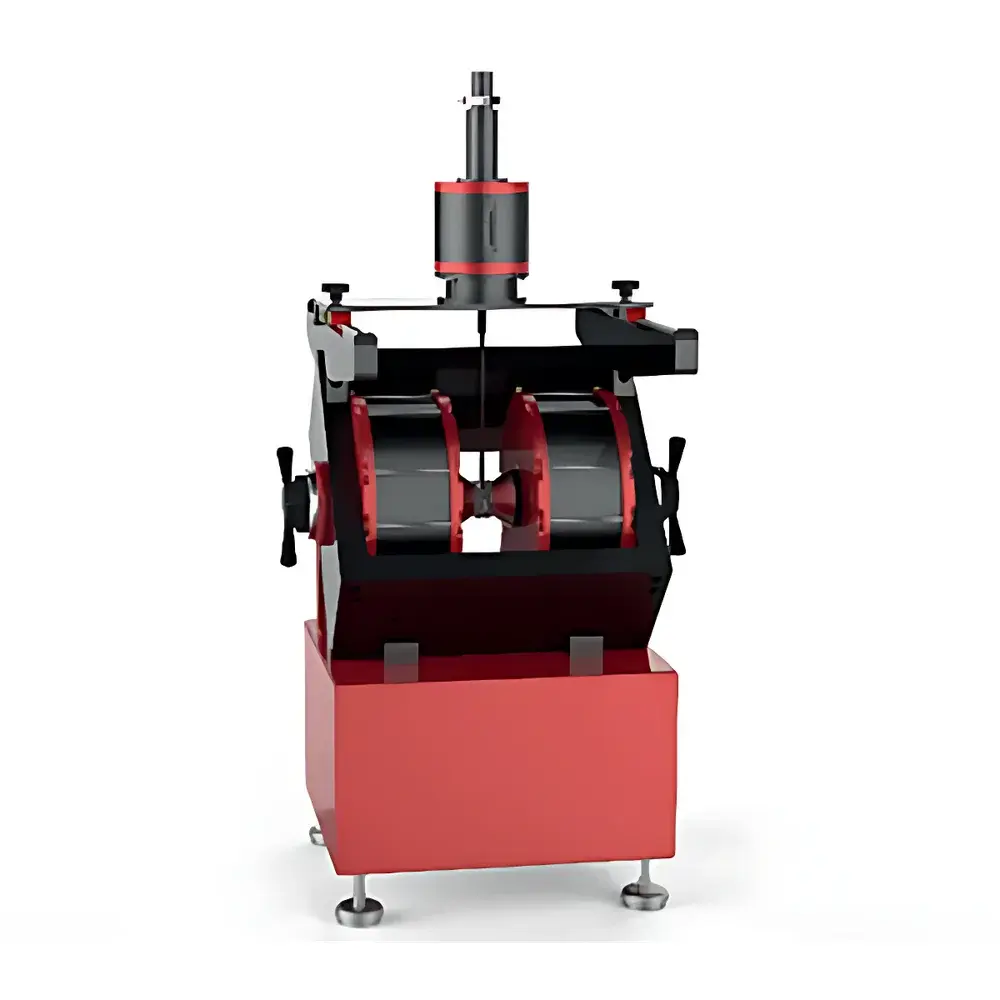
3i NMI-VSM Vibrating Sample Magnetometer
| Brand | 3i |
|---|---|
| Origin | Germany |
| Manufacturer Type | Authorized Distributor |
| Origin Category | Imported |
| Model | NMI-VSM |
| Price | Upon Request |
| Sensitivity (RMS) | 5×10⁻⁷ emu |
| Oscillation Frequency Range | 1–100 Hz (calibrated) |
| Oscillation Amplitude Range | 0.1–5 mm |
| Maximum Sample Diameter | 6 mm |
| Temperature Range | 2 K to 1000 K |
| Magnetic Field Range | Up to 2.5 T (electromagnet), up to 14 T (with cryostat) |
Overview
The 3i NMI-VSM Vibrating Sample Magnetometer is a precision instrument engineered for quantitative measurement of magnetic moment as a function of applied magnetic field and temperature. It operates on the principle of electromagnetic induction: a sample mounted on a non-magnetic rod is sinusoidally vibrated at a fixed frequency within a uniform magnetic field gradient, inducing a voltage in detection coils proportional to its magnetic moment. This signal is processed via lock-in amplification to deliver high-fidelity M(H) and M(T) data with exceptional signal-to-noise ratio. Designed for laboratory-based materials science research, the NMI-VSM supports fundamental studies of ferromagnetic, antiferromagnetic, superparamagnetic, and spin-glass systems—particularly where low-moment sensitivity, thermal stability, and field-temperature co-control are critical. Its modular architecture accommodates both room-temperature electromagnet and cryogenic superconducting magnet configurations, enabling seamless transition across thermomagnetic regimes without hardware reconfiguration.
Key Features
- High-resolution magnetic moment detection with RMS sensitivity of 5×10⁻⁷ emu, validated across multiple calibration standards including Ni, Co, and Gd2O3.
- Adjustable oscillation parameters: calibrated frequency range from 1 to 100 Hz and amplitude control from 0.1 to 5 mm, allowing optimization for sample geometry, mass, and magnetic susceptibility.
- Integrated thermal management: pre-mounted cryostat or furnace ensures rapid thermal equilibration; no manual disassembly required between temperature points.
- Ergonomic sample exchange mechanism: quick-release drive head enables tool-free sample mounting and removal, minimizing downtime during high-throughput characterization.
- Dual-field orientation capability: longitudinal configuration supports both parallel-field (for thin films) and perpendicular-field (for bulk crystals or powders) measurements using interchangeable sample holders.
- Air-cooled electromagnet power supply with programmable ramp rates; field sweep profiles synchronized with temperature steps for isothermal hysteresis loops or field-cooled/zero-field-cooled protocols.
Sample Compatibility & Compliance
The NMI-VSM accepts solid-state specimens in powder, pellet, single-crystal, thin-film, and ribbon forms. Standard sample holders accommodate diameters up to 6 mm and thicknesses up to 3 mm; custom fixtures are available for irregular geometries. All thermal stages—including the 2 K closed-cycle cryostat, 1000 K resistive furnace, and single-stage variable-temperature insert—are designed to maintain mechanical stability under field cycling and minimize thermal drift during long-duration scans. The system complies with ISO/IEC 17025 requirements for measurement traceability when used with NIST-traceable reference materials. Data acquisition protocols support GLP-compliant audit trails, including timestamped parameter logs, operator ID tagging, and raw signal metadata export—facilitating regulatory submissions under FDA 21 CFR Part 11 when integrated with validated software environments.
Software & Data Management
The proprietary NMI Control Suite provides real-time visualization of moment signals, automatic background subtraction, and multi-step sequence programming (e.g., field sweeps at fixed T, temperature ramps at fixed H, or combined H–T grids). Raw voltage outputs are digitized at ≥16-bit resolution with configurable sampling rates up to 10 kS/s. Export formats include ASCII (.dat), HDF5, and MATLAB-compatible .mat files, preserving full metadata (coil constants, calibration factors, thermal history, field homogeneity maps). Batch processing modules enable automated fitting of Langevin, Brillouin, or Stoner–Wohlfarth models. Software architecture supports remote operation via secure SSH tunneling and integrates with LabVIEW and Python APIs for custom automation workflows.
Applications
- Characterization of magnetic anisotropy in epitaxial thin films and multilayer heterostructures.
- Quantification of blocking temperature and effective anisotropy energy in nanoparticle dispersions.
- Thermomagnetic analysis of phase transitions in Heusler alloys, manganites, and rare-earth intermetallics.
- Quality control of permanent magnet precursors during sintering and annealing processes.
- Validation of first-principles DFT predictions via experimental M(H,T) datasets.
- Correlation of coercivity evolution with microstructural changes observed via TEM or XRD.
FAQ
What is the minimum detectable magnetic moment for this VSM?
The RMS sensitivity is specified as 5×10⁻⁷ emu under standard operating conditions (40 Hz oscillation, 1 mm amplitude, 2 K–300 K range, 1 T field). Actual performance may vary depending on sample mass, coil geometry, and environmental noise floor.
Can the system perform simultaneous field and temperature sweeps?
Yes—the control software allows fully synchronized ramping of both magnetic field and temperature, enabling continuous mapping of M(H,T) surfaces with user-defined step resolution and dwell times.
Is the system compatible with ultra-high vacuum (UHV) environments?
The base configuration is optimized for ambient or inert-gas purge environments. UHV-compatible variants with differential pumping stages and all-metal seals are available upon request and require factory integration.
How is calibration performed and maintained?
Calibration uses certified reference standards (e.g., Ni sphere, Co foil) traceable to NIST SRM 759. The software includes a built-in calibration wizard that records coil constant, field gradient, and vibration amplitude corrections—stored per measurement session for reproducibility auditing.
Does the system support third-party data analysis tools?
Yes—raw data exports retain full instrumental metadata and are natively readable by Origin, Igor Pro, and open-source libraries such as SciPy and Magpylib, enabling advanced modeling and cross-platform validation.



