
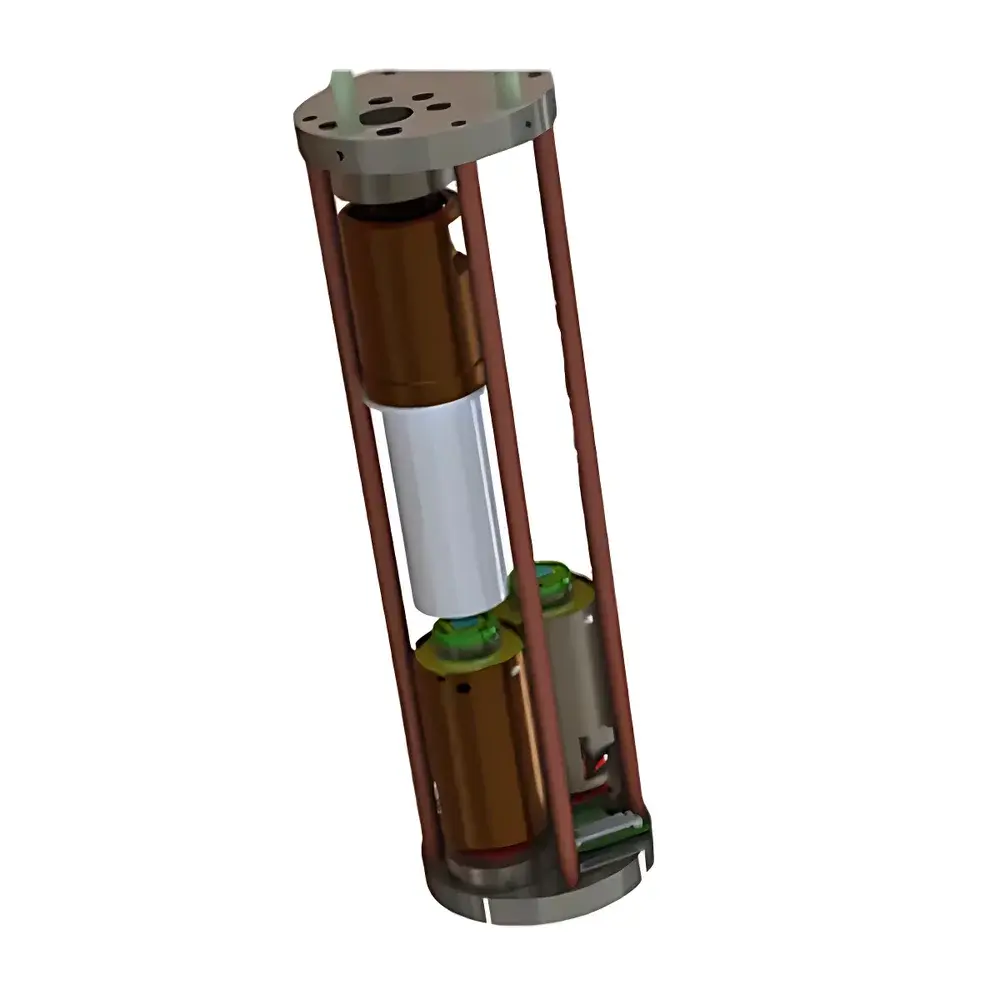
3i NV-CENTRE Confocal Microscope for Cryogenic Temperature Applications
| Brand | 3i |
|---|---|
| Origin | Germany |
| Manufacturer Type | Authorized Distributor |
| Origin Category | Imported |
| Model | NV-CENTRE CONFOCAL MICROSCOPY |
| Price | Upon Request |
| Objective NA | 0.82 |
| Working Distance | 0.95 mm @ 532 nm |
| Laser Source | SLM-stabilized 10 mW @ 532 nm |
| Scan Range | 30 × 30 × 15 µm at 4 K |
| Outer Diameter | 49 mm |
| Temperature Range | 10 mK – 300 K |
| Detector | Avalanche Photodiode (APD) |
| Sample Stage | XYZ Nanopositioning Platform, 6 × 6 × 12 mm travel |
| NV/QTF Sensor Stage | XYZ Nanopositioning Platform, 4 × 4 × 6 mm travel |
| Position Sensor Resolution | 200 nm |
| Controller | Ultra-low-noise FPGA-based AFM controller with high-speed USB interface |
| Real-time Processor | 32-bit, 128 MB DDR SDRAM |
| ADC | Dual-channel, 16-bit / 100 MHz |
| DAC | Dual-channel, 16-bit / 100 MHz |
| PID Loops | Seven digital PID controllers implemented on FPGA |
| Piezo Controller Channels | 19-channel |
| High-resolution ADC | 16-channel, 24-bit / 175 kHz |
| Scan Signal DAC | 24-bit XYZ output |
| High-voltage Amplifier | Low-noise design |
Overview
The 3i NV-CENTRE Confocal Microscope is a purpose-engineered cryogenic scanning optical microscope designed for high-spatial-resolution imaging and spectroscopic analysis of solid-state quantum emitters—particularly nitrogen-vacancy (NV) centers in diamond—under ultra-low-temperature conditions. It operates on the principle of point-scanning confocal fluorescence microscopy, where a diffraction-limited laser spot (532 nm, SLM-stabilized, 10 mW) is focused onto the sample via a high-numerical-aperture apochromatic objective (NA = 0.82, WD = 0.95 mm), and emitted photons are collected through a spatially filtered detection path using an avalanche photodiode (APD). This architecture ensures optical sectioning capability, axial resolution down to ~500 nm (at 4 K), and rejection of out-of-focus background—critical for isolating single-photon emission from individual NV− spin states. The system integrates seamlessly into dilution refrigerator or closed-cycle cryostat environments, supporting stable operation across a continuous temperature range from 10 mK to 300 K, enabling studies of spin coherence, charge state dynamics, and strain-coupled phonon modes in quantum materials.
Key Features
- Ultra-stable cryogenic optical platform with integrated 49 mm outer-diameter vacuum feedthrough-compatible mechanical housing
- High-NA apochromatic objective optimized for visible transmission and minimal chromatic aberration at 532 nm
- Sub-micron XYZ nanopositioning stages: dual-stage architecture comprising a coarse 6 × 6 × 12 mm piezoelectric platform and a fine-resolution 4 × 4 × 6 mm NV/QTF sensor stage
- 200 nm positional resolution enabled by integrated resistive position sensors and real-time closed-loop feedback
- FPGA-based control architecture featuring seven independent digital PID loops, 19-channel piezo drive, and synchronized 24-bit XYZ scan DACs
- Low-noise analog front-end: dual 16-bit/100 MHz ADC/DAC pairs for fast lock-in or time-resolved photon counting; 16-channel 24-bit/175 kHz ADC for multi-parameter correlation measurements
- On-board 32-bit real-time processor with 128 MB DDR SDRAM for deterministic latency control and embedded signal processing
- Integrated low-noise high-voltage amplifier for precise piezo actuation without thermal drift or ripple-induced image distortion
Sample Compatibility & Compliance
The NV-CENTRE supports non-contact, non-destructive characterization of bulk crystals, thin films, nanostructured diamond membranes, and heteroepitaxial quantum devices mounted on standard cryogenic sample holders. Its modular optical train accommodates additional excitation wavelengths (e.g., 594 nm, 637 nm) via optional fiber-coupled laser inputs and spectral filtering modules. All electronic subsystems comply with IEC 61000-6-3 (EMC emission limits) and IEC 61000-6-2 (immunity requirements) for laboratory instrumentation. Firmware architecture supports audit-trail logging and user-access-level controls aligned with GLP-compliant experimental workflows. While not FDA-certified (as a research-grade instrument), its data acquisition chain meets traceability requirements outlined in ISO/IEC 17025 for calibration laboratories performing quantum sensing validation.
Software & Data Management
Control and acquisition are managed through 3i’s proprietary SlideBook™ 6 software suite, extended with custom cryo-microscopy modules. The platform provides synchronized hardware triggering between laser pulsing, APD photon counting, microwave delivery (for ODMR), and stage positioning—enabling time-tagged photon correlation, Rabi oscillation mapping, and T₂* decay reconstruction. All raw detector signals, stage coordinates, and environmental metadata (temperature, magnetic field if interfaced) are saved in HDF5 format with embedded schema definitions compliant with FAIR data principles. Export options include TIFF stacks with calibrated pixel dimensions, CSV time-series logs, and MATLAB-compatible .mat files. Remote access and scripting via Python API (PySlideBook) support integration into automated quantum characterization pipelines.
Applications
- Spin-dependent fluorescence imaging and nanoscale magnetometry using NV centers in diamond
- Temperature-dependent photoluminescence spectroscopy of quantum emitters (e.g., SiV, GeV, SnV centers)
- In situ strain mapping in 2D materials via polarization-resolved confocal Raman under cryogenic conditions
- Coherence time (T₂) and spin relaxation (T₁) measurements as a function of lattice temperature and local strain
- Quantum defect engineering verification: correlation of nanoscale topography (via integrated AFM mode) with optical emission properties
- Development and benchmarking of quantum memory interfaces based on rare-earth-doped crystals or color-center arrays
FAQ
What minimum temperature does the system achieve, and how is thermal stability maintained during scanning?
The NV-CENTRE achieves base temperatures down to 10 mK when integrated with a validated dilution refrigerator. Thermal stability ±10 µK over 1-hour intervals is ensured via active vibration isolation, low-thermal-conductivity mounting, and real-time temperature feedback to the cryostat’s still-stage heater.
Is the system compatible with microwave delivery for ODMR experiments?
Yes—the microscope includes two 8-pin electrical feedthroughs rated for DC–10 GHz operation, supporting coaxial microwave waveguide integration and synchronized pulse modulation with laser excitation and photon detection.
Can third-party detectors be interfaced, such as superconducting nanowire single-photon detectors (SNSPDs)?
Absolutely—the APD input channel is electrically isolated and configurable for TTL/NIM logic levels; SNSPDs with compatible output impedance and timing jitter (< 100 ps) can be directly connected via SMA termination.
Does the controller support real-time image reconstruction during acquisition?
Yes—FPGA-accelerated histogramming and centroid fitting algorithms run concurrently with scanning, enabling live rendering of PL intensity maps, spin resonance contrast images, and drift-corrected time-lapse sequences.
What level of technical support and firmware update policy does 3i provide for this platform?
3i offers extended warranty options, annual calibration services traceable to NIST standards, and quarterly firmware releases—including enhancements for new quantum protocols, improved noise suppression algorithms, and expanded compatibility with commercial cryostat models (BlueFors, Leiden Cryogenics, Quantum Design).



