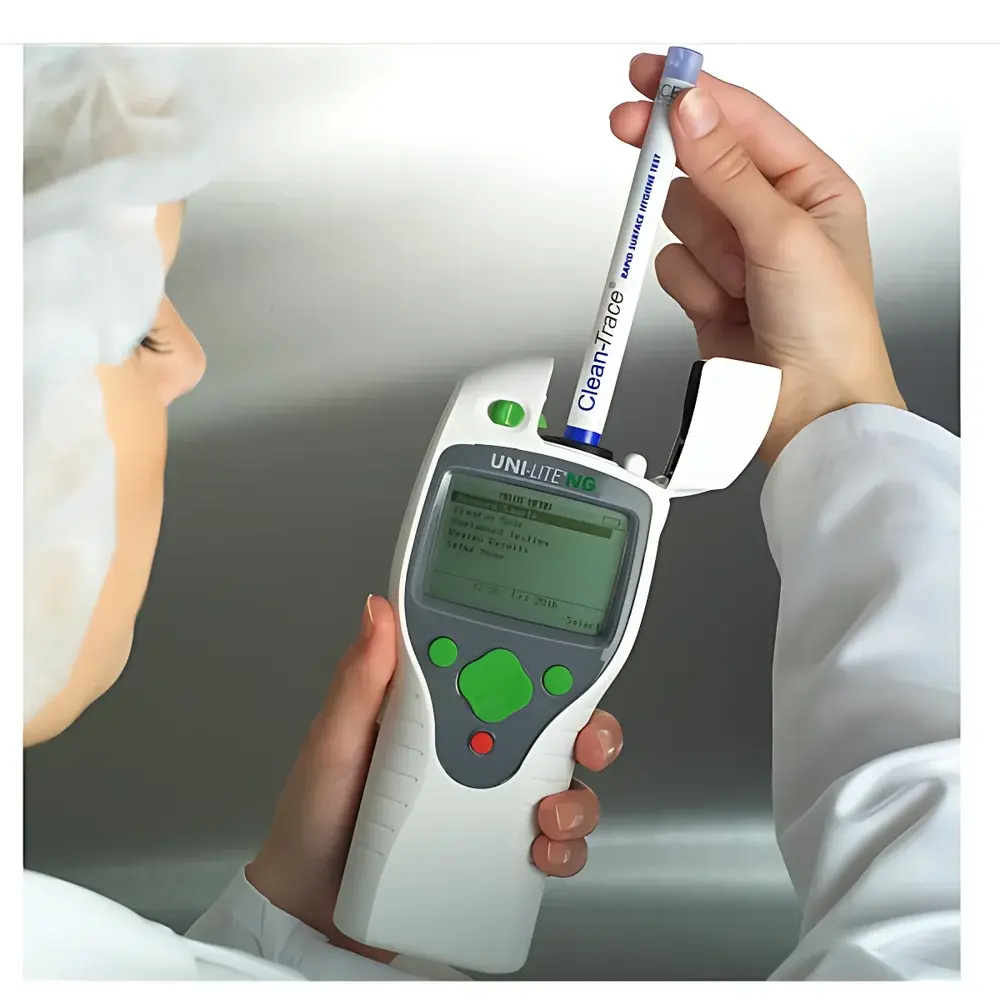
3M™ Clean-Trace™ NGI ATP Bioluminescence Detector
| Brand | 3M |
|---|---|
| Origin | USA |
| Manufacturer Type | Authorized Distributor |
| Product Category | Imported Instrument |
| Model | 3M™ Clean-Trace™ NGI |
| Pricing | Available Upon Request |
| Weight | 400 g |
| Detection Range | 0–999,999 RLU |
| Sensitivity | 10⁻¹⁵ mol ATP |
| Read Time | 10 s |
| Repeatability (CV%) | 7.4% |
| Data Storage | 10,000 test results |
| Sampling Plans | 100 plans (up to 300 points each) |
| Plan Points | 2,000 total |
| Display | 240 × 160-pixel backlit LCD |
| Battery | Rechargeable Li-ion, 36 h continuous operation |
| Auto-Diagnostics | Power-on self-test & real-time fault alerting |
| Sample Chamber | Auto-sensing lid with timeout alarm |
| Software | Trend analysis with 9 filtering modes, 5 report templates, 10 chart types, Excel export |
| User Management | Customizable role-based permissions |
| ATP Reagent Format | Pre-loaded liquid luciferin/luciferase in swab |
Overview
The 3M™ Clean-Trace™ NGI ATP Bioluminescence Detector is a portable, field-deployable luminometer engineered for rapid, quantitative assessment of adenosine triphosphate (ATP) in environmental and process hygiene monitoring applications. It operates on the principle of bioluminescent enzymatic reaction: ATP extracted from microbial cells—bacteria, yeasts, molds, and other viable organisms—reacts stoichiometrically with recombinant firefly luciferase and its substrate luciferin to emit photons at 560 nm. The emitted light intensity, measured in Relative Light Units (RLU), correlates directly with ATP concentration and thus serves as a validated surrogate for total viable microbial load. Unlike traditional microbiological culture methods requiring 24–48 h incubation, the NGI delivers objective, instrument-calibrated results within 10 seconds, enabling real-time decision-making in critical control points across food production lines, healthcare facilities, pharmaceutical cleanrooms, water treatment plants, and cosmetic manufacturing environments.
Key Features
- High-sensitivity photomultiplier tube (PMT) detector—optimized for low-light quantification with superior signal-to-noise ratio compared to photodiode-based systems
- Compact ergonomic design weighing only 400 g, with integrated rechargeable lithium-ion battery supporting up to 36 hours of continuous operation
- Intelligent sample chamber with auto-sensing lid and programmable timeout alarm to prevent carryover contamination and optical degradation from residual swab solution
- On-device data management: stores up to 10,000 test records, 100 customizable sampling plans (each supporting up to 300 locations), and 2,000 pre-defined plan points
- Multi-language interface—including English, Spanish, French, German, Chinese, and Japanese—configured via firmware to align with regional operator proficiency
- Robust operational validation: built-in power-on self-test verifies PMT gain stability, LED reference calibration, memory integrity, and battery status prior to each use
- Real-time pass/fail evaluation in Plan Mode using user-defined action limits per location, with integrated Retest functionality that appends follow-up readings to original entries
- Backlit 240 × 160-pixel monochrome LCD with adjustable backlight duration and intuitive icon-driven navigation
Sample Compatibility & Compliance
The NGI is exclusively validated for use with 3M™ Clean-Trace™ ATP Surface Swabs and Water Swabs—pre-hydrated, liquid-formulated devices containing stabilized luciferin/luciferase reagents. These swabs eliminate variability associated with lyophilized enzyme reconstitution, ensuring consistent reaction kinetics and ≥95% enzymatic activity retention over 10 months when stored refrigerated (2–8 °C). The system complies with ISO 22000:2018 hygiene requirements, supports HACCP verification protocols, and meets the performance criteria outlined in AOAC INTERNATIONAL’s Performance Tested Method℠ (PTM) for ATP hygiene monitoring. While not a direct replacement for microbiological enumeration, it satisfies FDA Guidance for Industry on Environmental Monitoring in Food Manufacturing and aligns with EU Regulation (EC) No 2073/2005 Annex I for process hygiene verification. Data audit trails generated by the companion software are compatible with GLP/GMP documentation workflows.
Software & Data Management
The NGI integrates seamlessly with 3M™ Clean-Trace™ Data Management Software—a Windows-based application designed for laboratory and quality assurance teams. It imports raw RLU values, timestamps, operator IDs, location metadata, and plan assignments directly from the instrument via USB or Bluetooth. The software provides nine configurable data filtering options (e.g., date range, location group, pass/fail status), five standardized reporting formats (including PDF summary reports and CSV exports), and ten visualization modes—including trend charts, Pareto analysis, heat maps, and statistical process control (SPC) plots. All reports support automatic export to Microsoft Excel for further statistical analysis. Role-based user permissions allow administrators to define read/write access levels, enforce electronic signatures, and maintain full traceability in accordance with 21 CFR Part 11 requirements for electronic records and signatures.
Applications
- Food & Beverage: Verification of cleaning efficacy on conveyor belts, slicers, fillers, and packaging surfaces pre- and post-sanitization
- Healthcare: Rapid assessment of high-touch surfaces in operating rooms, patient rooms, and endoscope reprocessing areas
- Pharmaceuticals: Routine monitoring of Grade C/D cleanroom surfaces and equipment contact points during aseptic processing
- Water Treatment: Screening of biofilm formation potential in distribution systems and membrane filtration units
- Cosmetics: Validation of sanitation procedures for mixing tanks, filling nozzles, and dispensing heads
- Environmental Services: Objective benchmarking of disinfection protocols across multi-site facility portfolios
FAQ
What does RLU stand for, and how is it calibrated?
RLU stands for Relative Light Unit—a proprietary, instrument-specific unit derived from photon count normalized against internal reference standards. Each NGI undergoes factory calibration using NIST-traceable ATP standards; no user recalibration is required under normal operating conditions.
Can the NGI differentiate between microbial ATP and non-microbial ATP sources?
No. ATP is present in all organic matter—including food residues, plant debris, and human epithelial cells. Therefore, RLU values reflect total recoverable ATP. Interpretation must be contextualized with cleaning protocol validation and baseline historical data.
How often should the instrument be serviced?
3M recommends annual performance verification by an authorized service center. Routine maintenance includes optical path inspection, battery health assessment, and firmware updates—none of which require disassembly.
Is the NGI suitable for regulatory submission?
While the NGI itself is not FDA-cleared as a medical device, its use in environmental monitoring programs is widely accepted by global regulators (e.g., USDA-FSIS, EFSA, MHRA) when implemented within a validated, documented hygiene management system.
What happens if a swab remains in the chamber beyond the timeout threshold?
The instrument triggers an audible and visual alert and disables further measurements until the swab is removed. This prevents optical contamination and ensures measurement integrity across consecutive tests.