
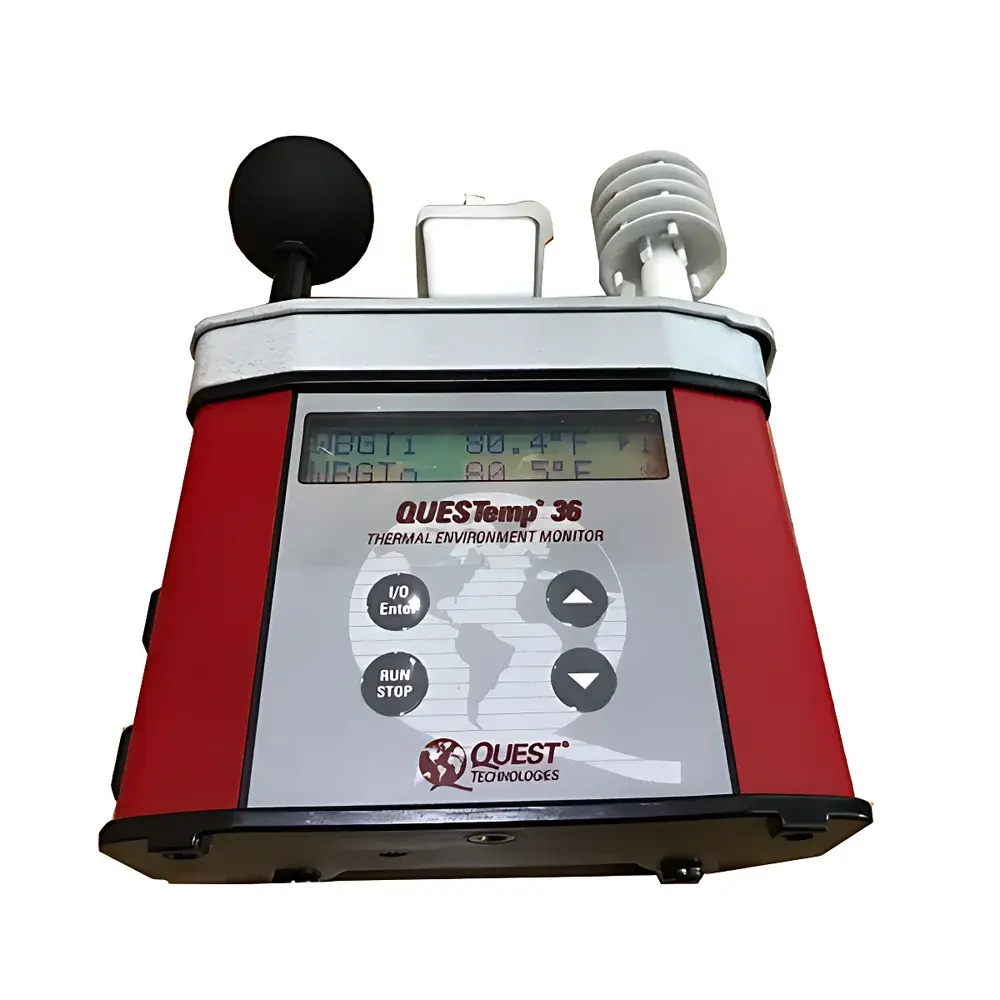
3M QUEST QT-36 WBGT Heat Stress Monitor
| Brand | 3M |
|---|---|
| Origin | USA |
| Manufacturer Type | Authorized Distributor |
| Product Category | Imported Instrument |
| Model | QT-36 |
| Pricing | Available Upon Request |
Overview
The 3M QUEST QT-36 WBGT Heat Stress Monitor is an industrial-grade, field-deployable environmental monitoring system engineered for precise assessment of heat stress risk in occupational and training environments. It operates on the widely accepted Wet Bulb Globe Temperature (WBGT) index—a composite thermal metric standardized by ISO 7243, ACGIH TLVs®, and OSHA guidelines—designed to quantify physiological strain from combined thermal loads: ambient air temperature (dry bulb), evaporative cooling effect (natural wet bulb), radiant heat flux (black globe temperature), relative humidity, and air movement. Unlike simple thermometers or single-parameter sensors, the QT-36 integrates calibrated tri-sensor architecture with real-time algorithmic computation to deliver compliant WBGTindoor and WBGToutdoor values per ANSI/ASHRAE Standard 55 and ISO 7933. Its robust design supports continuous deployment in high-risk settings—including foundries, naval vessels, military training facilities, and power generation plants—where thermal exposure must be quantified against regulatory exposure limits and preventive action thresholds.
Key Features
- Real-time WBGT calculation per ISO 7243 and ACGIH methodology, with automatic switching between indoor and outdoor algorithms based on sensor configuration and user selection
- Modular sensor architecture: detachable sensor head with up to 200 ft (61 m) cable length for remote placement in hazardous or elevated zones
- Multi-height WBGT profiling capability—supports simultaneous connection of three independent sensor modules (head, chest, ankle) for stratified thermal assessment and ISO-compliant weighted averaging
- Dual black globe options: 2-inch (51 mm) globe for rapid response in dynamic environments; 6-inch (152 mm) globe for enhanced radiometric accuracy in high-radiation settings (e.g., near furnaces or solar exposure)
- Multi-language display interface supporting English, French, German, Italian, Spanish, Portuguese, Korean, and simplified Chinese—configurable via onboard menu
- Intrinsically safe certification per UL/CSA Class I Groups A, B, C, D; Class II Groups E, F, G; Class III; T3 temperature rating; and ATEX Directive 2014/34/EU for use in potentially explosive atmospheres
- IP54-rated enclosure ensuring protection against dust ingress and water splashes during field operation
- Flexible power options: 9 V alkaline battery (up to 140 hours runtime), NiMH rechargeable pack, or AC adapter for extended stationary monitoring
Sample Compatibility & Compliance
The QT-36 is validated for use across heterogeneous thermal environments—from enclosed industrial workspaces to open-air military training grounds. Its sensor suite meets NIST-traceable calibration requirements and conforms to performance specifications outlined in ASTM D5423 (Standard Specification for Laboratory Ovens), ISO 7243 (Hot Environments — Estimation of the Heat Stress on Working Man), and EN 27243 (identical to ISO 7243). The device supports GLP-aligned data integrity through time-stamped logging and audit-ready output formats. All measurements adhere to the fundamental assumptions of the WBGT model: steady-state human thermal equilibrium, metabolic rate of 174 W/m² (light work), and clothing insulation of 0.6 clo—making it suitable for occupational hygiene assessments under OSHA 29 CFR 1910.142 and EU Directive 89/654/EEC.
Software & Data Management
The QT-36 interfaces seamlessly with 3M’s proprietary Data Management Software (DMS), enabling secure download, visualization, and export of time-series WBGT, dry/wet/black globe temperatures, RH%, and heat index values. DMS supports CSV and PDF report generation with customizable metadata fields (operator ID, location tag, shift code). All logged data includes embedded timestamps, sensor IDs, and firmware version stamps—ensuring traceability for internal audits or regulatory submissions. While the QT-36 itself does not enforce FDA 21 CFR Part 11 compliance (as it lacks electronic signature functionality), its raw data output is fully compatible with validated LIMS and EHS platforms that implement full ALCOA+ principles (Attributable, Legible, Contemporaneous, Original, Accurate, Complete, Consistent, Enduring, Available).
Applications
- Military and law enforcement: Heat acclimatization monitoring during recruit training, armored vehicle crew endurance evaluation, and desert operations planning
- Maritime and offshore: Thermal hazard mapping aboard naval vessels, submarines, and LNG carriers where confined spaces amplify heat retention
- Energy sector: Worker safety validation in nuclear containment support areas, turbine halls, boiler rooms, and petrochemical refineries
- Manufacturing & logistics: Ergonomic heat stress reviews in automotive assembly lines, warehouse sorting centers, and cold-chain distribution hubs with thermal crossover zones
- Sports science: Environmental load quantification for elite athlete conditioning protocols under controlled climatic chambers or outdoor stadiums
- Occupational health programs: Baseline WBGT benchmarking, job hazard analysis (JHA), and development of site-specific heat illness prevention plans (HIPP)
FAQ
What standards does the QT-36 comply with for WBGT measurement?
It implements ISO 7243, ACGIH TLVs®, and OSHA Technical Manual Appendix D methodologies for WBGT calculation, with hardware-level adherence to ASTM E1953 sensor performance criteria.
Can the QT-36 be used in explosive atmospheres?
Yes—it carries intrinsic safety certification per UL/CSA and ATEX for Class I, II, and III hazardous locations, including Group A (acetylene) and Group E (metal dust) environments.
Is multi-height WBGT measurement required for regulatory compliance?
While not universally mandated, ISO 7243 Annex B recommends vertical profiling in stratified thermal fields (e.g., steel mills), and the QT-36’s three-sensor configuration satisfies this best-practice requirement.
Does the device store historical data internally?
No—the QT-36 is a real-time display instrument without onboard memory; data logging requires connection to DMS software via USB or optional Bluetooth module.
How often should sensor calibration be performed?
3M recommends annual NIST-traceable recalibration; field verification using certified reference sources (e.g., dry-wet-black globe calibration kits) is advised before each critical assessment campaign.



