
3nh CR9 Advanced Portable Spectrophotometric Colorimeter
| Brand | 3nh |
|---|---|
| Origin | Guangdong, China |
| Manufacturer Type | Direct Manufacturer |
| Product Category | Spectrophotometric Colorimeter |
| Instrument Type | Portable |
| Optical Geometry | d/8° Integrating Sphere (SCI/SCE) |
| Illuminants | D65, A, C, D50, D55, D75, F1–F12 (including CWF, TL84, TL83/U30, TPL5, DLF) |
| Spectral Range | 400–700 nm |
| Wavelength Interval | 10 nm |
| FWHM | 10 nm |
| Repeatability | ΔE*ab ≤ 0.03 (MAV/SCI, after warm-up and calibration, avg. of 30 measurements on white tile at 5 s intervals) |
| Inter-instrument Agreement | ΔE*ab ≤ 0.3 (BCRA Series II 12-tile avg.) |
| Measurement Apertures | Ø8 mm & Ø4 mm |
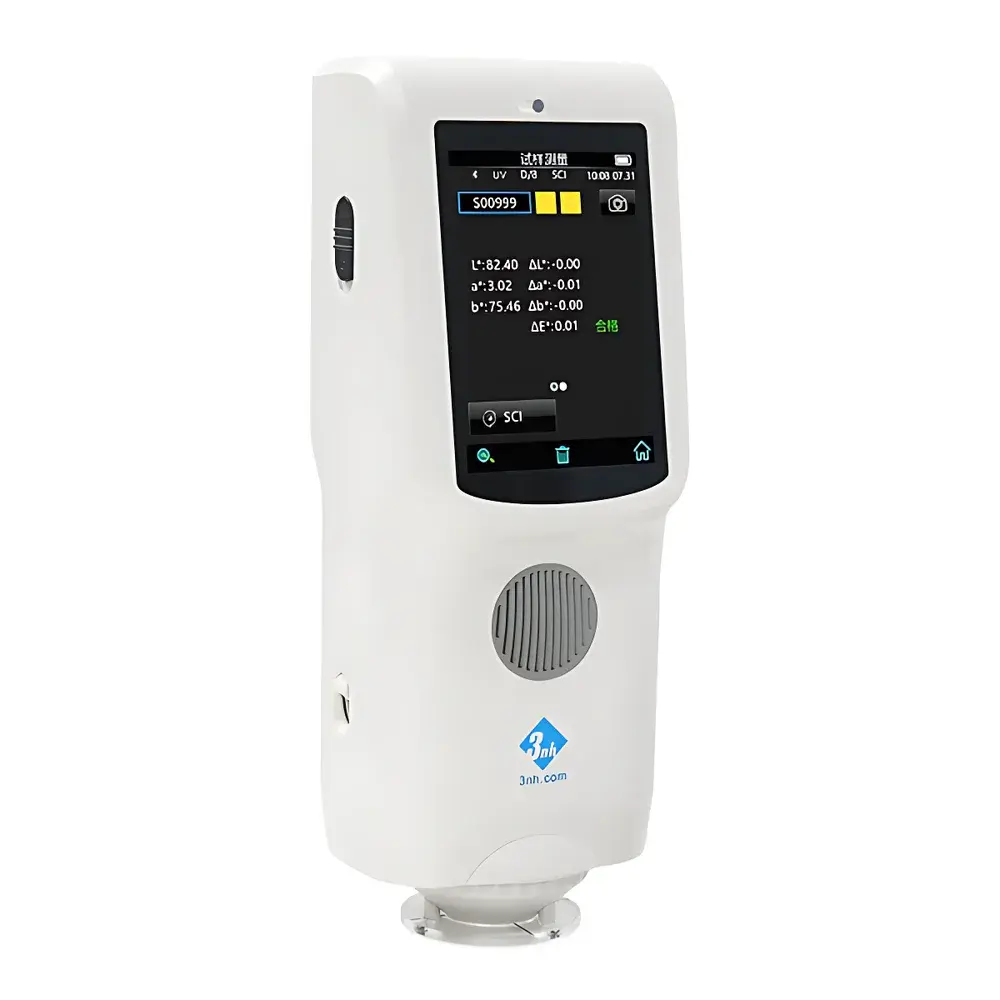
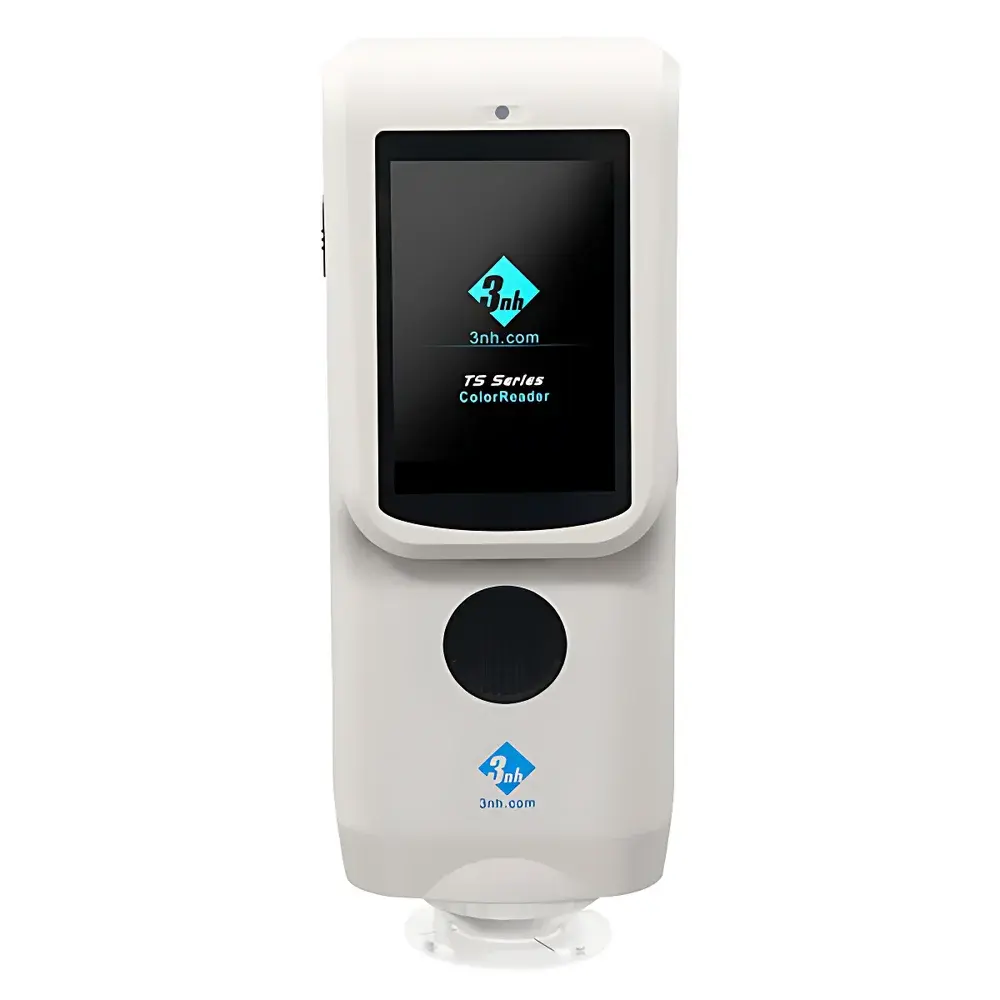
| Display | 3.5″ capacitive TFT touchscreen |
| Connectivity | USB 2.0, Bluetooth® 5.0 |
| Battery Life | ~8 h (up to 6,000 measurements) |
| Dimensions | 81 × 71 × 214 mm |
| Weight | ~460 g |
Overview
The 3nh CR9 Advanced Portable Spectrophotometric Colorimeter is a dual-mode optical measurement instrument engineered for high-precision colorimetric analysis in industrial quality control environments. Based on grating-based spectrophotometry, the CR9 captures full spectral reflectance data across the visible spectrum (400–700 nm) at 10 nm intervals with 10 nm full width at half maximum (FWHM) resolution. Its d/8° integrating sphere geometry—compliant with CIE No. 15, ISO 7724-1, ASTM E1164, DIN 5033 Teil 7, and GB/T 3978—supports both Specular Component Included (SCI) and Specular Component Excluded (SCE) measurement modes, enabling objective evaluation of intrinsic color independent of surface texture or gloss effects. Designed for traceable, reproducible color assessment, the CR9 integrates a dual-row 32-element silicon photodiode array sensor, full-spectrum LED illumination (including UV), and real-time camera-assisted targeting—making it suitable for R&D labs, production floors, and field inspections where metrological rigor meets operational flexibility.
Key Features
- Grating-based optical architecture delivering high spectral fidelity and long-term stability without moving parts.
- Dual-aperture design (Ø8 mm and Ø4 mm) for adaptable sampling of flat, curved, textured, or small-area surfaces.
- Integrated 3.5″ capacitive touchscreen with live camera preview for precise measurement region targeting and visual confirmation of sample alignment.
- Full-spectrum LED illuminants covering all standard CIE illuminants (D65, A, C, D50–D75, F1–F12) plus industry-specific sources (TL84, CWF, U30), eliminating spectral gaps inherent in conventional white LEDs.
- Robust thermal and photometric calibration system with factory-traceable white and black calibration tiles; includes lifetime stability guarantee for the reference white tile.
- High-speed measurement cycle: ~1.5 s per SCI or SCE reading; ~3.2 s for simultaneous dual-mode acquisition.
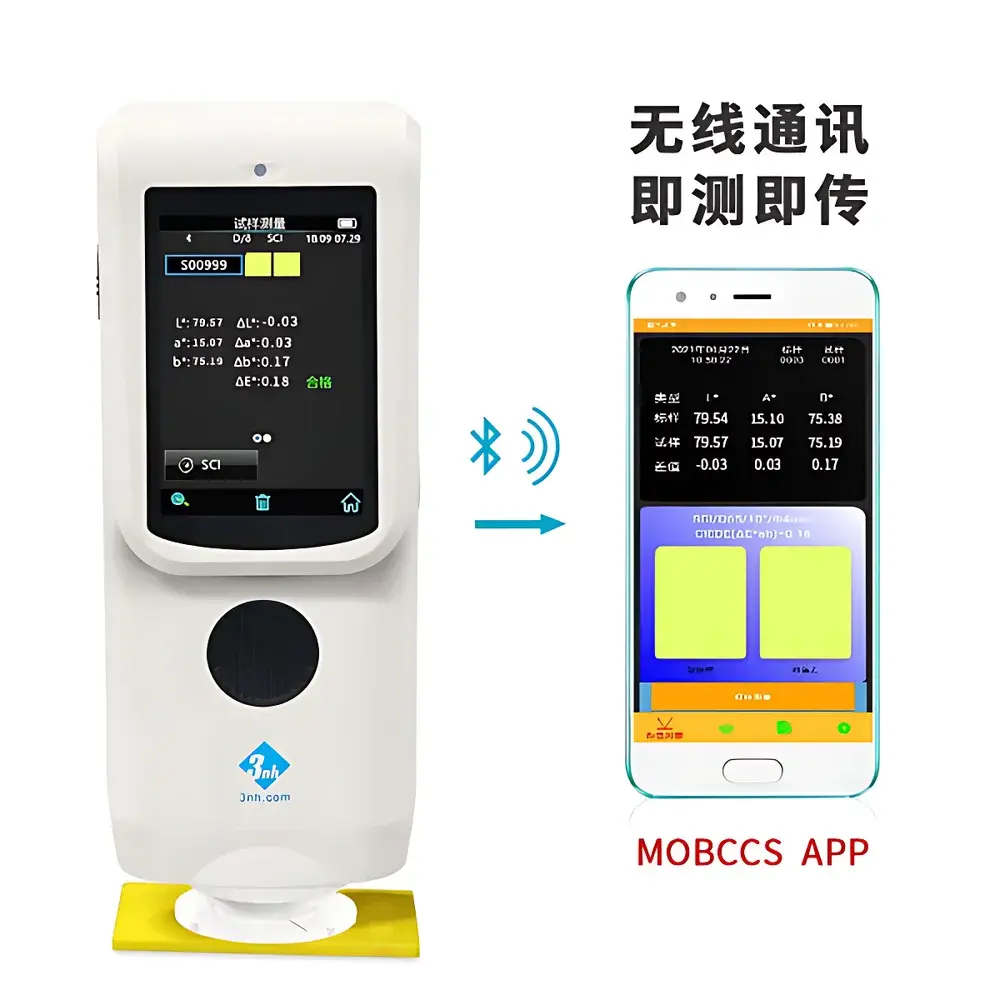
- Onboard storage for 1,000 standard references and 30,000 sample records (each supporting concurrent SCI/SCE data), expandable via cloud-synced MOBCCS mobile application.
- Comprehensive color space support: CIE LAB, XYZ, Yxy, LCh, CIE LUV, sRGB, βxy, DIN Lab9/Lab99, Munsell (C/2); multiple ΔE formulas including ΔE*ab, ΔE*00, ΔE*94, ΔE*cmc (1:1 & 2:1), and DIN ΔE99.
Sample Compatibility & Compliance
The CR9 accommodates diverse material classes—including plastics, painted surfaces, textiles, ceramics, printed media, and coated metals—without requiring sample preparation beyond standard conditioning (per ISO 291 and ASTM D618). Its Ø4 mm aperture enables reliable measurement of fine patterns, embroidery, or narrow extrusions, while the Ø8 mm mode ensures statistical representativeness for bulk materials. The instrument conforms to international color measurement standards: CIE Publication 15:2018, ISO 7724-1:2019, ASTM E1164-22, DIN 5033-7:2018, and GB/T 18833–2019. For regulated industries, raw spectral data and metadata (illuminant, observer angle, geometry, date/time, operator ID) are exportable in CSV and XML formats compatible with GLP/GMP audit trails. While not FDA 21 CFR Part 11–certified out-of-the-box, its SQCX desktop software supports configurable user access controls and electronic signature-ready reporting workflows.
Software & Data Management
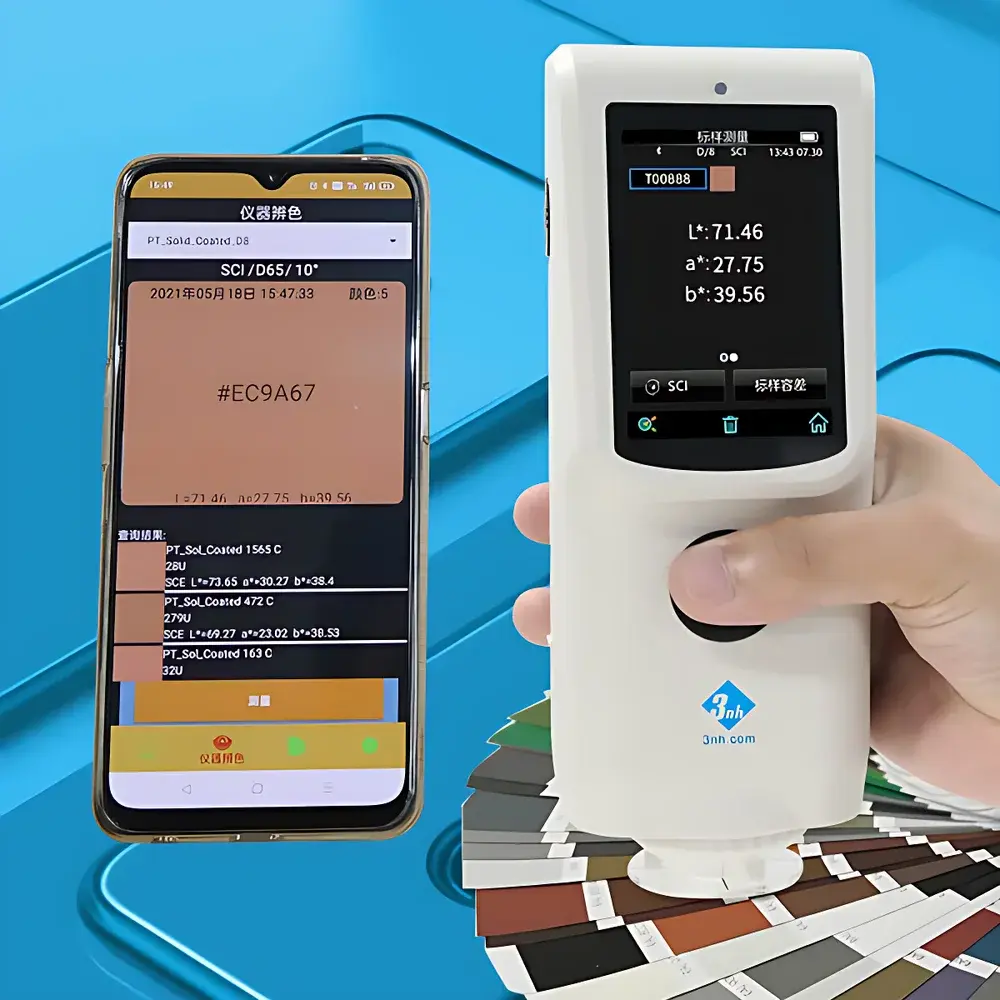
The CR9 operates standalone via its intuitive touch interface or integrates into enterprise color management ecosystems through three interoperable platforms: (1) SQCX Quality Control Software (Windows-based), offering SPC charting, tolerance banding, batch comparison, and PDF report generation with embedded spectral graphs; (2) MOBCCS mobile application (iOS/Android), enabling real-time cloud synchronization, remote firmware updates, cross-device color matching against proprietary or commercial color libraries (Pantone®, RAL, NCS), and offline database search; (3) direct USB/Bluetooth data transfer to LIMS or ERP systems via structured CSV exports. All spectral and tristimulus data include full metadata tags—ensuring traceability from measurement to final report. Audit logs record calibration events, user logins, and configuration changes—supporting internal QA reviews and external accreditation audits.
Applications
The CR9 serves as a primary color verification tool across vertically integrated manufacturing supply chains. In automotive interiors, it validates color consistency of injection-molded dash components under D65 and D50 lighting. In textile dye houses, it quantifies metamerism risk using F12 (TL83) vs. D65 comparisons and calculates AATCC TM179 whiteness indices. Packaging converters rely on its ΔE*00 tolerancing and spectral deviation alerts to reject ink lots drifting outside G7-certified gray balance targets. Paint formulators use its SCI/SCE toggle to isolate pigment performance from substrate effects during lab-scale dispersion trials. Additionally, its portability and battery endurance make it ideal for supplier audits, retail shelf audits, and in-line QC stations where benchtop spectrophotometers are impractical.
FAQ
What is the difference between SCI and SCE measurement modes?
SCI includes specular reflectance and measures total reflectance—ideal for evaluating colorant formulation and material composition. SCE excludes specular reflectance and simulates human visual perception under typical viewing conditions—preferred for appearance evaluation of glossy or textured surfaces.
Does the CR9 support UV fluorescence correction?
Yes—the instrument incorporates a dedicated UV LED source and spectral correction algorithms compliant with ISO 105-J03 and AATCC Test Method 183, enabling accurate whiteness and brightness assessment of optically brightened materials.
How is inter-instrument agreement maintained across a fleet of CR9 units?
Each unit undergoes factory calibration against BCRA Series II ceramic tiles; the reported inter-instrument agreement (ΔE*ab ≤ 0.3) reflects worst-case deviation across 12 standardized color tiles under identical environmental conditions.
Can spectral data be exported for third-party analysis?
Yes—raw reflectance spectra (400–700 nm at 10 nm steps), along with metadata (illuminant, observer, geometry, timestamp), are exportable in CSV and XML formats compatible with MATLAB, Python (NumPy/Pandas), and industry-standard color science toolkits.
Is the CR9 suitable for ISO/IEC 17025-accredited laboratories?
While the hardware meets metrological requirements for colorimetry, formal accreditation requires documented uncertainty budgets, periodic verification using NIST-traceable standards, and procedural adherence to ISO/IEC 17025 clauses—capabilities supported by the CR9’s calibration traceability and data integrity features.




