
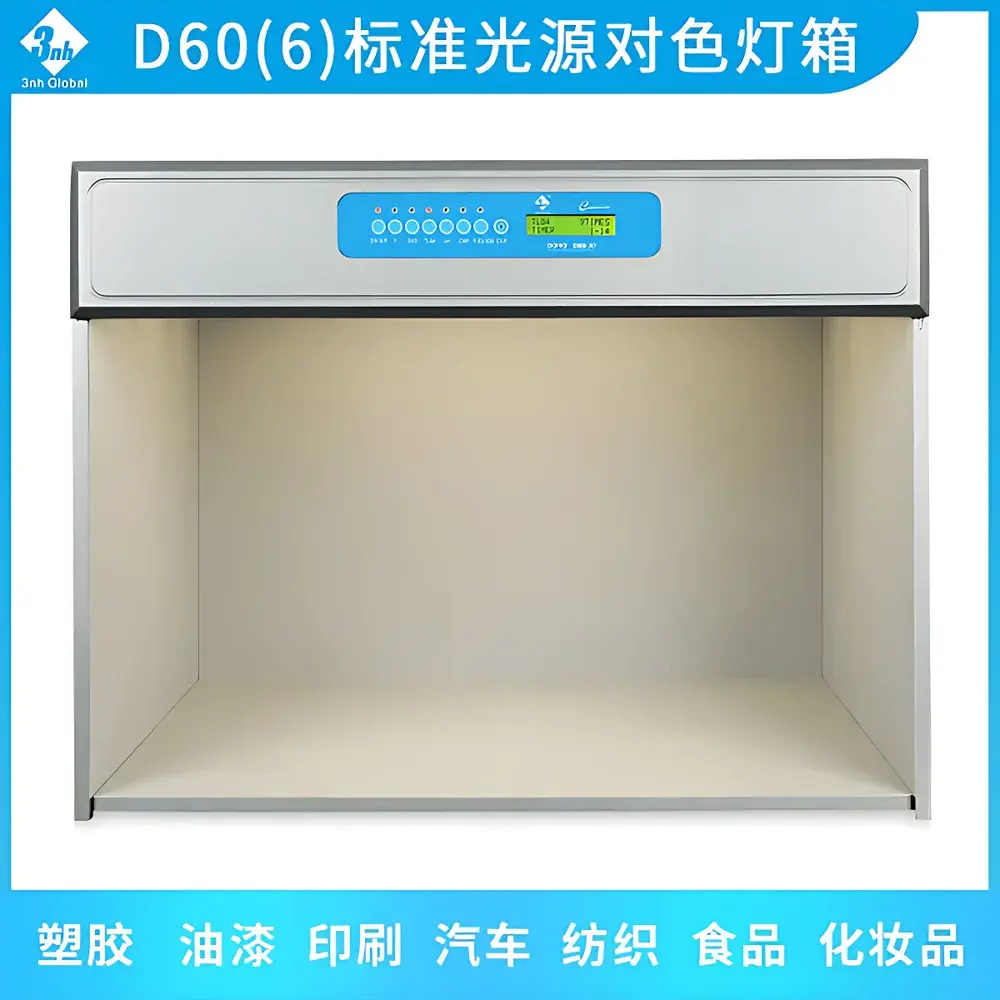
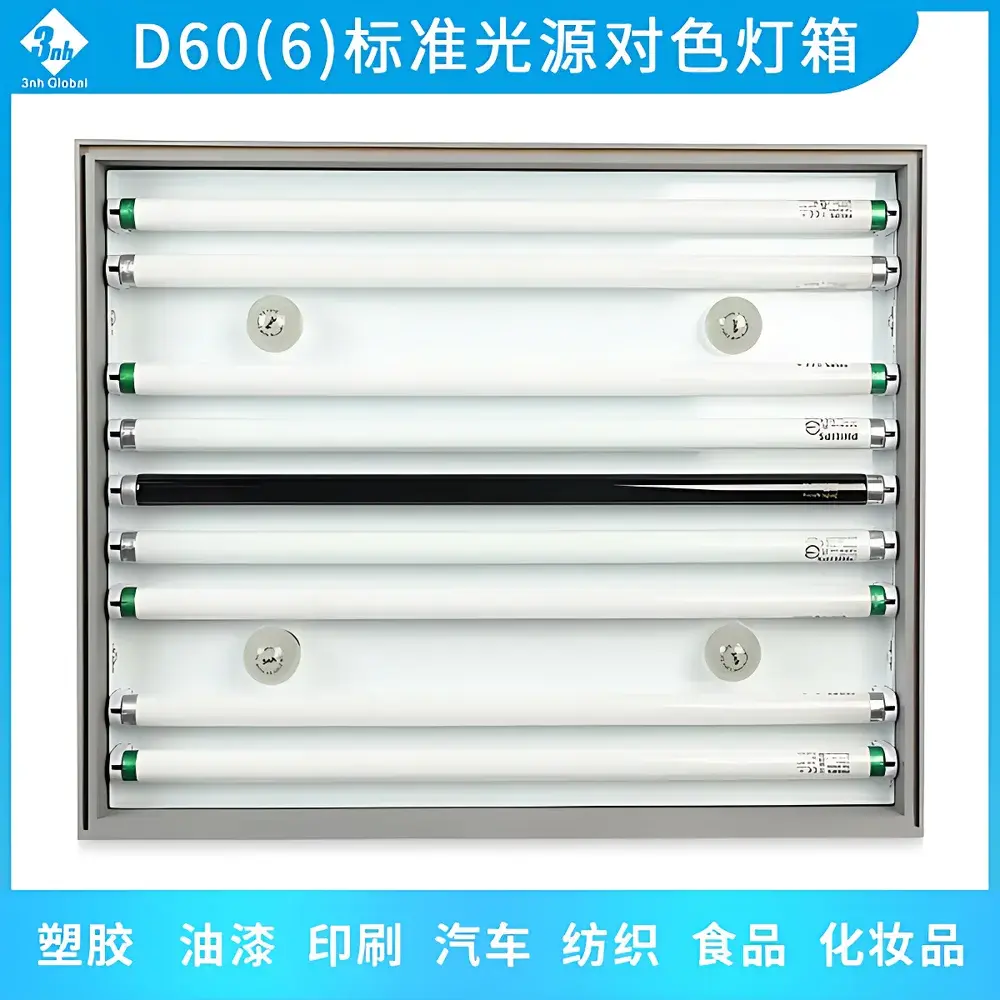
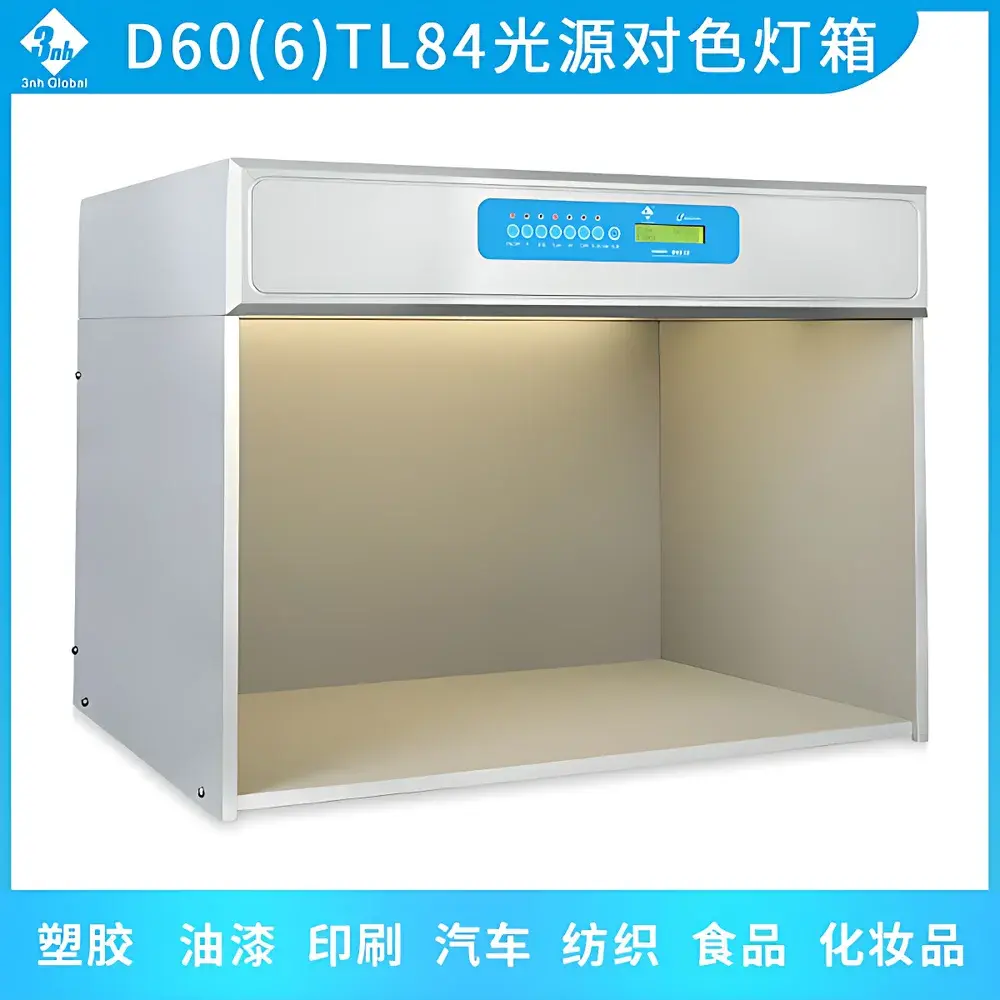
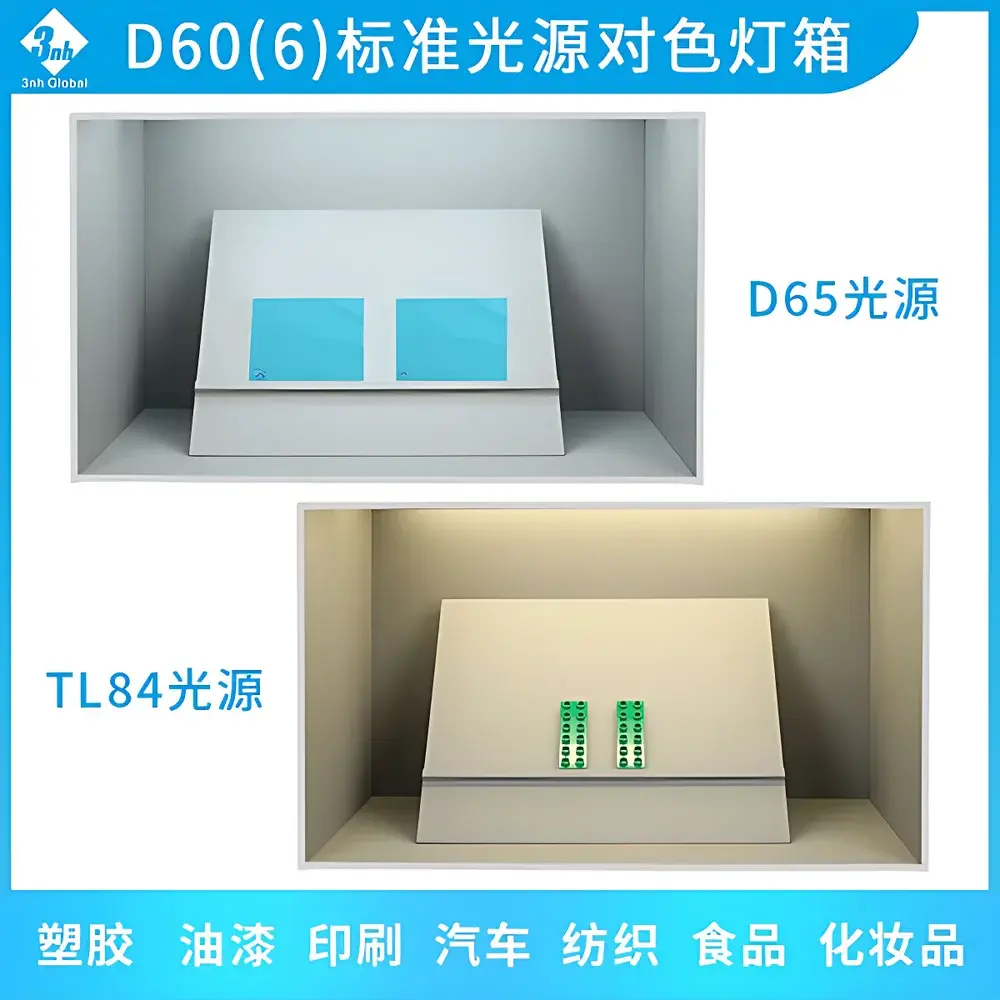
3nh DOHO D60(6) Standard Light Booth for Color Matching
| Brand | 3nh |
|---|---|
| Origin | Guangdong, China |
| Manufacturer Type | OEM/ODM Manufacturer |
| Model | D60(6) |
| Light Sources | D65 (6500K, 18W), TL84 (4000K, 18W), CWF (4150K, 18W), F (2700K, 40W), UV (365 nm, 18W), TL83 (3000K, 18W), U30 (3000K, 20W) |
| Power Consumption | ≤140 W total |
| Switching Method | Automatic electronic relay control |
| Lamp Life | ≥2000 h (D65/TL84/CWF/UV/TL83/U30), ≥1000 h (F) |
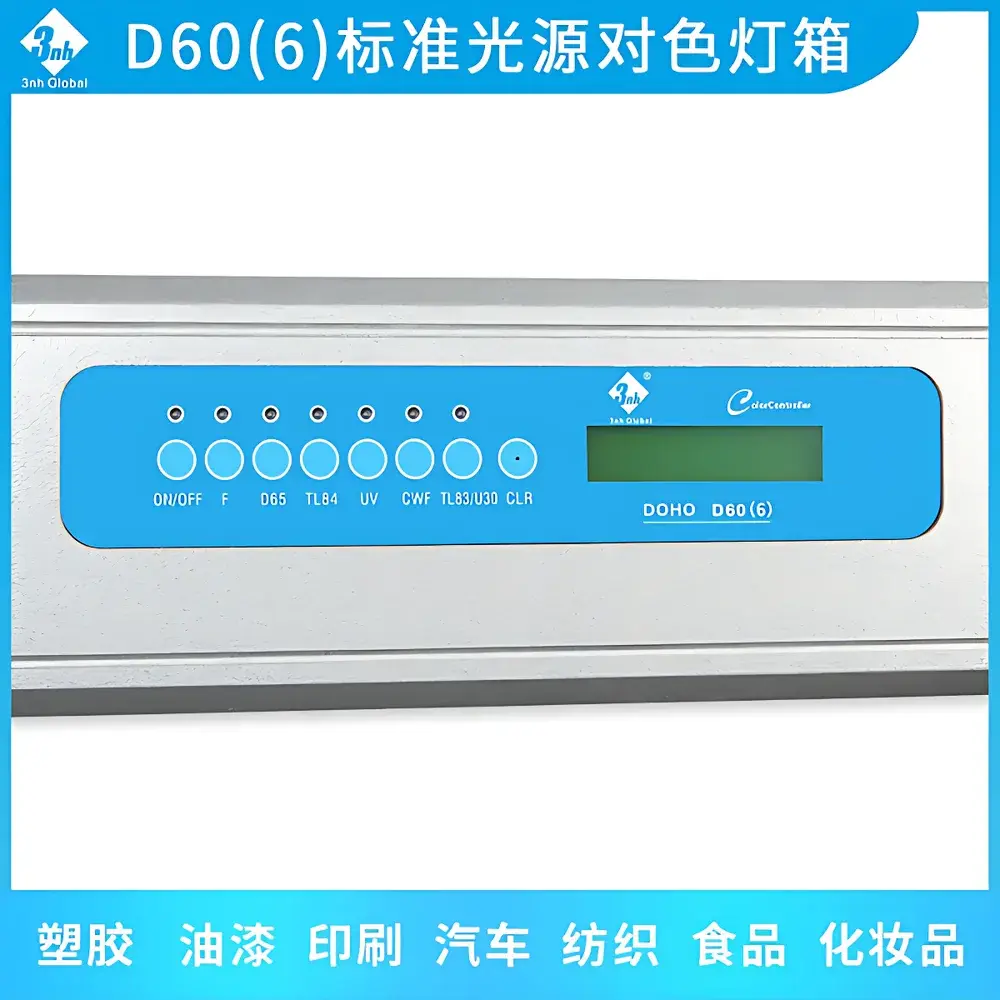
| Display | LED real-time counter for cumulative usage time and switch cycles per lamp |
| Heat Dissipation | Passive cooling (no fan required) |
| Compliance | Meets ISO 3664:2009, ASTM D1729–16, CIE Publication No. 51, GB/T 9761–2008 |
Overview
The 3nh DOHO D60(6) Standard Light Booth is an engineered color evaluation instrument designed to replicate standardized illuminants under controlled viewing conditions. It operates on the principle of spectral simulation—using high-stability fluorescent and incandescent lamps with precisely defined chromaticity coordinates, correlated color temperature (CCT), and spectral power distribution (SPD) to emulate key daylight and artificial lighting environments. This enables objective visual assessment of metamerism, color consistency, and hue shift across material batches, substrates, and production stages. The booth complies with international standards governing color-critical workflows—including ISO 3664:2009 for graphic technology and photography, ASTM D1729–16 for color matching in industrial applications, and CIE Publication No. 51 for standard illuminants. Its solid-state electronic switching architecture eliminates mechanical wear, while the absence of warm-up delay ensures immediate readiness for inspection cycles in fast-paced QC laboratories and R&D settings.
Key Features
- Seven pre-configured light sources: D65 (6500 K, 18 W), TL84 (4000 K, 18 W), CWF (4150 K, 18 W), F (2700 K, 40 W), UV (365 nm, 18 W), TL83 (3000 K, 18 W), and U30 (3000 K, 20 W), covering major global commercial and industrial lighting specifications.
- Real-time digital monitoring of individual lamp usage—tracking cumulative operating hours and switch cycles for each source to support preventive maintenance and lamp replacement scheduling.
- Fanless passive thermal management: Low-power lamp selection and optimized internal airflow design eliminate heat buildup, ensuring stable CCT output and preventing sample thermal degradation during extended evaluation sessions.
- No preheating requirement: Lamps reach photometric stability within <1 second of activation, enabling rapid sequential comparison across illuminants without workflow interruption.
- User-customizable lamp labeling: Firmware supports renaming of light source identifiers (e.g., “D65” → “Daylight_6500”) and facilitates future firmware-based addition of new illuminants via authorized update protocols.
- High-efficiency phosphor-coated lamps deliver >85 lm/W luminous efficacy and maintain <±0.002 Δuv chromaticity drift over rated lifetime, minimizing inter-lamp variability in multi-source assessments.
Sample Compatibility & Compliance
The D60(6) accommodates flat and low-relief samples up to 350 mm × 250 mm × 100 mm (W × D × H) within its matte-black interior cavity, which features ≥90% diffuse reflectance coating to suppress specular interference. It supports reflective, translucent, and fluorescent specimens—including textiles, plastics, paints, coatings, printed materials, and ceramic glazes. All installed lamps are certified to meet spectral irradiance tolerances specified in ISO 3664:2009 Annex A and ASTM D1729–16 Table 1. UV source output is calibrated to CIE-defined UVA band (315–400 nm), with peak emission at 365 nm ±5 nm. The unit carries CE marking and conforms to IEC 61000-6-3 (EMC emissions) and IEC 61000-6-1 (immunity). It is suitable for GLP-compliant environments when integrated with documented lamp calibration logs and usage records.
Software & Data Management
While the D60(6) operates as a standalone hardware platform, its lamp usage data is exportable via USB interface in CSV format for integration into laboratory information management systems (LIMS) or quality documentation workflows. Timestamped logs include lamp ID, total on-time (hh:mm:ss), number of actuations, and last reset date—enabling traceability for ISO 9001 internal audits and FDA 21 CFR Part 11–aligned record retention (when paired with validated timestamping servers). Firmware updates are delivered through authenticated 3nh technical support channels and include version-controlled changelogs compliant with IEC 62304 software lifecycle requirements.
Applications
- Textile and apparel manufacturing: Detection of metamerism between dyed lots under retail lighting (TL84, TL83, U30) and daylight (D65).
- Automotive paint QC: Visual verification of color match between body panels and trim components across multiple illuminants including UV for clear-coat fluorescence assessment.
- Printing and packaging: Evaluation of ink consistency, substrate interaction, and gloss effects under D65 (proofing), CWF (US retail), and F (hospitality environments).
- Plastics and polymer extrusion: Identification of batch-to-batch hue variation under controlled thermal and photometric conditions.
- Academic color science labs: Teaching spectral rendering indices (SRI), color difference metrics (ΔE₀₀), and illuminant-dependent perceptual shifts using standardized viewing geometry (0°/45°).
FAQ
What standards does the D60(6) comply with for color evaluation?
It meets ISO 3664:2009, ASTM D1729–16, CIE Publication No. 51, and GB/T 9761–2008 for illuminant spectral fidelity and booth geometry.
Can the UV lamp be used for fluorescence quantification?
The 365 nm UV source is intended for qualitative fluorescence detection—not quantitative measurement—and should be used with appropriate eye protection and exposure time limits per IEC 62471.
Is lamp calibration traceable to national metrology institutes?
Lamp spectral output is verified against NIST-traceable reference spectroradiometers during factory certification; end-user recalibration services are available through 3nh-accredited labs.
Does the D60(6) support automatic logging of inspection sessions?
No native session logging is built-in, but usage counters and timestamps can be exported manually for external audit trail reconstruction.
What is the recommended lamp replacement interval?
D65, TL84, CWF, UV, TL83, and U30 lamps should be replaced after 2000 hours; the F lamp requires replacement after 1000 hours to maintain chromaticity accuracy.




