
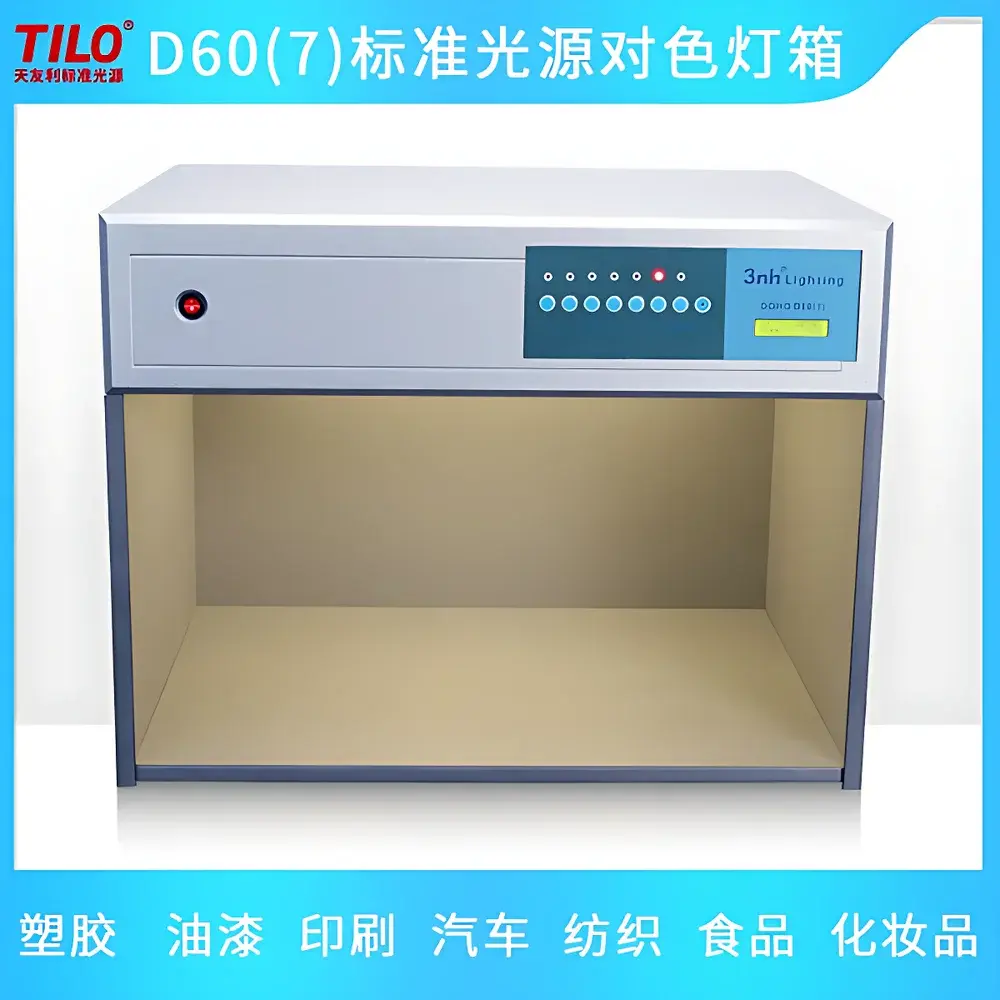
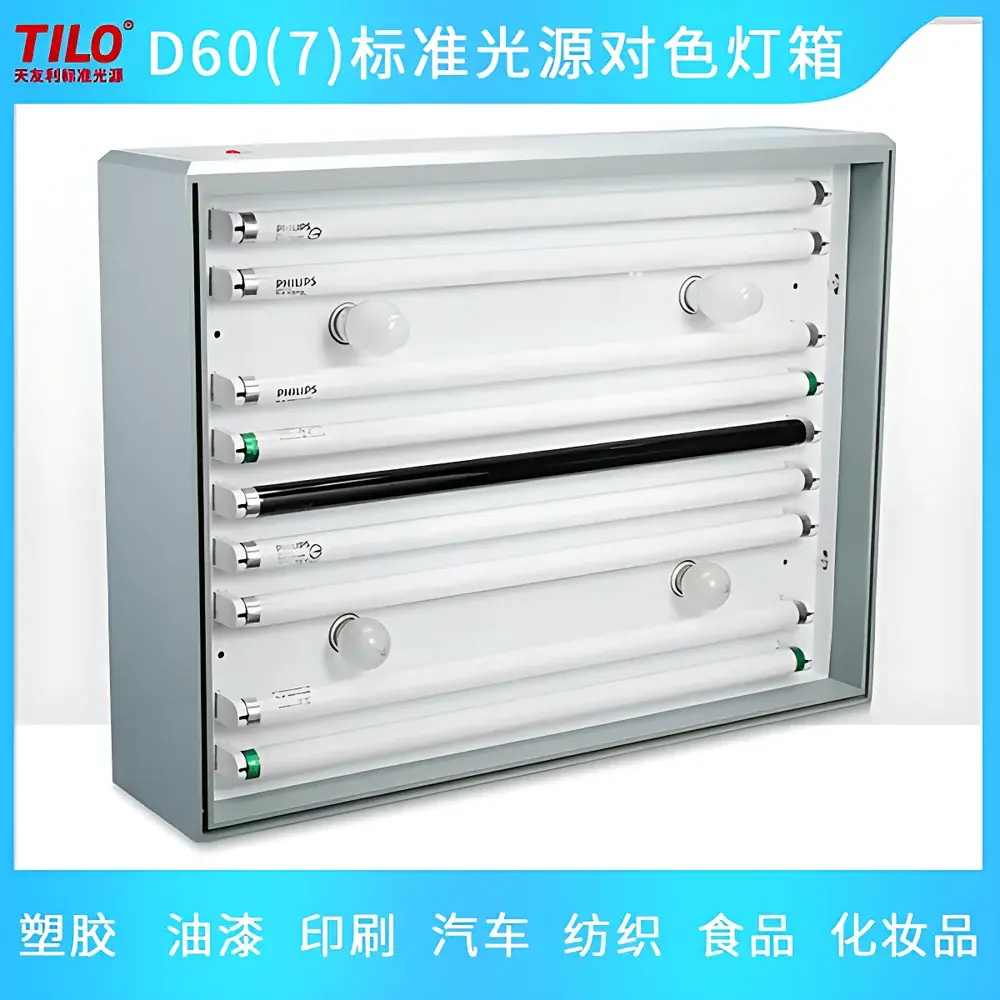
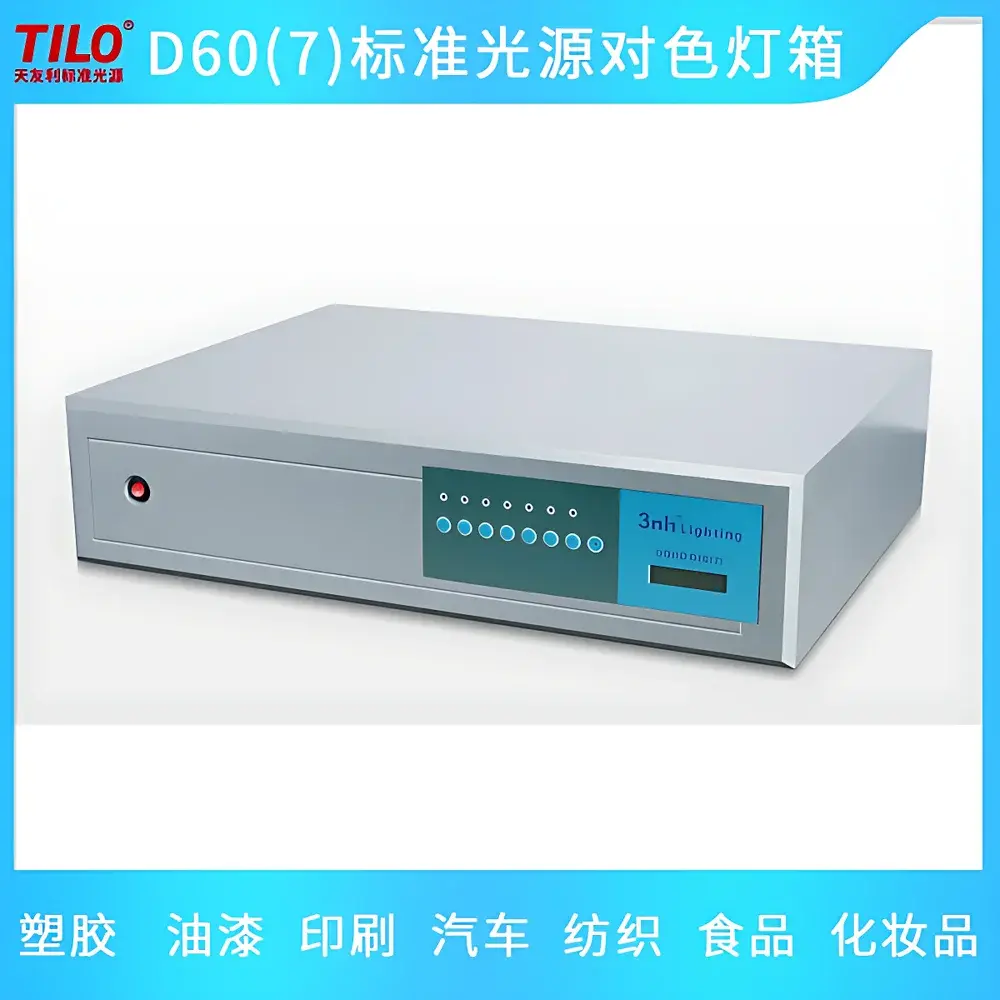
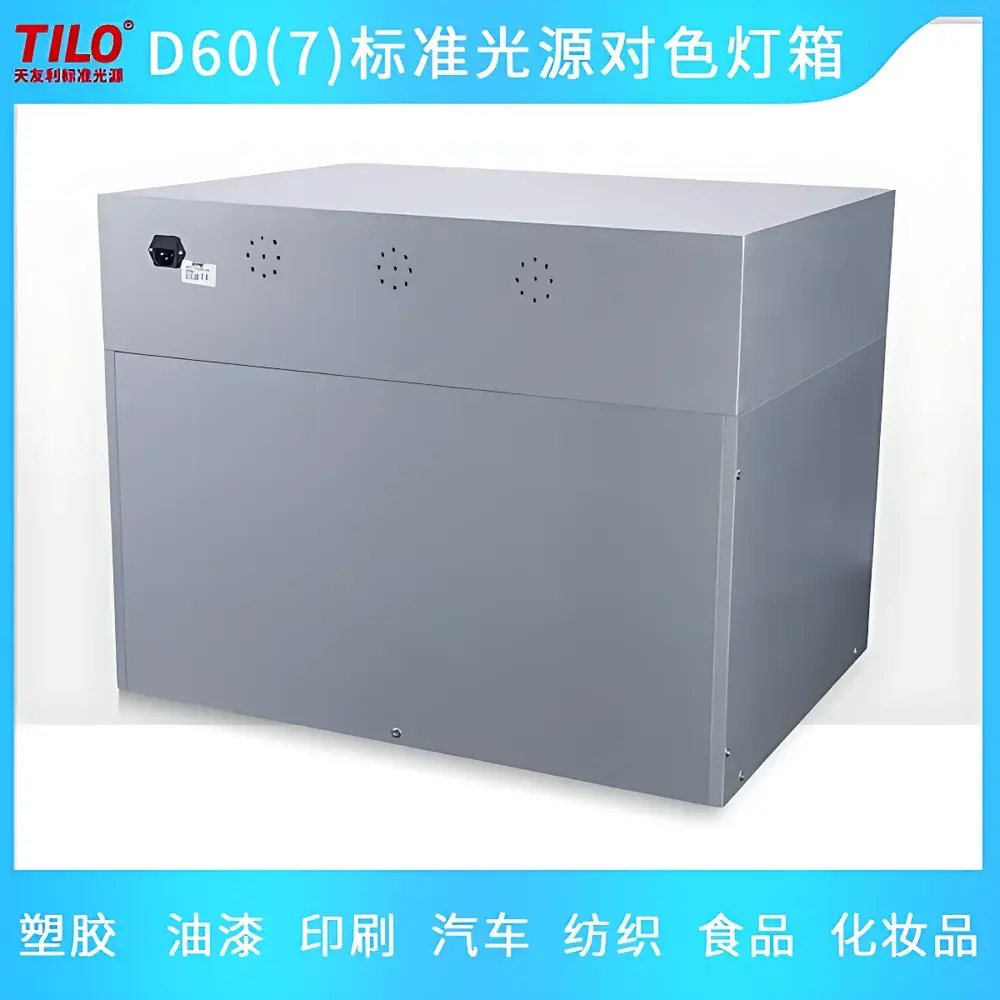
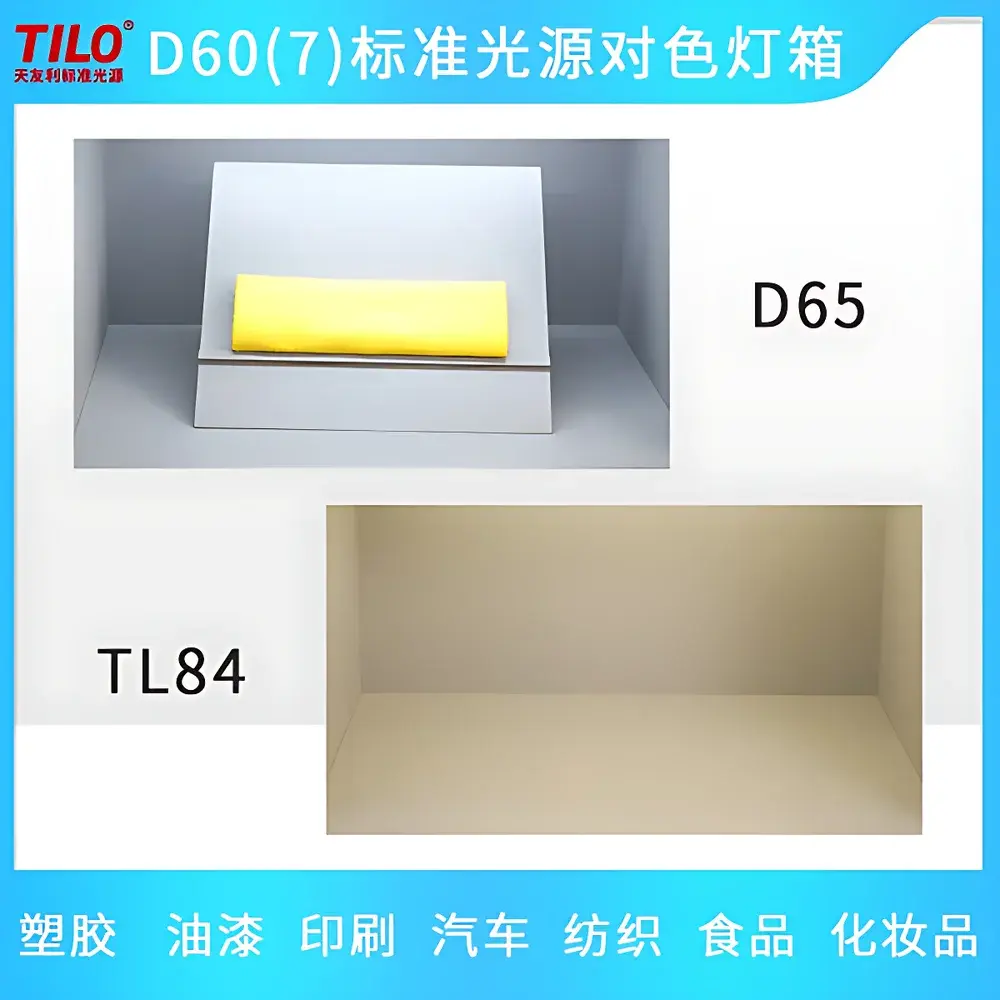
3nh DOHO D60(7) Standard Light Source Color Matching Cabinet
| Brand | 3nh |
|---|---|
| Origin | Guangdong, China |
| Manufacturer Type | Manufacturer |
| Country of Origin | China |
| Model | DOHO D60(7) |
| Voltage | 220V/50Hz or 115V/60Hz |
| Dimensions (W×D×H) | 710 × 530 × 570 mm |
| Weight | 38 kg |
| Light Sources | D65 (6500K, 18W), TL84 (4000K, 18W), CWF (4150K, 18W), F (2700K, 40W), UV (365 nm, 20W), A (2856K, 60W), TL83 (3000K, 18W) |
| Source Count per Type | D65×2, TL84×2, CWF×2, F×2, UV×1, A×2, TL83×2 |
| Features | Real-time source usage tracking, automatic source switching, metamerism evaluation capability, instant-on operation, no warm-up delay, flicker-free output, high luminous efficacy, low thermal emission, user-configurable source labeling |
Overview
The 3nh DOHO D60(7) Standard Light Source Color Matching Cabinet is an engineered solution for precise, repeatable, and standardized visual color assessment across industrial quality control, R&D, and production environments. Designed in accordance with ISO 3664:2009, CIE Publication No. 51, ASTM D1729, and GB/T 9761–2008, this cabinet delivers photometrically stable illumination under seven internationally recognized reference light sources. Its core function is to enable accurate detection of metamerism—the phenomenon where two color samples match under one illuminant but diverge under another—by providing simultaneous access to spectrally distinct lighting conditions without physical lamp replacement. The cabinet employs high-CRI fluorescent and incandescent lamps calibrated to meet spectral power distribution (SPD) tolerances specified in ISO/CIE standards, ensuring traceability to national metrology institutes. Unlike legacy systems requiring manual lamp swaps and extended stabilization periods, the D60(7) achieves full spectral readiness within milliseconds via solid-state relay-controlled ballasts—eliminating warm-up drift and enabling rapid comparative evaluation across multiple illuminants in sequence or side-by-side mode.
Key Features
- Seven pre-calibrated light sources: D65 (6500 K, daylight simulation), TL84 (4000 K, retail lighting in EU/Japan/China), CWF (4150 K, U.S. cool white fluorescent), F (2700 K, domestic/hotel tungsten), UV (365 nm, fluorescence excitation), A (2856 K, U.S. incandescent reference), and TL83 (3000 K, European warm white)
- Real-time operational logging: Each source displays cumulative operating hours, total switch cycles, and last-used timestamp—supporting preventive maintenance scheduling and GLP-compliant recordkeeping
- Flicker-free, instant-on electronic ballast architecture eliminates perceptible delay or intensity fluctuation during source transitions
- No active cooling required: Optimized thermal management ensures surface temperature rise remains below 5 °C above ambient after 2-hour continuous operation
- User-definable source naming: Custom labels can be assigned via front-panel interface to align with internal SOP nomenclature or client-specific lighting protocols
- Dual-voltage compatibility: Factory-configurable for either 220 V / 50 Hz (CE-marked) or 115 V / 60 Hz (UL-recognized) input, facilitating global deployment without hardware modification
Sample Compatibility & Compliance
The D60(7) accommodates specimens up to 600 mm × 450 mm × 150 mm (L×W×H) within its matte-black interior chamber, minimizing stray reflections and ensuring uniform irradiance distribution per ISO 3664 Annex B. Its viewing geometry conforms to the 45°/0° standard (with optional 45° viewing stand available), satisfying requirements for textile, paint, plastic, and print evaluation per AATCC Evaluation Procedure 1, ISO 12647-2, and DIN 6174. All installed lamps are certified to IEC 60081 and IEC 60901 photometric specifications. The cabinet’s electrical design complies with IEC 61000-3-2 (harmonic current emissions) and IEC 61000-4-3 (radiated immunity). Documentation includes factory calibration reports traceable to NIM (National Institute of Metrology, China) and a Declaration of Conformity covering CE, RoHS, and REACH directives.
Software & Data Management
While the D60(7) operates as a standalone hardware platform, its embedded microcontroller supports RS-232 serial output (optional USB-to-serial adapter) for integration into laboratory information management systems (LIMS) or enterprise quality databases. Logged source usage data—including timestamps, duration, and operator ID (via optional RFID badge reader)—can be exported as CSV for audit trail generation. Firmware updates are performed via secure UART interface; version history and checksums are retained in non-volatile memory to satisfy FDA 21 CFR Part 11 requirements for electronic records integrity. Audit logs are immutable and include event type, source ID, time stamp, and system state—enabling retrospective verification during GMP or ISO 9001 audits.
Applications
- Textile and apparel: Shade matching across dye lots under D65 and TL84 to verify consistency in retail environments
- Automotive coatings: Metamerism screening of OEM finish panels using D65 + A combinations to simulate daylight and garage lighting
- Packaging printing: Visual verification of spot-color fidelity on flexographic and gravure substrates under F and TL84
- Plastics manufacturing: Batch-to-batch comparison of injection-molded components under UV to detect fluorescence additive variation
- Paint formulation labs: Correlation of spectrophotometric measurements with human observer assessments under CWF and D65
- Academic color science research: Controlled stimulus presentation for psychophysical experiments on chromatic adaptation and color constancy
FAQ
Does the D60(7) support automated light source sequencing for multi-illuminant evaluation?
Yes—users can program up to five sequential illuminant sequences with adjustable dwell times (1–99 seconds), stored in non-volatile memory for recall across sessions.
Are replacement lamps supplied with NIST-traceable spectral certification?
All factory-installed lamps include individual spectral power distribution charts and luminous flux verification reports issued by 3nh’s ISO/IEC 17025-accredited calibration lab.
Can the cabinet be integrated into a networked QC workflow?
Via optional RS-232 or Ethernet module (DOHO-NET), the unit transmits real-time source status, error codes, and usage logs to centralized MES or SPC platforms.
Is UV exposure dose controlled to prevent sample degradation?
UV lamp duty cycle is limited to ≤30 seconds per activation; cumulative exposure time is logged and configurable alarm thresholds trigger visual alerts when daily limits are exceeded.
What is the recommended recalibration interval for long-term photometric stability?
Annual verification against reference illuminants using a calibrated spectroradiometer is advised; 3nh provides certified field service or return-to-factory recalibration with ISO/IEC 17025 report issuance.




