
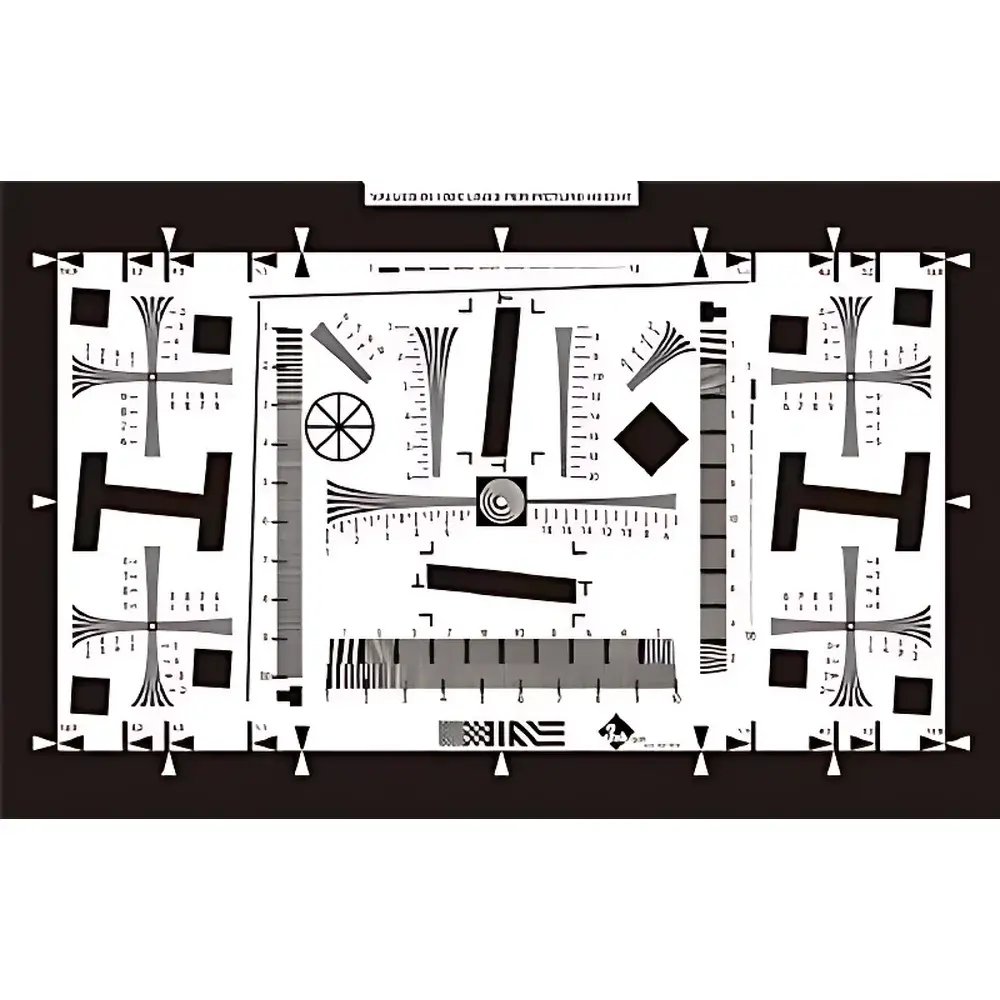

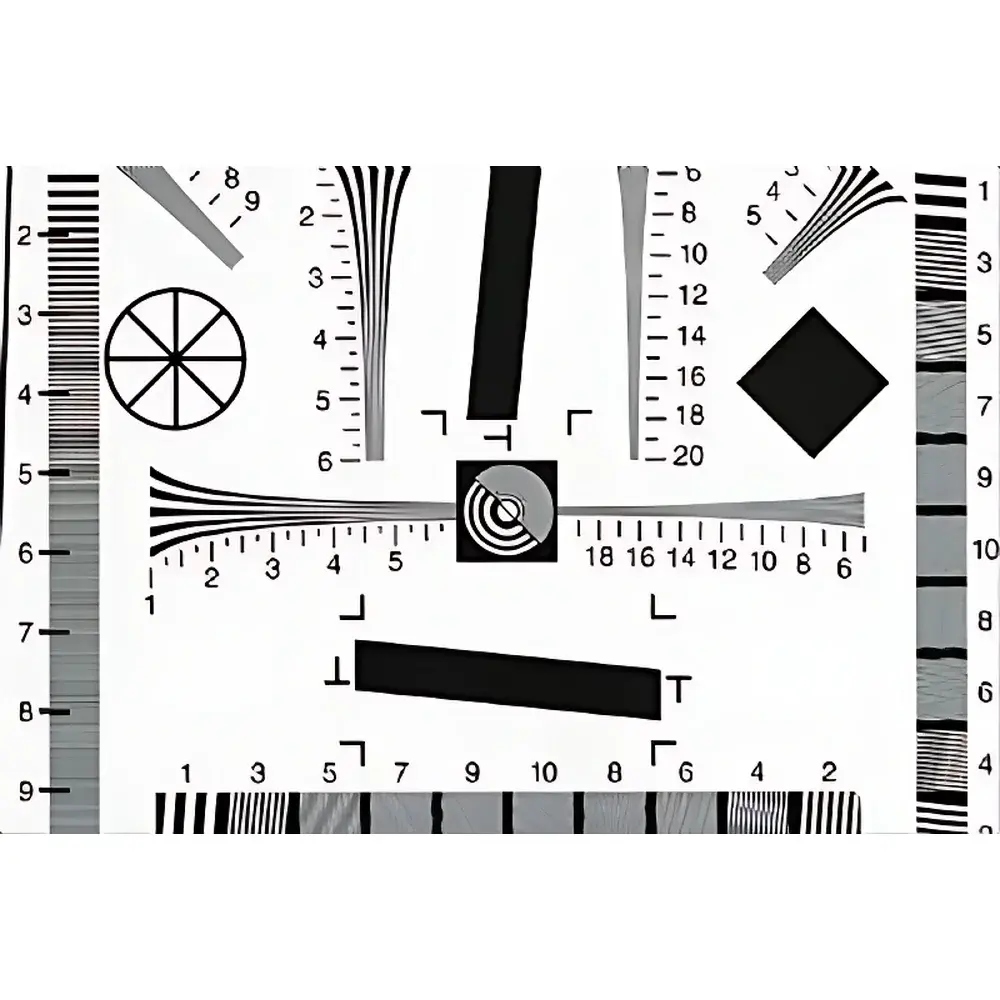
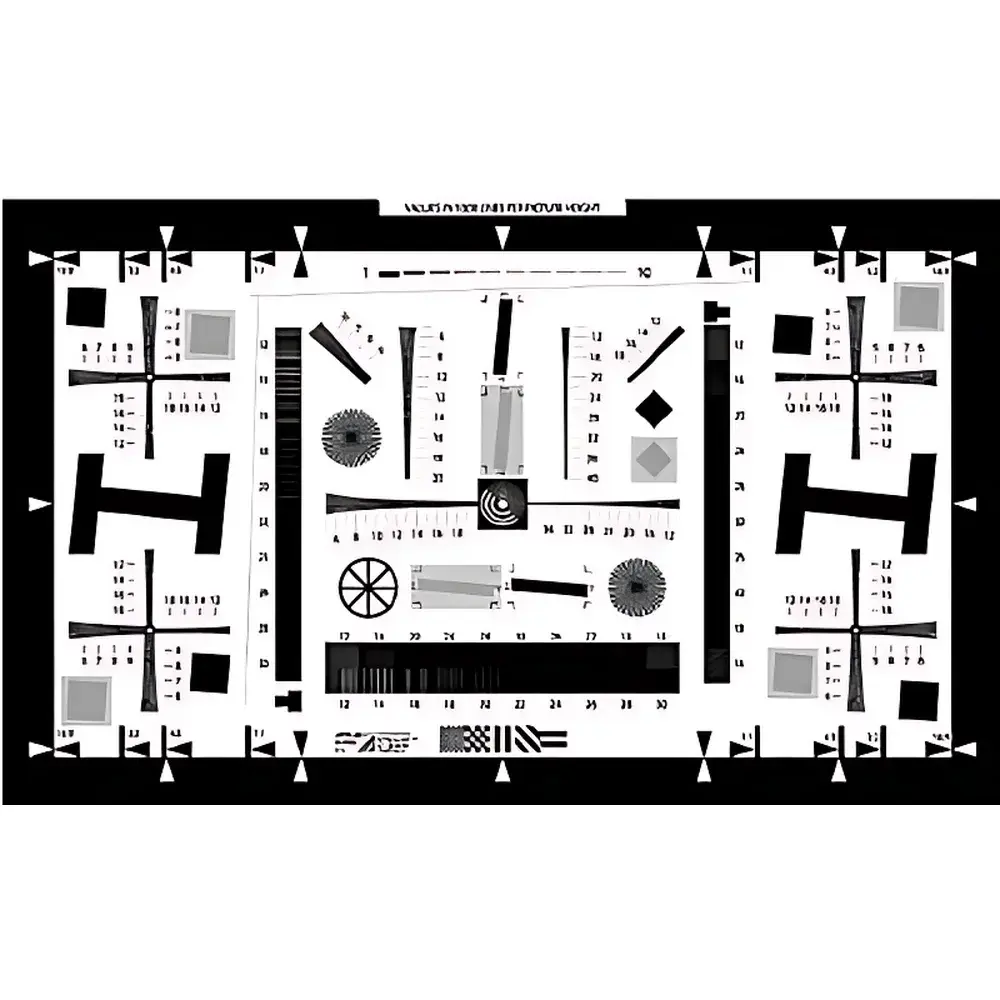
3nh ISO 12233 Enhanced Resolution Test Chart (1× Size)
| Brand | 3nh |
|---|---|
| Origin | Guangdong, China |
| Manufacturer Type | OEM/ODM Manufacturer |
| Country of Origin | China |
| Model | NQ-10-100A (Standard ISO 12233, 1×) / NE-10-100A (Enhanced ISO 12233, 1×) |
| Material | High-resolution photographic paper, semi-matte surface finish |
| Active Area Dimensions | 200 mm × 356 mm |
| Contrast | Normative (ISO 12233-compliant 4:1 luminance ratio) |
| Compliance | ISO 12233:2017 “Photography — Electronic still picture imaging — Resolution and spatial frequency responses” |
Overview
The 3nh ISO 12233 Enhanced Resolution Test Chart (1× size) is a precision-engineered optical calibration standard designed for quantitative assessment of spatial resolution performance in digital imaging systems—including machine vision cameras, industrial inspection sensors, medical endoscopes, broadcast lenses, and scientific CMOS/CCD imaging platforms. Based strictly on the ISO 12233:2017 international standard, this chart implements the slanted-edge methodology to enable objective, repeatable measurement of modulation transfer function (MTF), limiting resolution (in line pairs per picture height, lp/ph), and edge sharpness across both horizontal and vertical axes. Unlike subjective visual evaluation, the 3nh 1× chart provides traceable metrology-grade reference geometry—featuring high-fidelity sine-wave and bar-target patterns, contrast-defined slanted edges (4:1 nominal luminance ratio), and precisely registered spatial frequency gradients—enabling compliance-driven validation in regulated environments such as ISO/IEC 17025-accredited labs or FDA-regulated medical device development workflows.
Key Features
- ISO 12233:2017–compliant design with certified normative contrast (4:1 luminance ratio) and calibrated slanted-edge angle (5° ± 0.1°) for MTF derivation
- 1× active area dimensions: 200 mm × 356 mm—optimized for full-frame sensor evaluation under standardized working distance and illumination conditions
- High-stability photographic paper substrate with semi-matte surface finish to minimize specular reflection and ensure consistent diffuse reflectance (ρ ≈ 0.82 ± 0.03)
- Dual-series availability: Standard (NQ-10-100A) and Enhanced (NE-10-100A) variants—latter includes extended low-frequency targets, noise-reduction zones, and chromatic aberration indicators
- Manufactured under controlled cleanroom conditions; each batch undergoes optical density verification using NIST-traceable densitometry
- Compatible with industry-standard analysis software including Imatest, DxO Analyzer, HYRes, and ISO 12233–enabled modules in MATLAB Image Processing Toolbox
Sample Compatibility & Compliance
The 3nh 1× ISO 12233 test chart supports evaluation of imaging systems with sensor formats ranging from 1/4″ to full-frame (36 × 24 mm) and beyond, provided appropriate lens focal length and working distance are maintained per ISO 12233 Annex B guidelines. It is routinely deployed in conformance testing for IEC 62676-5 (video surveillance), EN 62676-4 (security camera resolution rating), and ASTM E3087 (optical resolution measurement). The chart’s physical construction meets ISO 12233:2017 requirements for geometric accuracy (±0.1 mm positional tolerance over full active area) and spectral neutrality (CIE D50 illuminant response within ±3% across 400–700 nm). For GLP/GMP applications, lot-specific calibration certificates—including MTF verification reports and spectrophotometric reflectance curves—are available upon request.
Software & Data Management
The chart is fully interoperable with ISO 12233–compliant image analysis pipelines. When used with HYRes or Imatest, it enables automated extraction of spatial frequency response (SFR), horizontal/vertical MTF50, MTF10, and edge overshoot metrics. All measurements adhere to ISO 12233:2017 Annex D protocols for slanted-edge processing, including noise-weighted averaging, oversampling correction, and aliasing mitigation. Raw data outputs comply with ASTM E2922–22 for digital image quality reporting and support audit-ready documentation required under FDA 21 CFR Part 11 (electronic records and signatures) when paired with validated software environments. Batch-level metadata—including chart serial number, manufacturing date, and calibration revision—is embeddable in EXIF headers via supported acquisition firmware.
Applications
- Objective resolution validation of industrial machine vision systems prior to deployment in automotive ADAS component inspection
- MTF benchmarking of C-mount and F-mount lenses during optical design verification and production QA
- Regulatory submission support for Class II medical imaging devices requiring ISO 12233–based performance evidence (e.g., dermatoscopes, ophthalmic fundus cameras)
- Calibration traceability for ISO/IEC 17025 accredited testing laboratories performing camera module characterization
- Research-grade spatial resolution studies in computational photography, including deconvolution algorithm validation and noise-resilient SFR modeling
- Training and proficiency testing for ISO 12233–certified imaging metrologists and optical test engineers
FAQ
What distinguishes the NE-10-100A (Enhanced) from the NQ-10-100A (Standard) version?
The NE-series incorporates additional low-frequency targets, chromatic fringing indicators, and dedicated noise-analysis regions—enabling simultaneous assessment of resolution, color fidelity, and temporal noise under identical capture conditions.
Is this chart suitable for measuring resolution of smartphone cameras?
Yes—when used with a fixed-focus test bench, collimated illumination (CIE D65), and proper working distance per sensor pitch, it delivers repeatable MTF50 results compliant with IEEE P2020 draft standards for mobile imaging.
Does the chart include traceable calibration documentation?
Each unit ships with a manufacturer’s declaration of conformity to ISO 12233:2017; NIST-traceable calibration reports with MTF verification data are available as an optional add-on service.
Can the chart be mounted vertically without affecting measurement validity?
Yes—the semi-matte surface and isotropic pattern layout ensure consistent performance regardless of orientation; however, gravitational sag must be mitigated for large-format (≥2×) variants during long-exposure testing.
How frequently should the chart be recalibrated or replaced?
Under controlled storage (dark, <40% RH, 20–25°C), the photographic substrate maintains dimensional and reflectance stability for ≥5 years; annual visual inspection for scratches, fading, or curling is recommended per ISO/IEC 17025 Clause 6.4.10.



