
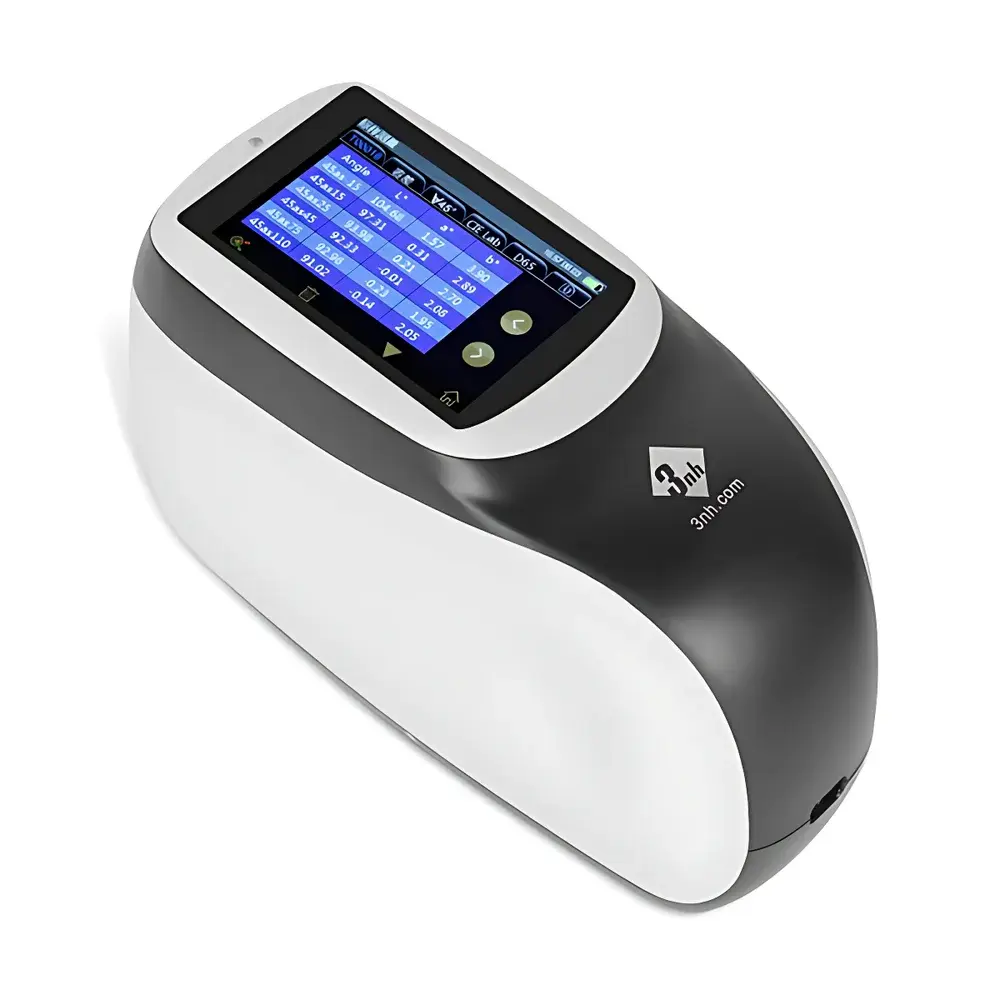
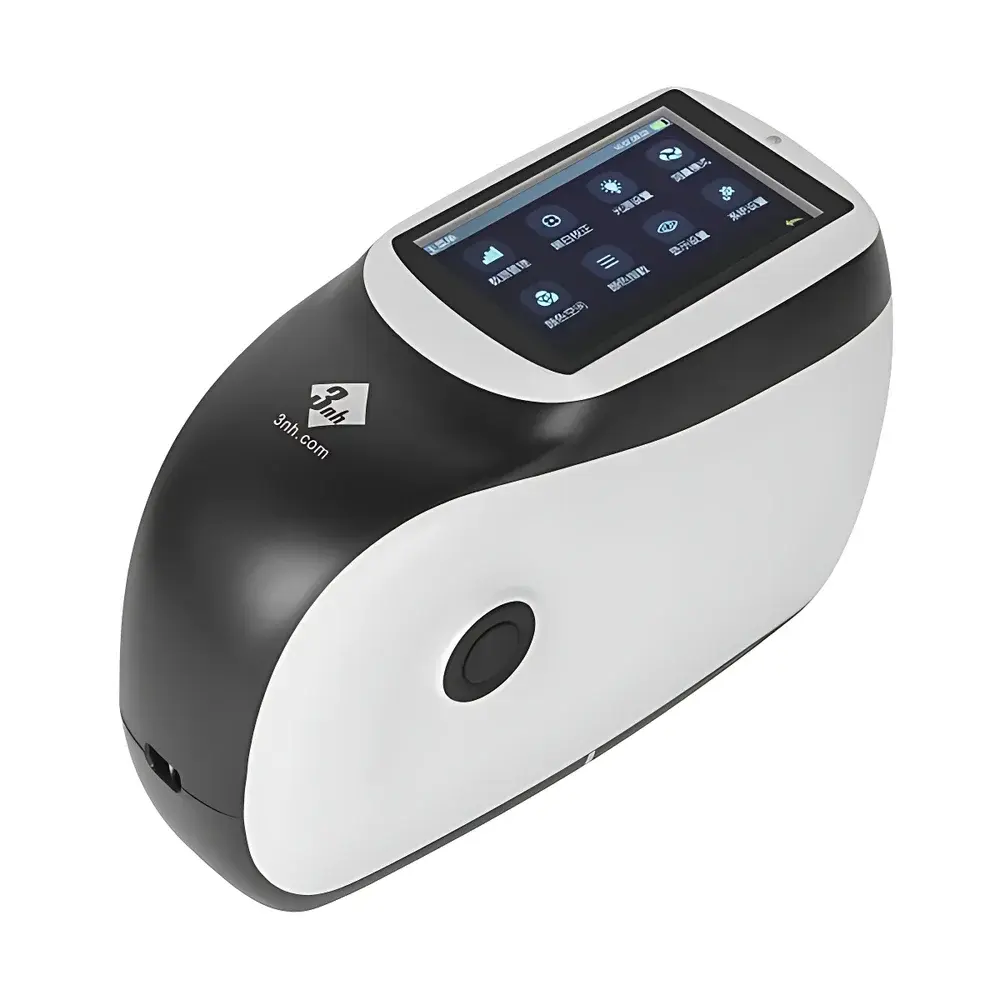
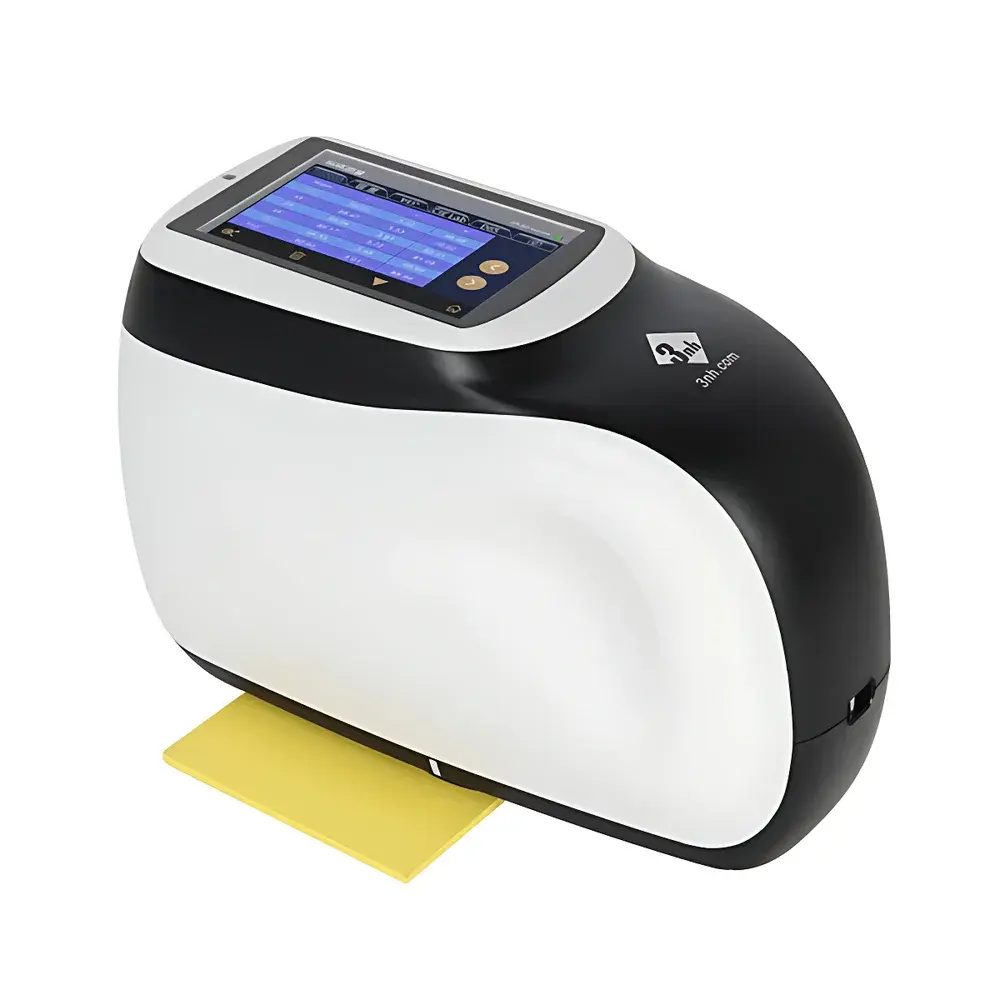
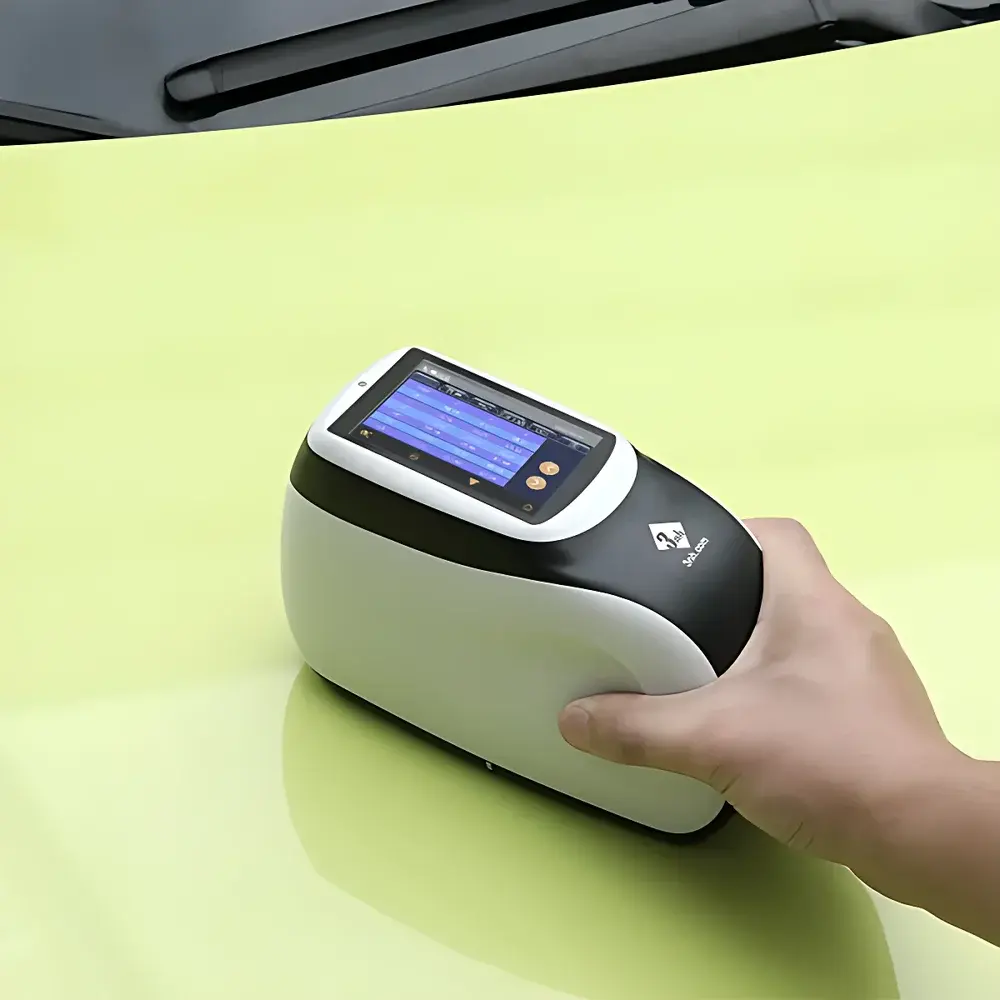

3nh MS3006 Multi-Angle Spectrophotometer
| Brand | 3nh |
|---|---|
| Origin | Guangdong, China |
| Manufacturer Type | Original Equipment Manufacturer (OEM) |
| Product Category | Spectrophotometer |
| Instrument Type | Portable |
| Optical Geometry | 0/45° integrating sphere |
| Light Source | Full-spectrum white LED with blue-light enhancement |
| Spectral Range | 400–700 nm |
| Wavelength Interval | 10 nm |
| FWHM | 10 nm |
| Reflectance Repeatability | ≤0.08% (standard deviation of spectral reflectance) |
| Colorimetric Repeatability | ≤0.03 ΔE*ab (measured on certified white tile, 30 readings at 5 s intervals post-warm-up and calibration) |
| Inter-instrument Agreement | 0.2 ΔE*00 (BCRA Series II, 12 tiles, average) |
| Effect Parameter Repeatability | Sparkle: 0.12% (10-read SD), Graininess: 0.09% (10-read SD) |
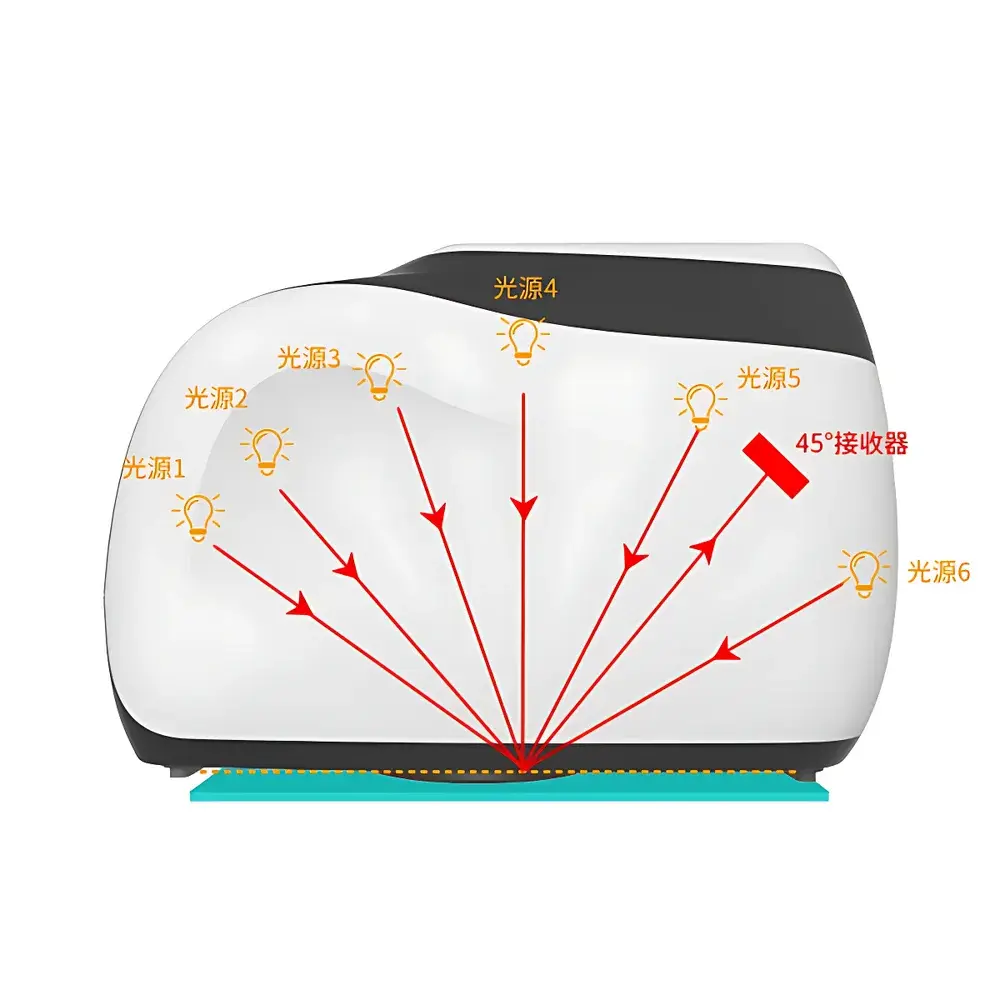
| Measurement Angles | Six angles — 45as-15°, 45as15°, 45as25°, 45as45°, 45as75°, 45as110° |
| Detector | 256-pixel dual-array CMOS image sensor |
| Spectral Dispersion | Concave holographic grating |
| Illumination Aperture | Φ23 mm / Sampling Area: 9 × 12 mm (optional Φ10 mm / 6 × 8 mm) |
| Display | 3.5″ capacitive TFT touchscreen |
| Connectivity | USB, Bluetooth 5.0 |
| Battery | 3.7 V / 5000 mAh Li-ion, ≥800 measurements per full charge |
| Operating Temperature | 10–50 °C, ≤85% RH (non-condensing) |
| Storage Temperature | −20–50 °C, ≤85% RH (non-condensing) |
| Compliance | ASTM D2244, E308, E1164, E2194, E2539 |
Overview
The 3nh MS3006 Multi-Angle Spectrophotometer is an industrial-grade portable instrument engineered for high-fidelity characterization of effect coatings—particularly metallic, pearlescent, goniochromatic, and other spatially anisotropic color systems. Unlike conventional 0/45° or d/8° spectrophotometers, the MS3006 implements a fixed multi-angle optical architecture: six discrete illumination channels (each at a unique azimuthal angle relative to the 45° incident plane) converge onto a single high-stability reception path within an integrated 0/45° integrating sphere. This design enables simultaneous acquisition of spectral reflectance data across six geometric configurations without mechanical repositioning—minimizing measurement drift and operator-induced variability. The system operates across the CIE-standard visible spectrum (400–700 nm) at 10 nm resolution, utilizing a concave holographic grating and dual-array 256-pixel CMOS detector to ensure high signal-to-noise ratio, low stray light, and robust photometric linearity. Its blue-enhanced full-spectrum LED source provides uniform irradiance across the entire band—including the critical 400–450 nm region—eliminating spectral gaps common in standard LEDs and ensuring metrological traceability to CIE illuminants.
Key Features
- Fixed six-angle illumination geometry (45as-15°, 45as15°, 45as25°, 45as45°, 45as75°, 45as110°) with single-receiver detection for synchronized, vibration-immune angular sampling
- Integrated 3.5″ capacitive touchscreen display enabling real-time visualization of all six angle spectra, color coordinates, effect metrics, and pass/fail status
- Dual-mode effect quantification: Sparkle (luminance fluctuation), Flop Index (hue shift), and Graininess (spatial texture variance), calculated per ASTM E2539 and ISO 18314-2 protocols
- 256-pixel dual-array CMOS sensor with on-chip dark-current compensation and temperature-stabilized readout circuitry for <0.03 ΔE*ab repeatability
- Concave holographic grating with 10 nm FWHM bandwidth and <0.08% spectral reflectance repeatability
- Industrial MCU core supporting real-time spectral processing, Bluetooth 5.0 LE and USB 2.0 host/device modes, and firmware-over-the-air (FOTA) updates
- Embedded color camera (VGA resolution) for precise targeting—enabling accurate measurement positioning on curved, textured, or irregular surfaces
- Comprehensive illuminant and observer support: CIE 2°/10°, D65/A/C/D50/D55/D75, F-series (F1–F12), and automotive-specific illuminants (e.g., TL84, U30)
- Full-color space coverage including CIE LAB, XYZ, Yxy, LCh, βxy, and DIN Lab99, with 11 industry-standard ΔE formulas (ΔE*ab, ΔE*94, ΔE*00, DIN ΔE99, etc.)
Sample Compatibility & Compliance
The MS3006 accommodates flat, curved, textured, and contoured substrates via its 23 mm illumination aperture and adaptive pressure-triggered measurement activation. Its non-contact optical design eliminates surface compression artifacts common in contact-based gloss or texture analyzers. The instrument complies with international standards governing appearance measurement of effect finishes: ASTM D2244 (color difference calculation), E2194 (multi-angle color measurement), E2539 (sparkle and graininess), and E308 (CIE colorimetric computation); ISO 7724 (colorimetry), 11664-4 (CIE colorimetric observers), and 18314-2 (gonioapparent color); DIN 6174/6175-1/6175-2 (effect paint evaluation); and SAE J1545 (automotive coating appearance). It supports GLP-compliant audit trails when used with optional PC software (SpectraMagic NX or 3nh QC Suite), including timestamped calibration logs, user authentication, and electronic signature capability per FDA 21 CFR Part 11 requirements.
Software & Data Management
The MS3006 ships with cross-platform quality control software (Windows/macOS) that supports full spectral database management, statistical process control (SPC) charting, tolerance mapping (ellipsoidal or rectangular), and automated report generation (PDF/CSV/XLSX). All stored data—up to 1,000 standards and 4,000 samples—retain full spectral metadata, geometric configuration tags, and effect parameter history. Bluetooth 5.0 enables secure, low-latency wireless synchronization with laboratory information management systems (LIMS) or enterprise resource planning (ERP) platforms. Firmware updates preserve backward compatibility with legacy calibration files and measurement templates. Raw spectral data export adheres to ASTM E2539-compliant .qtx format, ensuring interoperability with third-party analysis tools such as MATLAB, Python (via NumPy/Pandas), or commercial color science suites.
Applications
The MS3006 serves critical roles in R&D, production QA, and supplier qualification across industries where appearance consistency directly impacts brand perception and regulatory acceptance. In automotive OEM and Tier-1 supply chains, it validates batch-to-batch conformity of metallic basecoats, clearcoats, and tri-coat systems under multiple viewing geometries—supporting PPAP submissions and IATF 16949-aligned inspection plans. In architectural coatings, it quantifies flop behavior of mica- or aluminum-flake pigmented façade paints under varying solar elevation conditions. Consumer electronics manufacturers deploy it for evaluating anodized aluminum housings, PVD-coated watch cases, and vacuum-metallized plastic trims. Packaging converters use it to verify iridescent security inks and holographic laminates. Its portability and battery autonomy make it suitable for in-line verification on spray booths, powder coating lines, and roll-to-roll metallization processes.
FAQ
What distinguishes the MS3006 from conventional multi-angle spectrophotometers?
It uses a fixed six-source, single-receiver optical layout—eliminating moving parts, motorized goniometers, or sequential scanning. This architecture ensures higher angular registration accuracy, lower mechanical hysteresis, and improved long-term stability.
Can the MS3006 measure curved or irregular surfaces reliably?
Yes—the built-in VGA color camera enables visual confirmation of measurement location prior to triggering, and the 23 mm illumination spot maintains consistent geometry even on radii down to 25 mm.
Does the instrument support regulatory-compliant data archiving?
When paired with SpectraMagic NX or 3nh QC Suite, it generates audit-ready records including calibration timestamps, operator ID, environmental conditions, and raw spectral files—fully compliant with FDA 21 CFR Part 11 and ISO/IEC 17025 documentation requirements.
How is inter-instrument agreement maintained across a fleet of MS3006 units?
Each unit undergoes factory calibration against NIST-traceable BCRA Series II tiles. Inter-instrument agreement is specified at ≤0.2 ΔE*00 (average across 12 tiles), and field recalibration can be performed using the included ceramic white tile, black trap, and chromatic reference plate.
Is spectral data export compatible with custom analysis pipelines?
Yes—full-resolution spectral data (400–700 nm at 10 nm intervals) exports in ASCII-delimited .txt or ASTM E2539-compliant .qtx format, supporting integration into Python, R, MATLAB, or proprietary spectral modeling environments.




