
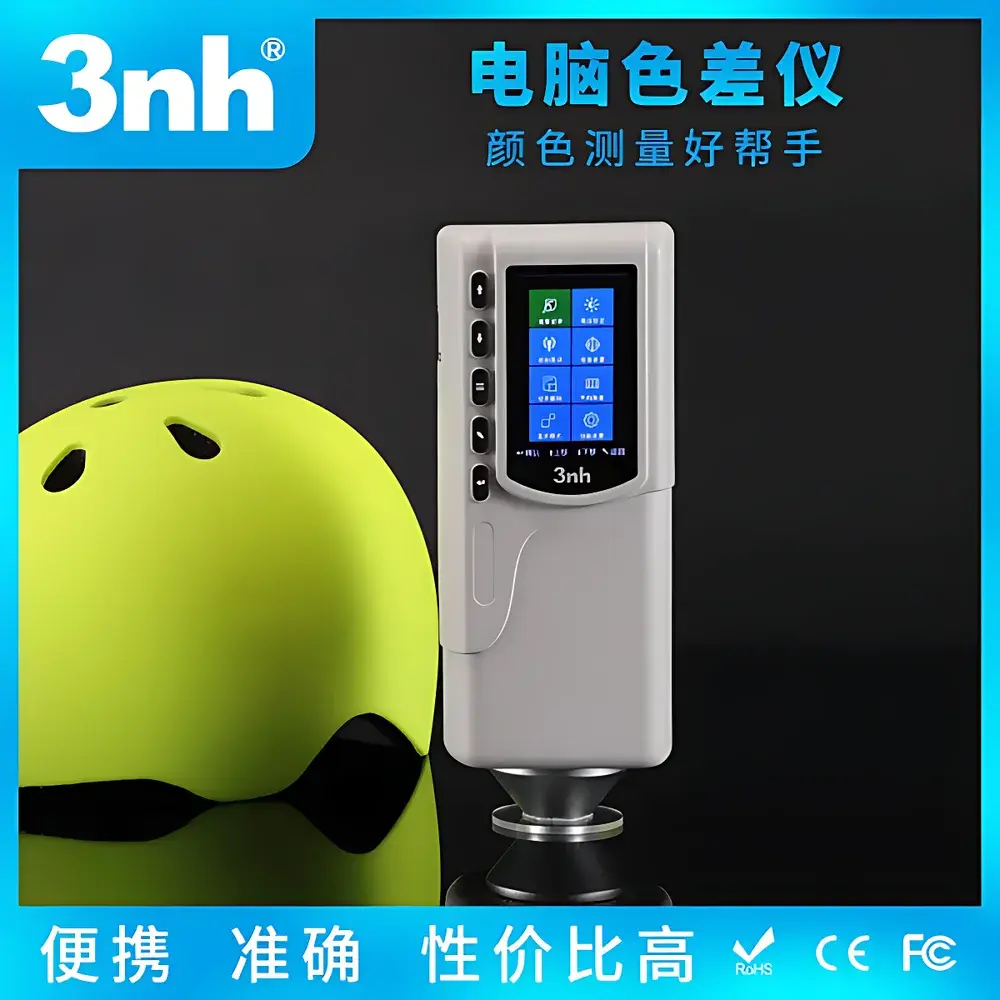
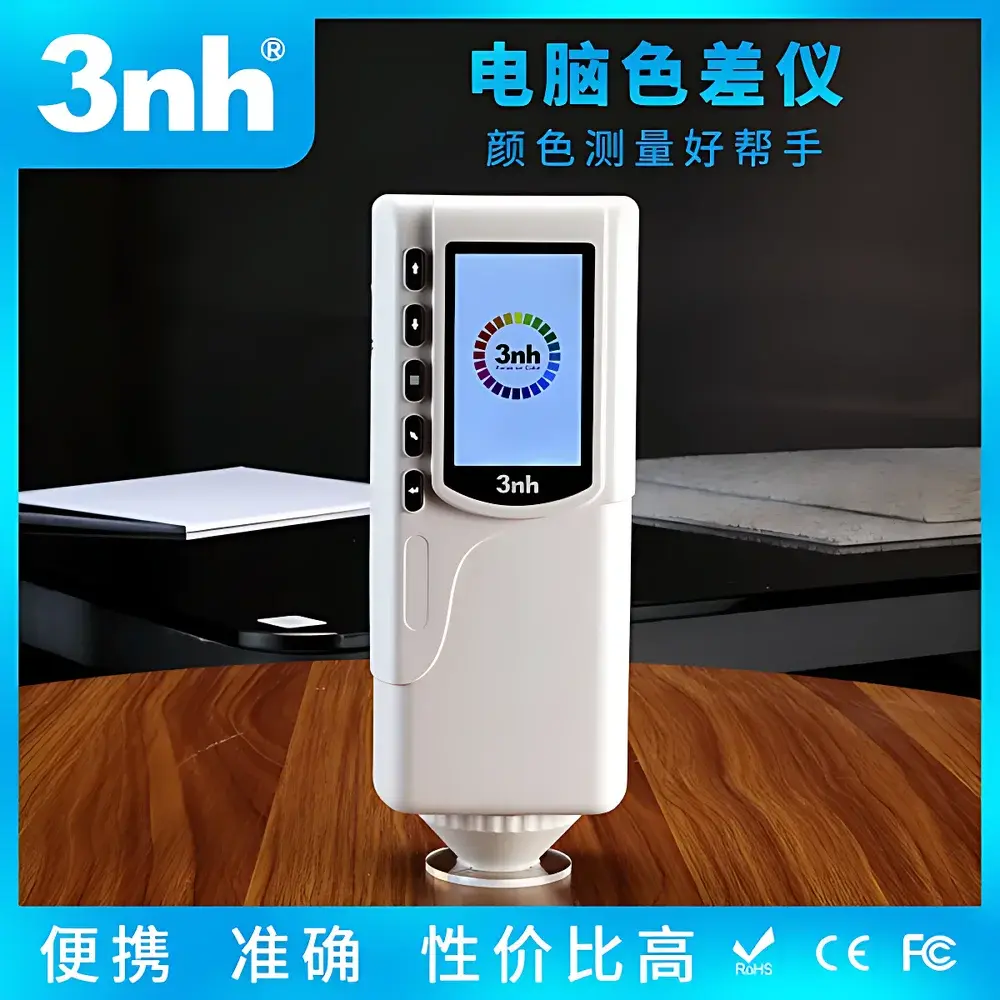
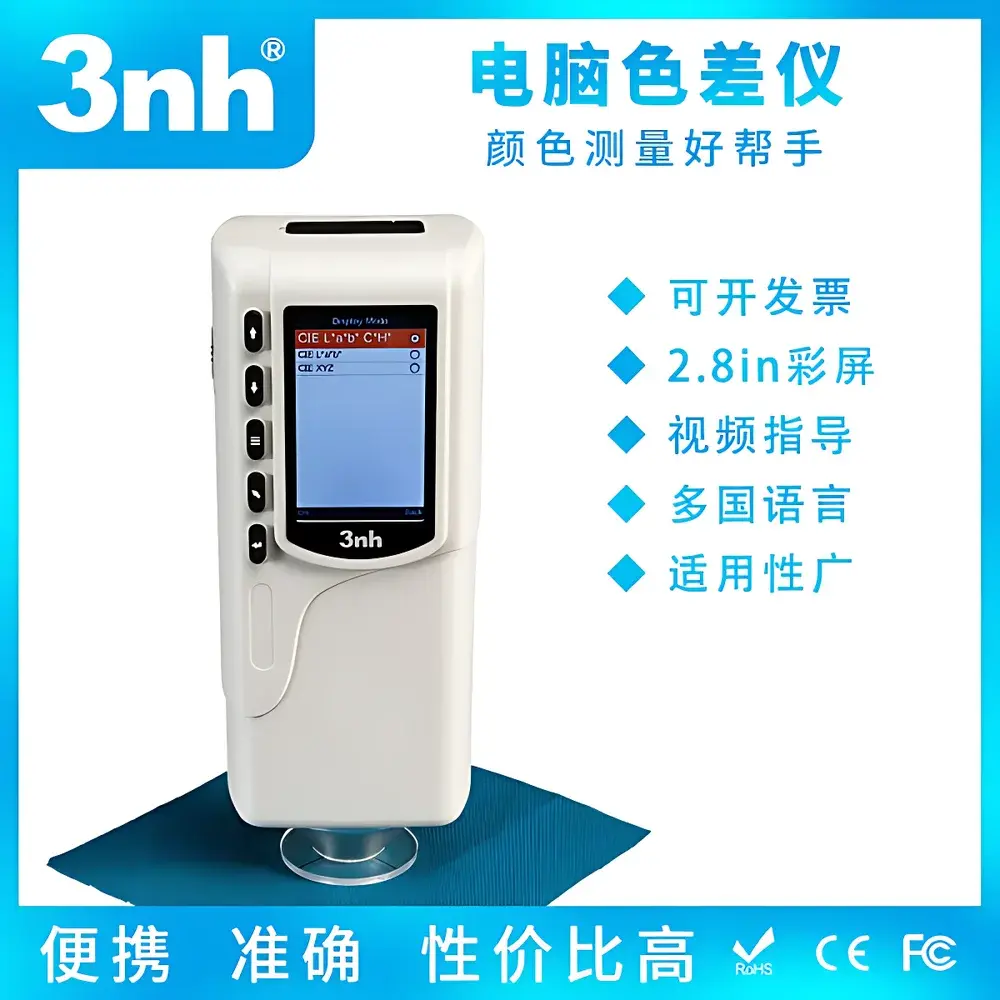
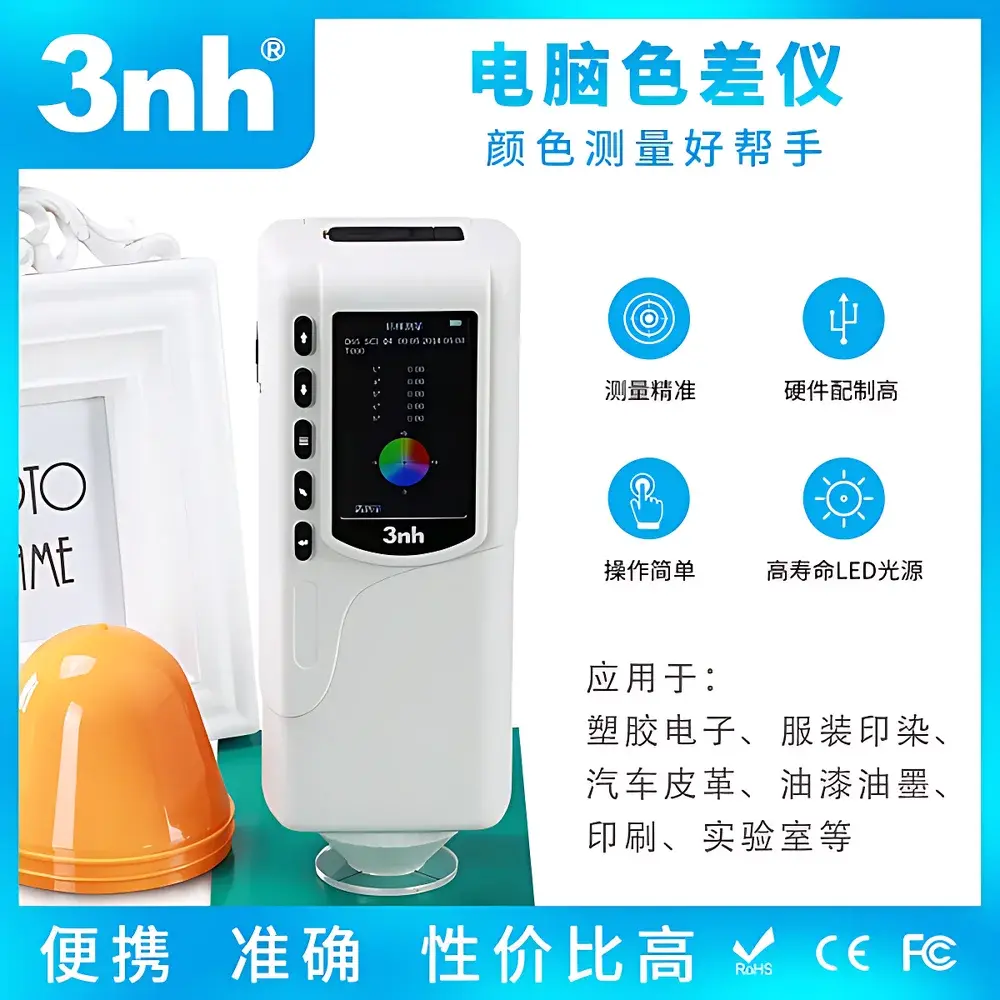
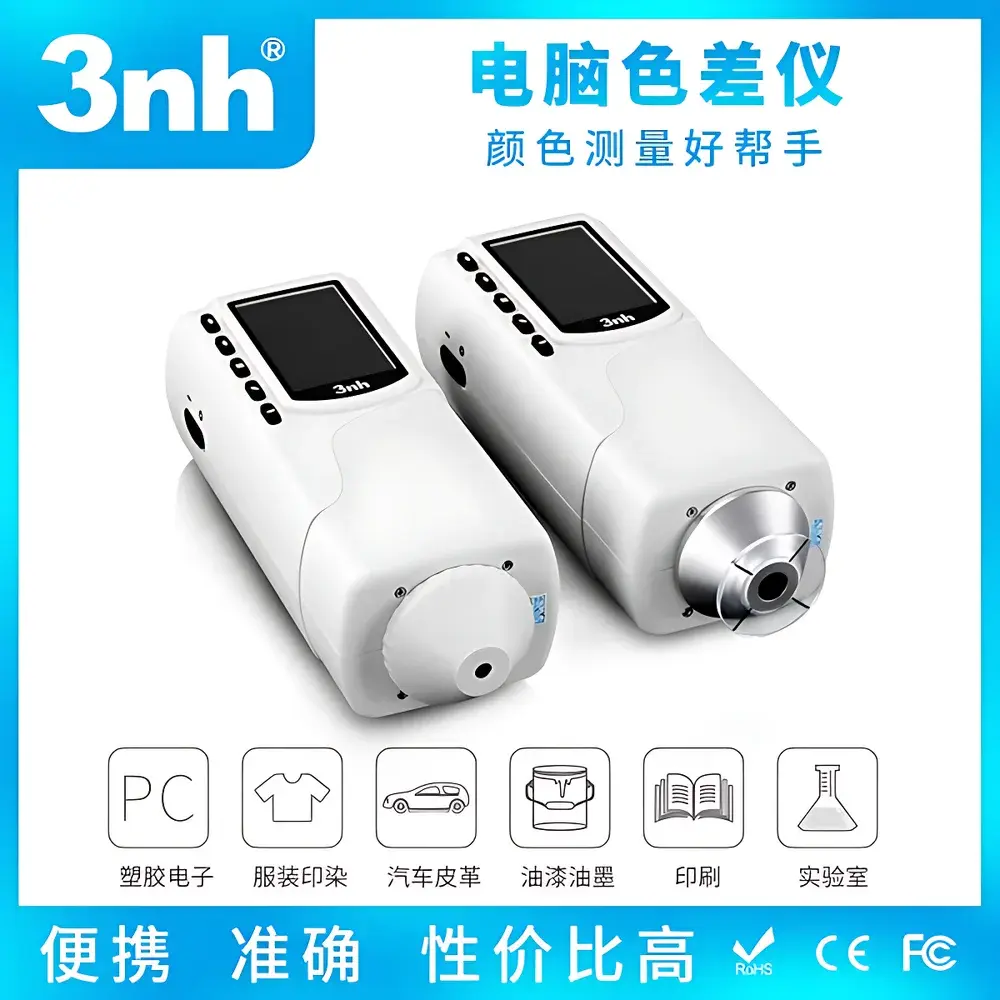
3nh NR10QC+ Handheld Colorimeter for Plastics and Paints
| Brand | 3nh |
|---|---|
| Origin | Guangdong, China |
| Manufacturer Type | Manufacturer |
| Product Category | Colorimeter |
| Instrument Type | Portable |
| Optical Geometry | 8°/d (Diffuse Illumination / 8° Viewing) |
| Light Source | Full-Spectrum LED |
| Spectral Range | 400–700 nm |
| Repeatability | Φ4 mm aperture / ΔE*ab ≤ 0.08 (after warm-up and calibration |
Overview
The 3nh NR10QC+ Handheld Colorimeter is an entry-level yet metrologically rigorous portable color measurement instrument engineered for rapid, repeatable color difference evaluation in industrial quality control environments. It operates on the CIE 1976 L*a*b* color space (ΔE*ab) using an 8°/d (diffuse illumination / 8° viewing) optical geometry—fully compliant with CIE Publication No. 15 and GB/T 3978 standards. This geometry ensures robustness against surface texture and gloss variations commonly encountered in plastics, coatings, and painted substrates. The device employs a full-spectrum LED light source spanning 400–700 nm, coupled with a dual-path CMOS sensor architecture to deliver stable spectral response across the visible range. Unlike legacy tungsten-halogen or xenon-based systems, the LED source provides consistent irradiance without warm-up drift, enabling immediate measurement after power-on—eliminating the need for extended stabilization periods typical in laboratory-grade spectrophotometers.
Key Features
- High short-term repeatability: ΔE*ab ≤ 0.08 (Φ4 mm aperture, measured on certified white tile under controlled conditions per ISO 13655)
- Dual-positioning guidance: Integrated crosshair reticle + bright LED illumination for precise targeting on curved, textured, or low-contrast surfaces
- Self-contained operation: Built-in rechargeable 3.7 V / 3200 mAh Li-ion battery supports >5,000 measurements per charge; no PC connection required for basic functionality
- Plug-and-play calibration: Factory-loaded white tile reference values stored internally—no manual white/black calibration needed before routine use
- Ergonomic handheld design: Compact dimensions (205 × 67 × 80 mm), lightweight construction (400 g), and wrist strap integration enable one-handed operation in production-line or field settings
- Robust display interface: 2.8-inch TFT true-color screen (16:9 aspect ratio) with intuitive icon-driven navigation and real-time pass/fail color tolerance feedback
Sample Compatibility & Compliance
The NR10QC+ is optimized for opaque, semi-opaque, and uniformly pigmented samples including injection-molded plastics, solvent- and water-based paints, powder coatings, automotive touch-up finishes, and industrial lacquers. Its Φ4 mm measurement aperture accommodates flat panels, small parts, and curved surfaces typical in automotive trim, consumer electronics housings, and appliance components. While not designed for transparent films or translucent gels, it meets functional requirements for visual color matching per ASTM D2244 (Standard Practice for Calculation of Color Tolerances and Color Differences from Instrumentally Measured Color Coordinates) and ISO 11664-4 (CIE colorimetry – Part 4: CIE 1976 L*a*b* colour space). Device firmware and data handling support audit-ready traceability under GLP-aligned workflows, though it does not implement FDA 21 CFR Part 11 electronic signature controls.
Software & Data Management
The NR10QC+ stores up to 100 standard references and 10,000 sample readings onboard. Data export is supported via USB interface (power-only mode; no data transfer over USB) to Windows-based PCs using the included 3nh Color Quality Management Software (CQMS). CQMS enables statistical process control (SPC) charting, batch deviation reporting, multi-instrument comparison, and export to CSV or PDF formats. All measurements are timestamped and tagged with operator ID (manually entered), instrument serial number, and measurement condition metadata. Raw spectral reflectance data is not recorded—the device outputs only CIE L*a*b*, ΔE*ab, and pass/fail status per user-defined tolerances (e.g., ΔE*ab ≤ 1.0, ≤ 0.5).
Applications
This colorimeter serves as a frontline verification tool in manufacturing QA/QC labs and production floors where speed, portability, and cost-efficiency are prioritized over full spectral analysis. Typical use cases include incoming raw material inspection (resin pellets, pigment dispersions), in-process coating validation (spray booth exit checks), final product release testing (plastic housings, painted metal brackets), and supplier color conformance audits. Industries routinely deploying the NR10QC+ include automotive Tier-2 suppliers, contract electronics manufacturers, furniture OEMs, packaging converters, and industrial paint formulators—particularly where ANSI/ISO-compliant ΔE*ab thresholds govern acceptance criteria.
FAQ
Does the NR10QC+ support multiple color spaces beyond CIE L*a*b*?
No—it reports exclusively in CIE L*a*b* (D65/10°) and calculates ΔE*ab only. Additional color difference metrics (e.g., ΔE00, ΔE94) or chromaticity coordinates (x,y; u’,v’) are not available.
Can it measure metallic or pearlescent coatings?
Not reliably. The 8°/d geometry lacks gonio-apparent capability and cannot resolve angular color shift (flop) inherent in effect pigments.
Is the device suitable for regulatory submissions requiring full spectral data?
No. It is a tristimulus colorimeter—not a spectrophotometer—and does not output reflectance spectra or support spectral library matching.
What is the expected lifetime of the LED light source?
Rated for ≥1.6 million measurements or ≥5 years of typical industrial use, assuming average usage of 500 measurements per day.
Does it comply with ISO/IEC 17025 calibration requirements?
It can be verified against traceable ceramic tiles (e.g., NIST SRM 2021), but the unit itself is not supplied with accredited calibration certificates; third-party calibration services are recommended annually for critical applications.






