
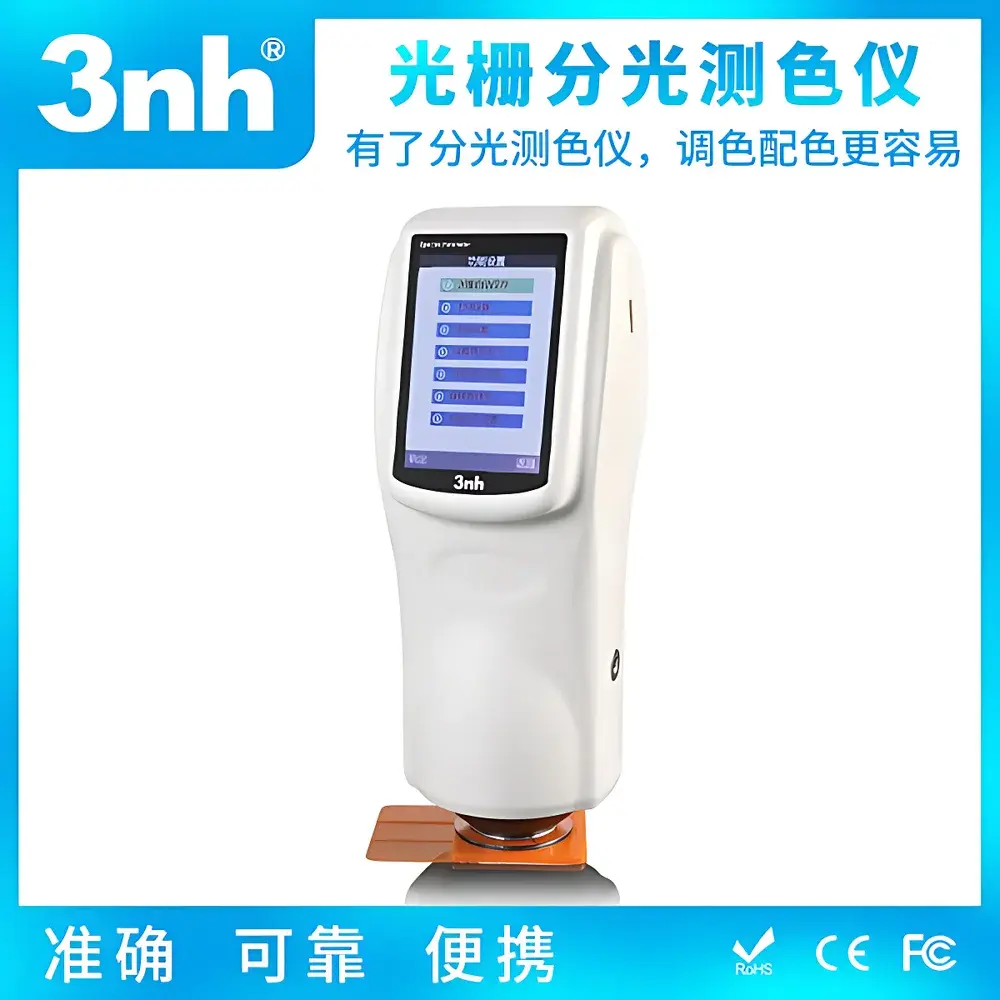
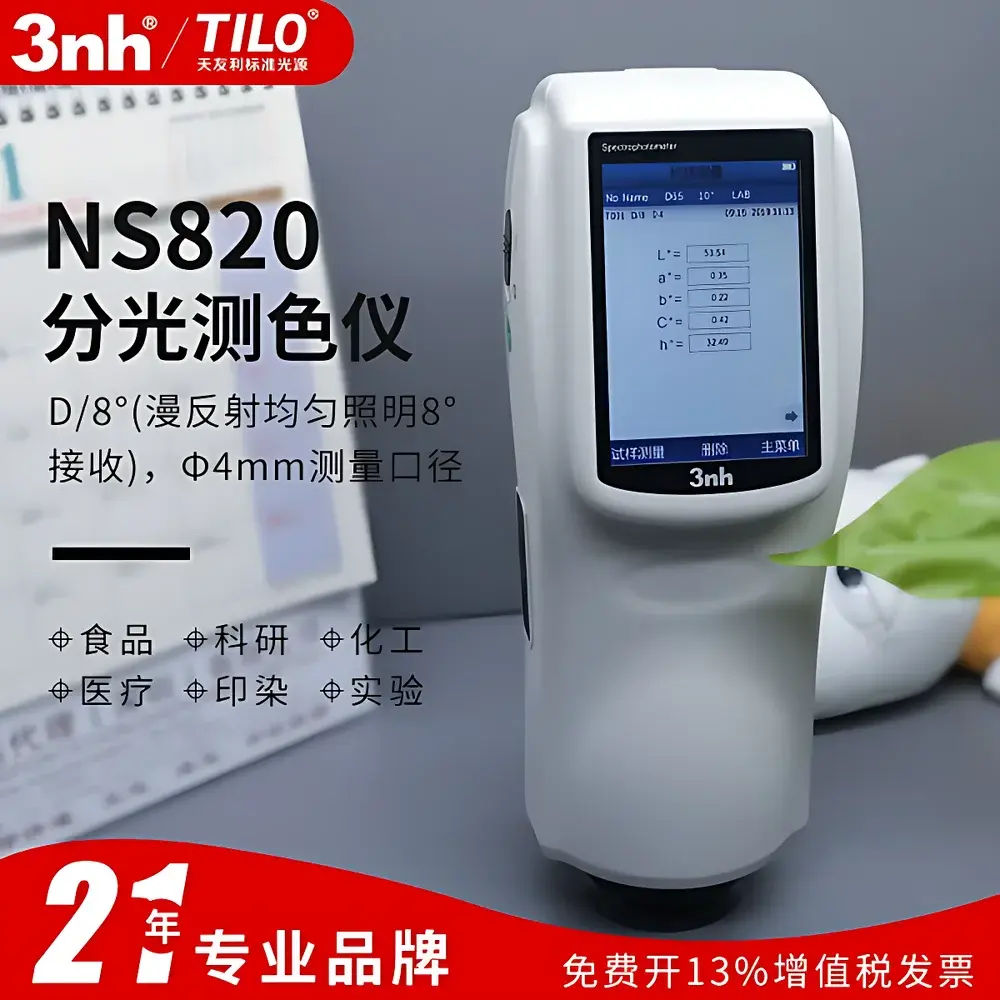
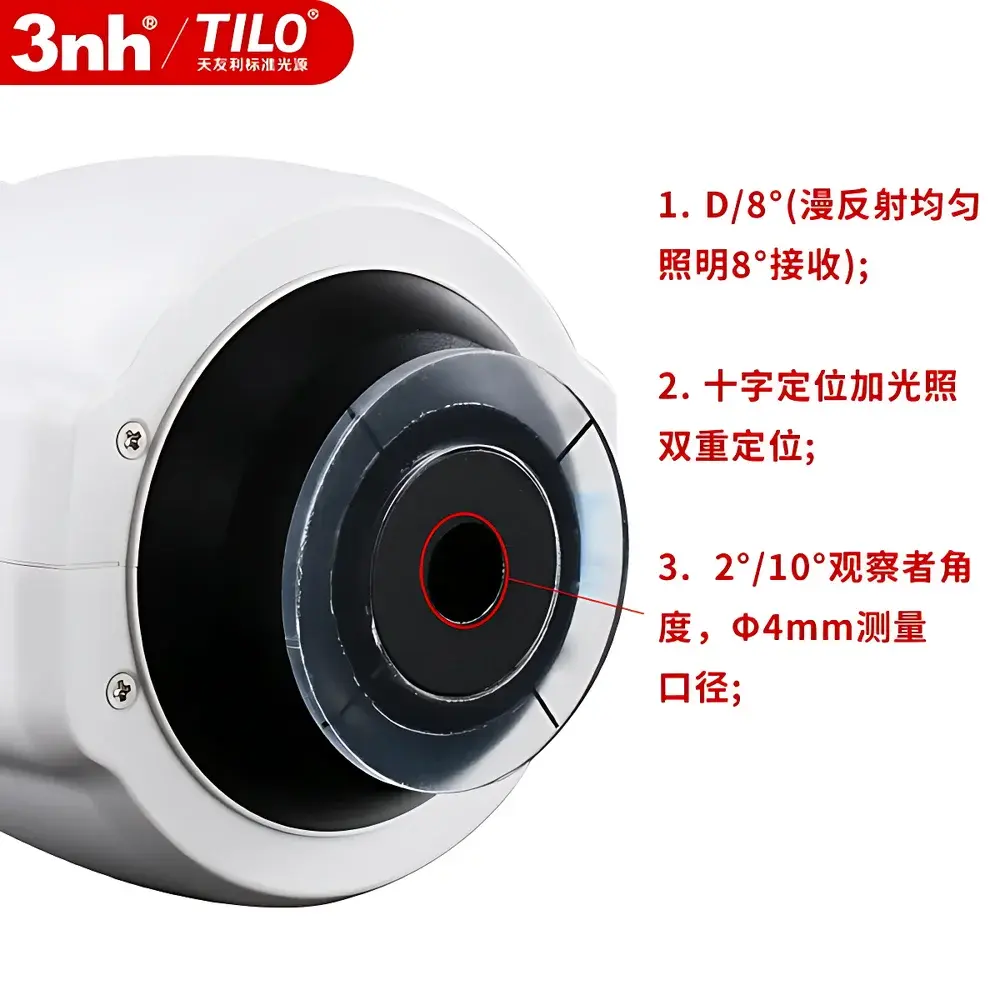
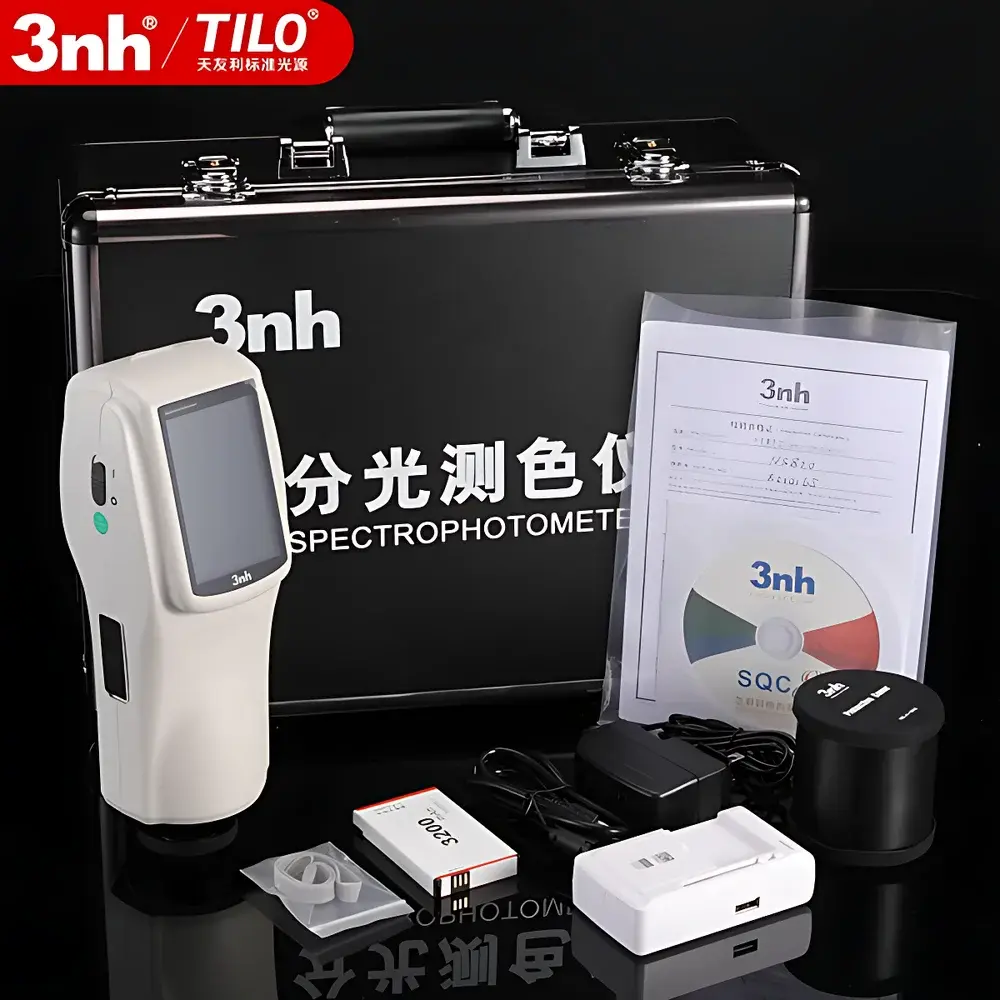
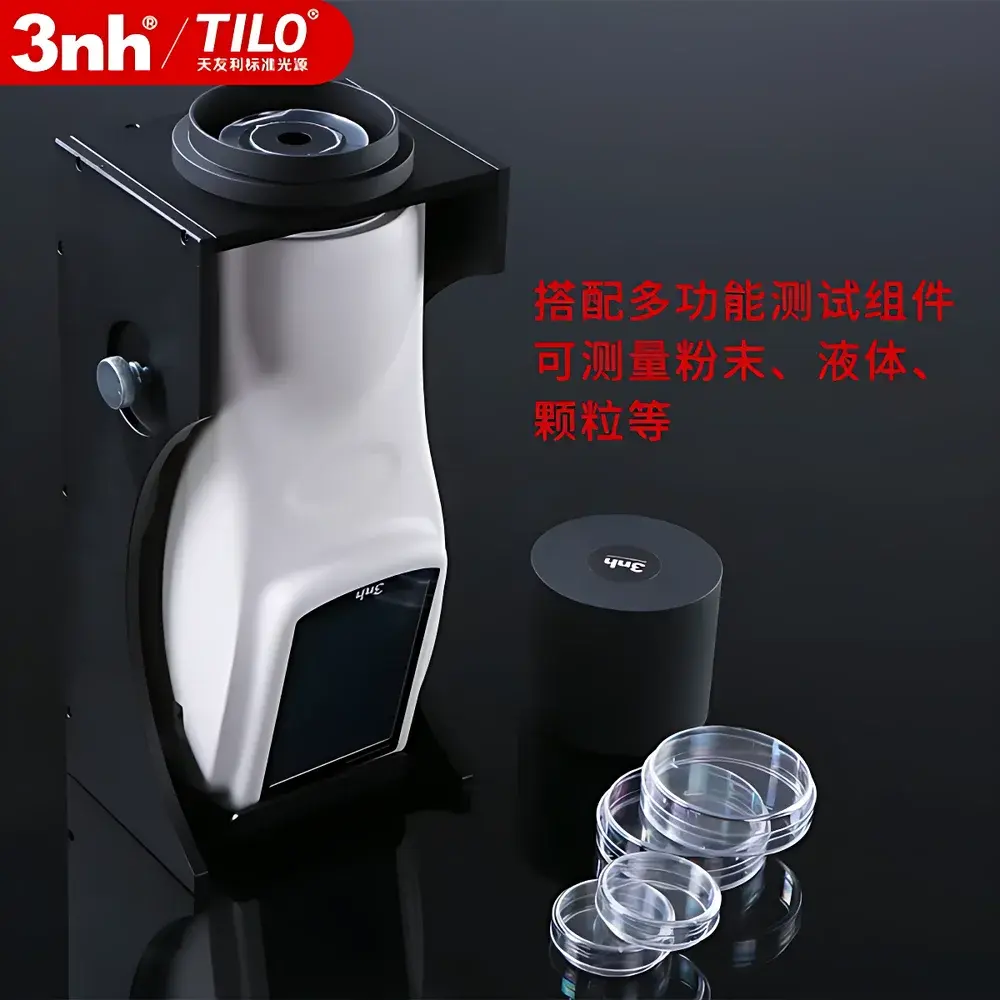
3nh NS820 Spectrophotometric Colorimeter
| Brand | 3nh |
|---|---|
| Origin | Guangdong, China |
| Manufacturer Type | Direct Manufacturer |
| Product Category | Domestic |
| Model | NS820 |
| Product Type | Spectrophotometric Colorimeter |
| Instrument Form Factor | Portable |
| Optical Geometry | d/8° Integrating Sphere |
| Illuminants | D65, D50, A |
| Spectral Range | 400–700 nm |
| Repeatability | ΔE*ab ≤ 0.04 |
| Inter-instrument Agreement (Typical) | ΔE*ab ≤ 0.2 |
| Display | 3.5-inch Capacitive Touchscreen |
| Viewing Angle Options | 2° & 10° Standard Observer |
| Color Spaces | CIE L*a*b*, L*C*h*, XYZ, Yxy, Hunter Lab, RGB, CMYK, Munsell (CIELAB-based), etc. |
| Data Storage Capacity | ≥10,000 measurements |
| Screen Tilt | 15° ergonomic angle |
| Compliance | CIE No. 15:2018, GB/T 3978–2008, GB/T 7921–2008, ISO 7724-1:1984, ASTM E308-22 |
Overview
The 3nh NS820 Spectrophotometric Colorimeter is a portable, high-precision instrument engineered for laboratory-grade color measurement and quality control in industrial manufacturing, R&D, and production environments. It operates on the principle of spectrophotometric analysis—capturing reflectance spectra across the visible range (400–700 nm) using a d/8° integrating sphere optical geometry compliant with CIE No. 15:2018 and ISO 7724-1:1984. The device computes tristimulus values (X, Y, Z) from spectral data via numerical integration against the CIE 1931 2° or 1964 10° standard observer functions, then derives chromaticity coordinates and color difference metrics—including CIE L*a*b*, L*C*h*, and ΔE*ab—in real time. Unlike filter-based colorimeters, the NS820 delivers full spectral reflectance curves, enabling advanced color formulation, metamerism evaluation, and spectral database correlation. Its design prioritizes metrological stability over compactness: the large-diameter integrating sphere ensures uniform illumination and minimizes directional bias, while the fixed 15° screen tilt aligns with ergonomic viewing conventions for prolonged operator use.
Key Features
- Optical architecture conforming to CIE d/8° geometry with diffuse illumination and 8° viewing angle—certified per GB/T 3978–2008 and ISO 7724-1.
- Dual standard observer support (2° and 10°) and multiple illuminants (D65, D50, A, F2, F7, F11) enabling cross-standard color evaluation per ISO/CIE/ASTM specifications.
- High repeatability of ΔE*ab ≤ 0.04 and inter-instrument agreement of ΔE*ab ≤ 0.2 under controlled conditions—validated against reference instruments traceable to NIM (National Institute of Metrology, China).
- Capacitive 3.5-inch touchscreen interface with intuitive icon-driven navigation; no physical buttons required for routine operation.
- Integrated spectral data logging: stores full 10-nm interval reflectance spectra (400–700 nm) alongside computed colorimetric values for each measurement.
- Onboard memory capacity exceeding 10,000 measurement records, each timestamped and tagged with user-defined sample IDs, batch numbers, and measurement conditions.
- Ergonomic 15° display tilt angle optimized for consistent visual alignment during manual sample placement and verification.
Sample Compatibility & Compliance
The NS820 accommodates flat, curved, textured, and matte surfaces—including plastics, paints, textiles, ceramics, printed materials, and coated metals—provided samples fit within the 12 mm measurement aperture. Its d/8° sphere geometry mitigates gloss and texture effects through diffuse illumination, making it suitable for both matte and semi-gloss specimens without requiring gloss compensation modules. The instrument meets national and international regulatory frameworks relevant to color-critical industries: compliance with GB/T 7921–2008 (equivalent to ISO 11664-4) for colorimetric computation methods; adherence to ASTM E308-22 for conversion of spectral data to CIE tristimulus values; and alignment with ISO 13655:2017 for spectral measurement uncertainty management. While not FDA 21 CFR Part 11–certified out-of-the-box, its PC software supports audit-trail-enabled data export for GLP/GMP-aligned documentation workflows.
Software & Data Management
The NS820 interfaces with 3nh’s proprietary PC software (ColorExpert v4.x), which supports spectral database creation, tolerance setting per CMC, DIN99, or DE2000 algorithms, batch statistical reporting (mean, SD, CPK), and comparative spectral overlay. Raw spectral data (.spc) and colorimetric reports (.csv, .xlsx) are exportable without proprietary lock-in. The software enables multi-instrument calibration synchronization, allowing centralized management of fleets across production lines. All measurement metadata—including instrument ID, date/time stamp, observer angle, illuminant, and user annotations—is embedded in exported files to satisfy traceability requirements under ISO/IEC 17025–2017 Clause 7.5.2.
Applications
- Quality assurance in automotive trim and interior component manufacturing, where color consistency across injection-molded parts must meet OEM-specific tolerances (e.g., ΔE*ab < 0.5).
- Paint and coating formulation labs verifying batch-to-batch match against master standards under multiple lighting conditions (D65 daylight vs. A incandescent).
- Textile dye houses performing metamerism checks between fabric lots viewed under retail (F11) and warehouse (F2) lighting.
- Printing and packaging facilities validating spot-color fidelity against Pantone® or ISO 12647-2:2013 targets.
- R&D teams conducting accelerated aging studies by tracking spectral shift trends—not just ΔE—over UV exposure cycles.
FAQ
What is the spectral resolution and sampling interval of the NS820?
The NS820 acquires reflectance data at 10 nm intervals across 400–700 nm, yielding 31 discrete wavelength points per spectrum.
Does the NS820 support spectral transmission measurements?
No—the NS820 is configured exclusively for reflectance mode; transmission capability requires a separate instrument model with dual-beam path and sample holder fixtures.
How is inter-instrument agreement validated?
3nh performs factory calibration against reference standards traceable to NIM and provides a certificate of conformance showing ΔE*ab ≤ 0.2 for a set of 12 ceramic tile standards measured across five units.
Can measurement data be integrated into LIMS or MES platforms?
Yes—CSV exports include all necessary metadata fields; custom API integration is supported via optional SDK licensing for enterprise-level system interoperability.
Is the instrument suitable for food or pharmaceutical applications requiring regulatory validation?
While the hardware meets basic metrological criteria, formal IQ/OQ/PQ validation packages and 21 CFR Part 11–compliant electronic signature modules are available as add-on services upon request.





