
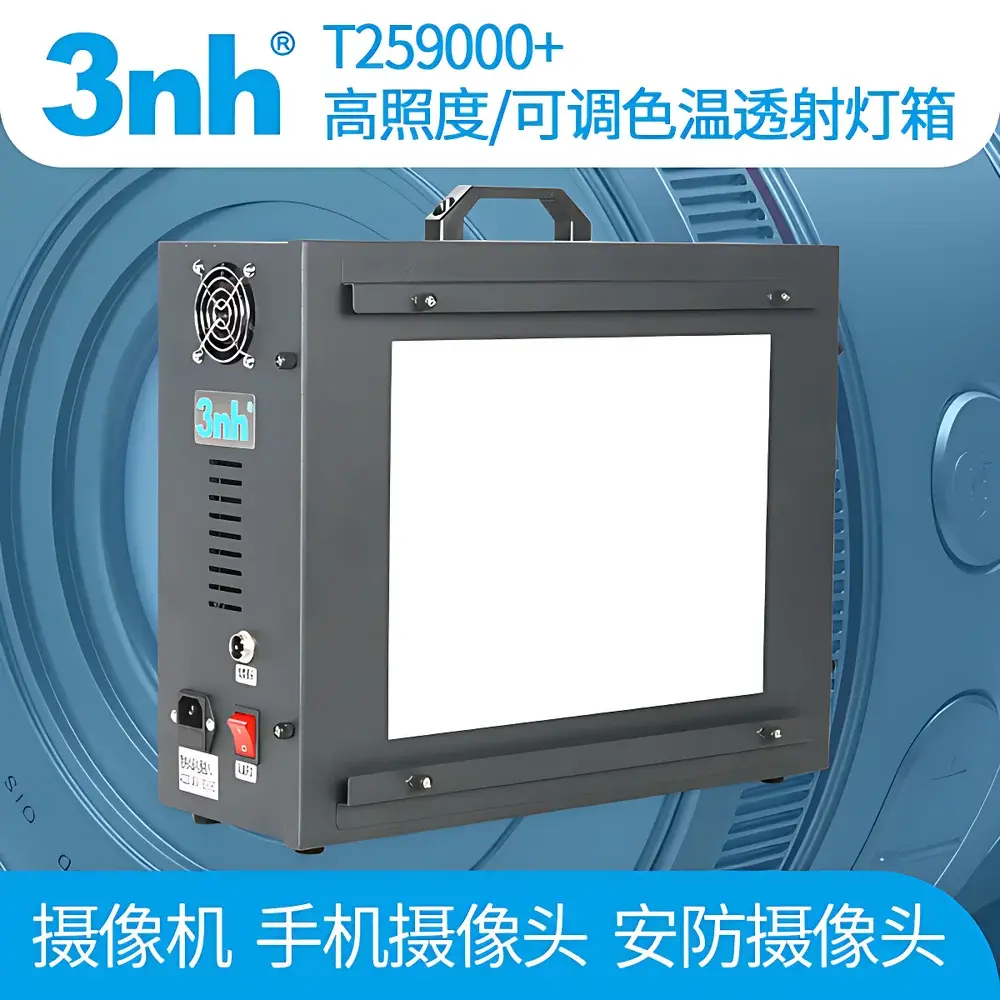
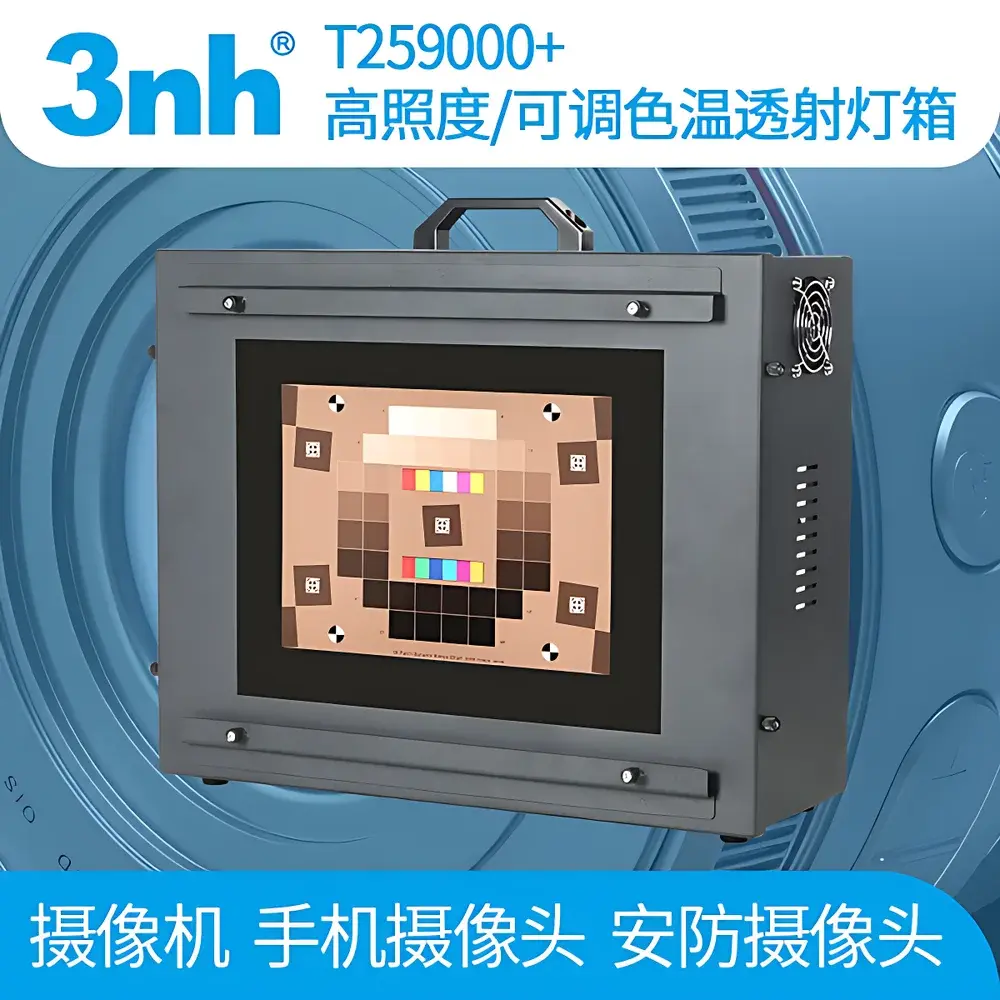
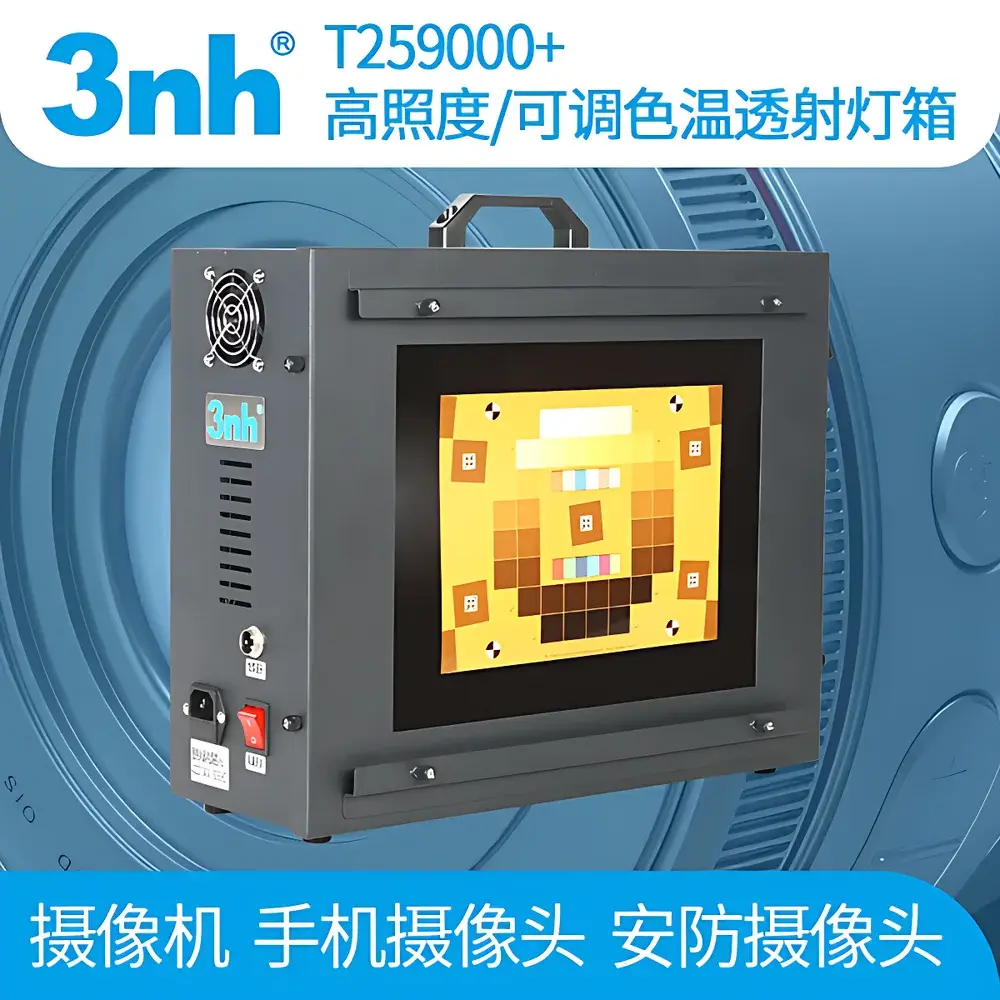
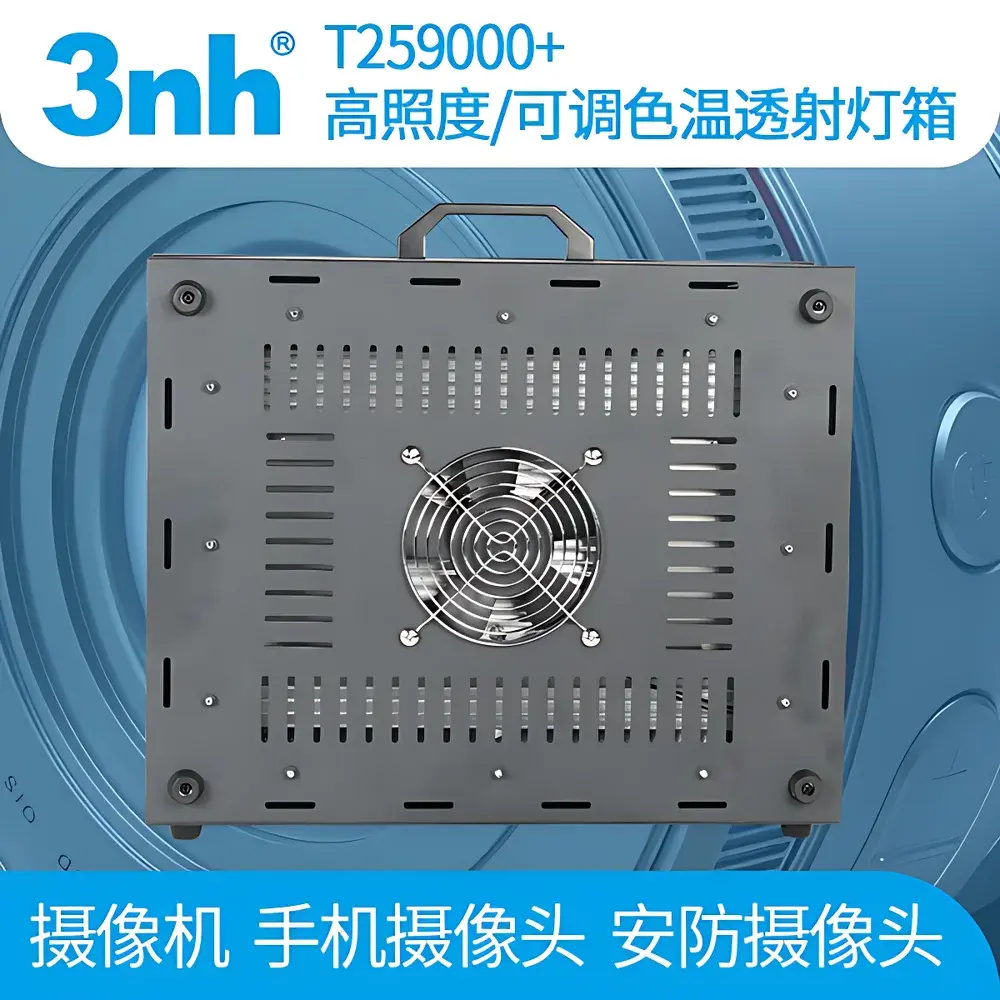
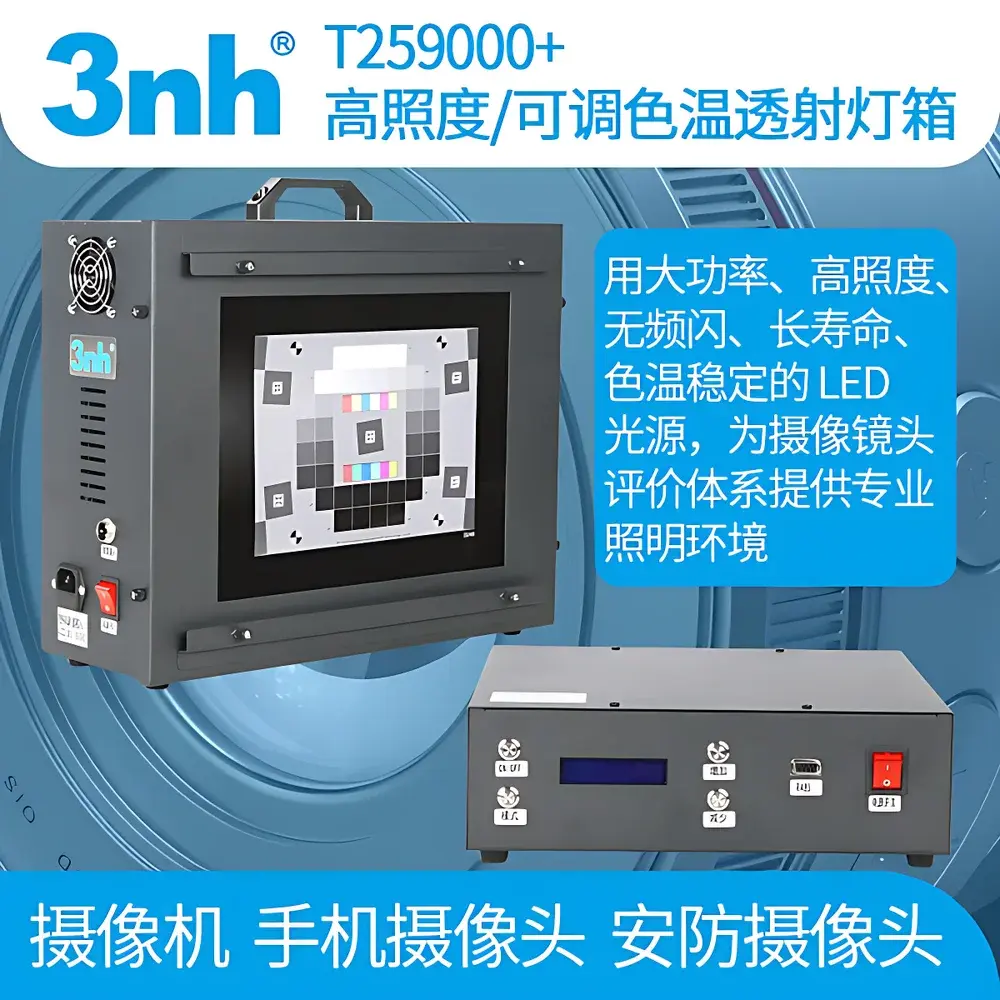
3nh T259000 High-Illuminance Camera Color Assessment Light Cabinet
| Brand | 3nh |
|---|---|
| Origin | Guangdong, China |
| Manufacturer Type | Manufacturer |
| Model | T259000 |
| Illuminance Range | 0–120,000 lux |
| Adjustable CCT | 2300–8000 K |
| Uniformity (Transmissive Surface) | >90% |
| Power Input | AC 110–240 V, 50/60 Hz |
| Max Power Consumption | 240 W |
| Dimensions (L×W×H) | 410 × 145 × 330 mm |
| Transmissive Panel Size | 290 × 220 mm |
| Test Card Slot | 360 × 8 × 285 mm |
| Operating Temp. | 0–28 °C, RH <85% (non-condensing) |
| Net Weight | 7.2 kg |
| LED Lifetime | ≥10,000 h |
Overview
The 3nh T259000 High-Illuminance Camera Color Assessment Light Cabinet is a purpose-built transmissive light source cabinet engineered for objective, repeatable evaluation of imaging systems—particularly camera modules, lenses, and image sensors used in consumer electronics, automotive ADAS, and industrial machine vision applications. Unlike conventional color-matching cabinets designed for human visual assessment, the T259000 integrates photometric precision with spectral stability to serve as a calibrated optical stimulus platform. It operates on the principle of uniform, spectrally controlled transmissive illumination: light emitted from high-power, flicker-free LEDs passes through a diffusing transmissive panel to generate a spatially homogeneous field, enabling quantitative measurement of lens MTF, chromatic aberration, white balance response, and dynamic range under programmable illuminance and correlated color temperature (CCT) conditions. Its architecture complies with foundational requirements of ISO/CIE lighting standards for imaging test environments—including CIE S 014-2/E:2020 (photometric uniformity), IEC 62676-5 (surveillance camera testing), and ASTM E308 (instrumental colorimetry)—while supporting traceable validation against NIST-traceable lux and CCT reference meters.
Key Features
- High photometric uniformity (>90% across the 290 × 220 mm transmissive surface), verified per ISO 9050 Annex D methodology, ensuring consistent irradiance distribution critical for pixel-level sensor response analysis.
- Continuously adjustable correlated color temperature (CCT) from 2300 K (warm incandescent) to 8000 K (cool daylight), achieved via multi-channel LED array with real-time thermal compensation to maintain Δu’v’ < 0.003 over operational lifetime.
- Dual-range dimming system: high-illumination mode (0–120,000 lux) for sensor saturation and HDR characterization; low-illumination mode with coarse/fine dual-knob control (0.1–1000 lux resolution) for low-light SNR and noise floor evaluation.
- Flicker-free constant-current LED driver architecture (flicker index < 0.01, SVM < 0.4), certified to IEEE 1789-2015 Class A compliance—essential for high-frame-rate rolling shutter analysis and temporal noise measurement.
- Robust mechanical design with aluminum alloy housing, anodized anti-glare interior surfaces, and precision-machined card retention slots (360 × 8 × 285 mm) accommodating standard ISO 12233 slanted-edge and ISO 15739 grayscale charts.
- Integrated power management with universal AC input (110–240 V, 50/60 Hz), active thermal regulation, and auto-shutdown protection at >45 °C internal temperature.
Sample Compatibility & Compliance
The T259000 accommodates rigid and semi-rigid test charts up to 360 mm in length—including ISO 12233 resolution charts, ISO 15739 grayscale targets, ISO 17321-1 color charts, and custom OEM calibration cards—with secure mechanical fixation via four M3 threaded inserts. Its transmissive geometry supports both front-lit and back-lit chart configurations, facilitating alignment with collimated or telecentric optical paths. The cabinet meets electromagnetic compatibility requirements per EN 55032 Class B and safety standards per IEC 61000-3-2 (harmonic current emissions) and IEC 62368-1 (audio/video ICT equipment). While not a metrology-grade reference standard, its output is suitable for in-house QC verification, R&D prototyping, and GLP-aligned camera module qualification when paired with calibrated photometers (e.g., Konica Minolta CL-500A, Sekonic C-800) and validated against NIST-traceable transfer standards.
Software & Data Management
The T259000 operates as a standalone hardware platform with no embedded firmware or proprietary software dependency—ensuring long-term interoperability and audit readiness. All operational parameters (illuminance, CCT, dimming mode) are set manually via front-panel controls, eliminating software-induced variability and aligning with FDA 21 CFR Part 11 principles of manual intervention traceability. For automated test integration, optional analog 0–10 V or RS-485 interfaces (available upon request) support external PLC or LabVIEW-based control systems. Illuminance and CCT calibration reports—including factory-measured spatial uniformity maps and spectral power distribution (SPD) data—are provided with each unit and archived for GMP/GLP documentation purposes. Firmware updates are not applicable; hardware revision history and component lot traceability are maintained per ISO 9001:2015 production records.
Applications
- Camera module qualification: MTF measurement, distortion mapping, vignetting analysis, and chromatic aberration quantification under standardized D50/D65/TL84/UV lighting conditions.
- Automotive vision system validation: ADAS camera performance testing under low-light (2300 K, 5–50 lux) and high-contrast (6500 K, 80,000+ lux) scenarios per ISO 16505 and GB/T 39901.
- Smartphone and tablet camera R&D: white balance convergence time, auto-exposure latency, and tone mapping consistency across CCT and illuminance gradients.
- Industrial inspection system calibration: reference illumination source for line-scan and area-scan camera validation in food sorting, PCB AOI, and pharmaceutical packaging lines.
- Educational and metrology labs: hands-on training in photometry, color science fundamentals, and imaging physics—including inverse square law verification and spectral sensitivity profiling.
FAQ
What is the recommended warm-up time before initiating camera measurements?
Allow 5–10 minutes after power-on to achieve thermal equilibrium and spectral stabilization; LED junction temperature must stabilize to ensure ≤±15 K CCT drift and ≤±2% illuminance variation.
Can the T259000 be used for reflective sample evaluation?
No—it is exclusively configured for transmissive illumination; reflective applications require a separate integrating sphere or directional reflectance setup compliant with ISO 28178.
Is the transmissive panel replaceable, and what is its optical transmission specification?
Yes—the diffuser panel is a removable Grade-A PMMA substrate with ≥87% total transmittance (380–780 nm), certified per ISO 13655:2017 spectral transmittance protocol.
Does the unit include calibration certification, and how often should recalibration be performed?
Each unit ships with a factory calibration report (illuminance ±3%, CCT ±50 K, uniformity >90%). Recalibration is recommended annually using a NIST-traceable handheld spectroradiometer and spatial uniformity scanner.
What safety precautions apply during extended high-illumination operation?
Continuous operation above 100,000 lux is limited to ≤2 hours to prevent LED thermal derating; ambient airflow ≥0.5 m/s and clearance ≥50 cm from adjacent surfaces are mandatory per IEC 62471 photobiological safety guidelines.




