
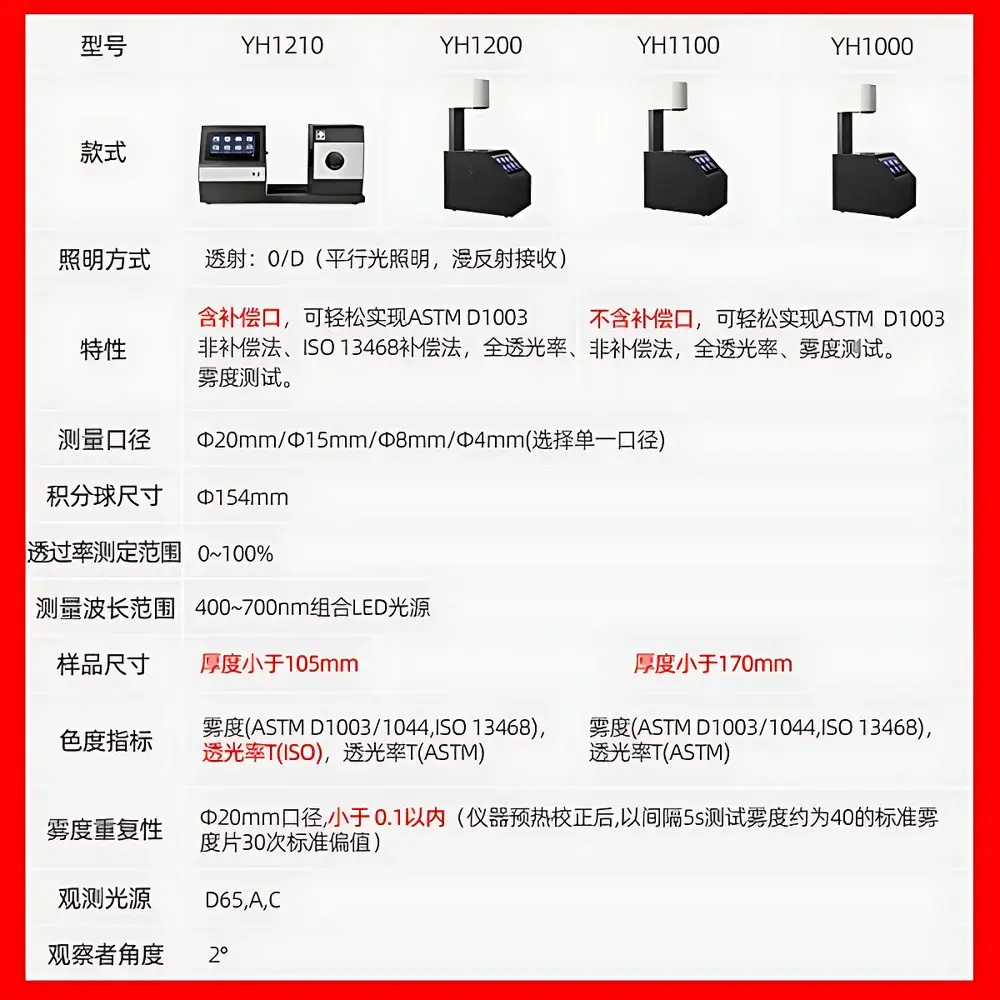
3nh YH1000 Haze Meter for Film, Glass, and Optical Lens Transmittance Measurement
| Brand | 3nh |
|---|---|
| Origin | Guangdong, China |
| Manufacturer Type | Direct Manufacturer |
| Product Origin | Domestic (China) |
| Model | YH1000 |
| Pricing | Upon Request |
| Type | Manual Operation |
| Haze Range | 0–100% |
| Total Transmittance Range | 0–200% |
| Haze Repeatability | <0.15% (20 mm aperture) |
| Transmittance Repeatability | <0.15% (20 mm aperture) |
Overview
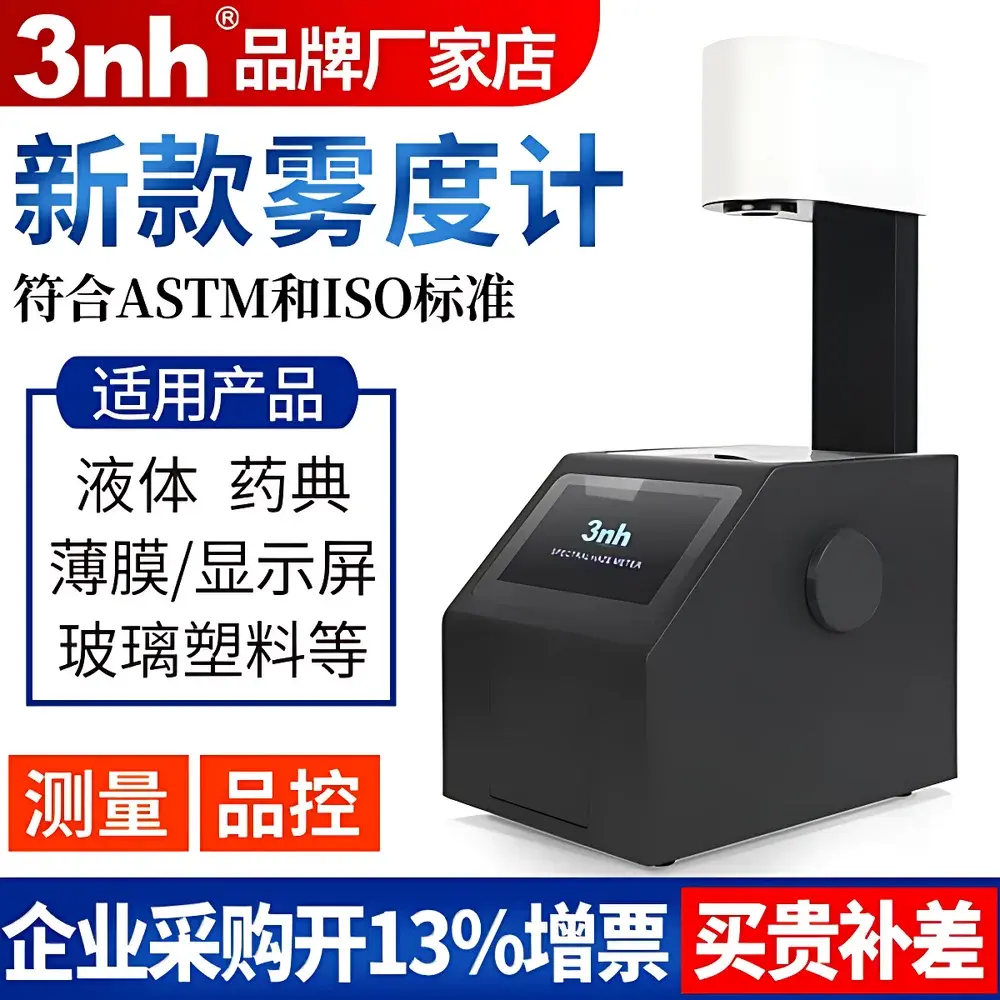
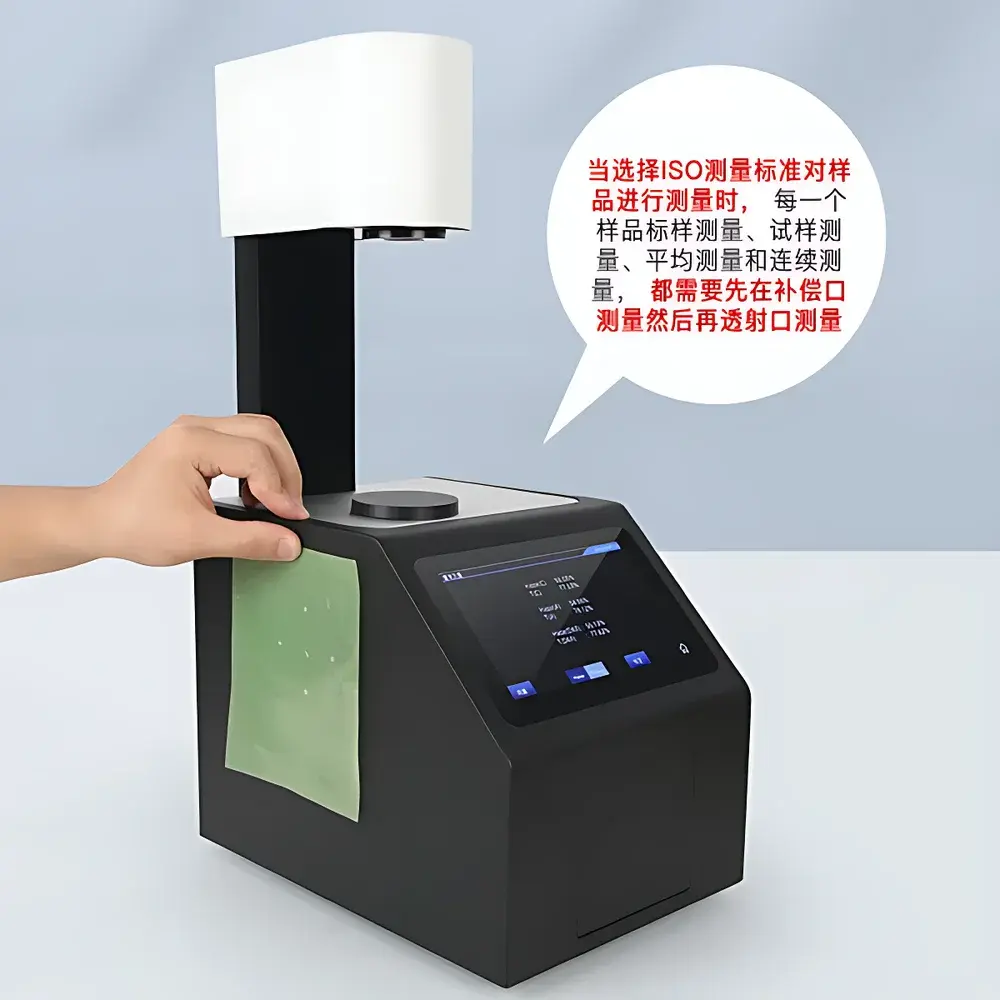
The 3nh YH1000 Haze Meter is a precision optical measurement instrument engineered for reliable, standardized evaluation of haze and total transmittance in transparent and translucent planar materials—including polymer films, float glass, optical lenses, display cover glasses, and coated substrates. It operates on the principle of collimated beam transmission per ASTM D1003 Section 8 (non-compensating method), where incident light passes through the sample and is separated into direct (specular + near-specular) and diffused components by a dual-detector geometry. The instrument integrates a photodiode (PD) array calibrated to the CIE standard photopic luminosity function V(λ) for 2° observer, ensuring spectral response conformity with international visual perception models. Its open-sample chamber design supports both vertical and horizontal placement of specimens—critical for handling rigid panels, curved lenses, or flexible films without mechanical constraint. As a manually operated system, the YH1000 delivers laboratory-grade reproducibility without automation overhead, making it suitable for QC labs, R&D facilities, and incoming inspection stations requiring traceable, standards-compliant optical characterization.
Key Features
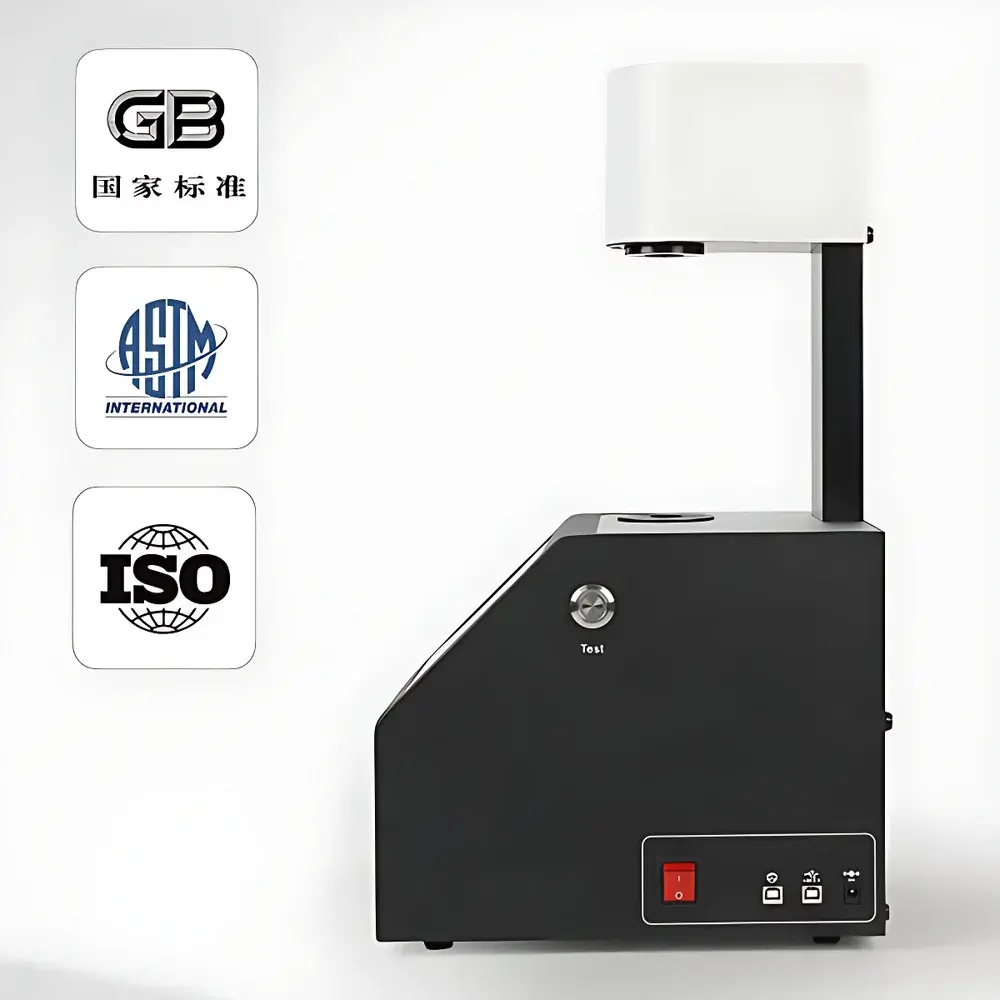
- Compliance with major international standards: ASTM D1003 (non-compensating method), ASTM D1044, ISO 14782, GB/T 2410, JJF 1303–2011, JIS K7105, JIS K7361, JIS K7136, and CIE 15.2
- High-precision PD array detector with CIE V(λ) 2° spectral weighting—enabling photometrically accurate transmittance and haze quantification
- Open-access sample chamber accommodating specimens up to 120 mm × 120 mm; configurable for upright or horizontal orientation to support diverse form factors
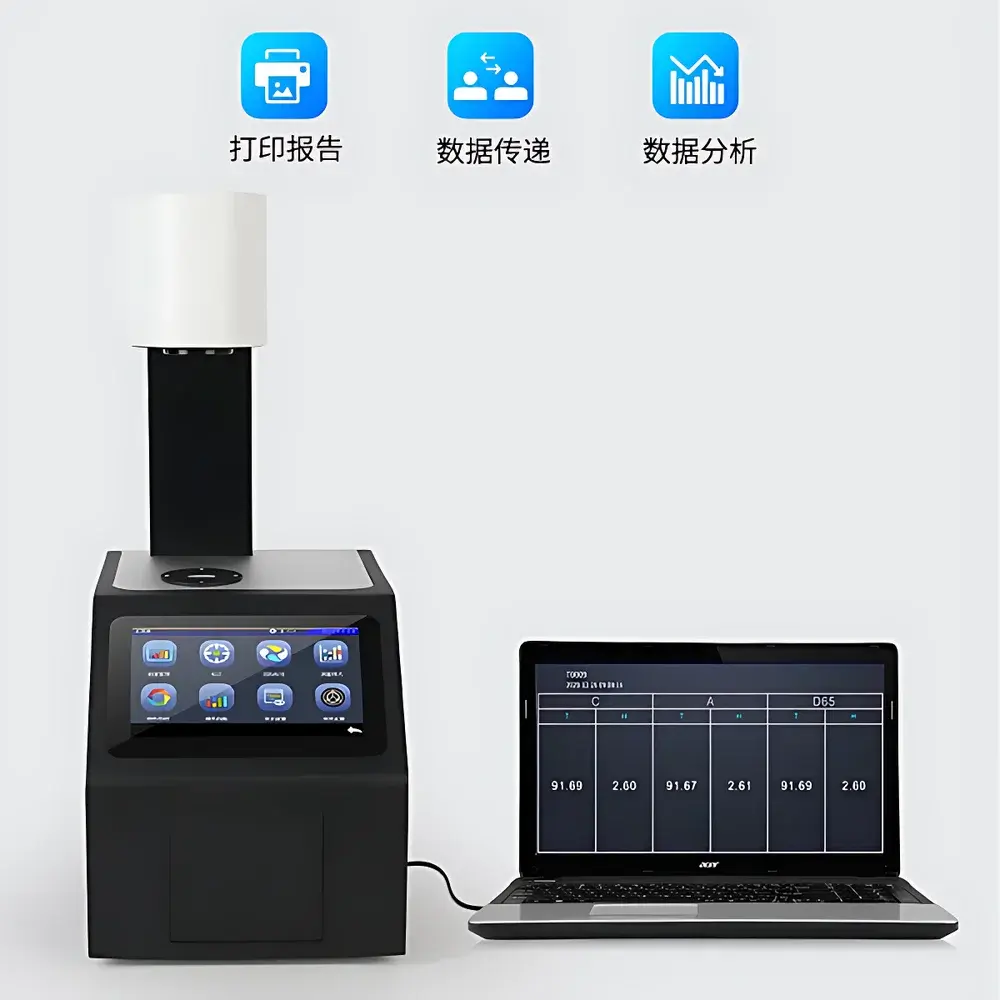
- Integrated 5-inch capacitive touchscreen interface with intuitive icon-driven workflow—no external PC required for basic operation
- Repeatability performance: ≤0.15% for both haze and total transmittance (measured using 20 mm aperture under controlled ambient conditions)
- USB 2.0 interface for raw data export (CSV format), compatible with LIMS integration and custom lab software via standard HID protocols
Sample Compatibility & Compliance
The YH1000 is validated for use with flat, rigid, or semi-rigid optically homogeneous samples with thicknesses ranging from 0.1 mm to 25 mm. Typical applications include PET, PC, and PMMA films; tempered and laminated architectural or automotive glass; AR/AF-coated smartphone cover lenses; and molded optical polymers used in lighting and sensor housings. All measurements adhere to GLP-aligned documentation practices: instrument serial number, date/time stamp, operator ID (optional), aperture size, and measurement mode are embedded in each exported dataset. While the YH1000 itself does not provide 21 CFR Part 11 compliance out-of-the-box, its deterministic measurement algorithm and audit-ready data logs support validation under GMP/QSR environments when paired with appropriate procedural controls and electronic record management systems.
Software & Data Management
The YH1000 operates autonomously via its onboard firmware and touchscreen UI—no proprietary desktop software installation is required. Measurement results are stored internally (up to 2,000 records) and exportable via USB mass storage mode. CSV files contain column headers aligned with ISO/IEC 17025 reporting requirements: Sample ID, Haze (%), Total Transmittance (%), Date, Time, Aperture Size (mm), and Instrument Serial Number. For enterprise integration, the device emulates a standard USB HID class, allowing scripted data capture using Python, LabVIEW, or MATLAB without driver dependencies. Optional SDK documentation (available under NDA) provides register-level access to real-time photodiode output, enabling advanced users to implement custom calibration routines or spectral correction models.
Applications
- Quality control of anti-glare and anti-fingerprint coatings on consumer electronics displays
- In-process verification of extruded polymer film clarity during blown-film manufacturing
- Validation of UV-blocking performance in architectural glazing and automotive laminates
- Material screening for medical device packaging transparency and sterility barrier integrity
- Research into scattering mechanisms in nanostructured optical composites and hybrid sol-gel coatings
- Calibration transfer between production-line haze meters and reference metrology labs
FAQ
Does the YH1000 comply with ASTM D1003 Section 7 (compensating method)?
No—the YH1000 implements only the non-compensating method per Section 8 of ASTM D1003, which is appropriate for routine QC and widely accepted for industrial specifications.
Can it measure curved or textured surfaces?
It is optimized for flat, parallel-surface samples. Curved lenses may be tested if mounted flat-side-down on the stage; however, surface texture beyond ±0.5 µm Ra may affect scatter distribution and require empirical correlation.
Is NIST-traceable calibration provided with the instrument?
Yes—a certificate of conformance with NIST-traceable reference standards (haze: PMMA SRM; transmittance: neutral density filters) is included at time of shipment.
What maintenance is required to sustain measurement accuracy?
Annual verification using supplied calibration tiles is recommended; optical path cleaning with lens-grade tissue and spectroscopic-grade ethanol every 200 measurements ensures long-term repeatability.
Is firmware upgrade capability supported?
Yes—firmware updates are distributed via USB flash drive and applied through the Settings menu; version history and release notes are published on the official 3nh technical support portal.





