
3nh YS4510Plus Automotive 45/0 Geometry Spectrophotometer
| Brand | 3nh |
|---|---|
| Origin | Guangdong, China |
| Manufacturer Type | Direct Manufacturer |
| Product Origin | Domestic (China) |
| Model | YS4510Plus |
| Product Category | Spectrophotometer |
| Instrument Type | Portable |
| Optical Geometry | 45/0 (45° annular illumination, 0° viewing) |
| Light Source | LED |
| Spectral Range | 400–700 nm |
| Repeatability | ΔE*ab ≤ 0.05 (MAV mode) |
Overview
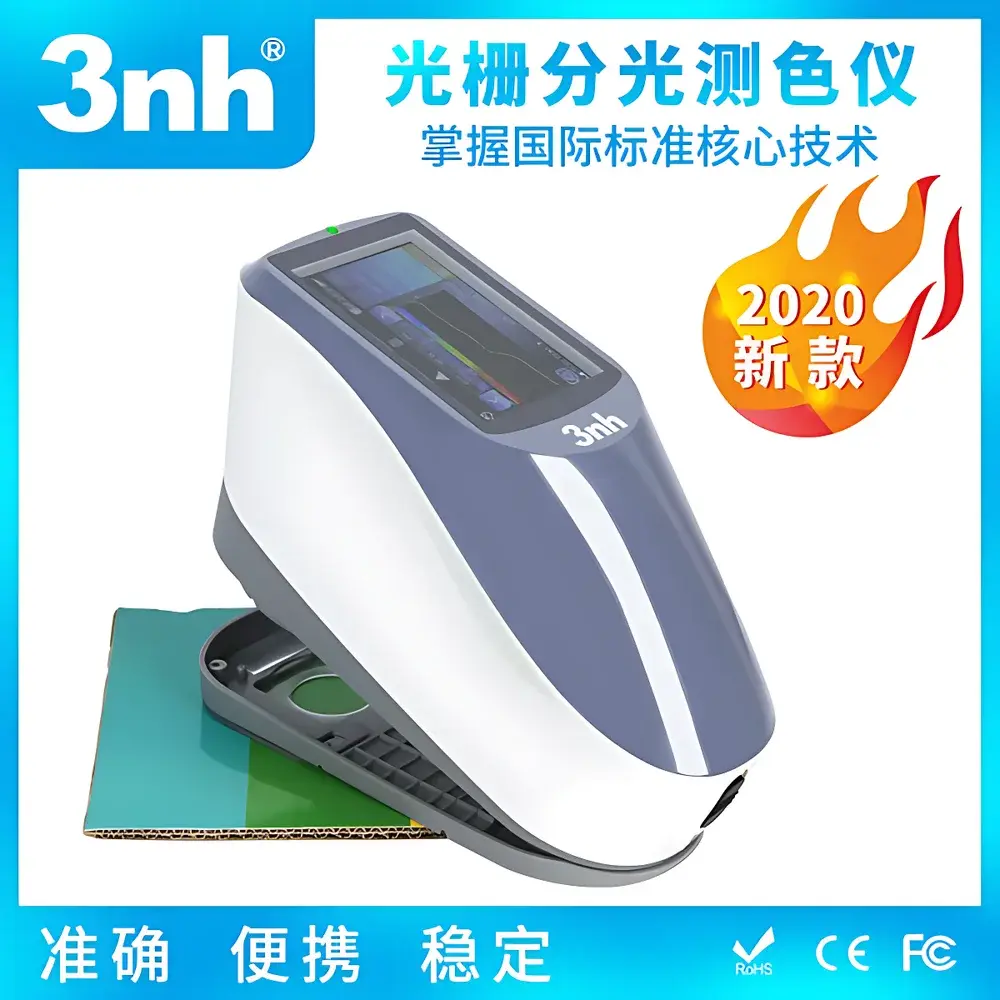
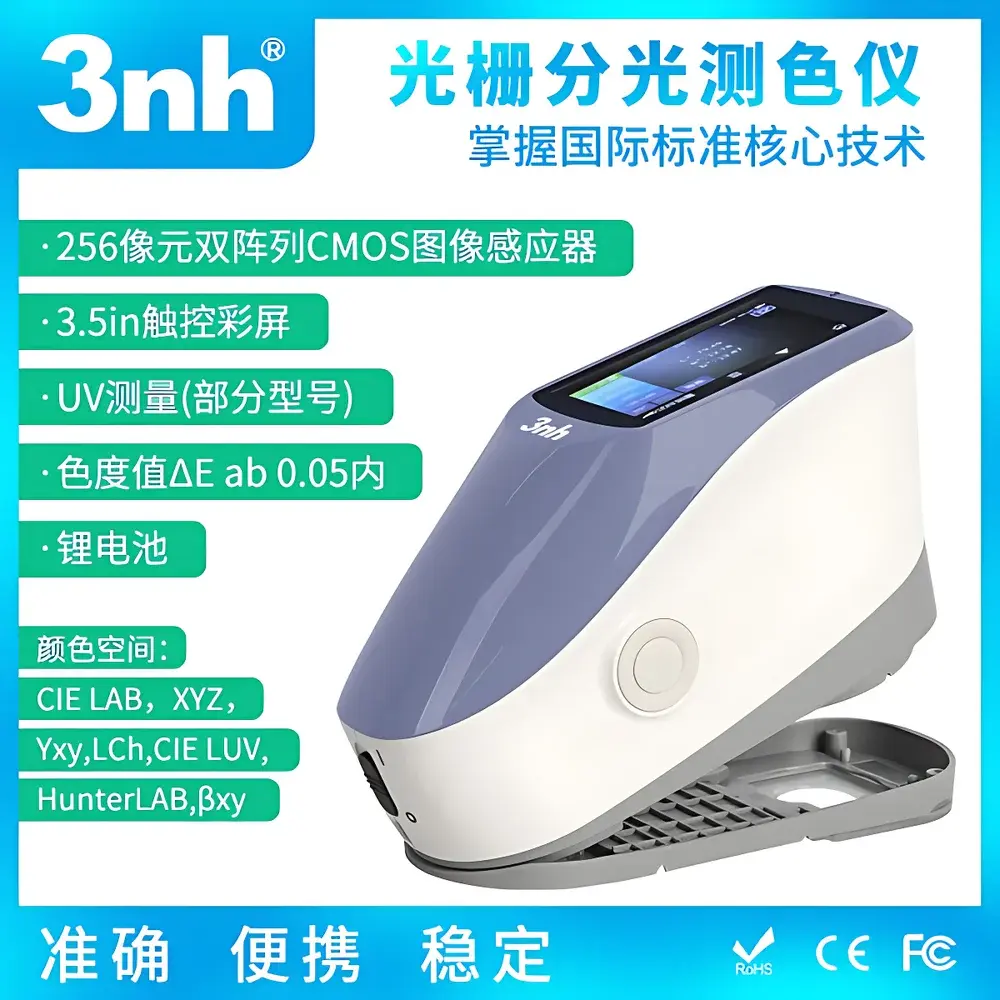
The 3nh YS4510Plus Automotive 45/0 Geometry Spectrophotometer is a precision portable spectrophotometer engineered for high-accuracy color measurement in industrial quality control environments where CIE-compliant 45/0 optical geometry is required. It implements the CIE No. 15-recommended 45° annular illumination / 0° normal viewing configuration—optimized for eliminating directional bias in textured, glossy, or structured surfaces common in automotive trim, painted body panels, and molded plastic components. Unlike 0/45 or d/8 instruments, the 45/0 design minimizes influence from surface texture and specular reflection, delivering robust reflectance data essential for consistent color matching across production batches. The instrument employs a concave holographic grating optical system with CCD array detection, enabling full-spectrum acquisition (400–700 nm) at 10 nm resolution. Its LED-based illumination ensures long-term photometric stability, low thermal drift, and compliance with ISO 13655:2017 spectral irradiance requirements for M0/M1/M2 illumination modes.
Key Features
- True 45/0 optical geometry conforming to CIE Publication No. 15 and ASTM E308-23 Annex A4 for non-diffuse surface evaluation
- Concave holographic grating spectrometer with 10 nm spectral bandwidth and 10 nm data interval
- Triple interchangeable apertures (Φ2 mm, Φ4 mm, Φ8 mm) — user-selectable via mechanical aperture wheel for precise area targeting on curved or small-area automotive parts
- LED light source with spectral power distribution certified per ISO/CIE standards; lifetime > 50,000 hours with <0.1% intensity drift per 1,000 hours
- ΔE*ab repeatability ≤ 0.05 under MAV (Medium Area View) condition per CIE 117-1995, verified using NIST-traceable ceramic tiles
- Integrated UV calibration port for optional UV-adjusted measurement of fluorescent pigments used in OEM automotive coatings
- IP54-rated enclosure with reinforced rubberized grip and drop-tested to MIL-STD-810G for field deployment in paint shops and assembly lines
Sample Compatibility & Compliance
The YS4510Plus accommodates flat, curved, matte, glossy, and textured substrates typical in automotive manufacturing—including Class-A painted surfaces, TPO/PP bumpers, ABS interior trims, and retroreflective road signage materials. Its 45/0 geometry inherently suppresses specularity, making it suitable for measuring coated metal, anodized aluminum, and multi-layer clearcoats without requiring gloss compensation algorithms. The instrument complies with ISO 7724-1:2022 (colorimetry – part 1: geometry), ISO 13655:2017 (spectral measurement conditions), and meets the optical performance criteria specified in SAE J1547 for automotive exterior color verification. It supports GLP/GMP-aligned audit trails when used with optional software modules, including user access logs, calibration history, and measurement metadata stamping (timestamp, operator ID, instrument serial, aperture setting).
Software & Data Management
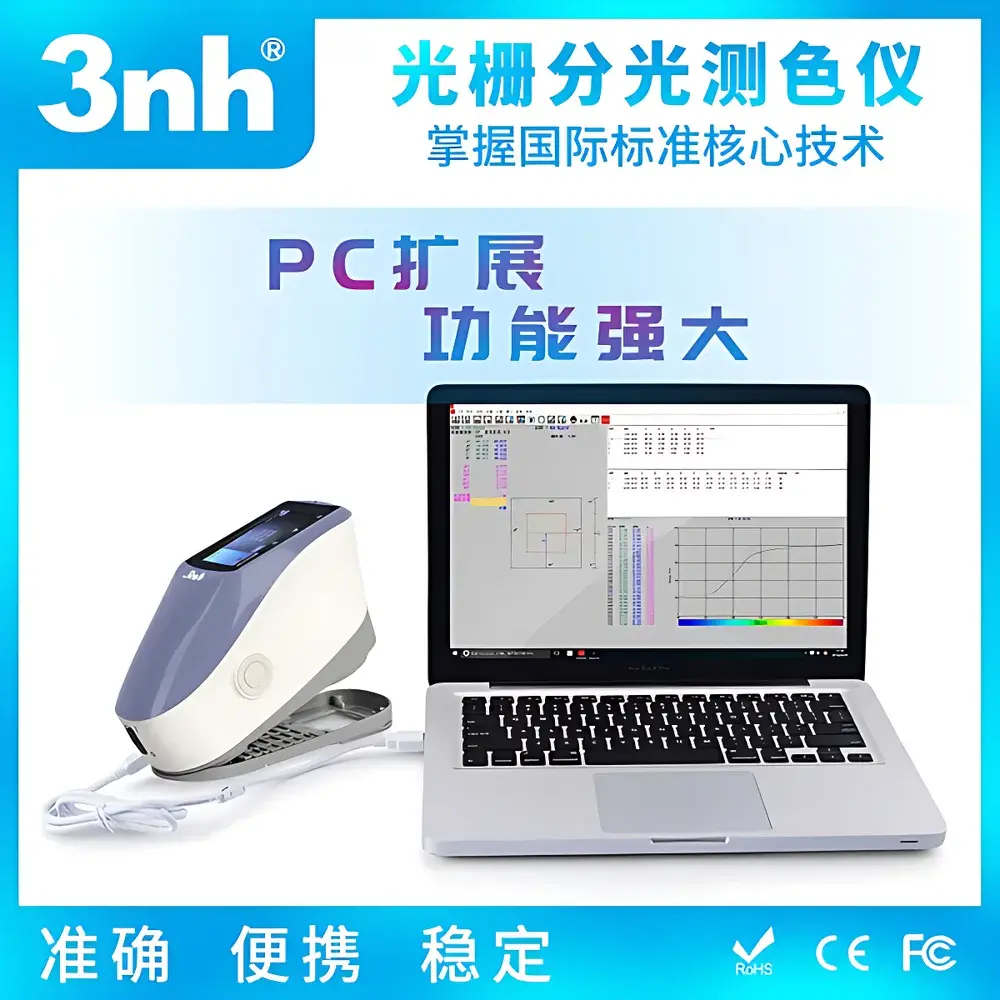
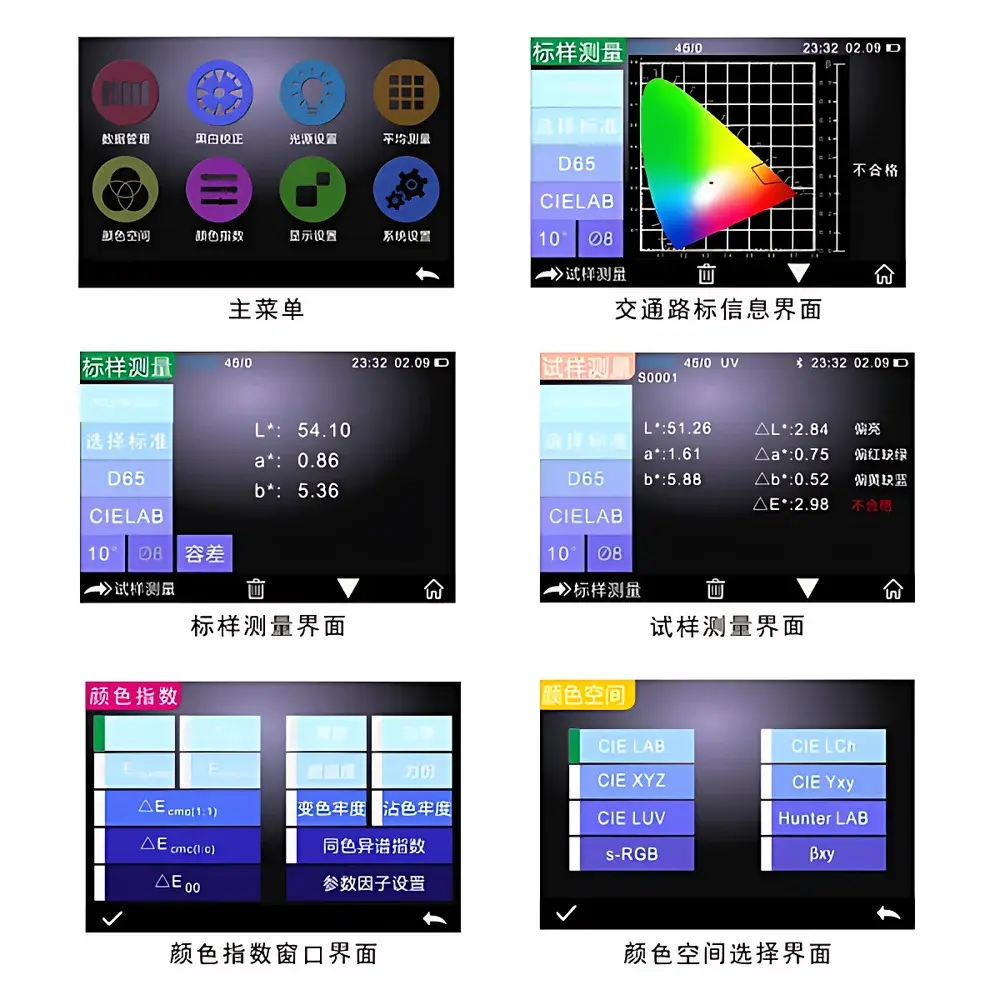
The spectrophotometer interfaces via USB-C or Bluetooth 5.0 with SpectraMagic NX (v3.8+), 3nh’s ISO/IEC 17025-aligned color management platform. The software enables full spectral data export (ASCII .csv, .spc), CMC(l:c), ΔE00, ΔE94, and DIN99d difference calculations, and supports custom tolerance ellipsoids per industry specification (e.g., BMW GS97036, Ford WSS-M99P1111-A). Measurement reports include full spectral curves, chromaticity coordinates (CIE XYZ, L*a*b*, L*C*h°), whiteness/yellowness indices (ASTM E313, ISO 2470), and batch statistical summaries (X̄, R, SD). All data files are timestamped and digitally signed; optional 21 CFR Part 11 compliance package provides electronic signatures, role-based permissions, and immutable audit trails for regulated manufacturing environments.
Applications
- Automotive OEM & Tier-1 supplier QC: paint booth color release, interior trim batch consistency, headlight lens tint verification
- Coating formulation labs: spectral match prediction against master standards using ∆E and spectral deviation overlays
- Plastic compounding: pigment dispersion uniformity assessment via multi-point measurements across molded parts
- Road safety product certification: retroreflective sheeting luminance factor validation per EN 12899-1 and FHWA R-2 specifications
- Printing & packaging: spot color verification on metallic inks and embossed substrates where 45/0 geometry reduces highlight interference
- Quality auditing: cross-site correlation studies using inter-instrument agreement protocols per ISO 13655 Annex B
FAQ
What does “45/0 geometry” mean, and why is it preferred for automotive applications?
The 45/0 configuration uses a ring of 45°-angled light sources surrounding a central 0° detector. This eliminates directional sensitivity to surface texture and minimizes specular contribution—critical for evaluating Class-A automotive finishes where gloss and orange peel affect visual appearance.
Can the YS4510Plus measure fluorescent or UV-enhanced automotive coatings?
Yes—the instrument includes a dedicated UV calibration port and supports UV-adjusted measurement modes when paired with UV-calibrated standards, enabling accurate assessment of fluorescent pigments in daytime running lights and safety-critical markings.
Is spectral data export supported for third-party color formulation software?
Yes—full 10 nm interval spectral reflectance data (360–780 nm) is exportable in standard ASCII format compatible with X-Rite Color iMatch, Datacolor Match Textile, and BASF ChromaTool.
How is instrument-to-instrument agreement maintained across a production facility?
The YS4510Plus supports inter-instrument calibration using CIE 13.3-2023 transfer standards and includes built-in diagnostics for spectral deviation monitoring; recommended calibration frequency is every 8 hours or per shift change in high-volume settings.




