
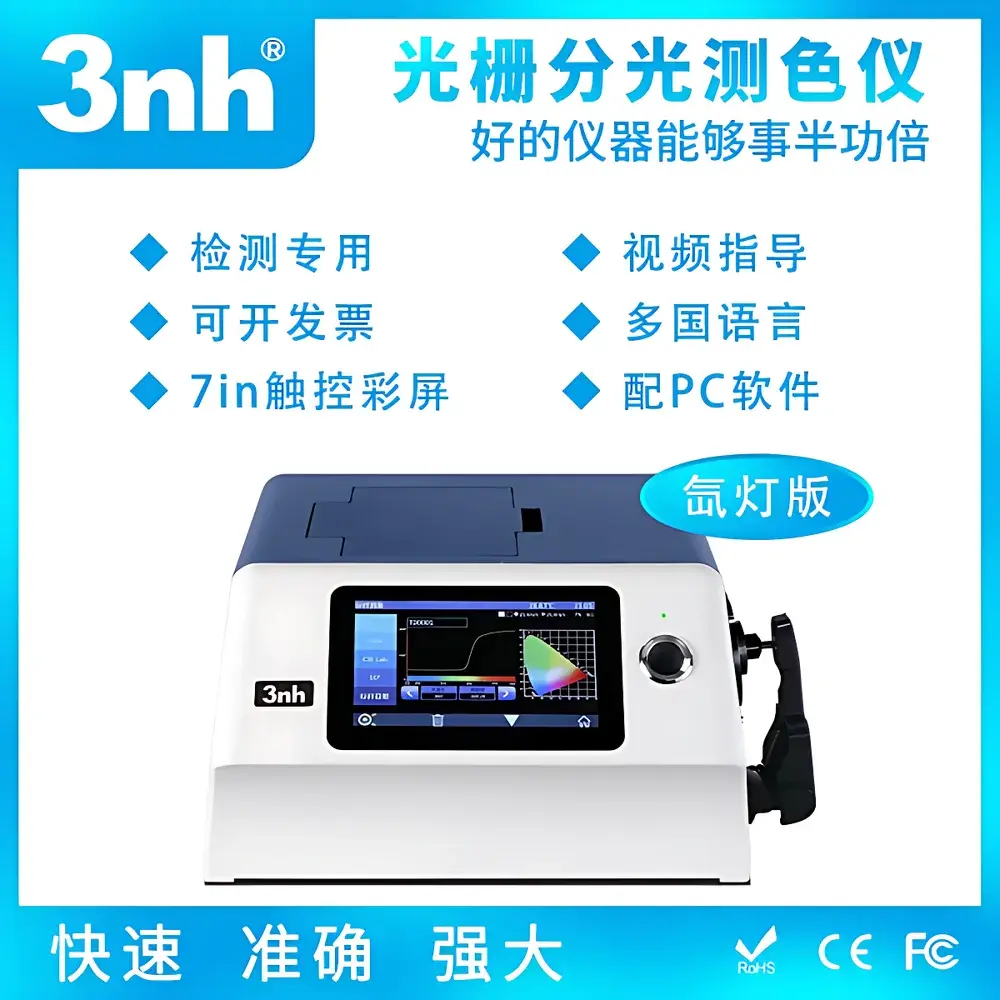
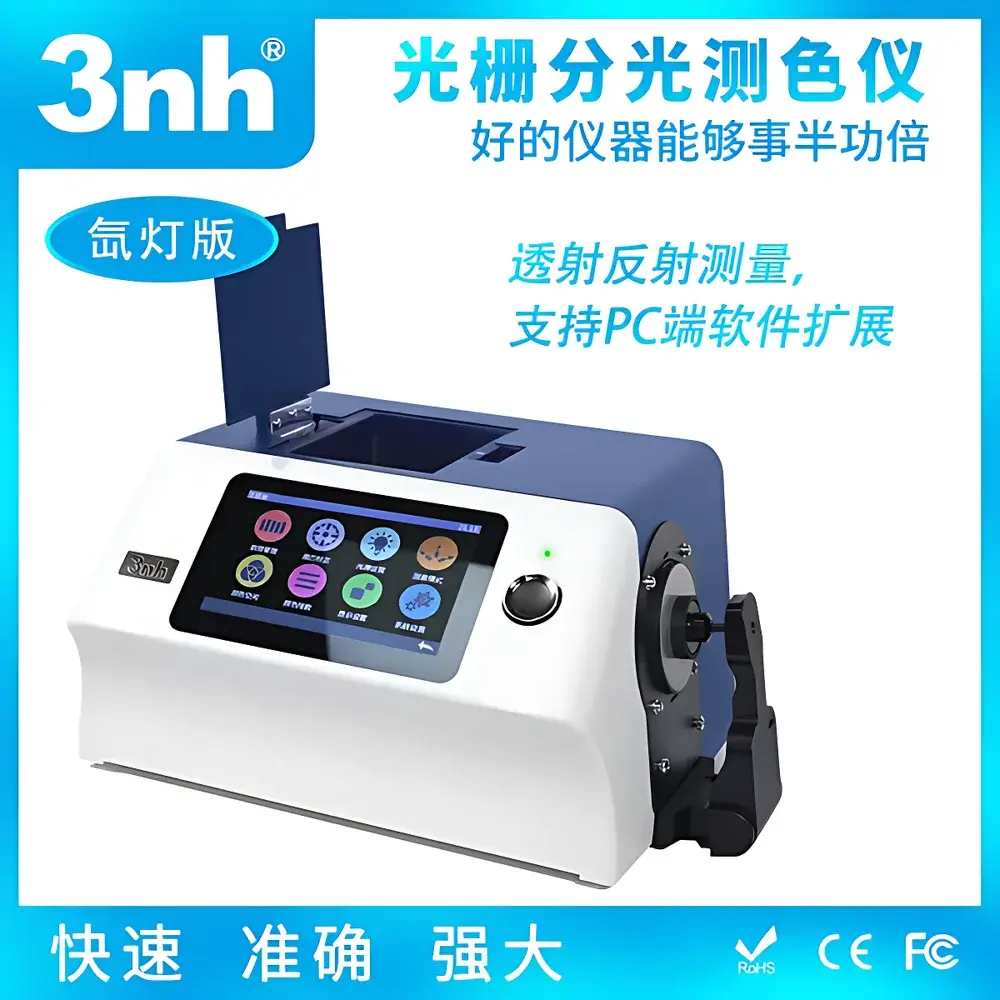
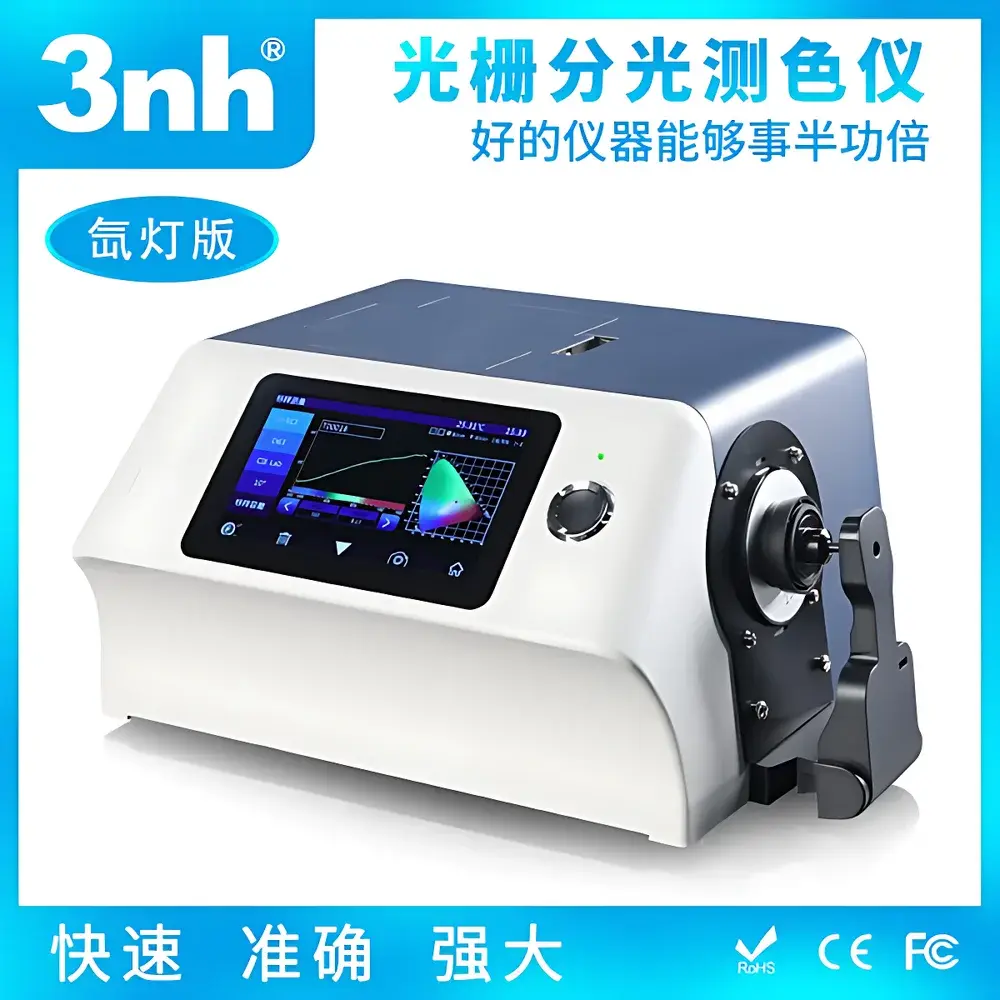
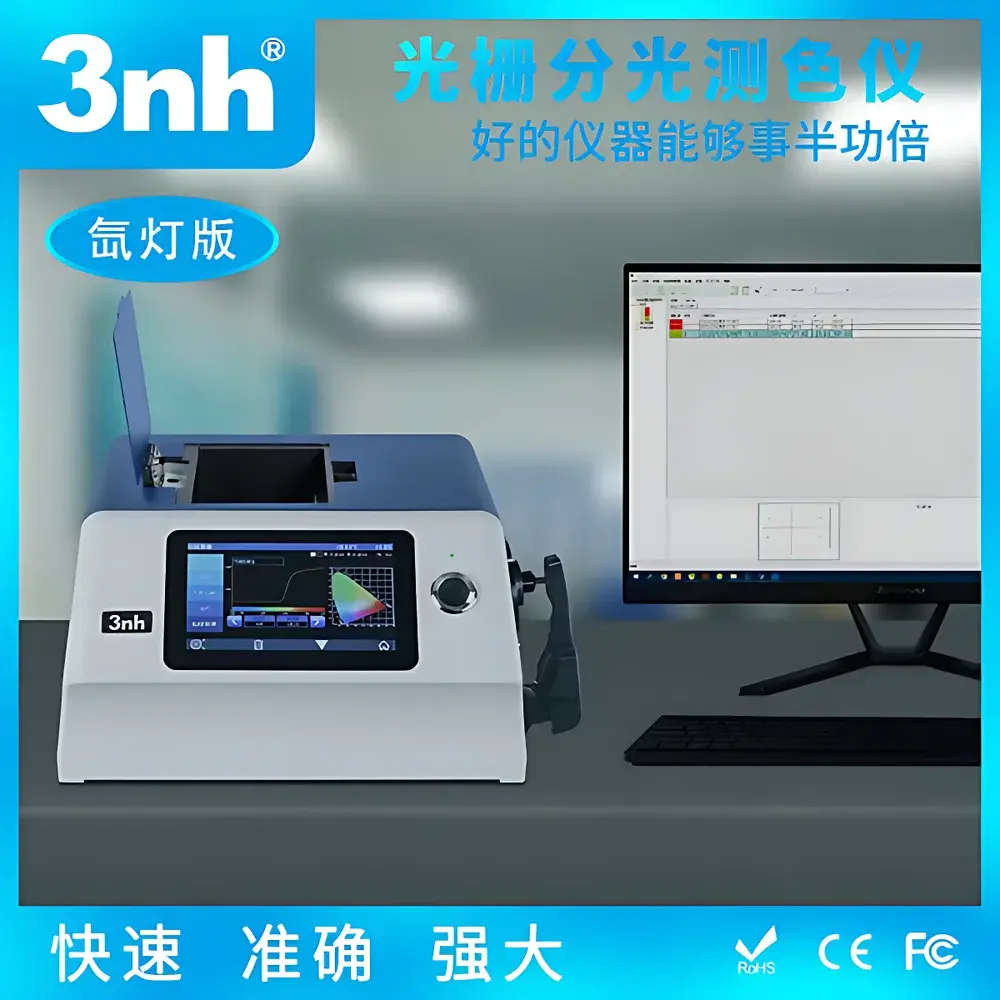
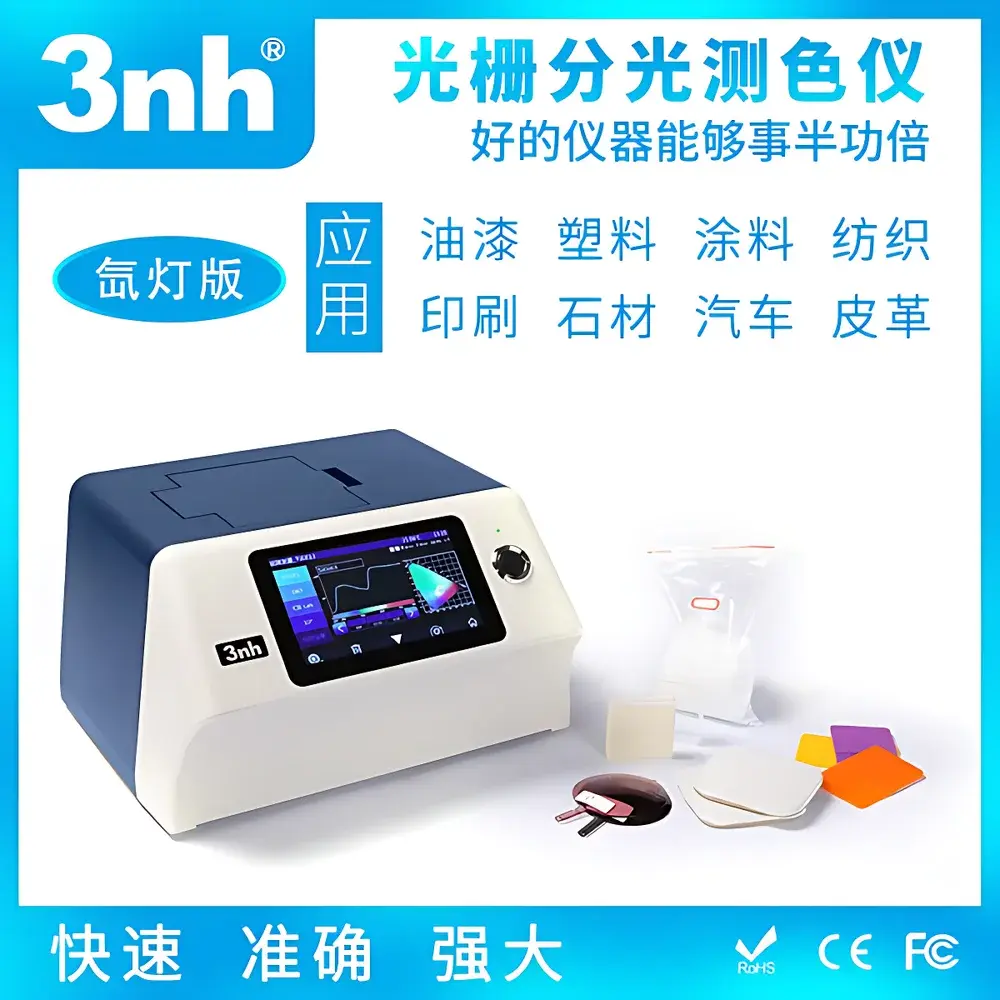
3nh YS6080 Benchtop Xenon Flash Spectrophotometric Colorimeter
| Brand | 3nh |
|---|---|
| Origin | Guangdong, China |
| Manufacturer Type | Direct Manufacturer |
| Product Category | Domestic |
| Model | YS6080 |
| Product Type | Spectrophotometric Colorimeter |
| Instrument Form Factor | Benchtop |
| Optical Geometry | d/8° integrating sphere (with specular component included) |
| Light Source | Pulsed Xenon Arc Lamp |
| Spectral Range | 360–780 nm |
| Repeatability | ΔE*ab ≤ 0.012 (Φ25.4 mm aperture, SCI mode) |
Overview
The 3nh YS6080 Benchtop Xenon Flash Spectrophotometric Colorimeter is a precision optical instrument engineered for high-accuracy color measurement and spectral analysis in controlled laboratory environments. It operates on the principle of spectrophotometric reflectance and transmittance measurement using a diffused illumination geometry (d/8° with specular component included), compliant with CIE No. 15, ISO 7724-1, ASTM E308, and DIN 5033-7 standards. The instrument employs a high-stability pulsed xenon arc lamp as its primary broadband light source—offering full-spectrum excitation without thermal drift or filament aging effects common in tungsten-halogen systems. Its core optical path integrates a precision blazed grating monochromator and a linear silicon photodiode array detector, enabling acquisition of reflectance/transmittance spectra at 10 nm intervals across the visible spectrum (360–780 nm). Designed for metrological traceability, the YS6080 supports both SCI (Specular Component Included) and SCE (Specular Component Excluded) measurement modes, with optional UV-included and UV-excluded configurations for fluorescence compensation—critical for evaluating optically brightened materials such as papers, textiles, and detergents.
Key Features
- True-color 7-inch capacitive touchscreen interface with intuitive icon-based navigation and real-time spectral visualization
- Dual-mode optical configuration: reflective d/8° geometry (Φ25.4 mm measurement area) and transmissive d/0° geometry, supporting both opaque and transparent sample evaluation
- Xenon flash illumination system delivering consistent spectral power distribution across repeated measurements—eliminating warm-up time and intensity decay
- Integrated UV calibration and mechanical UV filter actuation for seamless switching between UV-included and UV-excluded measurement protocols
- Onboard memory capacity supporting ≥20,000 spectral data records with timestamp, operator ID, and measurement condition metadata
- Rugged aluminum alloy housing with thermally stabilized optical bench, designed to maintain alignment integrity under ambient lab temperature fluctuations (20–25°C, ±5°C/h)
Sample Compatibility & Compliance
The YS6080 accommodates flat, rigid, or semi-rigid samples up to 120 mm × 120 mm in dimension and 40 mm in maximum thickness. Standard apertures include Φ25.4 mm (default), Φ15 mm, and Φ8 mm—interchangeable via front-panel tool-free mechanism. Liquid cuvettes (10 mm path length) are supported via optional transmittance adapter. The instrument complies with ISO 13655:2017 (spectral measurement of prints), ISO 27668-1:2013 (colorimetric performance criteria), and meets the optical repeatability requirements specified in CIE Publication 193:2010 for laboratory-grade colorimeters. Its firmware architecture supports audit-ready operation under GLP and GMP frameworks, including user access levels, measurement log encryption, and configurable electronic signature fields.
Software & Data Management
The YS6080 is fully compatible with 3nh’s proprietary ColorExpert PC software (v4.2+), which provides comprehensive data management capabilities including spectral database construction, multi-instrument network synchronization, and statistical process control (SPC) charting. Software features include CMC(2:1), CIEDE2000, and DIN99d color difference algorithms; batch comparison against master standards; pass/fail tolerance banding with visual heatmaps; and automated report generation compliant with ISO/IEC 17025 documentation requirements. Raw spectral data export is supported in CSV, XML, and CIE .cie formats. The software adheres to FDA 21 CFR Part 11 principles through role-based authentication, immutable audit trails, and electronic record retention logs.
Applications
The YS6080 serves as a reference-grade color measurement platform across industries requiring strict inter-laboratory reproducibility and regulatory traceability. In plastics and electronics manufacturing, it validates color consistency of injection-molded housings and PCB solder masks under standardized illuminants (D65, A, F2). Within paint and ink R&D labs, it quantifies metamerism indices and pigment dispersion uniformity via spectral derivative analysis. Textile and apparel QA teams deploy it for shade matching across fiber types (cotton, polyester, nylon) and dye classes (reactive, disperse, acid). Printing and packaging facilities use its transmittance mode to assess opacity, whiteness, and fluorescence of coated papers and laminated films. Additional validated applications include medical device polymer verification (ISO 10993-12), cosmetic formulation development (ICH Q5C), and food-grade packaging color stability testing (ASTM D313).
FAQ
What calibration standards are recommended for routine verification?
Certified ceramic tiles traceable to NIST SRM 2021 or BCRA Series II reference standards are recommended for daily verification; annual recalibration against a primary standard is advised.
Does the instrument support measurement under non-standard illuminants?
Yes—ColorExpert software enables user-defined illuminant spectra (imported as ASCII spectral power distribution files) and custom observer functions (2° or 10°).
Is remote firmware update capability available?
Firmware updates are performed via USB drive or Ethernet connection using signed binary packages; no cloud dependency or internet connectivity required.
Can the YS6080 be integrated into an LIMS environment?
Yes—via TCP/IP socket interface or OPC UA protocol extension (optional module), supporting structured data exchange with LabWare, Thermo Fisher SampleManager, and STARLIMS platforms.
What is the typical warm-up time before first measurement?
Zero—xenon flash operation eliminates warm-up delay; first valid reading is available within 2 seconds of power-on.





