
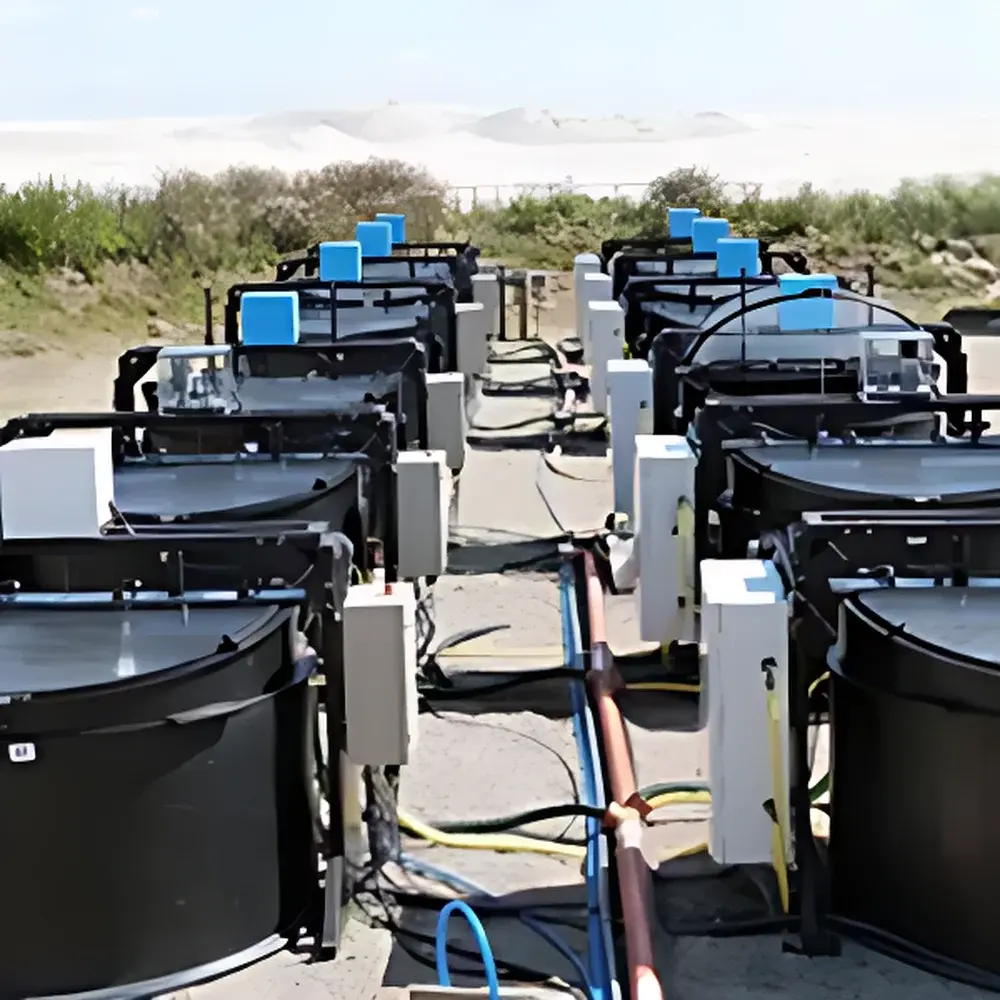
-4H-JENA Benthocosms Aquatic Ecosystem Simulation System
| Brand | -4H-JENA |
|---|---|
| Origin | Germany |
| Manufacturer Type | Authorized Distributor |
| Product Category | Imported Scientific Instrumentation |
| Model | -4H-Benthocosms |
| Pricing | Available Upon Request |
Overview
The -4H-JENA Benthocosms Aquatic Ecosystem Simulation System is a rigorously engineered, modular experimental platform designed for controlled, long-term simulation of benthic and pelagic aquatic environments—both marine and freshwater. Based on the principles of mesocosm science, the system employs multiple independent, pressurized-sealed cylindrical or rectangular chambers (typically 50–2000 L volume per unit), each functioning as an isolated microcosm with fully decoupled biogeochemical dynamics. Each chamber integrates programmable hydrodynamic actuation—including tidal cycle emulation (0–12 h periodicity, ±15 cm water level variation) and laminar-to-turbulent flow generation (0.5–30 cm/s velocity range)—to replicate natural sediment-water interface processes, resuspension events, and boundary layer transport. The system operates under ambient atmospheric pressure while maintaining gas-tight integrity, enabling precise control over dissolved O₂, CO₂, and headspace composition. Its architecture supports continuous, unattended operation over durations exceeding 12 months, making it suitable for chronic exposure studies, succession experiments, and multi-stressor ecological assessments aligned with OECD Test Guidelines 210, 211, and ISO 10253.
Key Features
- Modular chamber design: Configurable array of 4–24 independent benthocosm units, each with sealed lid, integrated sensor manifold, and bottom-sediment interface port
- Dynamic environmental replication: Programmable tidal oscillation (±15 cm amplitude, 0.5–12 h period) and directional current generation (0.5–30 cm/s, adjustable vector)
- Real-time multiparameter monitoring: In situ probes for temperature (±0.1 °C), salinity (±0.01 PSU), dissolved oxygen (±0.05 mg/L), pH (±0.02), CO₂ partial pressure (±5 ppm), turbidity (NTU), and redox potential (±5 mV)
- Automated fluid management: Scheduled water exchange (peristaltic or gravity-fed), auto-cleaning cycles using low-impact UV-C irradiation and mechanical flushing, and nutrient dosing via precision peristaltic pumps (0.01–5 mL/min resolution)
- Environmental parameter regulation: Closed-loop control of temperature (±0.2 °C stability), pH (via CO₂/N₂ sparging or acid/base titration), and nutrient loading (NO₃⁻, PO₄³⁻, SiO₂, trace metals)
- Fail-safe operation: Redundant sensor validation, dual-stage alarm escalation (email/SMS + local HMI alert), and automatic shutdown upon critical deviation (e.g., DO < 2 mg/L for >30 min)
Sample Compatibility & Compliance
The system accommodates diverse benthic and planktonic communities—including macroalgae, seagrasses, benthic diatoms, polychaetes, amphipods, juvenile fish, and microbial consortia—without cross-contamination between units. Sediment cores (up to 30 cm depth, 20 cm diameter) can be directly inserted and maintained under in situ redox gradients. All wetted materials comply with USP Class VI and FDA 21 CFR 177.2600 standards; chamber housings are constructed from UV-stabilized, non-leaching acrylic or electropolished 316L stainless steel. The system meets GLP requirements for environmental toxicology testing and supports full audit trails for data integrity under ISO/IEC 17025 and OECD Principles of Good Laboratory Practice. Calibration records, sensor drift logs, and event-triggered metadata are automatically timestamped and cryptographically signed.
Software & Data Management
Control and acquisition are managed via -4H AquaControl v4.2, a Windows-based SCADA platform compliant with IEC 62443-3-3 security standards. The software provides synchronized time-series logging at user-defined intervals (1 s to 24 h), configurable alarm thresholds with hysteresis, and automated report generation (PDF/CSV/XLSX) adhering to ASTM D5847 and EPA QA/G-5R protocols. Raw sensor data are stored locally on industrial SSDs with RAID 1 redundancy and mirrored to secure cloud storage (AES-256 encrypted). The system supports OPC UA server integration for interoperability with LIMS (e.g., LabWare, Thermo SampleManager) and third-party modeling tools (MATLAB, R, NetLogo). Full 21 CFR Part 11 compliance is enabled via electronic signatures, role-based access control, and immutable audit trails covering all configuration changes and manual overrides.
Applications
- Climate change impact assessment: Ocean acidification, warming, and deoxygenation effects on benthic community resilience
- Eco-toxicological screening: Chronic exposure studies of microplastics, pharmaceuticals, or antifouling biocides under realistic hydrodynamic conditions
- Restoration ecology: Evaluation of sediment capping efficacy, artificial reef colonization kinetics, and seagrass transplant survival
- Nutrient cycling research: Coupled N/P/Si flux measurements across sediment-water interfaces under varying redox states
- Aquaculture R&D: Larval rearing optimization, probiotic efficacy trials, and feed waste decomposition dynamics
- Biogeochemical model validation: High-resolution forcing data for FABM, GOTM, or ERSEM-type coupled models
FAQ
What is the maximum operational duration for uninterrupted benthocosm experiments?
Typical deployments exceed 365 days with scheduled maintenance every 90 days; chamber seal integrity and sensor calibration stability are verified per ISO 17025 Annex A.3.
Can the system simulate estuarine or brackish conditions?
Yes—salinity is continuously adjustable from 0 to 45 PSU via integrated conductivity-controlled dilution/mixing modules.
Is remote troubleshooting supported?
All units include embedded Ethernet/WiFi with TLS 1.3 secured remote desktop access and diagnostic telemetry (CPU load, memory usage, pump duty cycle, sensor health flags).
How is sediment disturbance minimized during water exchange?
Exchange occurs via bottom-inlet diffusers operating at <1 cm/s velocity, with simultaneous surface overflow to maintain constant volume and prevent resuspension.
Are custom chamber geometries available?
Yes—cylindrical, rectangular, and tapered designs are offered; custom ports, optical windows (UV-grade fused silica), and sediment coring interfaces can be integrated pre-shipment.







