
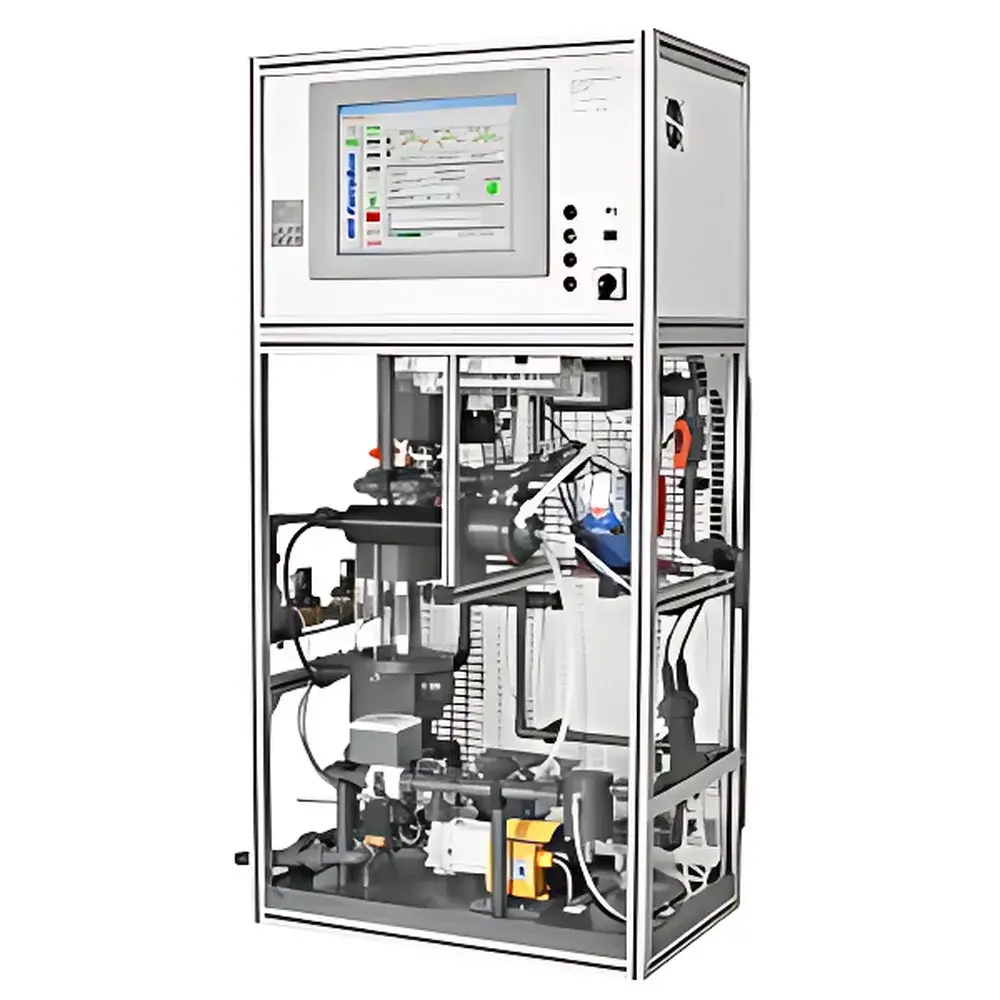
4H-JENA Ferrybox Online Automatic Water Quality Monitoring System
| Brand | 4H-JENA |
|---|---|
| Origin | Germany |
| Model | -4H-Ferrybox |
| Dimensions | 800 × 600 × 1600 mm (W/D/H) |
| Power Consumption | 450 W |
| Compliance | Designed for ISO/IEC 17025-aligned environmental monitoring workflows, compatible with GLP/GMP data integrity requirements via audit-trail-capable software |
Overview
The 4H-JENA Ferrybox is a modular, open-architecture online automatic water quality monitoring system engineered for continuous, real-time ecological assessment of marine, freshwater, and extreme-environment aquatic systems. Based on the Couette-flow principle for flow-through sensor integration and optimized hydraulic path design, the Ferrybox enables simultaneous multi-parameter acquisition without cross-sensor interference. Its core architecture supports uninterrupted operation aboard research vessels (e.g., RV Polarstern), at fixed coastal observatories, or in mobile emergency response deployments. Unlike closed proprietary platforms, the Ferrybox employs standardized wet-mateable connectors (DIN 43650, M12), pressure-rated flow cells (up to 10 bar), and configurable sample conditioning modules — ensuring long-term stability in high-turbidity, biofouling-prone, or low-temperature environments. The system operates under continuous laminar flow conditions, minimizing bubble entrapment and sediment deposition through integrated degassing chambers and self-cleaning siphon loops.
Key Features
- Modular sensor integration platform supporting >25 industry-standard water quality sensors from third-party manufacturers (e.g., Turner Designs, Sea-Bird Scientific, Aanderaa, TriOS)
- Active anti-fouling system: programmable ultrasonic cleaning cycles + mechanical wiper + optional hydrogen peroxide dosing module for biofilm suppression
- Integrated air-separation chamber and sand trap with automatic backflushing (triggered by differential pressure or time-based schedule)
- Industrial-grade 10.1″ capacitive touchscreen HMI with offline data logging (≥16 GB internal storage) and intuitive icon-driven workflow navigation
- Remote telemetry support: Modbus TCP/IP, MQTT, NMEA 0183, and IEC 61850-compliant protocols; dual SIM LTE fallback with GPS geotagging (±2.5 m CEP)
- Onboard calibration management: automated zero/span verification routines with traceable reference solution injection control
Sample Compatibility & Compliance
The Ferrybox accommodates raw seawater, brackish estuarine water, glacial meltwater, and treated wastewater effluents without pre-filtration (0.2–500 µm suspended solids tolerated). All wetted components comply with DIN EN ISO 10993-5 (biocompatibility) and ASTM D5116 (leachables testing). Sensor interfaces meet IEC 61000-6-2/6-4 (EMC immunity/emission) and IP66-rated enclosure protection. Data acquisition firmware is validated per ISO/IEC 17025:2017 Clause 7.7 (measurement traceability), and optional 21 CFR Part 11 compliance mode enables electronic signatures, audit trails, and role-based access control for regulated environmental reporting (e.g., EU WFD, US Clean Water Act Section 304).
Software & Data Management
Ferrybox Control Suite v4.x provides unified configuration, diagnostics, and visualization across all connected sensors. The software features time-series interpolation algorithms for gap-filling during transient flow interruptions, GPS-referenced spatial mapping of profiles (e.g., underway transects), and export-ready formats including NetCDF4, CSV, and OGC SensorML metadata. Raw sensor outputs are timestamped with microsecond precision using onboard GPS-disciplined oscillator (GPSDO). Automated QA/QC flags are applied per parameter based on user-defined thresholds (e.g., sudden DO drop >15% within 60 s triggers alert + snapshot capture). All data transfers utilize TLS 1.3 encryption; local database uses SQLite3 with WAL journaling for crash resilience. Remote firmware updates preserve calibration coefficients and historical configuration states.
Applications
- Long-term autonomous monitoring at offshore buoys, river gauging stations, and Arctic/Antarctic coastal observatories
- Underway oceanographic surveys aboard icebreakers and fisheries research vessels
- Real-time wastewater discharge compliance verification at municipal treatment plants
- Early-warning detection of harmful algal blooms (HABs) via synchronized phycocyanin/phycoerythrin/chlorophyll-a fluorescence ratios
- Carbon cycle studies: co-located pCO2, CH4, CDOM, and DOC measurements for flux modeling
- Post-spill hydrocarbon tracking using crude oil fluorescence (PTSA) and rhodamine WT tracers
FAQ
Can the Ferrybox operate unattended for more than 30 days without maintenance?
Yes — field deployments exceeding 180 days have been documented in Antarctic coastal zones using the optional biocide injection module and extended-life filter cartridges.
Is sensor calibration traceable to national metrology institutes?
All factory calibrations are performed against NIST-traceable standards; users receive calibration certificates with uncertainty budgets per ISO/IEC 17025.
Does the system support integration with existing SCADA or LIMS infrastructure?
Yes — OPC UA server implementation enables bidirectional data exchange with industrial automation platforms; REST API supports JSON/XML payloads for LIMS ingestion.
What is the maximum allowable turbidity for reliable optical sensor operation?
Up to 750 FTU with TriOS RAMSES hyperspectral radiometers; for standard fluorometers, performance remains stable up to 250 FTU when combined with the integrated de-bubbling and flow-stabilization modules.
How is data integrity ensured during satellite or low-bandwidth telemetry transmission?
The system implements forward error correction (FEC) with Reed-Solomon encoding and stores all raw data locally until confirmed ACK receipt; missing packets are automatically retransmitted upon link restoration.
Related Products







