
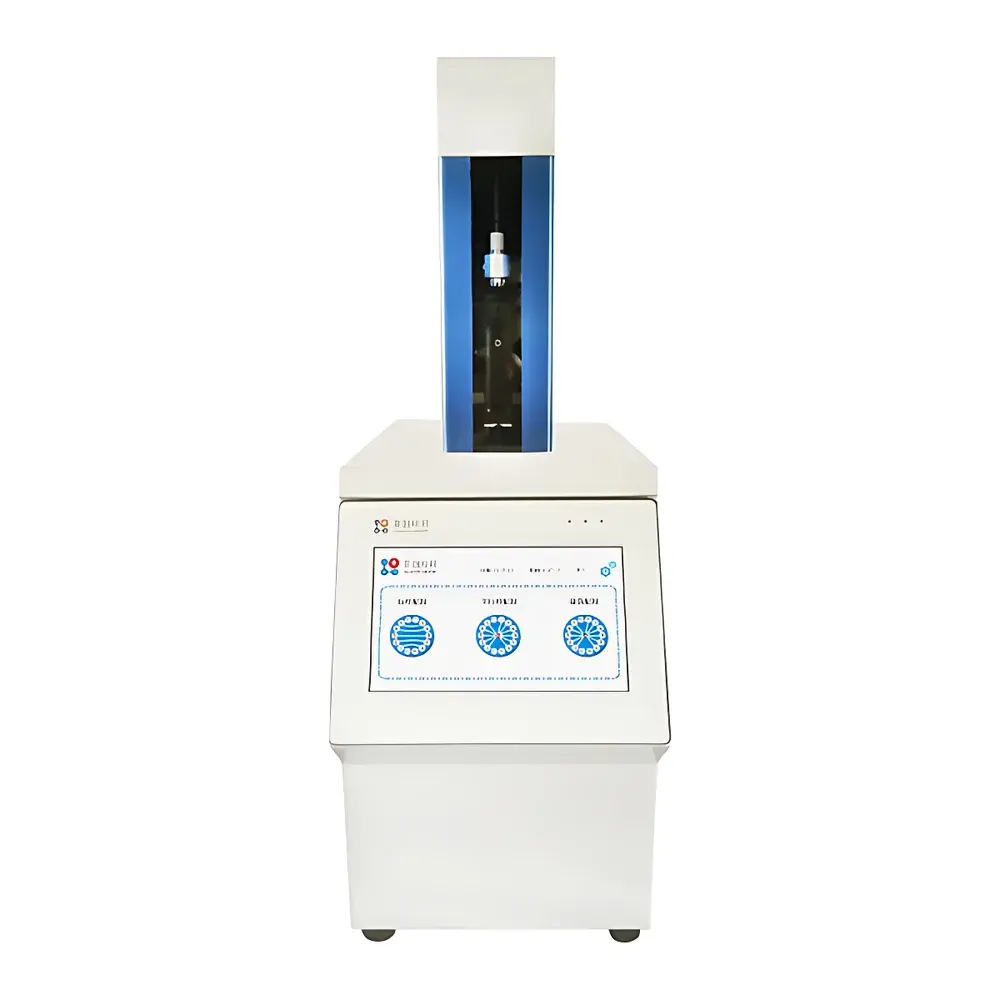
4Labplus ASP660L Automated Thermal Desorption Tube Standard Preparation System
| Brand | 4Labplus |
|---|---|
| Origin | Guangdong, China |
| Manufacturer Type | OEM Manufacturer |
| Product Category | Domestic |
| Model | ASP660L |
| Instrument Type | Dual-Stage Thermal Desorber / Thermal Desorption Unit |
| Automation Level | Fully Automatic |
| Desorption Zone Temperature Range | 0–45 °C |
| Valve Injection Zone Temperature | Ambient |
| Transfer Line Temperature | Ambient |
| Cold Trap Temperature | 0 °C |
| Temperature Control Accuracy | ±0.5 °C (at ambient) |
| Analyte Recovery Rate | ≥95% |
| Sample Position Capacity | 6 |
Overview
The 4Labplus ASP660L Automated Thermal Desorption Tube Standard Preparation System is an engineered solution for precise, reproducible calibration standard generation in thermal desorption–gas chromatography (TD–GC) workflows. Designed specifically for laboratories performing volatile organic compound (VOC) and semi-volatile organic compound (SVOC) analysis per EPA Method TO-17, ISO 16017-1, and ASTM D6196, the ASP660L integrates liquid-phase standard delivery with controlled thermal conditioning to prepare quantitative reference standards directly onto sorbent-packed thermal desorption tubes. Unlike manual or semi-automated approaches, the ASP660L employs a closed-loop, pressure-balanced liquid injection system coupled with programmable desorption zone temperature control (0–45 °C), enabling consistent solvent evaporation, analyte adsorption kinetics, and minimal breakthrough during tube conditioning. Its architecture supports both single-point and multi-level calibration curve preparation—including internal standard spiking—without cross-contamination or carryover, ensuring metrological traceability from stock solution to loaded tube.
Key Features
- Fully automated operation via integrated touchscreen HMI, eliminating manual pipetting, tube handling, and timing dependencies.
- Simultaneous preparation of up to six independent calibration levels (e.g., 25–1000 ng/μL) on individual sorbent tubes within a single run.
- Programmable liquid delivery parameters: injection volume (0.1–10 μL), rinse cycles, needle wash (solvent + air purge), bubble expulsion, and post-injection dwell time.
- Dedicated thermal zones: independently controlled desorption chamber (0–45 °C), ambient-valve manifold, and unheated transfer line—optimized to prevent premature analyte loss or condensation.
- Integrated cold trap at 0 °C stabilizes low-boiling compounds during tube loading and minimizes vapor-phase migration prior to sealing.
- Compact footprint (W × D × H: 420 × 380 × 410 mm) enables benchtop placement inside fume hoods or dedicated analytical prep areas.
- Compatible with standard 6.35 mm OD stainless steel or quartz thermal desorption tubes, including extended-length variants (up to 120 mm).
Sample Compatibility & Compliance
The ASP660L supports a broad range of sorbent media—including Tenax TA, Carbopack B/C, Carboxen, and multibed configurations—across both single- and dual-bed tubes. It accommodates aqueous and organic solvent-based standard solutions (e.g., methanol, acetone, CS₂, and hexane dilutions) without degradation of syringe or valve integrity. All fluidic pathways are chemically inert (PTFE, PEEK, and fused silica), minimizing adsorption or catalytic decomposition. The system complies with GLP documentation requirements through audit-trail-enabled method storage and user-access logging. While not FDA 21 CFR Part 11 certified out-of-the-box, its method export functionality (CSV, PDF) and timestamped run records support validation under ISO/IEC 17025 and USP analytical instrument qualification protocols.
Software & Data Management
Controlled via a Linux-based embedded OS with intuitive graphical interface, the ASP660L stores up to 200 user-defined methods—including concentration gradients, internal standard ratios, and blow-down parameters—with versioned backups exportable via USB. Each run generates a machine-readable log file containing timestamps, actual delivered volumes (verified via integrated gravimetric calibration module), temperature profiles, and recovery check flags. Raw data exports integrate natively with LIMS platforms via configurable CSV schema mapping. Optional remote monitoring is available via Ethernet-connected diagnostic port for predictive maintenance alerts and uptime tracking.
Applications
- Preparation of multi-level calibration curves for VOC/SVOC analysis in ambient air, indoor air, and workplace monitoring (per EPA TO-11A, TO-15, TO-17).
- Internal standard addition (e.g., deuterated surrogates) to quantify extraction efficiency and correct for instrument drift in TD–GC–MS quantitation.
- Parallel sample spiking for method validation studies, including precision (repeatability/reproducibility), linearity (R² ≥ 0.999 demonstrated for C6–C16 aliphatics and aromatics), and limit of quantitation (LOQ) assessment.
- Stability testing of sorbent tubes under controlled humidity and temperature exposure prior to field deployment.
- Generation of reference materials for interlaboratory comparison programs and proficiency testing schemes.
FAQ
What sorbent tube formats are supported by the ASP660L?
Standard 1/4″ OD (6.35 mm) stainless steel or quartz tubes, including 90 mm and extended 120 mm lengths, with or without pre-installed frits.
Can the ASP660L prepare standards using aqueous solutions?
Yes—compatible with water-miscible solvents (e.g., methanol/water mixtures) when paired with hydrophilic sorbents such as Carboxen 1000 or graphitized carbon black.
How is injection accuracy verified?
Each unit includes a factory-calibrated gravimetric verification routine; users may perform periodic checks using certified microgram-weight standards and balance integration.
Is method transfer possible between different ASP660-series instruments?
Yes—method files are binary-compatible across ASP660L, ASP660M, and ASP660H models, supporting seamless scaling from R&D to QC environments.
Does the system require external gas supplies?
Only purified nitrogen or zero-air (≤1 ppb THC) for purge and desorption gas; no compressed air or vacuum pump required.




